
The GM invasion is underway

Jayanthi Natarajan dumped the Congress back in 1996 (under the leadership of Mir Jafar Moopanar GK) and Congress got its chance to dump her back in 2013 after Congress was crushed in the state polls and industrialists complained about her to Man Mohan Singh. It was let known that this action was on behalf of a decisive new leader who wanted to show-case his friendliness towards the industry. May not be the best example of poetic justice….but then what is?

….
Jolted by the recent electoral drubbing that was attributed to the
UPA government’s non-performance and indecisiveness, Prime Minister
Manmohan Singh Saturday cracked the whip, ensuring the resignation of Environment & Forests Minister (Independent charge) Jayanthi Natarajan.

The move, signalling the government’s intent to remove
bottlenecks in the decision-making process, came ahead of Rahul Gandhi’s
address to India Inc. Sources said the Congress vice-president was
instrumental in Natarajan’s ouster and that several batches of
industrialists had met Rahul in recent times and singled out the
environment ministry for having vitiated the investment climate though
“arbitrary objections” and “rent-seeking”.

……

However the person in charge now is making J.N. look like an angel. The GM invasion is coming and that heroic quantum theoretician Dr. Vandana Shiva and her colleagues will not be able to stop it.

….
Taking a major step forward to scientifically assess ‘risk’ and ‘safety’
aspects of transgenic crops, the government’s top regulator – Genetic
Engineering Appraisal Committee (GEAC) – on Friday revalidated 10 varieties of
GM crops including wheat, rice, maize and cotton and allowed multi-national
seed companies to go for “confined field trials” of these varieties.

The companies like Monsanto, Mahyco and BASF whose applications got
revalidation will, however, be able to go for field trials only after getting
state’s mandatory nod. Revalidation of these varieties was required as their “validity
period” got lapsed due to state government’s stand of not allowing them to
go for field trial. The GEAC had given its clearance in those 10 cases way back
in 2011 and 2012.

The revalidation of 10 cases on Friday would allow the seed companies, which
developed these varieties, to go for “confined field trials” (called
Phase-II trial) in bigger area as compared to their tests in a very small tract
of land during Phase-I.

The move comes barely a month after the ministry had given its nod to
“confined field trials” of over 200 transgenic varieties of GM crops
which got GEAC’s clearance in its 117th meeting in March last year.

Though the regulatory body had given its go ahead to those 200 varieties,
the then environment minister Jayanthi Natarajan had kept this in abeyance.
The
ministry had then felt that the companies should not be allowed to go for field
trials unless the Supreme Court takes a final view on a pending PIL on the
contentious issue of GM crops.

The MoEF had, however, under the present minister M Veerappa Moily, last
month allowed the GEAC to hold its 118th meeting on Friday, taking in view
demands of scientist community from across the country.
Agriculture scientists from research institutions including IARI, ICAR and
various Universities have been demanding “field trials” for GM crops
for long,
arguing that “confined field trials are essential for the
evaluation of productivity performance as well as food and environmental safety
assessment”.


A group of prominent scientists had met under ‘father of green revolution’ M
S Swaminathan here at National Academy of Agricultural Sciences (Nasa) in
February and issued a 15-point resolution in favour of GM crops.
Pitching for the field trials, the resolution said, “The
non-conductance of regular field trials is a handicap as well as disincentive
in harnessing the benefits of a wide array of transgenic material available
with different research organizations”.

Anti-GM activists have, however, taken strong objection to the GEAC’s
decision on Friday to revalidate those 10 cases of transgenic varieties which
will pave the way for their field trials.

Protesting field trials, convenor of Coalition for GM Free India, Rajesh
Krishnan
said, “The bio-safety tests can be done in a greenhouse or glass
house. The field trials are mostly for agronomic purposes. The industry wants
to reduce the period of regulation and hence wants to run these things
simultaneously”. He said, “It is, in fact, ridiculous to simultaneously do assessment of
risks and open up the experiment for contamination, which often happens in the
case of a field trial, before the risk assessment is done”.


The industry body – Association of Biotech Led Enterprises- Agriculture
Group (ABLE-AG) – has, however, welcomed the GEAC’s move, calling it “a
progressive push to the march of GM technology in India”.
“We welcome this and hope that the rest of the applications too shall
be expeditiously cleared,” said Ram Kaundinya, chairman of the ABLE-AG. 

regards
Doctor Dharma fails Dharma for Doctors

It is not as we have been advised “first do no harm.”

Instead the motto for the (not so) good doctor apparently is “money helps my conscience go to sleep.”

Even if he does not get the stipulated 14 years in jail he should be banished from the medical community as is deserving of the first ever person in the UK to be prosecuted for female genital mutilation. Similar contempt should be also directed to doctors who perform sex-selective abortions.

A London doctor and another man will
become the first people to be charged in Britain over female genital
mutilation, state prosecutors announced on Friday….Another man, Hasan Mohamed, is
accused of intentionally encouraging an offense of FGM, and of aiding,
abetting, counselling or procuring Dharmasena to commit the offense.


“It was alleged that following
a patient giving birth in November 2012, a doctor at the Whittington Hospital,
in London, repaired FGM that had previously been performed on the patient,
allegedly carrying out FGM himself,” said Alison Saunders, director of
public prosecutions. “Having carefully considered
all the available evidence, I have determined there is sufficient evidence and
it would be in the public interest to prosecute Dr Dhanoun Dharmasena.”


Some 100 to 140 million girls and
women globally are thought to have undergone FGM, which ranges from removal of
the clitoris to more widespread mutilation, and can lead to infection and
long-term severe pain.

FGM has been illegal in Britain
since 1985 but no-one has ever been prosecuted.

There have been increasing calls on
police and the government to act, and last month ministers introduced a new
requirement on British hospitals to keep a record of patients who have been
subjected to FGM.

The latest Department of Health
figures from 2007 suggest that 66,000 women in England and Wales are living
with the consequences of FGM, and a further 23,000 girls under the age of 15
are at risk every year.

FGM was first made illegal in
Britain under a 1985 law, which was extended in 2003 to make it an offense for
British nationals or permanent residents to carry out FGM abroad or seek FGM
abroad, even where it is legal.

The maximum penalty is 14 years in
jail.


regards

Neville Maxwell

Maxwell was the reporter for the Times (UK) who covered India (1959-1967) and south Asia and is famous for the comment that the 1967 general elections would be the last one that India had as a democratic country. He covered the Indo-China war and his considered viewpoint was that…it is all India’s fault.

Maxwell at least has the virtue of being consistent, he has also blamed America for the current problems that have opened up between China and her maritime neighbors.

Here are his comments on releasing the Henderson-Brooks report (on the Indo-China war) which is still classified secret in India.

The most interesting question is (as always): who was the whistle-blower?

Those who gave me access to the Henderson Brooks Report when I was researching
my study of the Sino-Indian border dispute laid down no conditions as to how I
should use it.  That they would remain anonymous went without saying, an
implicit condition I will always observe, otherwise how the material was used
was left to my judgement.  I decided that while I would quote freely from
the Report, thus revealing that I had had access to it (and indeed had a copy),
I would neither proclaim nor deny that fact; and my assumption was that the
gist of the report having been published in 1970 in the detailed account of the
Army’s debacle given in my India’s China War, the Indian government would
release it after a decent interval.

The passing of years showed that assumption to have been mistaken and left
me in a quandary.  I did not have to rely on memory to tell the falsity of
the government’s assertion that keeping the Report secret was necessary for
reasons of national security, I had taken a copy and the text nowhere touches
on issues that could have current strategic or tactical relevance.  The
reasons for the long-term withholding of the report must be political, indeed
probably partisan, perhaps even familial. 
While I kept the Report to
myself I was therefore complicit in a continuing cover-up.

I marked the new century by publishing as an “Introduction to the Henderson
Brooks Report” a detailed description, and account of the circumstances in
which it was written, explaining its political and military context and
summarising its findings (EPW, April 14, 2001): there was no public reaction in
the Indian press or even among the chauvinist ranks of the academic security
establishment.  My first attempt to put the Report itself on the public
record was indirect and low-key: after I retired from the University I donated
my copy to Oxford’s Bodleian Library, where, I thought, it could be studied in
a setting of scholarly calm.   

The Library initially welcomed it as a
valuable contribution in that “grey area” between actions and printed books, in
which I had given them material previously.  But after some months the
librarian to whom I had entrusted it warned me that, under a new regulation,
before the Report was put on to the shelves and opened to the public it would
have to be cleared by the British government with the government which might be
adversely interested! 
 

Shocked by that admission of a secret process of
censorship to which the Bodleian had supinely acceded I protested to the head
Librarian, then an American, but received no response.  Fortunately I was
able to retrieve my donation before the Indian High Commission in London was
alerted in the Bodleian’s procedures and was perhaps given the Report.


In 1962, noting that all attempts in India to make the government release
the Report had failed, I decided on a more direct approach and made the text
available to the editors of three of India’s leading publications, asking that
they observe the usual journalistic practice of keeping their source to
themselves. (I thought that would be clear enough to those who had long studied
the border dispute and saw no need to depart from my long-standing “no comment”
position)  

To my surprise the editors concerned decided, unanimously, not
to publish.  They explained that, while “there is no question that the
report should be made public”, if it were leaked rather than released
officially the result would be a hubbub over national security, with most
attention focused on the leak itself, and little or no productive analysis of
the text.  The opposition parties would savage the government for laxity
in allowing the Report to get out, the government would turn in rage upon those
who had published it.


Although surprised by this reaction, unusual in the age of Wikileaks, I
could not argue with their reasoning.  Later I gave the text to a fourth
editor and offered it to a fifth, with the same nil result.  

So my dilemma
continued – although with the albatross hung, so to speak, on Indian necks as
well as my own.
As I see it now I have no option but, rather than leave the dilemma to my
heirs, to put the Report on the internet myself.  So here is the text
(there are two lacunae, accidental in the copying process)
.

regards

Carlotta Gall

She claims physical abuse by the Pakistan Special Branch (or perhaps even agents of the ISI or MI).

This may have provided her with the motivation to write her book which accuses the Army Chief (Gen Ashfaque Pervez Kayani) and ISI chief (Gen Ahmed Shuja Pasha) in Pakistan of being knowledgeable about the presence of Osama Bin Laden.

Conclusion: keep a (well connected, foreign) reporter happy or else. We can also see the example of Neville Maxwell (reporting on the Indo-China war and his comments with regards to the Henderson-Brooks report).

…..
New York Times correspondent Carlotta Gall tells ABC News she was
assaulted by plain-clothed government security agents while reporting in
Quetta, a Pakistani city near the Afghan frontier where NATO suspects
the Taliban hides its shadow government.


Akhtar Soomro, a freelance Pakistani photographer working with Gall,
was detained for five-and-a-half hours. According to Gall, the agents
broke down the door to her hotel room, after she refused to let them
enter, and began to seize her notebooks and laptop. When she tried to
stop them, she says one of the men punched her twice in the face and
head.


“I fell backwards onto a coffee table smashing the crockery,” she
recalled in a written account of the incident. “I have heavy bruising on
my arms, on my temple and my cheekbone, and swelling on my left eye and
a sprained knee.” 

Gall says the agents accused her and Soomro of trying to meet the
Taliban. They identified themselves as working for Pakistan’s Special
Branch, an undercover police department, but Gall said other local
reporters identified them as employees from one of the country’s two
powerful spy agencies: Inter-Services Intelligence or Military
Intelligence.
  

a few of the conclusions as laid out in her book

On ISI and evidence of actual culpability (still no smoking gun as we can see):
In trying to prove that the ISI knew of Bin Laden’s whereabouts and
protected him, I struggled for more than two years to piece together
something other than circumstantial evidence and suppositions from
sources with no direct knowledge.
Only one man, a former ISI chief and
retired general, Ziauddin Butt, told me that he thought Musharraf had
arranged to hide Bin Laden in Abbottabad. But he had no proof and, under
pressure, claimed in the Pakistani press that he’d been misunderstood. 

Finally, on a winter evening in 2012, I got the confirmation I was
looking for. According to one inside source, the ISI actually ran a
special desk assigned to handle Bin Laden. It was operated
independently, led by an officer who made his own decisions and did not
report to a superior. He handled only one person: Bin Laden.
I was
sitting at an outdoor cafe when I learned this, and I remember gasping,
though quietly so as not to draw attention. (Two former senior American
officials later told me that the information was consistent with their
own conclusions.) This was what Afghans knew, and Taliban fighters had
told me, but finally someone on the inside was admitting it. The desk
was wholly deniable by virtually everyone at the ISI — such is how
super secret intelligence units operate — but the top military bosses
knew about it, I was told.

On Afghanistan: When I remember the beleaguered state of Afghanistan in 2001, I marvel at
the changes the American intervention has fostered: the rebuilding, the
modernity, the bright graduates in every office. Yet after 13 years, more than
a trillion dollars spent, 120,000 foreign troops deployed at the height of the
war and tens of thousands of lives lost, Afghanistan’s predicament has not
changed: It remains a weak state, prey to the ambitions of its neighbors and
extremist Islamists.
This is perhaps an unpopular opinion, but to pull out now
is, undeniably, to leave with the job only half-done. Meanwhile,
the real enemy remains at large.


regards

Randa Zarar responds to hate-mail

The original article was critiqued by Dr Omar and here is her detailed response aimed at her critics (does not speak about her forthcoming book though).

It is startling what she has to report- arab americans are facing grave levels of discrimination – the author is speaking from personal experience (people throwing lit cigarettes at a composite arab lady of college going age, also making fun of her mother’s accent, sneering at her muhajjaba aunt and trying to deport her brother)

 …..


In my essay, I historicized the appropriation of belly dancing, but I
naively thought people knew about the British empire, about U.S. imperialism,
about how these have fucked the Middle East for centuries.

I’ve read the following arguments, all of which ignore the systematic racism
by the dominant culture:

“So black women can’t be ballerinas?” If black women
were part of a dominant culture that had colonized Europe starting at the
Italian renaissance, and later colonized France and Russia, and if, after all
that, black ballerinas danced in bikini tops, then yes, this argument would
work. But it doesn’t.

“I’m Egyptian and I love white belly dancers!” Good
for you. Come live in America for 23 years, have people throw lit cigarettes at
you and make fun of your mother’s accent and sneer at your muhajjaba aunt and
try to deport your brother, see a white woman be applauded in a bar while
dancing to “Walk Like an Egyptian” in a
“Nefertiti hat,” and if, after that, you still feel the same way, cool,
write your own opinion piece about it.

 â€œYou’re an idiot! America
is a melting pot!”
Yes, America pretends to be a melting pot, but
this means everyone has to adhere to a cultural norm, and in the process,
minorities are negated and further made invisible.

“It’s appreciation, not appropriation!” No. Please read
this for more about appreciation vs. appropriation.

“But Korean tacos! Mixing cultures is delicious!”
Again, if the person making and serving those 

tacos is from a dominant culture
that, for centuries, colonized Korea and Mexico, and then served those tacos to
you in a conical Asian hat and a mariachi outfit, with a bikini top underneath,
then, yeah, this argument would work. Again, it doesn’t.

”You’re a racist!” Please, save us both time,
watch this, and
learn how that’s not possible.

“You’re appropriating white culture by using a computer right
now!”
I can’t even honor this level of idiocy and entitlement with
a response.

“If you don’t like our multiculturalism, go back to your own
country!”
Umm, doesn’t multiculturalism imply an acceptance of
people from different cultures? Also: I was born in Chicago. This is my
country. I know it’s hard, but Ay-rabs are Americans, too. Also: OK, let’s say
I humor you and try to go back to another country: Whoops, I don’t have one,
because I’m a descendent of Palestinians.

Many other arguments kept centering white people in the discussion, asking
what they’re allowed or not allowed to do. Ultimately, that’s not the
discussion I want to have. And one person can’t stop anyone from doing
anything: White women will continue to belly-dance. What I’m asking is, when
you are part of the dominant culture and live in a country that subsidizes the
theft of land and resources from Arab people; in a country that supports and
financially aids Arab governments that silence and even imprison
democratic protesters; in a country where kids don’t feel safe telling
schoolmates that they’re Arab-American
– maybe think twice before you put on
some genie pants and kohl and call yourself Samirah Layali?

How difficult is it to examine one’s own privilege without calling the
person asking you to do so a douchebag?
Evidently, it is very, very
difficult.

At the end of the day, it’s not belly dance that people are protecting. It’s
the right to take anything they want and not be criticized for it.

I’m thrilled that something I wrote on my dining table in a few hours, one I
thought a couple of hundred people would read, has sparked such a discussion. I
refuse to sit quietly in the margins and only speak when I can “calmly” educate
and teach. I’m fucking angry, y’all, at decades and centuries of
dehumanization, and belly dancing is just the tip of it – hate mail be damned.

regards

The Southern (second) Front is open

The chances of the NDA (and that of the BJP) has always been zero in Tamil Nadu.

However, with the brand new seven party alliance in place we have to wait and see if things finally change in 2014. The BJP count likely to be still zero even while the vote share may substantially increase, partners may win a few seats.
 …
Interestingly, BJP managed to bring DMDK and PMK, parties which are
poles apart, under the umbrella of the alliance which also comprises of
MDMK, IJK and KMDK.


Under the seat-sharing agreement agreed upon by the allies, DMDK was
given the lion’s share of 14 out of 39 seats, followed by BJP and PMK at
eight each. MDMK will be fighting from seven seats while IJK and KMDK
will field candidates from one constituency each.


Singh made the announcement flanked by allies Vijayakanth (DMDK),
Anbumani Ramadoss (PMK), Vaiko (MDMK) and Paariventhar and Easwaran
from IJK and KMDK, respectively. However, PMK founder S Ramadoss was
conspicuous by his absence. 


Singh said the fishermen’s issue and the Sri Lankan Tamils issue would
top BJP’s agenda and accused the Congress of failing to ensure their
interests. He promised that the BJP, if voted to power, would impress upon Sri
Lanka for the welfare of Tamils, reflecting on an emotive issue being
played by the Dravidian parties here in the run up to the elections.


The BJP-led alliance is hoping to put up a good show in the elections
riding on the strong influence wielded by the respective parties in
pockets of the state.
For instance, PMK and DMDK have a considerable hold in northern Tamil
Nadu while KMDK is believed to have the backing of a particular
community in the Western belt.


BJP intends to invite Modi to address one or two election rallies,
considering that his earlier shows at Tiruchirappally and Vandalur had
evoked good response.

regards

An agnostic bats for ahimsa

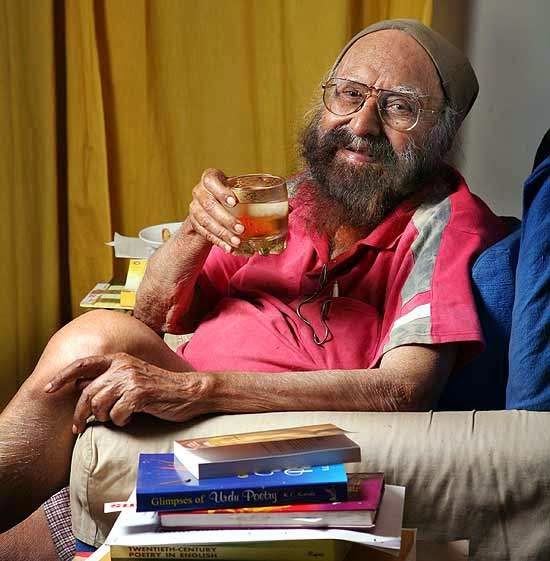
…and death with dignity. This is from the golden pen of Khushwant Singh who is no more with us. RIP

Killing
is not right. Killing animals to eat them is not a civilised thing to
do, but carnivores exist in nature and in many places, humans have to
subsist on non-vegetarian food for reasons beyond their control. But
wherever possible, vegetarianism must be practised. Hurting people
physically or mentally, whether by word or action is wrong. Ahimsa is
more important than prayer. Ahimsa should be the central principle of
your faith, but you have to raise your voice against injustice.
Then, if
you hurt someone who has hurt other people, it is justified. But the
death penalty is barbaric — it is murder by the state.


So, life should be lived with
compassion and non-violence. I think a lot about life and the way we
live it; I also think about death and how we deal with it. The basic
point is, we don’t know where we come from; we also don’t know where we
go after death.
In between, we might know a little about life. 

People
talk a lot about body and soul — I’ve never seen a soul, nor do I know
anyone who has seen one. So for me, death is a full stop. I don’t
subscribe to the theory of rebirth endorsed by Hinduism and Buddhism nor
do I believe in the Judeo-Christian belief in a heaven and hell.
Ghalib
said: “We know the truth about paradise but to beguile your mind is not
a bad idea.”


When I met The Dalai Lama, I told him I didn’t
believe in God. He threw his head back and laughed, saying, nor do
Buddhists. I often wonder, how only Hindu and Buddhist children relate
incidents from previous births while Muslim and Christian children
don’t. There is nothing unique about death. 

Death comes to all who are
born. So we don’t need to pull a long face when death comes.
Of course,
it is human nature to grieve for someone you’ve lost. But that’s no
reason to create a big fuss, wailing and screaming. Nor is there any
need to have elaborate rituals.


Death is in the order of
nature — when your time comes, die with dignity. I’m a member of the
‘Die with Dignity’ society formed by Minoo Masani 20 years ago. I can’t
say I don’t fear death — but I’m more concerned about whether it is
going to be a long drawn out painful process.


Iqbal wrote: “If
you ask me about the sign of faith/when death comes to him/he should
have a smile on his face.” I’m all for the ancient tradition of
celebrating death. When people over 70 years die, their death should be
marked with celebrations including music, dancing and feasting. It is a
sign of maturity and acceptance of the inevitable. 


I’ve discarded all
religions, but I feel closest to Jainism.
Every person has the right to
end his life — after having fulfilled his worldly duties and if he feels
he has now become a burden on others. It is legitimate to want to
extinguish your life. Acharya Vinoba Bhave and Jain munis have done
this. 

I wish to be buried with just a tree planted over my grave — no
tombstone, nothing. If you live close to the sea, go for burial at sea.
It saves wood.

regards

Palaniappan Chidambaram

It happens to the best amongst us- there is a time when we are no longer indispensable and we are disposed off without much fanfare.

That said, it should be noted that this was a very quick fall for such a tall man- by rights he should have been made PM for UPA-II. It is unlikely that he would have provided the measly excuses on corruption that ultimately gave rise to the Aam Aadmi Party and which now threatens to annihilate Congress for a long long time.

At this point it will be difficult for PC to even get elected to the Rajya Sabha (unless he is given an out-of-state quota). His career is effectively over.
 

Union
Minister P Chidambaram has opted out of the Lok Sabha election with the
party tonight nominating his son Karti from his constituency Sivaganga
in Tamil Nadu. 

[ref. wiki] Palaniappan Chidambaram (born 16 September 1945) is an Indian politician affiliated with the Indian National Congress and the current Union Minister of Finance of the Republic of India.
P. Chidambaram is a well-known corporate lawyer and an important member
of the last two Congress-led Governments. He also served as the Finance
Minister from May 2004 to November 2008. However, after the resignation
of Shivraj Patil in the wake of the Mumbai terror attacks in November 2008, Chidambaram was made the Home Affairs Minister. After a three and a half-year stint as Home Minister, Chidambaram returned as Finance Minister, succeeding Pranab Mukherjee, who demitted office to become the President of India

regards

Train to Pakistan

Khushwant Singh (2 February 1915 – 20 March 2014) is no more. He was born in (pre-partition) Pakistan and always retained his fondness and love for his native land. His great novel was the “Train to Pakistan” which elaborated on the injustices (faced by common people) of that time. He will be missed.

Singh,
who was a Member of Parliament from 1980 to 1986, was awarded with the
Padma Bhushan in 1974 but returned the decoration in 1984 in protest
against the storming of the Golden Temple in Amritsar by the Indian
Army. He is survived by son Rahul and daughter Mala.
 

It is the summer of 1947. But Partition does not mean much to the Sikhs
and Muslims of Mano Majra, a village on the border of India and
Pakistan.
Then, a local money-lender is murdered, and suspicion falls
upon Juggut Singh, the village gangster who is in love with a Muslim
girl. When a train arrives, carrying the bodies of dead Sikhs, the
village is transformed into a battlefield, and neither the magistrate
nor the police are able to stem the rising tide of violence. Amidst
conflicting loyalties, it is left to Juggut Singh to redeem himself and
reclaim peace for his village.

regards

NASA-NSF predicts collapse of civilization

Plus the important (and novel) assertion that Maurya, Gupta and Han empires were equal to (if not better) than the Roman Empire. Since these are “western scholars” we must take their erudition for granted and their claims as sacrosanct.

But what if the underlying conclusions are actually true? Are we all set-up for a mass collapse? When is this due? The wise people need to be brave and tell us clearly what they know (and dont know). Otherwise its all (cheap) talk and (free) publicity for fairy tale spinners (like Jared Diamond).


A new study sponsored by Nasa’s Goddard Space Flight Center has
highlighted the prospect that global industrial civilisation could
collapse in coming decades due to unsustainable resource exploitation
and increasingly unequal wealth distribution.

Noting that
warnings of ‘collapse’ are often seen to be fringe or controversial, the
study attempts to make sense of compelling historical data showing that
“the process of rise-and-collapse is actually a recurrent cycle found
throughout history.” Cases of severe civilisational disruption due to
“precipitous collapse – often lasting centuries – have been quite
common.”

The research project is based on a new cross-disciplinary
‘Human And Nature DYnamical’ (HANDY) model, led by applied
mathematician Safa Motesharrei of the US National Science
Foundation-supported National Socio-Environmental Synthesis Center,
in association with a team of natural and social scientists. The study
based on the HANDY model has been accepted for publication in the
peer-reviewed Elsevier journal, Ecological Economics.

It finds
that according to the historical record even advanced, complex
civilisations are susceptible to collapse, raising questions about the
sustainability of modern civilisation:

“The fall of
the Roman Empire, and the equally (if not more) advanced Han, Mauryan,
and Gupta Empires,
as well as so many advanced Mesopotamian Empires, are
all testimony to the fact that advanced, sophisticated, complex, and
creative civilizations can be both fragile and impermanent.”

By
investigating the human-nature dynamics of these past cases of
collapse, the project identifies the most salient interrelated factors
which explain civilisational decline, and which may help determine the
risk of collapse today: namely, Population, Climate, Water, Agriculture,
and Energy.

These
factors can lead to collapse when they converge to generate two crucial
social features: “the stretching of resources due to the strain placed
on the ecological carrying capacity”; and “the economic stratification
of society into Elites [rich] and Masses (or “Commoners”) [poor]” These
social phenomena have played “a central role in the character or in the
process of the collapse,” in all such cases over “the last five thousand
years.”

Currently, high levels of economic stratification are
linked directly to over-consumption of resources,
with “Elites” based
largely in industrialised countries responsible for both:

“…
accumulated surplus is not evenly distributed throughout society, but
rather has been controlled by an elite. The mass of the population,
while producing the wealth, is only allocated a small portion of it by
elites, usually at or just above subsistence levels.”

The study challenges those who argue that technology will resolve these challenges by increasing efficiency:

“Technological
change can raise the efficiency of resource use, but it also tends to
raise both per capita resource consumption and the scale of resource
extraction, so that, absent policy effects, the increases in consumption
often compensate for the increased efficiency of resource use.”

Productivity
increases in agriculture and industry over the last two centuries has
come from “increased (rather than decreased) resource throughput,”
despite dramatic efficiency gains over the same period.

Modelling
a range of different scenarios, Motesharri and his colleagues conclude
that under conditions “closely reflecting the reality of the world
today… we find that collapse is difficult to avoid.” In the first of
these scenarios, civilisation:

“…. appears to be on
a sustainable path for quite a long time, but even using an optimal
depletion rate and starting with a very small number of Elites, the
Elites eventually consume too much, resulting in a famine among
Commoners that eventually causes the collapse of society.
It is
important to note that this Type-L collapse is due to an
inequality-induced famine that causes a loss of workers, rather than a
collapse of Nature.”

Another scenario focuses on the
role of continued resource exploitation, finding that “with a larger
depletion rate, the decline of the Commoners occurs faster, while the
Elites are still thriving, but eventually the Commoners collapse
completely, followed by the Elites.”

In both scenarios, Elite
wealth monopolies mean that they are buffered from the most “detrimental
effects of the environmental collapse until much later than the
Commoners”, allowing them to “continue ‘business as usual’ despite the
impending catastrophe.” The same mechanism, they argue, could explain
how “historical collapses were allowed to occur by elites who appear to
be oblivious to the catastrophic trajectory (most clearly apparent in
the Roman and Mayan cases).”

The two key solutions are to reduce economic
inequalit
y so as to ensure fairer distribution of resources, and to
dramatically reduce resource consumption by relying on less intensive
renewable resources and reducing population growth:

regards

Brown Pundits