YFull has amassed an extensive database of modern and ancient Y-DNA samples and computed time estimates for the formation of various branches. This post will outline some important observations from looking at the page for R1a-Z93, which arose in the steppe and became the dominant Y haplogroup in Fatyanovo culture and its descendant Abashevo and then the Sintashta culture, from which steppe ancestry in India and Iran ultimately originates.
Indic Lineages
Examining lineages with samples found almost exclusively in South Asia is instructive, especially when we look at formation dates of the lineages.
Dates
Consider the famous R1a-L657. The estimated formation date and TMRCA for it is ~2100 BCE.
That could of course be a fluke defined by some sort of later founding effects. But we can consider the other major subclade of R1a-Z93, namely R1a-Z2124. This is sometimes assumed to be an Iranic clade, but it contains Indic sub-branches as well, such as R-YP523 with a formation time of ~2100 BCE and TMRCA of ~1700 BCE, and R-Y46 and R-Y43743 both with formation time and TMRCA of ~1800 BCE. A little messier but also likely originally Indic is R-Y37 with a formation time of ~2500 BCE and a TMRCA time of ~2000 BCE.
Based on these, we can estimate that the main steppe migrants into India branched off from the rest of the steppe ~2100-1800 BCE. A plausible scenario is that at the same time that many Sintashta clans were spreading out and establishing the cultures of the Andronovo horizon as well as related cultures like Tazabagyab, one or more clans chose to travel past them into the Hindu Kush and the Indian subcontinent, contributing the bulk of steppe ancestry seen in modern day Indians. This is backed up by the fact that the Indian lineages seem to split off close to the time of expansion of R1a-Z93 into star like phylogeny, which is a tell-tale sign of rapid population expansion and migration of the kind observed archeologically in the Andronovo horizon.
Indic Samples in Arabia
What’s interesting is when we take a look at sublineages of these that have ended up in the Arabian peninsula, where modern Arabs have apparently been enthusiastic adopters of genetic testing services. There are some lineages from recent centuries (especially related to Pakistani lineages), but also many that go back significantly further.
These include one with formation time ~1800 BCE and TMRCA ~450 CE, another with formation time ~900 BCE and TMRCA ~1050 CE, one with formation time ~1100 BCE and TMRCA ~1450 CE, and one with formation time ~200 BCE and TMRCA 1450 CE.
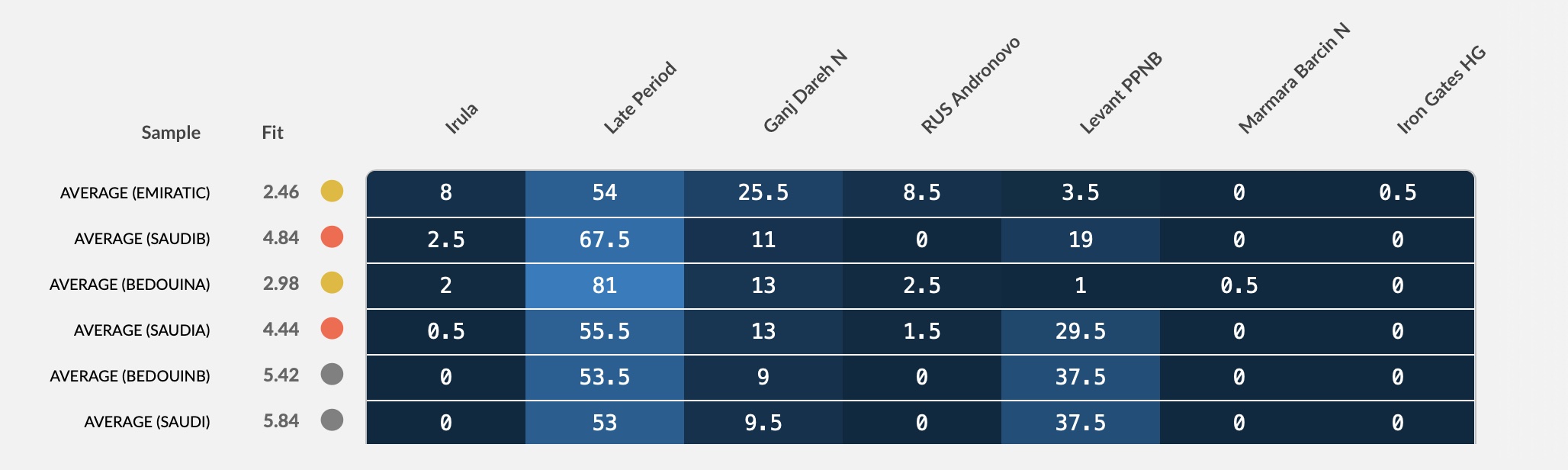
Likely all of these (or at the very least the first two) entered the Arabian peninsula via medieval, early historic, and protohistoric Indian Ocean traders. These samples are found across Arabia, including in Qatar, Bahrain, Oman, and western Saudi Arabia. In fact, we can see that there is some AASI admixture (using Irula as a proxy) in some modern populations in the Arabian peninsula.
Iranic Lineages
Russians
Unfortunately, very few samples from Iran are available, and they do not allow us to make meaningful conclusions. Fortunately, we have many samples available in Russia that are surviving descendants of Sintashta / Andronovo lineages, both in Z2124 and R1a-Y3 (from which L657 descends on the Indian side).
Both R-Y75187 and R-S23592 exhibit a mix of old (dating as far back as Andronovo) and modern samples in the Central Steppe in Turkic-speaking places like Bashkorstan, Tatarstan, Kazakhstan, and Kyrgyzstan. Another that shows modern samples in Russia (as well as an Azeri Iranian sample) is R-Y38987.
It should be noted that these R1a lineages are cannot be from any outflux from India – both their ancient and modern samples remain in the steppe, and no samples in these lineages are found in India. Additionally, the lineages were not spread by Buddhism, as the various Kipchak Turks such as Bashkirs and Tatars that settled this region of Russia practice Tengrism (or previously practiced Tengrism for those that have since adopted Islam), and never practiced Buddhism, unlike Turks and Mongols further to their east who adopted Buddhism.
Iranic Lineages in Arabs
What about Iranian influence in and near the Arabian peninsula? Well, R-BY149647 has both an Andronovo and modern Russian steppe sample as well as descendants in Arab countries. R-F1417 shows a lineage in Russia, another lineage in Arabs, as well as a sample in an Iranic tribe in ancient Kyrgyzstan.
Notably though, nearly all these samples are located in Kuwait or Ash Sharqiyah Province of Saudi Arabia. These likely originate with Iranian settlement and rule of modern day Kuwait under the Persian Empires. As such, though we don’t have many direct samples from Iran, neighboring Kuwait provides a useful source of data for Iranian lineages. Iran was not historically known as a major participant in the Indian Ocean trade, and this distribution of Iranic lineages appears to reflect that.
Conclusion
In summary, we’ve found that Indian R1a lineages from the steppe date to the early 2nd millennium BCE, consistent with a migration into India simultaneous with the Andronovo horizon. We’ve also found that we can observe surviving Iranic lineages in the Central Steppe in Russia, and that Iranian lineages to Kuwait and Ash Sharqiyah by land, while Indian lineages appear in the entire Arabian peninsula via ancient and medieval sea trade.