A Conversation on Caste with Dr. Prakash Shah

Postscript from Omar Ali: My apologies to Maneesh and Gaurav, who got very little air time. And my apologies to listeners. I think Prakash and I should have explained more clearly what his argument is. I can see that many listeners expected a description of caste oppression in India, not a discussion of why this description is itself problematic or at least, incomplete..

We may have ended up with a discussion that will fail to get past the existing beliefs of most listeners. I hope we will try again in the future and as is the case with all complicated arguments, it may become clearer with repetition and rejigging. For now, take my advice from late in this podcast and see what happens if you suspend judgment and give the arguments a chance… Also see the articles and books linked at the end.

Another Browncast is up. You can listen on LibsynAppleSpotify, and Stitcher (and a variety of other platforms). Probably the easiest way to keep up the podcast since we don’t have a regular schedule is to subscribe to one of the links above!

Dr Prakash Shah, Reader in Culture and Law at School of Law Queen Mary University of London, talks to Dr Ali on the framework of studying caste in India and it’s colonial antecedents.

A list of publications from Prakash Shah and associates can be found here. 

A long talk from Prakash Shah on this topic may give more background:
 

Perhaps the Indus Valley Civilization did descend from Zagrosian farmers?

On the limits of fitting complex models of population history to f-statistics:

These results show that at least with regard to the AG analysis, a key historical conclusion of the study (that the predominant genetic component in the Indus Periphery lineage diverged from the Iranian clade prior to the date of the Ganj Dareh Neolithic group at ca. 10 kya and thus prior to the arrival of West Asian crops and Anatolian genetics in Iran) depends on the parsimony assumption, but the
preference for three admixture events instead of four is hard to justify based on archaeological or other arguments.

Why did the Shinde et al. 2019 AG analysis find support for the IP Iranian-related lineage being the first to split, while our findGraphs analysis did not? The Shinde et al. 2019 study sought to carry out a systematic exploration of the AG space in the same spirit as findGraphs—one of only a few papers in the literature where there has been an attempt to do so—and thus this qualitative difference in findings is notable. We hypothesize that the inconsistency reflects the fact that the deeply-diverging WSHG-related ancestry (Narasimhan et al. 2019) present in the IP genetic grouping at a level of ca. 10% was not taken into account explicitly neither in the AG analysis nor in the admixture-corrected f4-symmetry tests also reported in Shinde et al. (2019).

Open Thread – 04/14/2023 – Brown Pundits

Since Pandits and Kamboj always ask me if it’s true if they’re Iranian, Iran through the ages: civilization’s eternal crossroads and Pre-Persian Iran: from the invention of agriculture to the Aryan onslaught. Part 3 and 4 will land next week.

I have a post (right now at 5,500 words) that I’m working on relating to caste, the CISCO case, and the US, for my Substack. I want it to be my “last word” on the topic…but basically, the issue here is that Leftist-prog types who believe in the total malleability of culture somehow also believe that Indian Americans are moving their society in toto to the US without modification. This is obviously false. You can speculate why this is happening, but it’s just a fact.

Also, Saagar Enjeti is asked about his caste on Red Scare. It’s kind of a joke, as the hosts are pro-Indian (especially Dasha). I am hopefully going to on Red Scare in the next six months to talk about genetics (last time I was in New York Anna K. was out of town).

Conversation with Chitra Iyer: Founder- Space2Grow a Social Impact Firm

Another Browncast is up. You can listen on LibsynAppleSpotify, and Stitcher (and a variety of other platforms). Probably the easiest way to keep up the podcast since we don’t have a regular schedule is to subscribe to one of the links above!

Chitra Iyer, Co-founder and CEO of Space2Grow, talks to Maneesh about Anti Child Trafficking, Digital Safety and making  Indians employable.


You can read more about Space2Grow on:

Website : www.space2grow.in
LinkedIn  – Space 2 Grow (https://www.linkedin.com/company/space-2-grow/)
Facebook – Space2grow (https://www.facebook.com/profile.php?id=100064233876263)
Twitter – space2grow_llp (https://twitter.com/space2grow_llp)


Cousin marriage in Bangladesh


This piece arguing for the end to cousin marriage in the UK in The Times (driven by Pakistanis) took me to a paper in PLOS One, Genetic and reproductive consequences of consanguineous marriage in Bangladesh:

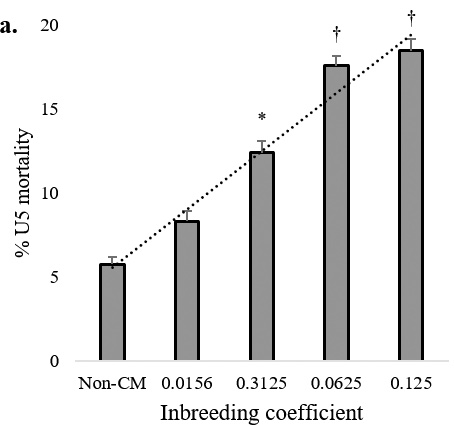
The mean prevalence of CM in our studied population was 6.64%. Gross fertility was higher among CM families, as compared to the non-CM families (p < 0.05). The rate of under-5 child (U5) mortality was significantly higher among CM families (16.6%) in comparison with the non-CM families (5.8%) (p < 0.01). We observed a persuasive rise of abortion/miscarriage and U5 mortality rates with the increasing level of inbreeding. The value of lethal equivalents per gamete found elevated for autosomal inheritances as compared to sex-linked inheritance. CM was associated with the incidence of several single-gene and multifactorial diseases, and congenital malformations, including bronchial asthma, hearing defect, heart diseases, sickle cell anemia (p < 0.05). The general attitude and perception toward CM were rather indifferent, and very few people were concerned about its genetic burden.

A rate around 5% is in line with my intuition and what I’ve seen elsewhere, though there is wide variance by locality. The best thing about the paper is the chart above, the offspring of first cousin marriage have mortality rates 3 times greater than non-cousin marriages. There are other numbers relating to disease, etc. The paper is good because it’s from a developing country without world-class healthcare (though no longer a total basketcase) so you can see disease risk plainly.

More generally in relation to “cousin marriage”

– I have seen “outbred” Pakistani genomes that look like the product of cousin marriage due to the practice’s frequently earlier on in the pedigree

– This is comparable to some Indian caste groups that practice exogamy (North Indian) on the jati level. The jati has been endogamous so long that everyone has become a second cousin…

Critical Caste Theory: A Dubious Discourse

As a tsunami of social justice sweeps across the world today, the roots of traditions are uprooted in an unrelenting furor. In India, the axe of modernity grinds against the caste system as caste, the primary identity of many Indians, now faces pressure from more cosmopolitan identities such as political ideology and class. While many see this as a positive development, some seek not only to entrench these age-old divisions but also enflame the trenches with the kerosene of hate. Building upon and going beyond colonial caste activists such as Ambedkar and the Phules, modern sociologists devise a theory designed to shatter Indian society and grant deliverance to the lower castes of India. While much of this theory is plagiarized from the infamous Critical Race Theory of America, caste is not race and race is not caste. You cannot tell someone’s caste by the color of their complexion or the features of their face. With the rise of Hindutva attracting a rainbow coalition of castes granting a decisive mandate to the BJP in India, the opposition seeks to break this coalition by inciting caste tensions, and it is in Critical Caste Theory that they find a prophetic message to part the saffron sea.

Critical Caste Theory does not seek the annihilation of caste no matter how much it harps on this talking point. Rather, it seeks the annihilation of Brahminism, a polemic and deceptive term for Hinduism originally used by Jesuit missionaries and colonial scholars. It is in the rigid contours of caste that CCT activists see the opportunity to exploit and shatter the cultural and religious body of India and Hinduism. Upper castes must be made aware of their ancestral penalties of the past, privilege of the present, and penance of the future. The lower castes must be made aware of the oppression of the past, discrimination of the present, and revolution of the future. The cloak of caste must smother all discourse surrounding politics, economics, and culture. And most of all – caste must be framed as a simple, homogenous concept that conquers time and space; heterogeneity is heresy.

Continue reading Critical Caste Theory: A Dubious Discourse

Did Hinduism Spread to South East Asia Via Missionaries – Response to The Print Article

On the 32nd Episode of The Indic Explorer Show, I spoke to Jeysundhar on How Did Hinduism Spread to South East Asia.

This is a response video with full historical sources on the Original Article written in The Print by Anirudh Kani titles ‘India’s Hindu preachers — How Shaiva monks converted Cambodia.’

Link Here-https://theprint.in/opinion/indias-hindu-preachers-how-shaiva-monks-converted-cambodia/1097764/

All Historical Sources used in this video are cited in the link of the Video Description.

The Indic Explorer YouTube channel focusses on the interplay of Indic culture with modernity explored through different facets in the socio-cultural sphere.

Do subscribe to the channel at https://www.youtube.com/theindicexplorer

and follow me here

Twitter- https://twitter.com/theindicexplor1

Instagram- https://www.instagram.com/theindicexplorer/

Substack-https://digitaldharma.substack.com/

Episode 21: South India Post Vijayanagar Empire till 1857


Another Browncast is up. You can listen on LibsynAppleSpotify, and Stitcher (and a variety of other platforms). Probably the easiest way to keep up the podcast since we don’t have a regular schedule is to subscribe to one of the links above!

Shrikanth talks to Maneesh about the History of South India post Vijayanagar kingdom till the year 1857.  He talks about the varies polities, their interactions and the Europeans among other facets that shaped the history of Deccan.

He wraps up the episode with the socio-cultural legacy of this period.


Sources and References:

1. History of the Nayaks of Madura : R Sathianatha Aiyar
2. The Nayaks of Tanjore : V. Vriddhagirisan
3. Textures of time : Writing history in South India – 1600-1800 – Sanjay Subramaniam, Velchuru Narayana Rao, David Shulman
4. Haidar Ali and Tipu Sultan : Lewin Bowring
5. Symbols of Substance : Court and State in Nayaka Period Tamil Nadu – Sanjay Subramaniam, Velchuru Narayana Rao, David Shulman
6. Thomas Munro : The Origins of the Colonial State and His Vision of Empire – Burton Stein
7. Why Europe Grew Rich and Asia Did Not? Global Economic Divergence, 1600–1850 – Prasannan Parthasarathi

8. India, Modernity and the Great Divergence: Mysore and Gujarat 17th to 19th c – Kaveh Yazdani

9. History, Institutions, and Economic Performance: The Legacy of Colonial Land Tenure Systems in India – Abhijit Banerjee and Lakshmi Iyer


Conversation with Pooja Sharma: Founder The Sarvodya Collective


Another Browncast is up. You can listen on LibsynAppleSpotify, and Stitcher (and a variety of other platforms). Probably the easiest way to keep up the podcast since we don’t have a regular schedule is to subscribe to one of the links above!


Maneesh is in a freewheeling conversation with Pooja Sharma, founder of The Sarvodya Collective. A NPO working to build awareness and allyship for Neurodiversity as a cause.

You can mail Pooja at pooja.sharma@sarvodya.org

The Sarvodya Collective Instagram handle: https://instagram.com/thesarvodyacollective

Inclusive Duniya Instagram handle: https://instagram.com/inclusiveduniya


Ankit Bhuptani on Dharma and LGBTQ

On the 31st Episode of The Indic Explorer Show, I spoke to Ankit Bhuptani a person from the Queer community and a practitioner of Hinduism on how he reconciles both these identities. He also talks about Hinduism and its commentary on LGTBQ identities. He is a TEDX Speaker as well as an activist for LGBTQ rights in the United Nations. Do check this one out for a unique perspective.

The Indic Explorer YouTube channel focusses on the interplay of Indic culture with modernity explored through different facets in the socio-cultural sphere.

Do subscribe to the channel at https://www.youtube.com/theindicexplorer

and follow me here

Twitter- https://twitter.com/theindicexplor1

Instagram- https://www.instagram.com/theindicexplorer/

Substack-https://digitaldharma.substack.com/

Brown Pundits