GauravL · February 24, 2022 · Comments Off on Browncast: Indic explorer on Hinduism, Dharma, etc
Another Browncast is up. You can listen on Libsyn, Apple, Spotify, and Stitcher (and a variety of other platforms). Probably the easiest way to keep up the podcast since we donât have a regular schedule is to subscribe to one of the links above!
In conversation with Indic explorer, Mukunda and Omar discuss a lot of things related to all things “Indic” . Items include how to define Hinduism, why it does not get the respect it deserves and why its most ardent fans may need to “up their game”.. .
Indic (who prefers to remain anonymous for now) can be found on Twitter at @theindicexplor1
sbarrkum · February 22, 2022 · Comments Off on Ferry From Talaimannar in SL to Rameshwaran, India
Ferry was from Talaimannar to Rameshwaran Island and part of rail link from Colombo to Madras (I think). There was a small ferry for each vehicle from Rameshwaran Island to Mainland India.
22 miles, the same distance from Dover to Calais. Couple of guys have swum it too. One such was Kumar Anandan, swimming from Sri Lanka to India and back in 51 hours, in 1971. While attempting to swim the English Channel on 6 August 1984 he collapsed and died due to heavy currents. Other trivia; Kumar Anandan hailed from Valvettithurai, the village of the Thalaivar, i.e. Prabhakaran.
Almost all Tea Estate indentured workers were brought by Ferry and had to walk thru thick jungle to Tea estates in the hill country. Quite a few died, no records were kept.
The Brits did not give the Estate indentured labor Ceylon Citizenship. Because that would mean they would be under Ceylon Labor Laws which were quite reasonable. Would defeat the whole purpose of getting slaves in all but name.
It became an issue after independence. The estate Tamils were almost 15% of the population. Half were repatriated back to India, with even Ceylon Tamils voting for the move.
Another BP Podcast is up. You can listen on Libsyn, Apple, Spotify, and Stitcher (and a variety of other platforms). Probably the easiest way to keep up the podcast since we donât have a regular schedule is to subscribe to one of the links above!
Amana in a conversation with Maneesh Taneja talks about being a Muslim woman in India. State of affairs, challenges that the Muslim community and the country face, caste dynamics and what makes for a good movie.
Currently, i have only uploaded History series podcasts on Youtube, but hopefully in the coming days we can upload some vodcasts and some popular podcasts on too
Another BP Podcast is up. You can listen on Libsyn, Apple, Spotify, and Stitcher (and a variety of other platforms). Probably the easiest way to keep up the podcast since we donât have a regular schedule is to subscribe to one of the links above!
This discussion has a lot of digressions and tangential issues but it is a discussion worth having. Leaving aside the Hijab controversy, how India is represented (or more misrepresented) in global media (arguably of both sides) is something Indians have to confront. Maybe that’s a separate podcast why India and Hindutva which is certainly moderate when compared to polities of the subcontinent get such a bad rep. I would lay the blame more on the Indian origin interlocuters than any foreign design (though that bias is undeniable).
I would even go on to add that the Western world, in general, hasn’t treated most non-Western countries as sovereign nation-states. I guess if sovereignty is treated as sacrosanct by people of Indian origin, inspite of personal biases some semblance of balance would be maintained in the “India” discourse
Another time, Pariyar brought up his experiences with caste discrimination during a classroom discussion about the trauma of racism and sexism. Some South Asian students in the class, he said, reacted as though caste discrimination was completely foreign to them. He felt they were effectively gaslighting him. And when he tried to organize a conference on issues of caste, Pariyar said he got little support from other South Asians.
The story starts out with the experiences of a Dalit from Nepal who seems to have immigrated to the US. Many of the instances of caste discrimination in the US seem to be from fellow Nepali immigrants. It is possible that immigrants from Nepal bring some caste attitudes? Obviously. But when you switch to the context of talking about caste with Indian Americans born or raised in the US, they may actually honestly not understand much what it means. The piece is flattening the experience of a recent immigrant with Indian Americans, and this flattening and conflation is what’s going to happen if caste becomes a protected class more broadly.
Later on in the piece:
The opponents, who included alumni, professors and community members, argued that discussions about caste unnecessarily divided South Asians and that caste discrimination no longer existed. They claimed that caste was a construct of British colonialism, even though it had existed for millennia, and insisted that the resolution would instead provoke hate against Hindus on campus.
Krystal Raynes, a student at Cal State Bakersfield who currently serves as a CSU student trustee, wasn’t familiar with caste and caste-based discrimination before that meeting. But the language and line of reasoning she heard that day rang familiar.
“It reminded me so much of the discrimination happening against Black people in America,” she said. “Black students being gaslighted, [being told] your experience isn’t discrimination, your experience isn’t oppression.”
There are a few issues here. Indians quite often engage in what we’ll call “denialism” about caste and how it shapes Indian society. When you go around claiming caste was a construct of British colonialism, and discrimination no longer exists, you’ll seem crazy to people. Even though the reality is that in the US making caste a protected class cause huge problems, obfuscating or whitewashing the reality of caste in India does not help your argument in America.
Second, Americans are really just reinterpreting caste in the context of black-white relationships in this country. It’s not about India, it’s about America, and some Indian Americans (the founder of Equality Labs) are engaging in “cultural arbitrage” to to provide a “product” that American administrators can “consume.”
What makes an Indian? Is it the passport? The genetics? The culture? The religion? The food? The fashion? All of the above? Itâs a question thatâs been hotly debated amongst the citizens of the Indian Republic since the bloody partition and independence of 1947. Praise of Indiaâs diversity finds purchasing power both inside and outside its borders, but this diversity does come at a cost. Between religion, caste, ethnicity, language, and so many other identities, India at times seems to tear from its seams. Harbingers of hatred need no excuse to dig into the annals of history finding division and discord that can be applied today. One proposed division takes us to the time of Indiaâs infancy. From the southern tip of the grand Indian peninsula came an ideology that posited that Dravidians, a speculative group of people who speak Dravidian languages, as the original inhabitants of the subcontinent. The patriarch of this ideology, EV Ramaswamy, known as Periyar amongst his faithful, spewed venom and violence against the âinvaderâ north Indians and their Brahmin patriarchs and progeny.
But how accurate is this notion? Was there an idyllic, secular, and rational society prior to when the first horse hooves of the steppe stampeded into India? Did these âAryansâ bring a foreign religion called Hinduism into India as well and impose it on the Dravidians who followed a now lost faith? Half truths at least; full falsehoods at most.
Societies are stories. They are the fallout of generations of narrations about our past and who we are. Jawaharlal Nehru, freedom fighter and Indiaâs first Prime Minister, sought to weave an âIdea of Indiaâ that was a composite tapestry of Hindu and Muslim fabrics. That tapestry has been torn to shreds for several decades now. Instead, it has been Hindutva that has supplanted the Nehruvian sacrament as the sacred fire of the yajna of yore engulfs Indians politics and a common Indian identity built on Dharma gains popularity.
But not all bow to the ritual of these ancients.
Politics Is War
There are few places where historical invasions animate the populace more than India. While much of this headspace is focused on more recent Islamic invasions of the medieval era as well as British imperialism of the colonial era, in some pockets of India, headaches originate from invasions in a time where history wasnât even recorded in India. A missing memory of the subcontinent.
Politics is war without bloodshed while war is politics with bloodshed.
-MAO ZEDONG
These battles are highlighted in the deep south of India, Tamil Nadu and lately have entered elite academic debates on caste. The conflict in Tamil Nadu is over the ancient peopling of India with an onus on the enigmatic Aryans. But this piece is not going to exclusively focus on the migration of the Aryans into India; there are many that do. What we will examine are the many migrations into and within India as well as the present political consequences. But first, letâs establish some quick background.
RECONSTRUCTION OF THE BATH OF MOHENJO-DARO, SINDH CIRCA 2600-2000 BCE BY DR. MICHAEL-JANSEN.
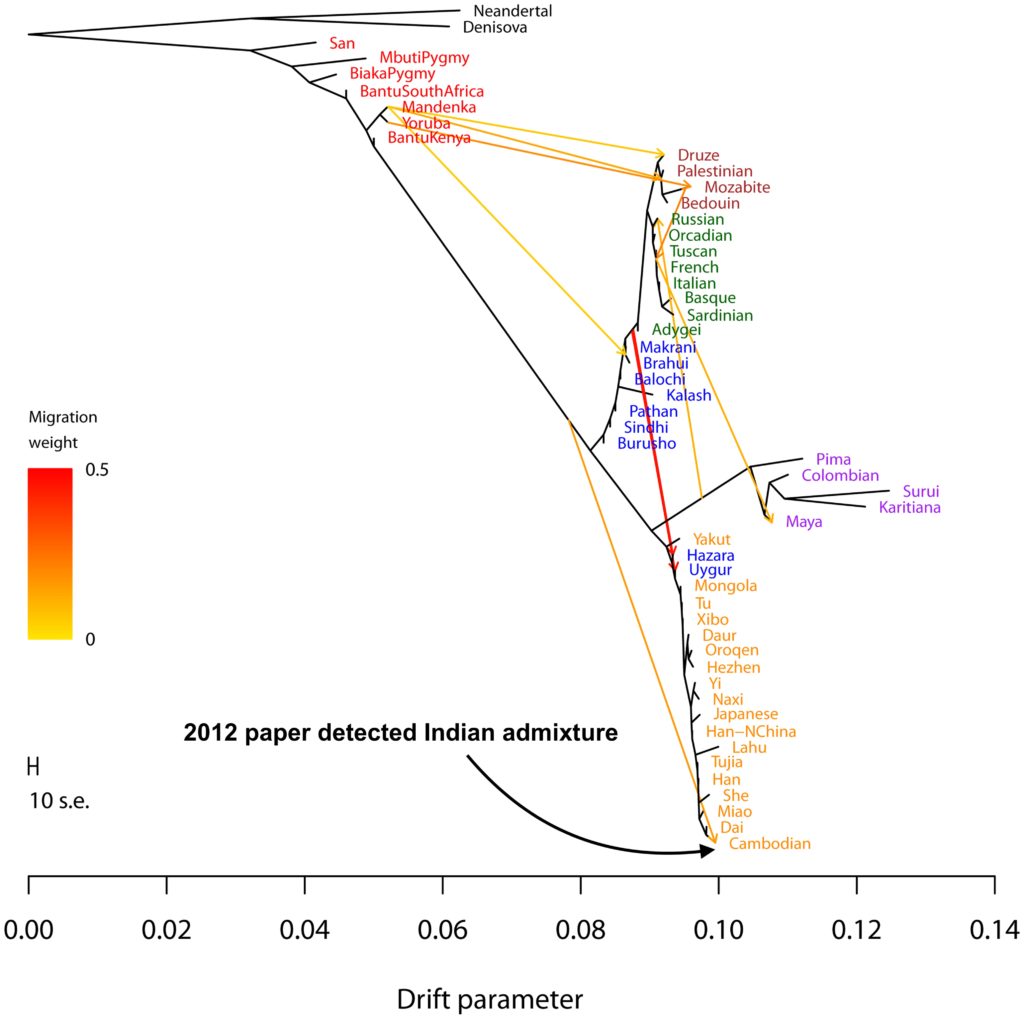
The aboriginal Indian, whose genes run through the blood of nearly everyone from the Indian subcontinent, descended into the subcontinent around 50,000-70,000 years ago. This population would become known as AASI â Ancient Ancestral South Indian.
The Iranian hunter-gatherer would enter India around 10,000 years ago and mix with aboriginals to form the Indians who gave rise to the Indus Saraswati Civilization.
The steppe component entered India most probably in waves after 2000 BCE to 1000 BCE. They are usually the big hubbub as they are posited to be the legendary Aryans, but more on this later.
The Austronesian component would enter from southeast Asia at a similar time of 2000 BCE to 1000 BCE.
There are other migrations into and outflows from the subcontinent as well, but for now letâs call the aforementioned out as the prominent ones we know of today. Feel free to dive into the 2 pieces I mentioned prior. I highly recommend them as they are treasure troves of information.
Indigeneity
THE SACRED MOUNT KAILASH WITH STUPAS IN THE FOREGROUND. ACROSS THE SUBCONTINENT IS SACRED GEOGRAPHY THAT INTRINSICALLY TIES DHARMA TO INDIA.
One of the most potent lines of rhetoric that stems from Hindutva discourse is that it is fundamentally an indigenous rights movement. âIndigenous rightsâ â that phrase is a sacred cow today. Conjuring the bloody European campaign of terror that walked in lock step with colonialism, those who were crushed under the European heel are today demanding their reparations and retribution. In Western discourse, you cannot dare to cross these lines of persuasion. Indigeneity evokes powerful emotions and a primordial attachment to the land, where the spirits of ancestors connect to the soil itself.
But where Hindutvaâs call of indigeneity faces hurtles is the proposed ancient migrations into India. Keep in mind that migrations have occurred across the world, yet this notion of indigeneity is only challenged in India. The nomadic Mexica people would clear out the valley of Mexico before they established Tenochtitlan and became the Aztecs. A substantial genetic portion and culture of the ancestors of the emblematic Greeks, Romans, hell, so many Europeans come from the steppe in the model we are discussing. The ancient Egyptians did not speak Arabic nor had a 1 to 1 genetic makeup to modern Egyptians. The massive Bantu expansion across Sub-Saharan Africa was not a Mandelan march of peace. Yet it is only in India that this standard of indigeneity is upheld. Indra, who rides an Indian elephant and blesses the agricultural Indian with rain for their crops, is a steppe central Asian god; but Zeus and Thor are decidedly Greek and Nordic. I think you see the double standard here.
Urheimat
While much attention and ire surrounds the entry of the Aryans into India, little is sounded around the Dravidians. And therein lies the hypocrisy. Politics flows from emotion first, then logic.
As we established prior, the Indian population is a mixture of 3 large waves or migrations. This 2nd migration consists of a group that was related to, but distinct from, Iranian agriculturalists in the Zagros mountains. In the shadow of the Zagros is where the people of Elam flourished. From around 3200-540 BCE, the Elamites formed the eastern frontier of the Fertile Crescent. The Elamites worshipped a menagerie of gods, many of whom they shared with Akkadian Mesopotamians, and spoke a purported language isolate; but some believe it had a cognate. The proposed cousin is to the east, in the Indus Saraswati Civilization; a civilization that the Elamites traded with frequently. The proposition is that the ancestors of the Zagros farmers of Elam kept moving east and mingled with the AASI Indians eventually forming the base population for the Indus Saraswati peoples (and much of the genetic makeup of modern Indians themselves). Ironically, this means there was an earlier set of Indo-Iranians prior to the Indo-European speaking Indo-Iranians. History indeed loves to rhyme and repeat!
Returning to the model of steppe migration, it seems that this was concurrent with both a Dravidian migration into peninsular India as well as a thrust of AASI enriched Indians towards the northwest. This great Indian churn reminiscent of the Samudra Manthan motif or âchurning of the cosmic oceanâ in the Hindu Puranas is what produced the precursors of Indian culture and society today. The modern Indian was being assembled in this churn. Even more ingredients were added to the mixture through the east through Munda migrations from Southeast Asia. These migrants would particularly populate the DNA of Indiaâs tribals or âadivasis;â a misnomer meaning âfirst inhabitantsâ that has been hijacked by political interests to misclassify these tribals as the original people of the Indian subcontinent. As weâve seen, this is simply not the case.
HARAPPAN PRIEST-KING ON THE LEFT. PRIME MINISTER NARENDRA MODI ON THE RIGHT. BOTH CHILDREN OF THE INDUS SARASVATI CIVILIZATION. YOU KNOW I HAD TO DO IT.
Politicized almost beyond repair, the term âAryanâ is hotly debated amongst historians, geneticists, archeologists, and edgy internet posters across the globe. But why not ask the Aryans themselves?
The common characterization of these Vedic peoples is that they came into India and wiped out the natives, completely destroying their culture and bringing their traditions as the new centerpiece of Indian civilization. But this is not true either. With climate and geological changes, the Indus Saraswati civilization waned eventually collapsing prior to the entry of the steppe people. These steppe people would come into India and indeed would conquer, but they would then be integrated completely. They came, they saw, they conquered, and then they were swallowed.
THE PURANIC TALE OF THE KING OF THE DEVAS, INDRA, FIGHTING THE LORD OF THE ASURAS, JAMBHA. WHILE THE ASURAS WERE NOT NECESSARILY EVIL IN THE VEDAS, THEIR ORIENTATION EVOLVED WITH TIME.
The people who wrote the Vedas were in love and reverent to the land of India. The rivers, mountains, plains, forests, even the literal dirt itself was holy to them. Their gods were flanked with Indian flora and fauna. They delved into philosophies and rituals alien to the wider world. They were a profoundly unique people who would not be who they were if they did not live and die in India.
Over time, many of the gods who found the most praise in the Vedas, the lords of the elements such as Indra, Varuna, Agni, etcâŠ, would give way to other divinities who would eclipse them in prominence. Vishnuâs greatness could be gleaned throughout the early Vedic verses as he was frequently paired with Indra, Surya, Agni, and light itself. He was referenced as the guardian of the highest home, where a soul that has broken the cycle of reincarnation resides. The dawn of Vishnu and Shiva would arrive with the transition to the Puranas and Itihasa epics. In the Yajurveda, Narayana, a popular epithet for Vishnu, is mentioned as the supreme being. The icon of the Pashupati seal of the Indus, Shiva, known as Rudra in the Vedas also makes frequent appearances as a lord of storms and destruction. Adorned with a cobra for a necklace, his home in the Himalayas, the sacred Ganga river springing from his matted locks, and donning leopard skin, Shivaâs iconic Indian brand radiates his local roots.
LORD KRISHNA, SOMETIMES REFERRED TO AS THE DARK LORD IN DEVOTIONAL HYMNS DUE TO HIS DARK SKIN, LIFTING THE HILL OF GOVARDHAN
Krishna, Vishnuâs incarnation, watched as his adoptive father, Nand, prepared to pray to Indra to bless them with rain. The young Krishna would chide his father for fearfully worshipping a god who had grown jealous and arrogant with power. He instead told his father and the villagers to pray to the mountain Govardhan and revere their cattle for those were the true guaranteers of their agricultural success. An incensed Indra would send a terrible torrent on Krishnaâs home, Braj, flooding the land. The legend climaxes with Krishna lifting Govardhan with his finger, protecting Braj from the storm, and humbling Indra into obeisance. Perhaps this represents the transition of which god(s) curried the most favor with the ancient Indians. Perhaps not, but it is a convenient tale.
DRAVIDIAN SUPREMACISTS HAVE FOUND INSPIRATION IN ATTACKING MICRO-MINORITIES FROM SIMILAR FASCIST MOVEMENTS
So ironic this is, as much of India owes itself to Tamil Nadu. From the wise Vedanta philosopher, Ramanuja, whose ideas catapulted the Bhakti movement across all of India to the great Chola emperors (who funny enough referred to themselves as Aryans) who carried the Tamil crown across the subcontinent and Southeast Asia. Tamil Nadu functioned as the incubator and refuge of a Hinduism ravaged in the north during medieval invasions. Scores of Tamil scientists, especially the former Indian President Dr. APJ Abdul Kalam, would push Indian technology and capability forward making the lives of all Indians better. Yet today, it is Periyarâs ideology that dominates the Tamil political sphere.
One of the more disturbing parts about the effect of such simplistic takes on ancient Indian migrations is a niche form of genetic supremacy that is developing. While some embellish the stature of their steppe DNA, others claim themselves as the true aboriginal of the land due to their large proportion of AASI lineage. They go so far as even asking for reparations based on this poppycock of logic. While there is some correlation between mixes of steppe, IVC, and AASI lineages around caste, it is an imperfect and a diverse amount that is in the end, a mixture. All Indians are an amalgamation of these people to various degrees. There is almost no pure steppe, IVC, or AASI person in the subcontinent (the Andaman Nicobar people may be sole exception on the AASI front). The movement towards heightened caste consciousness combined with the advocation of an almost racial element to caste could be potentially disastrous for India.
Indiaâs history is one of syncretism and synchronization. Multiple identities, ideas, and itihasas were welded together by the Vedic verses millennia ago. Both the Brahmins and Ćramanas or priests and ascetics traversed the Indian expanse and spread the message of Dharma. Still, they all agreed on the inherent divinity and sacredness of the subcontinent, of BhÄrata. That is what distinguishes these people, these ideas, and these philosophies from the rest of the world. Indeed, as one delves into the story of India, a story that encapsulates much of human history and audacity of both thought and action, one attains the truth in the Mahabharataâs triumphant epilogue:
Whatever is here, may be found elsewhere; what is not cannot be found anywhere else.
-MAHABHARATA 18:56-3
This is a repost originally published in The Emissary. Follow on Twitter for updates!
I (Maneesh Taneja) am in conversation with Arihant Pawariya. Arihant is a senior editor with the Swarajya magazine and an influential voice in the right-wing ecosystem in India. In a freewheeling conversation, Arihant talks about the âCoreâ agenda and how he sees the Indian state behaving were India to turn into a Hindu state.
My take away, the as positions on both sides of the ideological divide harden, the window of bringing in a Uniform Civil Code in India will close in a decade.
You can listen on Libsyn, Apple, Spotify, and Stitcher (and a variety of other platforms). Probably the easiest way to keep up the podcast since we donât have a regular schedule is to subscribe to one of the links above!
Look forward to your thoughts and feedback.
https://five.libsyn.com/episodes/view/22075706
@maneesht and @haryannvi on Twitter.
Authors and books mentioned in the episode:
M. N. Srinivas: https://en.wikipedia.org/wiki/M._N._Srinivas
Caste in Modern India: https://www.jstor.org/stable/2941637
Social Change in Modern India: https://www.jstor.org/stable/24431229
Thomas Sowell: https://en.wikipedia.org/wiki/Thomas_Sowell
The Vision of Anointed: https://en.wikipedia.org/wiki/The_Vision_of_the_Anointed
Nassim Nicholas Taleb: https://en.wikipedia.org/wiki/Nassim_Nicholas_Taleb
Lata ji, probably the most recognized and most admired (and certainly the most prolific) female singer of the 20th century has passed away. She reigned as the queen of Indian playback singing for over 50 years. There are videos on the internet of people from Azerbaijan to Zambia singing singing her songs, but it was in the Indian subcontinent that she was Queen and goddess rolled into one; there won’t be another like her.
Tributes are pouring in from all over the world. This one from Pakistani political scientist Dr Ishtiaq Ahmed captures some of what an older generation of Pakistanis felt about her:
With her, an age and an era may also be passing. In spite of partition and all the TNT nonsense it promoted, it takes generations and decades to erase all aspects of common culture. Old Bollywood songs are a repository of Indic wisdom and culture (all layers, upto and including cabarets and nightclubs imported from Europe) that may be superior to any holy book (and are treated as such by their fans, who can sing them or listen to them in every conceivable situation and find solace, romance, passion, pathos and, sometimes, good advice). In our family the elders would break out into Lata songs at the slightest opportunity; for my father (and many others of his generation) the ability to play endless bollywood songs on youtube was the saving grace of their golden years. Many a lonely old person was young again listening to those songs and humming along.
In the last few years I noticed some people (mostly younger people) calling her “sanghi” for her Hindutva sympathies. And on the opposite side, Shah Rukh Khan blowing blessings on her was enough for some Hindutvvadis to get upset and claim that he had spit on her at her funeral. Such attitudes may indeed become standard some day. I hope not, but who knows. Partitions and separations have consequences. Maybe it cannot be helped. But to us, she will always be the nightingale of India and a major link to a culture that may or may not survive too long. Then again, perhaps one should not be pessimistic. There are hidden depths in our cultures, we may surprise yet..