my 7,000th comment on Brown Pundits

I believe the number 14 is associated with Lord Ram so this is a fortuitous comment (7, 14, 1,400). I have’t written as much since the Comments have been on fire so it becomes a little difficult to write on new topics but I’m 66 posts (65 after this one) from my 1,000th post on BP.

After the jump Omar’s interesting take on whether the Mughal’s were colonisers.

Continue reading my 7,000th comment on Brown Pundits

Open Thread: The Courtesy Guidance & the Two Factions (Majority vs. Minority)

  • BP’s two Factions in light of its “Bharat” underpinning?
  • What defines the “Majority”?
  • What does Courtesy Mean in an online forum?

The majority, described

Now that we are Brown, that is Bharat, Pundits, all of us who are the majority share things in common. Five come to mind, and they should be front and centre:

  1. Hindu by birth or Hindu by marriage (broadly Upper Caste social milieu).
  2. India’s borders can never be reduced. Some, myself included, are very much in the Akhand Bharat camp; I see Iran to Indonesia as one vast Indic, Hindu Continental sphere.
  3. Hinduism was oppressed under the Anglo-Islamicate legacy, which has been a mixed blessing at best (that is a most charitable view). The LeLi Brahmin view that we should have been grateful to be chattel under Despots, who professed Islam, is odd.
  4. Dharma has space for all, and that more Hinduism does not mean less secularism; as well as an inclination for more Hindu-Indic symbology in the national discourse.
  5. Broadly supportive of the current government of India and sceptical towards RaGa.
  6. Partition was a mistake and the two-nation theory was not a good idea. Pakistan has not succeeded.

That defines the majority to a very strong extent, and the minority is defined by being against these positions, in whatever combination. We have such a strong majority that all of us agree with it, including the full admin team.

It just so happens that even if I’m not Hindu by birth, I’m definitely Hindu by marriage. My entire social reality, where I engage with Brown people, is Hindu, so I have become an acculturated Hindu. A fortnight ago I said the divide here was ideological, not sectarian; the last week taught me the map is older than the ideology. It’s not Saffron or Crescent, left liberals or right wing. It is the majority versus the minority, and in a weird way we are converging towards what is modern-day India, and really mapping that.

The minority Continue reading Open Thread: The Courtesy Guidance & the Two Factions (Majority vs. Minority)

In Ruchira’s Honour

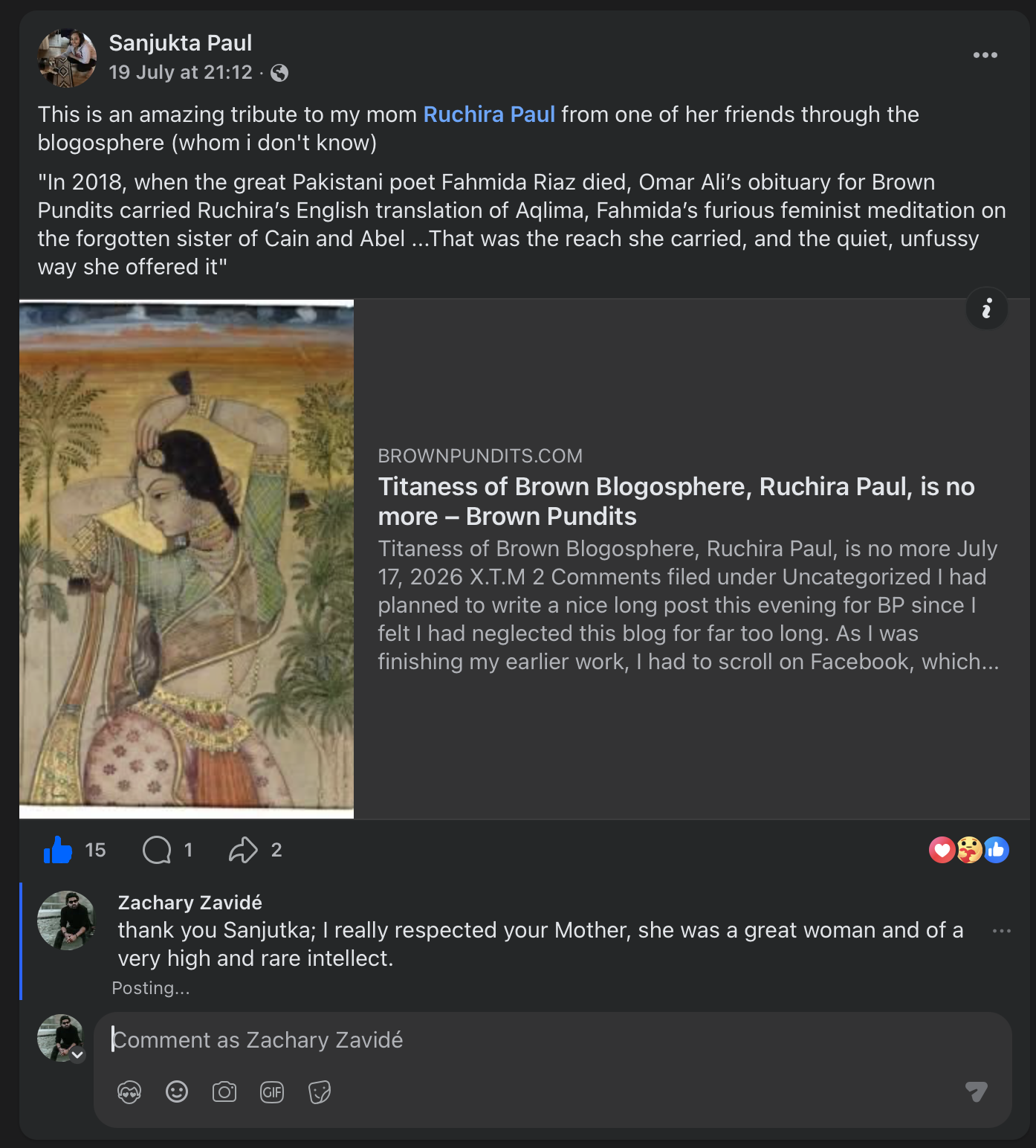
Ruchira’s daughter Sanjukta shared my tribute on Facebook this week and called it amazing. She does not know me. Her mother did, through nearly two decades of this blog, and that a stranger’s grief could reach her family and land as comfort is the whole case for keeping BP alive. The original post is here, Ruchira’s obituary is here, and her daughter’s own tribute is here.

Rest in peace, dearest Ruchira.

In her honour I have started using “I” again instead of the impersonal “we”. I wanted to emotionally invest in this space the way she did in her interactions online.

Moments like this are what I want to cultivate here, so, two years after I revived the blog here from Chennai.

Continue reading In Ruchira’s Honour

Did Modi Make India Great Again?

Seven to One

Tomorrow, Andy Burnham will be sworn in as Britain’s seventh prime minister in ten years. Keir Starmer resigned ten years, almost to the week, after the Brexit referendum. The CNN piece I read over breakfast had all but reconciled Britain to middle power status, and nobody in London seems to find the phrase strange anymore. Britain will have had seven prime ministers this decade. India has had one since 2014.

Everything I have been thinking about this week turns out to be the same question at different scales. The state of India. The state of Britain. The state of my own small republic of letters. What does continuity buy, and what does churn cost? Delhi will not let me put the question down.

Oh, could I have one more? Yes, please. Thank you. My fourth cup of sambar. Right now, it is sublime.

South Indian meals are, I always say, like Arabic food: a very good balance of taste and health, neither sacrificed to the other.

Ghalib at the Airport Continue reading Did Modi Make India Great Again?

High-Intensity Precedent

Brown Pundits runs on attention. When we put hours into the site, it hums; when work and travel pull us across three jurisdictions at once, it slows. We have a backlog of pieces we want to write and lives that keep getting in the way. The June survey took the wind out of the schedule. We do not want to run this place as full-time editors, and we should not have to.

First, a thing worth saying plainly. Brown Pundits is not a magazine. It is a discussion community with essays attached, and it always has been. The life of the site is the conversation, not the rate of publication. Everything below follows from taking that seriously.

The principle is high-intensity posts. A lot of writing is rewriting, and we want authors to work their pieces hard before they go up. We have noticed the same thing for years. A post that carries real thought and attention never dies at ten or fifteen comments. Fifty is our quiet benchmark. Past a hundred, the thread stops being ours at all and takes on its own life, because people come here to argue with each other and use the post as fodder. Signal pulls signal. Thin posts pull nothing.

The rules:

  1. Fresh original writing is the post. Work it hard, put it up on its own, and let the comments run. This is the essay, and it keeps standing where it always has.
  2. Reposts do not each get a post. Links, columns, reviews, the odd video, other people’s work: these stack into a single running thread, one per author or theme. The author upranks the newest entry to the top, refreshes the timestamp, and lets the curation gather in one place. One dense thread beats ten thin link-drops that die overnight.
  3. Open threads, where the general cross-talk lives, stay scarce. We open a new one only when the current thread crosses fifty to a hundred comments, or once a week, whichever comes first. Two or three live threads, not twenty.

The obvious worry is that a long thread walls out newcomers. It does not, because the newest entry always sits on top, and the open threads rotate weekly or at a hundred, so the live conversation is never buried under a year of history.

An example. A contributor who shares a steady stream of links, a column here, a book review there, the odd YouTube, keeps one running thread for the lot instead of a dozen one-line posts. Each new link goes to the top. The older ones stay underneath. The regulars know exactly where to find it and argue about it, and the thread grows heavier and more valuable every week instead of vanishing down the feed in a day.

That is the whole idea. Original essays worked harder, reposts gathered in one place, cross-talk kept to a few live threads. We stay a discussion community with essays attached. We are just building better rooms for the discussion to happen in. Less churn for us, more weight for you.

Brown Pundits