
A textbook currency crisis, triggered by a bunch of policy mistakes.
Tag: Global
Open Thread – 07/11/2022 – Brown Pundits
What’s going on?
Pocket Review: Secret City. A History of Gay Washington
![Secret City: The Hidden History of Gay Washington by [James Kirchick]](https://m.media-amazon.com/images/I/416zlOdHX2L.jpg)
For a good review, see here at Reason
I dont have a detailed review, just a short note. The book is not a detailed history of gays in Washington (such a book would have to start in the 1790s and would have to include the stories of Black and poor gay people; two groups notably excluded from this book, which is mostly high class elite gossip). This book actually covers the time from the 1930s to the 1990s (though it does begin with a reference to Abraham Lincoln sharing a bed with his male friend, that anecdote is just a hook to start the book with; Kirchick does not actually claim that Lincoln was gay). Prior to the 1930s there were gays in government, but little or no overt discussion of the topic; their sexual preference mostly caused problems from the 1940s to the 1990s, when there was a “lavender scare” that actually exceeded the Red scare in duration. Interestingly this lavender scare was partly driven by closeted gays, including McCarthy’s aide (and Trump’s teacher) Roy Cohn. There was a fear that homosexuals were a security risk because they could potentially be blackmailed, but actual analysis of American spies indicates that very few were gay and none were recruited via blackmail. Still, many lives were destroyed in the course of this scare and the topic remained “hot” until the 1990s, when gay liberation finally took hold and by now we are the point that we have an openly gay transportation secretary (and former presidential candidate) whose main scandal is that he took paternity leave in the middle of a transportation crisis. Though his final conclusion is optimistic (gay liberation is “a magnificent accomplishment of the liberal society, enabled by the fundamentally American concepts of free expression, pluralism, and open inquiry.”) there is a backlash in process (mostly directed against Trans activist over-reach, but likely to catch gays in the dragnet) and the current equilibrium may not be that stable. The notion that gay liberation is an active cause of civilizational decline is not gone (there is an anecdote in the book about the state department security chief commissioning a study of how homosexuality causes civilizational collapse, but the researcher concluded that homosexuality did not in fact cause the collapse of Rome and Greece) and may come back in other guises.
The book is an easy read and is full of interesting stories and characters. If you are interested in American politics and recent history, you will enjoy it.
See the Reason review for more details.
Open Thread – 06/10/2022 – Brown Pundits
What’s going on?
Open Thread – 05/20/2022 – Brown Pundits
Open Thread – 4/22/2022 – Brown Pundits
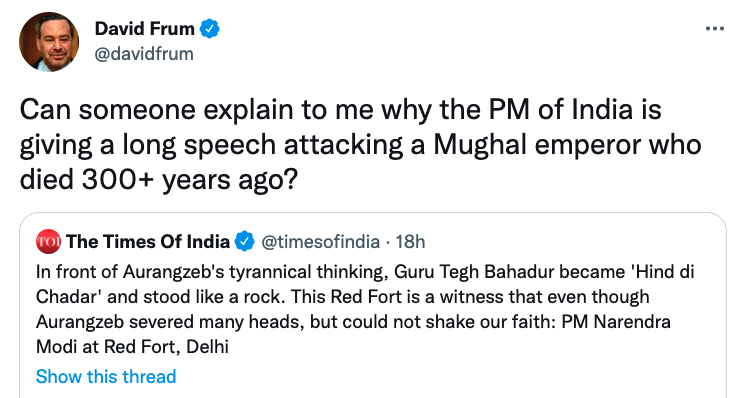 What’s going on? Some Twitter controversy around Aurangzeb.
A video on the Sintashta Culture
Sri Lanka: Mob Rule or Color Revolution
It’s Mob Rule in Sri Lanka. For its supporters it is a color revolution a la Ukraine Maidan in 2014 (more on that later). There are calls to hang and quarter President Gotabya Rajapakse. who was democratically elected by an overwhelming majority These are not sentiments of rural folk. It’s the call from Western leaning, educated urban affluent folk, plus those comfortably living in western countries. These are the types whose platitudes are about rule of law, democracy, guilty until proven and other trope.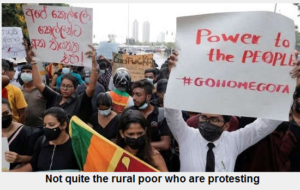
But then the fruit does not fall from the tree does it. The tree been that beacon of democracy, the US. Just a few weeks ago there were calls for regime change, including assassination of a world leader, not just by some nonentity but by the leader of the “free” world and one of his senior member in the government.
Then of course there is the history, much to do with oil
Eg 1: Overthrow Assassination of the democratically elected Iranian PM Mosaddegh and the Shah being installed. When there was a popular revolution and a democratic government kept getting elected under theocratic oversight (no much different from UK monarchy) sanctions against were done done with the hope of regime change.
Eg 2 : Venezuela. Conspiracy theories of Chavez being murdered. However, very clear the US has continued using sanctions to attempt regime change and install a client Guido (is he from South Jersey). Note: Venezuela and Iran have been able to live with US sanctions because they are energy independent.
Eg 3: Korea the first division a la a possible Ukraine Vietnam, Kosovo, Libya, Iraq, Afghanistan, Syria almost all still occupied by the US/NATO
In Sri Lanka this is a class struggle, which the west oriented urban elite hope to regain power by other means That is not by democratic vote. The small vocal (in English) is extremely against the current regime. Not just against, a visceral hatred of the rural types, (godayas or bumpkins), much like visceral hatred of Russia or the rural Evangelicals and deplorables who support Trump. It is very evident in the language used against them, extremely discourteous to say the least. The Rajapakses have continued the pro rural people, socialist policies started by the Bandaranaike in 1956..The rural people (80 % of SL) are not happy. Who likes power cuts and shortages of diesel. But not to the extent of doing protest. They just need to cut firewood to cook.
The whole do a little protests and then go for sushi meal sums up the depth of these protests. Urban, affluent and no depth or “deep hunger” for change, so no real staying power or commitment. Much like Occupy Wall Street it will fizzle out.
Now the US connection: It’s no coincidence Victoria Nuland the architect of the Ukraine Maidan revolution visited Sri Lanka, India, Pakistan trying to drum up support for US sanctions against Russia. India said it was neutral and continued to import Russian crude. Same with Pakistan and Sri Lanka commenting they were neutral. Lo and behold a few weeks later a no confidence motion against Imran Khan the Pakistan PM, with rumors his party MP’s were bribed. The hope was that the pro US Pakistan army (they get lots of goodies from the US) would takeover. In Sri Lanka so called grassroots protests by the urban affluent for which none of the opposition parties claim responsibility.
So why the economic crisis in Sri Lanka. Lanka is being hit by a perfect storm.
a) The consequences of 2019 Easter bombing by Islamics and loss of tourism for three years (20% FX)
b) Economic shut down by a 1+ year lockdown because of Covid (30% FX, eg Garments)
c) Loss of mid east remittance for 2 years, as workers were sent back because of COVID fear. (30% FX)
d) And now having to pay for refined fuels and diesel shortages. Our only refinery Sapugaskanda built by the Iranians is to process Iranian crude or Russian crude.
In my opinion, fuel shortages are the biggest problem. 10 hour power cuts in urban areas. Lines to get diesel, petrol, kerosene and LPG if available. Again not too bad in rural areas. i.e. use firewood. I just built an outdoor fireplace.
Mid east workers started going back starting around Dec 2021. About 40 have left so far from the village.
Tourism had picked up in March. I was getting about 2 visitors a week, about a USD 200 income. Pre easter bombing in 2019 it was USD 600+. The rioting and power cuts are going to kill that goose.
Anyway this is democratically elected govt. Mob rule regardless of how urbane or affluent (and NOT representative of greater Sri Lnka) should not be allowed to stage coup or color revolution.
China: A Book and a TV serial..
I just finished Edward Rutherford’s “China, the novel” and enjoyed it. Capsule review:
![China: The Novel by [Edward Rutherfurd]](https://m.media-amazon.com/images/I/51OkcO-y3ZL.jpg)
This author writes sweeping sagas about particular places (London, New York) and clearly researches a lot before he writes. This one covers China from the first opium war to the end of the Qing dynasty. As usual, he has created characters (a British opium trader, a missionary, a Chinese mandarin, a Chinese rebel, a eunuch in the Manchu court, etc) that cover all important events (opium wars, Taiping rebellion, court intrigues, empress Cixi, etc). The book is a fun read and the history is well researched. While you can read many books about the history of the era, this one fills in the social mores, family dynamics etc in ways that a history text cannot. Well worth a read.

And happened to finish the overly long serial “Ruyi, Royal Love in the Palace” on Amazon Prime at the same time. This is a (very fictional) account of Ruyi, the Ula Nara empress in the reign of the Qianlong emperor. The details are ALL fictional, but the serial is lavishly produced and seems to capture the atmosphere of the harem (or what i imagine to be the atmosphere of the harem) very well. The novelist seems to have had some moral purpose in view, so the evil nature of the whole arrangement is perhaps a bit overdone (but it is also possible that in actual practice it was even more evil than this), and the serial is TOO long, going on for 87 episodes where 20 would have been more than enough. And some of the plot devices are also unrealistic (everyone is plotting, plots get discovered all the time, but the emperor never seems to take precautions against them; on the other hand, he too may be constrained the nature of the institution). But slowly but surely it does capture the terrible nature of this institution. Worth skimming through if you don’t have the time for a long soap opera.

Open Thread – 4/1/2022 – Brown Pundits
 In the last week of this month I will be posting a podcast I did with Francis Young, author of Pagans in the Early Modern Baltic: Sixteenth-Century Ethnographic Accounts of Baltic Paganism (at my Substack). Over the hour and a half we talked about many topics, but one thing that struck me listening to him describe the details of the beliefs and practices of Lithuanian pagans, practices that persisted as living traditions centuries after the official Christian conversion of the state in ~1400 AD (Young estimates that in the 1500’s 30-40% of the population were what was then termed “Old Lithuanians,” baptized into Christianity but rural people who were almost totally uncatechized and continued to practice their ancestral religion), is how redolent they are of the Vedic religion. Young has convinced me that it is likely that the original Baltic branch of Indo-Europeans flourished somewhat to the south of their current distribution, which may be an outlier relic. If that is correct, they were likely positioned just to the west of the Indo-Iranian ur-heimat of the Fatyanovo-Balonov culture. Linguistically many scholars argue that Indo-Iranian and Balto-Slavic are a natural ‘clade’ within Indo-European languages.
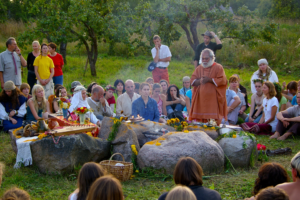
The Wikipedia entry on Lithuanian neo-paganism (Romuva) has a section titled “Relation with Hinduism”:
…But for Lithuania’s Romuva community, which traces its traditions back to ancient folklore, it is evidence of a connection to India, Hinduism and Sanskrit that has become a part of their Romuva identity, along with its pantheon of gods and fairly standard pagan rituals. Some believe that the connection between Hinduism and Romuva made Romuva to be more than a “primitive, shamanic religious tradition”…
…
Similarly Ašvieniai are divine twins in the Lithuanian mythology, counterparts of Vedic Ashvins. The Ašvieniai are represented as pulling a carriage of Saulė (the Sun) through the sky. Ašvieniai, depicted as žirgeliai or little horses, are common motifs on Lithuanian rooftops…
Romuva and Hindu groups have come together on numerous occasions to share prayers and participate in dialogue. These events have taken place in Lithuania, Atlantic City, New Jersey, Boston, Massachusetts, Epping, New Hampshire, and elsewhere.
I had assumed that Lithuanian Catholicism derived its strength from the Counter-Reformation period (the last sacred snake groves were destroyed by priests in the 18th-century), but Young explained that the reality is that Catholicism and the Lithuanian national identity became associated only with the absorption of Lithuania into the Russian Empire, where the dominant religion was Eastern Orthodoxy. It was in the context of religious and ethnic marginalization in the 19th century that the two elements of modern Lithuanian identity finally began to become synergistic, and therefore heterodox peasants began to finally adhere more strictly to a Catholic identity.