Missing God…in God’s own country

We believe this wholeheartedly- if there was a God, a supreme being who feels for her children (as we all are) she would not allow such an abomination to stand.

Normally we get along very well with people of faith, we truly enjoy the varied cultures that shine through during the ceremonies and we absolutely relish the food. Every dish is prepared with an abundance of love and it is a pleasure to share the joy. Hindu, Muslim, Sikh, Christian…this may be a cliche…they are all the same.

Then there is the sinister aspect of religion (they are all the same, again). It breeds zealots who turn into monsters on the pretext of acting as angels. In  this sense, religion is a veritable poison, tolerable in light doses, at higher doses will kill both friend and foe without discrimination.

In this case highlighted below, the greatest culpability (in our opinion) lies with Joseph’s own people at the high table.  They are supposed to (at the minimum) stand by their brother in times of need. Instead what we see is a full and complete betrayal, condemning a lady (and a loyal wife) to death and her husband who is now amongst the living dead.
……
After a
four year long legal battle with college authorities for his
reinstatement, Prof T J Joseph, whose right hand was chopped off by
fundamentalists in 2010, rejoined service at the church-run Newman
college in Idukki on Friday morning, three days before his retirement.


However, since annual examinations are going on, he could not take classes.

Students clapped and his colleagues shook hands as the lecturer, who is
recovering from the shock of his wife Salomi’s suicide few days ago,
rejoined service.

Joseph, head of the Malayalam department, was
suspended from service following the controversy over framing of a
question paper in 2010. Alleging that the lecturer had hurt
their religious sentiments, a fundamentalist outfit had brutally
attacked the lecturer as he was returning with his family after a Sunday
Mass on July 4, 2010.

The hand was later sutured back and he slowly recovered from the brutal attack.

The family was going through tough times with the sole bread winner
having no job. Salomi (48), who stood by Joseph during his trying times,
last week ended her life as the family was facing severe financial
problems.

Within days of her death, the college decided to take him back before his retirement on March 31.

Joseph was escorted to the college in Idukki district from Muvattupuzha in Ernakulam district by police.
…..

regards

Many Poonams required for (social) revolution

But two will do for now.

First off, congratulations to all who contributed towards eradication of polio. But bigger and fiercer battles lie ahead. 

Here is some thought as to how we can improve health-care of individuals by caring for the health of the society. Social revolutions will help reduce and eventually remove the burden of caste based discrimination that lies at the heart of why and how entire populations have gone missing from the civilian radars.

From anecdotal observations, India has a problem of traditional mature generation drifting apart from a westernized younger generation. For the good of the society this needs to change and the best place for  the change to take place is in the fertile fields of social service.

The youngsters will always get points for energy and youthful beauty (aka click-bait but equally the most click-safe picture we could find), but they will need to learn wisdom and patience from their elders. The matured folks need to give the youngsters their space in the front-lines and allow them to grow up as contributing citizens and (better) leaders for tomorrow.

This is the parampara model that we do recommend strongly, inter-generation bonding is good for the community, nation and for the democratic model to work properly. 


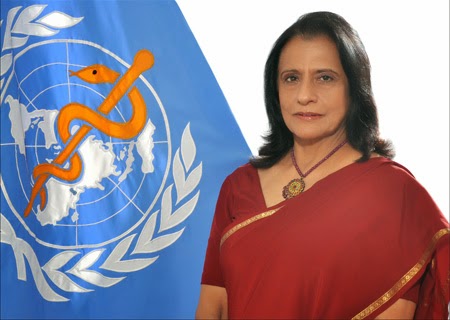
In the spirit of the above, we request Poonam Khetrapal Singh to welcome Poonam Pandey to add her star power towards eradication of malaria, TB and HIV from SAsia. I am sure things would work out just fine for all concerned (especially the people affected by the disease). 

Last but not the least, we are very happy that some effort is being made to understand and ameliorate mental illness which may overwhelm India in the years to come. 

….
The World Health Organisation’s South East
Asia regional director Poonam Khetrapal Singh
, the first woman to hold
this position, had a proud moment when she declared the region
polio-free on March 27. But, this is just the beginning; we need to deal
with tuberculosis and measles as well, Singh points out to Narayani
Ganesh

Q: The WHO declaring the South East Asian region as polio
free has come nearly two decades after India first launched its
anti-polio drive in 1995. Why did it take so long for India to do this?

A:
Yes, India was the last country in the region to eradicate polio,
thereby delaying the declaration considerably. First, the Americas did
it in 1994, followed by the western Pacific in 2000 and the European
region in 2002. And now, the polio virus is present in only three
countries in the world: Nigeria, Afghanistan and Pakistan, all
conflict-ridden areas and so posing challenges in terms of success in
immunisation programmes.  To declare the world polio-free, we have to
wait for these three countries to eradicate polio.

India is a
large country with more than a billion people, with 170 million children
under the age of five. There is a lot of moving population and an
estimated eight million children too are on the move at any given time,
so you can imagine how difficult it is to sustain the immunisation
process. At one time we thought it might never happen! So it is no mean
achievement, and we waited for the mandatory three year period before
making the declaration. The last polio case in India was detected in
2011.

Q: What if polio reappears like it reportedly has in California recently? What’s the risk factor of recurrence of the disease?

A:
Importation of the ‘wild’ polio virus does happen even if a region is
declared polio-free, so long as there still are some countries that
continue to battle the disease as importation can happen only from
there. That’s the risk factor. That’s why you need to have a plan. You
need to have good surveillance, first of all, to detect the importation
of polio virus. India and other countries will continue with
immunisation and also expect visitors to the country to have been
vaccinated against polio. Immunisation has to be repetitive. India’s lab
surveillance system is excellent – that is, the ability to detect a
virus in the lab. Otherwise, often you might suspect a polio case and it
may not be so.

Q: And when children get infected during immunisation? How often does that happen?

A:
Sometimes this can happen; they can derive polio from vaccine since the
virus is live. But the numbers are few, an estimated 53 to 100 in
total, but even if there is one case it is indeed of great concern.
Hence we are now moving to IPV or inactivated polio virus so you cannot
get vaccine derived polio from it. It is as effective as the live virus
but less used as it is expensive and given through injection as opposed
to oral drops.

As part of WHO’s global polio eradication project,
we’ve put in place an Endgame Strategy 2013-2018. They are advocating
IPV now because once the Oral Polio Vaccine (OPV) transmission is
stopped, it is safer to switch to IPV.

There are three different
types of polio strains: Type 1, Type 2 and Type 3. With OPV, Type 2,
the most virulent form, got eradicated in 1999. So Type 2 was out and
we’re now left with Type 1 and 2. The world is now moving toward
monovalent vaccine to address one Type at a time.

Q: How important a role did civil society groups play in eradicating the virus?
A:
India had three points in its favour: Strong political commitment,
generous budget allocation and good partners like Rotary International,
Unicef and others, including the Gates Foundation. And there has been a
successful review of the program. India was open to trying out
different types of vaccine – monovalent, bivalent and trivalent. Then we
had this big problem of under-serviced areas. In areas where polio was
persistent, like the Kosi River region in Bihar with high incidence, we
had special strategies in place, with gradually evolving programmes.

Q: You’ve said that polio-eradication alone is not enough. What are your focus areas to make the region disease free?

A: Polio eradication is just the beginning; we still
have to deal with other communicable diseases like TB. Since 1990, TB
mortality has declined by 40 per cent and Malaria, by 82 per cent.
Maldives is already malaria-free. In most countries in the region, the
HIV epidemic has been reversed.
However, we do face challenges in terms
of drug resistance and co-infections. And then we have recurrence of
influenza, SARS and avian flu that travel the globe in a shrunken world.
The answer is to scale up national capacity so as to prevent diseases
from spreading out.
 

As you know, India has the
largest incidence of cardio-vascular disease, diabetes, cancer and
chronic respiratory diseases. One third of these deaths occur in people
below 60 years of age. 

Tobacco use is a huge menace and other lifestyle
factors play a huge role in increasing the spread of non-communicable
diseases and this can only be reversed by taking multi-sectoral
preventive action. Other important areas of focus are mental health and
malnutrition.

….
regards

The new un-touchables are rising

A new caste rises in India- comprising of political dynasties who cornered 29% of the seats in 2009, 9% more than 2004. They are the new un-touchables, not because they have too little power, but too much. And people love them and accept this as a natural phenomena.  

Thus even as Brahmins fade away, Brahmanism will  survive in India cutting across all barriers. This includes even the Dravida Munnetra Kazhagam (Hindus are thieves and Hindu rituals are kaatumirandithanam- barbaric) and the Majlis-e-Ittehad-ul Muslimeen (Hindus are impotent). They abhor the Hindu caste pyramid in theory, but insist that they should be the top caste in practice (kind of like how the British were the royal caste before 1947).

The voters are fine with this, because they accept the basic logic of the caste system, that of the parampara, by which a father teaches his son (and on rare occasions the daughter) the tricks of the trade. It is perhaps unfortunate that the list is headed by an under-performing son (perhaps the daughter would have been a better choice).

Carnegie professes to be shocked by this but they should note the list of presidents in the USA (excepting Obama) of late reads as Bush, Clinton (twice), Bush (twice) and is expected to revert to Clinton in 2016 (and perhaps after that, Jeb Bush from Florida). In a pure meritocracy that is the USA is this truly kosher?
….A poll released by the Washington-based Carnegie
Endowment for International Peace confirmed recent surveys pointing to a
strong showing by the Bharatiya Janata Party (BJP) after a decade of
rule by Gandhi’s Congress Party.

Gandhi, 43, whose father,
grandmother and great-grandfather were all Prime Ministers, is the
candidate from the Congress Party in elections starting on April 7,
going against the BJP’s Narendra Modi, the son of a tea-stall owner.

But the poll did not support suggestions that Indians have rejected
hereditary candidates. Instead, 46 per cent of voters said they
preferred politicians who hail from dynasties. 
 “What we found was kind of shocking,” said Milan Vaishnav, an associate at the Carnegie Endowment’s South Asia programme. “Nearly one in two Indians say, if I had a choice, I would prefer to
vote for a candidate who has a family background,” he said.

The
vast majority of voters who preferred dynasties said they thought such
candidates would be more adept or likely to succeed, with only 15 per
cent saying that their main motivation was an expectation of patronage.

Twenty-nine per cent of Indian lawmakers elected in the last election
in 2009 succeeded family members or have relatives also serving in
Parliament, a figure that rose by nine per centage points from the
previous vote in 2004, Vaishnav said.

The survey, conducted
with the University of Pennsylvania’s Center for the Advanced Study of
India, took opinions from 65,000 households as part of a project that
will examine changing trends.

When asked about voting
preferences in late 2013, 31 per cent sided with the BJP-led alliance
and 23 preferred the Congress-led coalition, in what would amount to a
reversal of fortunes since the last election.

..  regards 

Uma and Maya face an uncaring world

How many of you have little daughters (children even)?  

How would you react if you knew that they were lost? Would you hope and pray for some kind stranger to show up? Would you be worried about “stranger danger.” Our advice for the children is to holler, (as is clear from the article) just standing and looking forlorn may not suffice.

What about the stranger himself? If he is a man, our advice is to look for a woman (or a cop). Doing nothing is not an answer.

….
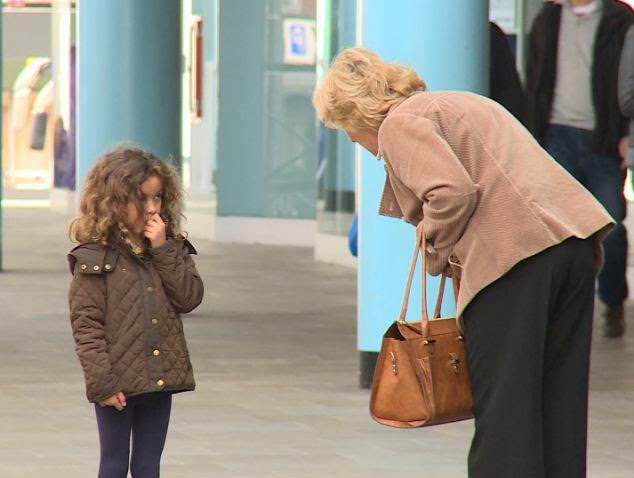
One little girl was clutching her favorite toy while her younger
sister was sucking her thumb – and both looked utterly lost and forlorn. The girls stood for
an hour on a Saturday morning in a busy shopping arcade looking for
‘help’, as part of a social experiment for television.

Hidden cameras recorded Uma, seven, and Maya, five, who took it in turns to look lost.

Astonishingly,
over the whole hour only one person, a grandmother, took a moment to
find out if there was a problem. All of the 616 other passers-by
completely ignored the girls.


ITN researchers chose Victoria Place shopping centre, next to London’s bustling Victoria Station, to test the British public. Maya
and Uma agreed to help and were brought along by their mother Reshma
Rumsey, who watched from behind a nearby pillar with a presenter. Uma
went first, standing alone in the middle of the concourse, holding her
pink  doll and putting on a good act of being scared and vulnerable.

Under the gaze of the hidden cameras 25 yards away, dozens of
shoppers and travelers bustled past. A mother with a pram manoeuvred
around her, then a group of women pulling suitcases turned a blind eye. After
20 minutes, not a single person had stopped to ask the seven-year-old
if she was all right, even though some of them had plainly seen her.

Next,
it was her five-year-old sister’s turn. Maya stood sucking her thumb,
and then tried kneeling down, gazing up forlornly at passing shoppers,
but she too seemed to be invisible. Eventually, a pensioner gave her a concerned look. At first, Pearl
Pitcher, of Kent, who is in her seventies, carried on walking, but she
soon turned around and came back to ask Maya if she was waiting for
somebody.

Mrs Pitcher said later: ‘She had stood too long by
herself and no parent or friend came up to see her. I was very hesitant
to come and ask her, and I walked past but I thought I must come back –
just in case.
‘I think the older generation would stop, but very
cautiously, a bit like I was. I don’t know about the younger generation.
A lot of people walked by and didn’t take any notice at all.’

Mrs Rumsey said she was ‘gobsmacked’ by seeing her daughters ignored by more than 600 members of the public. The 39-year-old journalist said: ‘When you see that little face looking so lost, and people are walking past, it is awful. ‘I
did not expect so few people to stop … it’s shocking that people
noticed a child on her own and they just walked past, whether it’s
through fear or because they didn’t care or because they didn’t notice.
As a mother, to watch your child on their own, looking lost and needing
help and watch people walk past is heartbreaking.’

Experts said
the reluctance of the passers-by was partly explained by people being
busy, and partly a fear – especially among men – of any help they offer a
child being misinterpreted.
 

But the NSPCC said a child’s welfare was more important than worrying about being labelled a ‘stranger danger’. A
spokesman said: ‘We have got to get a message out to adults that they
have a responsibility to protect children and that must supersede any
concern you have for other people’s perception of why you are reaching
out to help that child.’

* Little Girl Lost: A Police 5 Special will be shown on Channel 5 at 6.30pm tomorrow.

regards

Double century not out

BP has registered 200 posts for March- the Big Chief was gracious enough to run the 22 yards for the 200th one. An above-average effort for sure, and more still yet to come.

Speaking from the desk-clerk’s desk we only have a hazy idea about who the readers are, what they like (and dont like) about BP. Please feel free to add your comments or better yet, step up and pen down those great thoughts. As a very wise man has noted:

An idea that is not expounded or written, is as good an idea that never was

Just one (redundant) observation if we may, the readers still hang on to every word (a bit infrequent alas) penned by Dr Omar (hint: yeh dil mange more). While the good old days (and good old friends) may never come back it is reassuring to know that some things will not change.

Heart-felt thanks to the blog-owners for letting us have a good time.

warm regards

Hinduism: is it only sex (and death)?

A critique of Doniger which steers away from the Hindutva-secular fight and asks some pertinent questions, one of which is: does the distinguished professor know (or care) about what is special (or unique) about Hinduism?
….
Such a shared core may well be close to, among other ideas, the
Upanishadic monism that crystallized in the seventh century CE into the
non-dualistic Vedanta of Shankara who established it both by
interpreting the classical texts and by refuting the competing
philosophical schools of the day. Early evidence of an incipient monism
is mentioned, for example, by Mohanty (2007, p. 24):  While the Vedas contain a myriad of different themes, ranging from
hymns for deities and rules of fire sacrifices to music and magic,
there
is no doubt that one finds in them an exemplary spirit of inquiry into
“the one being” that underlies the diversity of empirical phenomena, and
into the origin of all things.  

If this core truly pervades popular belief today then it cannot be
easily explained as a late nineteenth and twentieth century product of
colonialism as many on the left try to do.
This is not to deny the
presence of other orthodox and heterodox traditions in this core, only
to say that such a monism’s mass appeal must surely have preceded
colonial times. Doniger and her supporters never acknowledge this wider
humanity in their arguments and so end up attacking a straw man.
 

For instance, Vamsee Juluri’s essay
articulates an attitude that may be widely shared by modern practicing
Hindus. He clearly differentiates it from militant Hindutva by making
plain the diverse and plural heritage of Hindu thought. But he
simultaneously argues against Doniger by saying her interpretations
flagrantly contradict the lived experience of devout Hindus.
This
dialectical argument raises many difficulties for both sides, and sets
up a tension between Hinduism seen as an intellectual object and as a
sacred practice. 

Second, however, it may be asked, shouldn’t the lived experience of
religious symbols and myths be part of what is explained by inquiry?
That is, shouldn’t the external, intellectual stance account for the
internal, experiential facts? For example, if one holds that the Shiva
lingam represents Shiva’s erect penis, how does this square with the
interpretive community’s view (e.g. possibly something abstract like
Shiva’s sexual and creative power or just Shiva himself)? In a parallel
situation, is it right to describe the Holy Communion in Christianity as
a cannibalistic rite?
Certainly there is a connection between a penis
and a Shiva lingam as there is between the body and blood of Christ and
the ritual bread and wine, but do these connections involve the literal connotations of “penis” and “cannibalism”? 

Doniger’s book is not about revelatory insights into the Hindus but
generally about completely worldly things like sex, death, and material
pursuits.
While Eros and Thanatos are undoubtedly powerful forces in
human lives and while material pursuits are indispensable to survival,
Doniger succeeds only in clarifying that the Hindus, like other humans,
were and are part of the animal kingdom.
 

Much of what she says is
probably true—the Brahmins did eat beef early on, for example—
and the
Hindus who have been offended by such facts ought to recognize that
religious values are not eternal but emerge through history. But, for
her part, Doniger fails to make sufficiently salient how unique and
humane the impulse of vegetarianism was as a response to the barbaric
conditions of material life
in all early human civilizations. She passes
up such opportunities over and over again.


For the aims she chose, her cultural history needed to
have been more of an intellectual history. She never explores what the thinkers
of Indian civilization did—whether Brahmins or non-Brahmins, men or
women—when they confronted conceptual problems like the origins of the
world and how we might come to know it.
No logic of inquiry or
argument is described as it would have to be if one wanted to “show the
presence of brilliant and creative thinkers entirely off the track.” 

Indeed, there is hardly any speculation about the metaphysical instincts
of the Hindus at all.
Her materialism, while right in spirit, is
summoned too soon and all one gets is the subterfuges and stratagems of
the ancients. No doubt these existed as they are an inevitable part of
human nature and no doubt they played some role in the worldviews of the
Hindus, but do they constitute what is special and unique about Indian
civilization, or any civilization for that matter?

regards

Dravidas of the world unite (no brotherly love)

MK Alagiri is the second son of M Karunanidhi (by his second wife Dayalu Ammal). MK Stalin is the third son (MK/DA). In all there are six children from three wives.

As of today Alagiri stands expelled from the primary membership of DMK. Stalin has already been anointed as the Yuvraj.

The eventual demise of dynastic politics in India through brother shedding the blood of brother is well known (example: Aurangzeb vs Dara Shikoh). Less well known is the example of father throwing one son to the wolves so that the other son may reign in peace. This one is truly for the history books.

The point is- it is
not just the current generation that needs protection from the unseen
hand(s) of fate, additional insurance must be purchased so that the
wheels of fortune remain frozen in time.

This is the same logic followed by Duryadhona in Mahabharata when he rebuffed Krishna’s peace settlement – gifting the Pandavas a token amount of 13 villages – he would not even consider giving away land that fits the point of a needle.  

So what happens in Act II? File a criminal case against the “boy” and get him jailed for life (at the present moment DMK is not in favor of death penalty due to its campaign to release the LTTE gangsters)?

A hard-headed and indeed a hard-hearted dad. One thing for sure, this will not end nicely.

regards

529

There is many a time when citizens in a democracy get royally frustrated. Especially in flawed democracies like India, which is further segregated into war zones (Kashmir, North-East, Central India) and backward zones where the daylight of justice is usually overwhelmed with clouds of Armed Forces Special Powers Act (AFSPA) and Khap committees and the like.

However if one wants to see a true police state in operation, then modern day Egypt can serve as a fine example. There are many many private horrors on a daily basis, this one below is an example of a public horror show.

As a model these states can choose to follow the rightist thugs-in-chief (Pinochet, Franco etc) or the leftist ones (Mao, Stalin etc.). True they are not as evil as the full blown crazies (Pol Pot, Kim Jong-un, Mullah Omar, Assad etc.) but that is the only nice thing going for them.
…A
court in southern Egyptian has convicted 529 supporters of ousted
Islamist President Mohammed Morsi, sentencing them to death
on charges
of murdering a policeman and attacking police.

The court in
Minya issued its ruling on Monday after only two sessions in which the
defendants’ lawyers complained they had no chance to present their case.

Those convicted are part of a group of 545 defendants on trial
for the killing of a police officer, attempted killing of two others,
attacking a police station and other acts of violence.

More than 150 suspects stood trial, the others were tried in absentia. Sixteen were acquitted.

The defendants were arrested after violent demonstrations that were a
backlash for the police crackdown in August on pro-Morsi sit-ins in
Cairo that killed hundreds of people.

regards

The Dalits need no religion

Behenji (dear sister) Mayawati hates (justifiably) the Hindu caste system with every fiber of her body.

The famous slogan of Kanshi Ram (her mentor) was : Tilak, taraju aur talwar, unko maro juthe char (Brahmins, Baniyas and Khatriyas should be given a good kick).

One of the pressing problems facing India (as our overlords see it) is the religious affiliation of the dalits and tribals which will translate into muscle power and as cannon fodder. They are officially listed as (mostly) Hindus.

In Maharashtra a section of dalits have adopted neo-Buddhism (with all the rituals of Hinduism extending to idolatry). The dalit army is named Bhim-Sena after Bhima of Mahabharata who married a dalit lady (Hidimbi) and had a valiant progeny (Ghatot-kacha).

We believe this strategy kills two birds with one stone- it establishes Dalits in the Dharmic sphere and embeds them firmly in the fold of Indian mythology and culture (as the original Indians even). This also achieves a degree of separation with the foreign origin religions/cultures of Islam and Christianity.  

While RSS and other Hindutva organizations may not be pleased by this strategy of subversion there is little they can do about it. And as far as the eager-to-convert emissaries of desert religions are concerned, their talking points dont work against the (supposedly) egalitarian Buddhism. And the foreign origin point is un-answerable. 

Thus just like all forms of carbon will eventually convert into diamond, Buddhism should be the default religion of all Indians. Presumably this is what Mayawati would wish for but for now she needs the Brahmins on board to defeat the pesky Shudras. This is why she has
a (successfully tested) reservations carrot for the upper-caste (economically
backward) folks as well.  It is her own special form of Marxism- class equations merged with caste equations.

In conclusion electoral compulsions has forced Behenji to be a sister for the Tilaks aka Brahmins instead of kicking them into the mud. Another magical aspect of the (bottoms up) social revolution.

BSP
supremo Mayawati on Sunday slammed religious conversion and asked
members of weaker sections, dalits and tribals to change the government
instead of their religions.
“I understand that people from BJP
and RSS visit remote areas of Odisha and persuade adivasis and dalits to
go for reconversion in order to change their living standards. I am
telling you not to change religion, but governments both in the state
and the Centre,” Mayawati told a public meeting.

Stating that
about 50% of Odisha’s population comprised tribals and dalits, Mayawati
said there had been no development of poor people even 65 years after
Independence. She also highlighted the plights of poor people among the
upper caste communities.

Blaming the economic policies of both
Congress led UPA government and previous BJP led NDA regime at the
Centre, she said “while a huge amount of black money is stashed in
foreign banks neither Congress nor BJP had made any effort to bring it
back.”

“If the black money is brought back, most of the
problems faced by the poor, dalits and tribals would be over for all
time to come. But, those in power don’t take such step,” she said.

Holding poverty and unemployment responsible for the growth of left
wing extremism, Mayawati said the Maoist menace would certainly come
down if the government took steps to uplift the poor members of the
society.

She said Odisha remained poor and backward for ages
due to faulty policies of successive governments in the state and the
Centre. “We will fulfill Odisha’s demand of a special category State
status if voted to power in Centre,” Mayawati said.

“We have
reduced poverty in Uttar Pradesh and distributed unutilized government
land to landless people. Same can be done in Odisha and elsewhere,” she
said.

Appealing to people to vote for BSP candidates in the
ensuing twin polls, Mayawati said “we do not have alliance with anyone
in the state. BSP has put candidates in all the 21 Lok Sabha and 147
assembly segments of Odisha.”

On the thin attendance in her
first public meeting here, Mayawati said she was happy that poor people
attended the BSP rally. “We do not bring people by bus or train to show
fake strength. I am happy that so many people attended the meeting
despite scorching heat,” she said.

regards

(un) Indian mother

India (length and breadth) by bike in (about) a hundred hours.

To all appearances, here is a middle-class, ordinary mother. IMO she should be given a medal for encouraging her boy (who suffered a bike accident and went into coma) to keep following his dreams in the face of extreme adversity (granted it is an exercise in stupidity but still). For India and Indians to grow (and grow up), many more of such mothers will be required.

Congratulations to Manish.
 ….
Raised
in Ranchi, Manish is currently a manager at an MNC in Bangalore. He did
his graduation in commerce from St Xavier’s College, Ranchi in 2000,
and followed it up with an M Com from Marwari College, Ranchi and MCA
from BIT Mesra.

Manish started his east-to-west India
expedition on April 16, 2013 at 10.30 am from Tezu in Arunachal Pradesh
and ended the trip at Koteshwar in Gujarat on April 21 at 5.30 am,

covering a distance of 3,830 km, following the route-map provided by
Limca Book of Records in four days and 19 hours (115 hours). The
previous record was of 119 hours.

He started his expedition of
north-to-south India on May 31, 2013 at 7.30 am from Leh in Jammu &
Kashmir and ended at Kanyakumari in Tamil Nadu on June 4, 2013 at 9 am.

This distance of 3,843 km was covered in four days and 1.5 hours (97.5
hours). He broke the previous record of 102 hours.

The records mean a lot to Manish, he had met with
an accident while riding a bike in 2004 in which he ruptured his spleen
and fractured his knee and collarbone and was in coma for three days.
He said, “I am thankful to my parents who understood that it was an
accident and never discouraged me from getting on a bike thereafter.
Especially my mom, who unlike other mothers, never asked me to refrain
from riding.”

 regards

Brown Pundits