Sphygmomanometer (Excerpt)–Translation from the Urdu

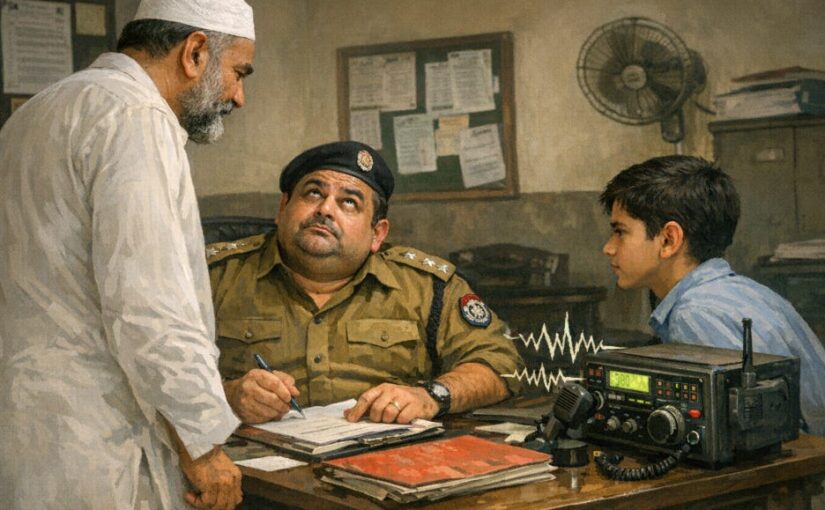
This translation was originally published in The Peshawar Review earlier this month. It is an excerpt from my translation of “Sphygmomanometer”, one of the Urdu short stories included in Bilal Hasan Minto’s collection Model Town (Sanjh Publications 2015). The collection consists of linked short stories set in Lahore in the late 1970s and early 1980s — at the beginning of General Zia ul Haq’s martial law. The narrator of these stories is an adolescent boy who comments on the hypocrisies of the adults around him.

One day, Naveed Bhai hadn’t returned from college by five o’clock. Usually, this wouldn’t have been cause for concern — a slight delay in returning home. But, over the past few days, Naveed Bhai had been behaving in a way that caused Abba to worry that he might be getting involved in something that would land him in trouble with the government of the cartoonish General Zia. Sitting at the dining table one day, Naveed Bhai had said angrily, through clenched teeth, that “we should teach these ignorant student union thugs a lesson.” On hearing this, Abba stared at him and said they had sent him there to study, not to get involved in useless things. Naveed Bhai should go straight to college and come right back. He shouldn’t even think about getting involved in union affairs and getting mixed up with dangerous people. Instead of being quiet after this reprimand, Naveed Bhai started speaking even more loudly:

“They are thugs! Their legs should be broken the way they broke Junaid’s. General Zia is behind them!”

Alarm bells had gone off in Abba’s head once before when Naveed Bhai had said he was going to join an underground group of progressive, pro-democracy students. Abba had only gently rebuked him, saying that future doctors shouldn’t get involved in such nonsense. Student unions were against the law. There was no need to get himself in trouble.

Who knows who he was, poor Junaid, whose legs had been broken. And I didn’t even know what a ‘union’ was but when Abba and Naveed Bhai started arguing loudly, I figured some dangerous people had become members of a student group sponsored by a political party, and now they were hovering around colleges and universities. The party they were affiliated with considered itself the last word on religion, and its sole champion. From Abba and Naveed Bhai’s conversation, I also gathered that these political workers used to beat students and coerce them into obeying strange orders. For example, boys and girls could not walk together on the street. If an emergency forced a boy to talk to a girl, neither of them was to be heard laughing — but such an emergency should never occur. Similar illogical things spewed from their strange minds, like the vomit from Faizan’s mouth. They had always done things like this, on behalf of that criminal general with the cartoon face and never did anything commendable just as that shameless general hadn’t either.

When Abba heard from Naveed Bhai about poor Junaid’s broken legs he became even more worried. Pointing his finger for emphasis, he warned, “Don’t you dare get involved in such things!” Continue reading Sphygmomanometer (Excerpt)–Translation from the Urdu
Aasiya (Part 2)–Translation from the Urdu

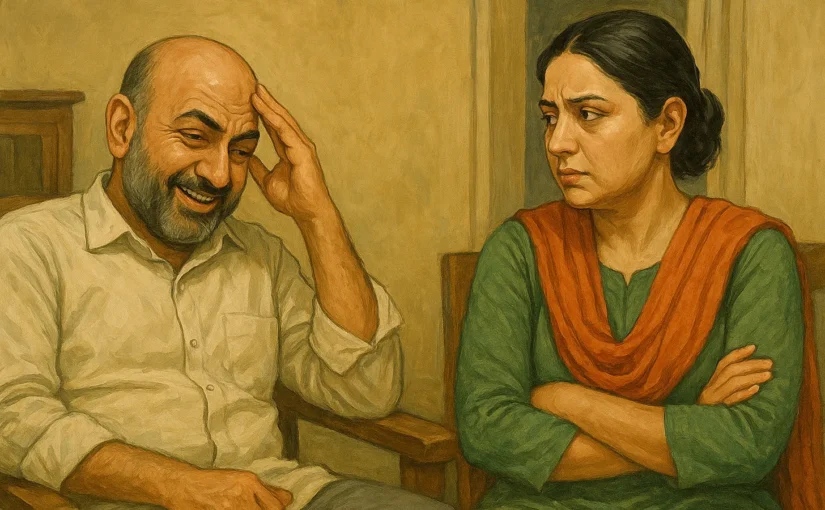
Last week, I shared the first part of my translation of Aasiya, a story from Bilal Hasan Minto’s Urdu short story collection Model Town.  Today, I am posting the second part of the story.


Abba and Naveed Bhai were very angry when they heard this story. Because Abba was an advocate of human rights and other similar causes, he said categorically he would report Apa Sughra to the police. Naveed Bhai agreed.

“This is criminal,” Abba had said in English and his use of this admirable language of global importance impressed me very much and drove home the real significance of this incident. Although I was still hesitant to speak English, I had no doubt of its position. Naveed Bhai also spoke it with great fluency. He would often converse even with me in this important language and it is true that I would sometimes respond spontaneously in it.

“She should go to jail,” Naveed Bhai said, putting English to use again. Continue reading Aasiya (Part 2)–Translation from the Urdu

Aasiya–Translation from the Urdu

Here is an excerpt from another story from Bilal Hassan Minto’s Model Town:

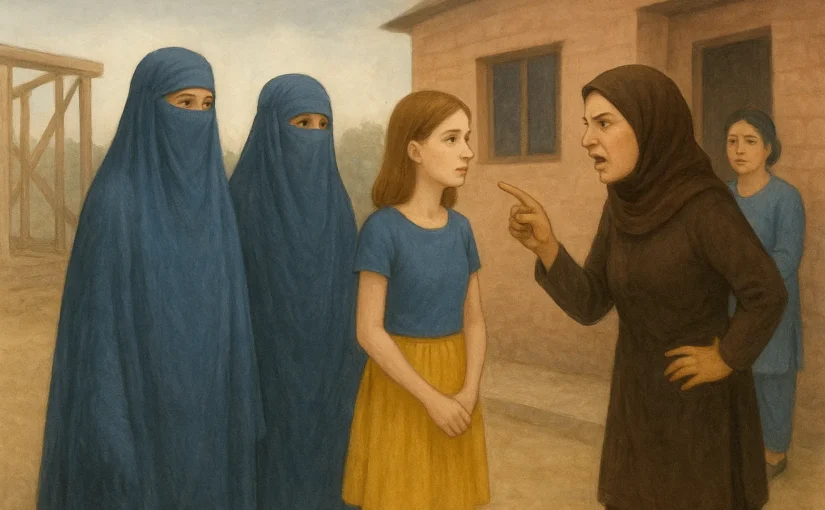
There are people who might have felt the neighborhood was against Apa Sughra  just like that, without a reason. They could have wondered how anyone could be against a woman so devout that she had fired her cleaning lady Alice on a matter of principle when she found her drinking water from glasses reserved for Apa Sughra’s Muslim household. A woman so righteous that she had summarily dismissed Susan because her husband supplied alcohol to a Muslim. But such people who question our hatred of Apa Sughra are ignorant of the facts.

We had not always been against her. When she rented the house next door, Ammi sent her both meals that first day because her kitchen wouldn’t be ready. So obviously, we hadn’t hated her from the very beginning. Quite apart from all the terrible things we found out later, what she did to her own daughter Pari, soon after moving to our neighborhood, was enough for us  to condemn her, vilify her, and treat her with hostility. Pari was not at all to blame for the incident. Whoever heard of it said “What did the poor girl do wrong?” Naveed Bhai had been really angry and said Apa Sughra needed to be taught a lesson but Ammi strictly forbade him, saying there was no need to mess with that witch. It’s a different matter that I suspected Naveed Bhai didn’t have any way to do anything to Apa Sughra even if Ammi hadn’t said so. I thought he was just boasting.

Ever since Apa Sughra began living in our neighborhood we had noticed she didn’t allow her twin daughters, Fari and Pari, out of the house at all. Meeting us was out of the question; they weren’t even allowed to play with the neighborhood girls. We always thought the poor things were locked in the house after school. What did they do all day? Did they play with each other or was that not allowed either? And if they were so constrained, why did Apa Sughra even send them to school? Why was she educating them? Continue reading Aasiya–Translation from the Urdu

Doctor Walter (Translation from Urdu)

During the pandemic, I experimented with translating Bilal Hassan Minto’s Model Town (Sanjh 2015)—a collection of Urdu short stories told from the perspective of a preadolescent boy growing up in Lahore’s Model Town neighborhood during the late 1970s (at the beginning of General Zia’s Martial Law). This was my first attempt at translation so I’m not sure how successful it was but I did learn a lot from the attempt.

The story I’m sharing here is called “Dr Walter”. One of the main themes of the story is the discrimination faced by minorities in Pakistan (in this case Christians).

When the Walters’ house was going up, we — Talat, Aqib, Qamar, Mazhar and I — hung around the construction site in the evenings and romped on the sand and gravel piles. At the time, most houses in Model Town had been built by Hindus before the Partition and abandoned when they fled in disorder to India so that some Muslim, trying to take over their houses, or for no reason at all, wouldn’t behead them or sprinkle oil on them and set them on fire or stab them in the stomach with a sharp knife. This precipitous departure left many unclaimed plots on which new houses were built from time to time. When construction of the Walters’ house began near us, a minor frisson of excitement entered our slow-moving lives.

Horsing around, boring tunnels in the sandpiles, Mazhar had asked a laborer:

“Whose house is this?”

“Sai,” he had said, meaning “Isai.” Christians. People who follow Jesus Christ as first among the Prophets of God, just as the Jews consider Moses. Well, what someone believes or not and why are mysterious and dangerous things about which I can’t say anything, but even before the laborer told us, we had a sense that these people were of some other religion because several signs suggested they weren’t our sort.

At this time, the obnoxious General Zia had not descended on our country like a curse and new revelations about our religion, Islam, hadn’t begun to mushroom. No one in their wildest dreams could have imagined that prayers would become mandatory in offices or that women wouldn’t be able to appear on television without covering their heads, or that punishments would be meted out to people seen eating or drinking during Ramzan. And, more surprising than all these, that every day, before the entire country, news on TV would be delivered in Arabic. All this was about to happen, just some days after the Walters built their house near us. Continue reading Doctor Walter (Translation from Urdu)

The River Cannot Go Back

I wanted to share something that floored me. Through Sahil Bloom, I came across this poem by Kahlil Gibran, and it struck me with its simplicity and depth. As an aside, it is worth remembering that Gibran was deeply inspired by Ê»Abdu’l-BahĂĄ, whose vision of unity and spiritual renewal touched many thinkers and artists of his time.

For the Commentariat, it’s worth noting that one of the 20th century’s greatest poets had Muslim antecedents: Gibran’s maternal great-grandfather converted from Islam to Christianity, a reminder that conversion did happen, and that traditions were more porous than the common perception that “Muslims can never leave Islam.”


The River Cannot Go Back

It is said that before entering the sea

a river trembles with fear.

She looks back at the path she has traveled,

from the peaks of the mountains, Continue reading The River Cannot Go Back

Why Indian English Loves Long Sentences

If China endured a century of humiliation, India has lived through a thousand years of it. Invasions and exploitation left it poor in wealth but rich in culture; intricate, adaptive, and resilient. That depth shows in Desi English, which often favours long, ornate sentences over plain ones.

This habit echoes Persian’s former role in the subcontinent: a prestige language whose mastery signalled rank. Even Ghalib’s vast Persian verse drew less love than his Urdu. In India, Persian was the colonial language of power; today, English plays that part.

In Iran, Persian changes fast. Slang, borrowed terms, and foreign tones reshape it so quickly that many in their forties struggle with teenage speech. My own Persian, kept alive in Kuwait and India, is closer to Shirazi and Tehrani standards than to the language my ancestors spoke. I’m self-conscious with Iranians, but with diaspora Persians, I speak freely; we share a looser, accented form of speech. Continue reading Why Indian English Loves Long Sentences

Brown Pundits