
Review: In the City of Gold and Silver by Kenize Mourad

In the spirit of discussing Indian history, I am sharing this book review of a fictionalized biography of Begum Hazrat Mahal.  The author, Kenize Mourad, comes from a fascinating background. Her mother, Selma Hanimsultan, was the granddaughter of Murad V, Sultan of the Ottoman Empire. Her father was Syed Sajid Hussain Ali, the Raja of Kotwara. 

Kenizé Mourad’s In the City of Gold And Silver is a fictionalized biography of Begum Hazrat Mahal (c.1820-1879), one of the wives of Nawab Wajid Ali Shah (1822-1887), the last ruler of Awadh –one of the major North Indian princely states. After the British deposed Wajid Ali Shah and annexed the state, Hazrat Mahal became one of the major leaders of the Revolt of 1857 . She had her eleven-year-old son, Birjis Qadir, crowned king and took on the role of regent (who would rule until the sovereign attained the age of majority). Although the rebellion was ultimately defeated and Hazrat Mahal died a prisoner in Nepal, she is remembered today as a major figure in Indian nationalist history.

Mourad’s novel does an excellent job at evoking the atmosphere of Awadh during 1856-1858: the crucial period in which the state was annexed and the rebellion occurred. As the novel begins, the ladies of the court are staging a play satirizing the British. The narrative then flashes back to Hazrat Mahal’s childhood as an orphan and details how she was trained as a courtesan and then became part of the Nawab’s harem. However, the bulk of the book takes place during the Rebellion and describes the various battles fought with the British. The Nawab himself is a minor character since he had been exiled from Awadh and spent most of this period imprisoned in Fort William in Calcutta. While it is not a major part of this novel, Wajid Ali Shah is an enormously important figure in the development of Hindustani Classical Music, particularly in the genres of thumri and kathak. In fact, his devotion to music was one of the justifications that the British gave for annexing Awadh, deeming him unfit to rule. Continue reading Review: In the City of Gold and Silver by Kenize Mourad
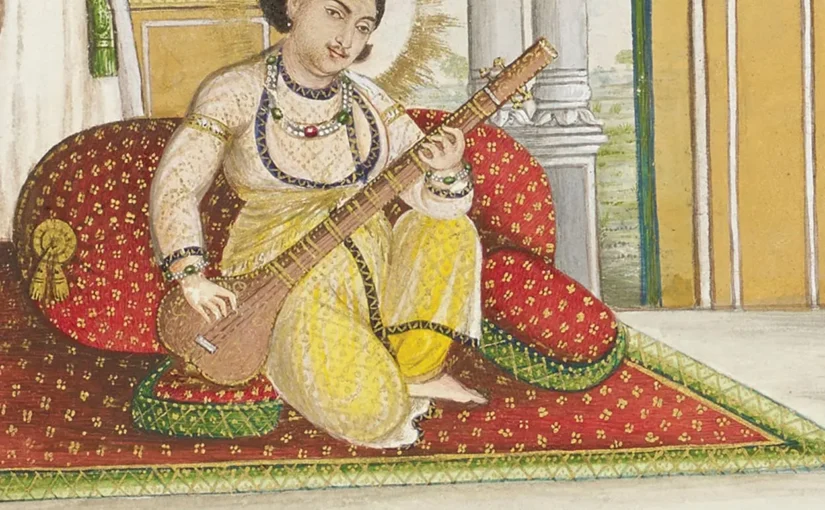
Review: The Scattered Court: Hindustani Music in Colonial Bengal by Richard David Williams

In an attempt to shift the focus from geopolitics, I am sharing this review of a book by Richard David Williams (my professor at SOAS). 

This piece was originally published in South Asia Multidisciplinary Academic Journal (SAMAJ) in January 2025. 

Richard David Williams’s The Scattered Court: Hindustani Music in Colonial Bengal examines the Calcutta-based court-in-exile of Nawab Wajid Ali Shah (1822-1887), the last ruler of Awadh who was deposed by the British in 1856. The book is based on Williams’s doctoral thesis “Hindustani music between Awadh and Bengal, c. 1758-1905.” It develops a social history of how Hindustani classical music and dance responded to the transition from the Mughal Empire to British colonialism. Using previously unexplored sources in Urdu, Bengali, and Hindi, Williams aims to demonstrate the importance of Wajid Ali Shah’s exile in Calcutta in enabling the rise of that city as a celebrated center of Hindustani music. As he writes in the introduction:

Establishing the connections between Lucknow in Hindustan and Calcutta in Bengal challenges the notion of distant, regional performance cultures, and underlines the importance of aesthetics and the performing arts to mobile elite societies. Since Lucknow is associated with late Mughal or nawabi society, and Calcutta with colonial modernity, examining the relationship between the two cities sheds light on forms of continuity and transition over the nineteenth century, as artists and their patrons navigated political ruptures and social transformations (p. 3).

Most previous studies of Wajid Ali Shah treat his thirty years of exile as a footnote to the culture of Lucknow.1 In contrast, Williams focuses on the court-in-exile at Matiyaburj (located in southwestern Calcutta) in order to examine the impact of the nawab’s presence in Calcutta on the development of Hindustani music in Bengal. He examines the circulation of musicians between the transposed court and musical soirees in North Calcutta. Through his reconstruction of musical life at Matiyaburj, Williams demonstrates that the nawab’s musical innovations continued in Bengal and that he was engaged with his surrounding environment—for example, by composing lyrics in a mixed Bengali-Hindustani register. Continue reading Review: The Scattered Court: Hindustani Music in Colonial Bengal by Richard David Williams

Brown Pundits