Following piece about recent clouds on Pakistan’s scene was mainly for non-Pakistani audience as many questions/confusions came my way.
This is an attempt to understand the view from barracks although I strongly oppose such moves from military. This is first of two part. Second part will deal with modus operandi.
Hamid
Political Engineering – View from the Barracks
Hamid Hussain
In July 2017, disqualification of Pakistan’s Prime Minister Mian Nawaz Sharif by Supreme Court again opened the debate about the role of country’s powerful army. This was one of the most politicized decision of country’s Supreme Court. In April 2017, Supreme Court not only ordered formation of a Joint Investigation Team (JIT) but went ahead and nominated its members. It included a serving Brigadier Kamran Khurshid of Military Intelligence (MI) and a retired Brigadier Nauman Saeed of Inter-Services Intelligence (ISI). Supreme Court disqualified Sharif based on JIT investigation. In the aftermath of Sharif disqualification, many political changes including change of provincial government in Baluchistan achieved by defection of several members, defeat of government’s nominee for Senate chairman position and defection of many politicians from ruling political party Pakistan Muslim League (Nawaz) (PML-N) to rival Pakistan Terek-e-Insaaf (PTI) were alleged to be orchestrated by the army brass.
A recent BBC report discussed how contractors employed by ISPR (Inter-Services Public Relations, the media arm of the Pakistani armed forces) monitor and harass people who are perceived as being disloyal or anti-military. Today I saw an email from a friend who is a very patriotic Pakistani with mainstream (pro-democracy) views, who was just kicked out of an “elite” Whatsapp group because the group admin was under pressure from “sources”. I am excerpting the relevant part of the email here with his identity removed; to me the interesting part is that this is a relatively small group of people, and they are not Left wing activists or ethnic nationalists or starry eyed peaceniks, they are mostly bankers and Westernized members of the elite, deeply committed to Pakistan and the idea of Pakistan.. that someone was looking at them and making specific requests to remove members is a new and rather extreme step in the spread of XiJinping thought in Pakistan..
“Yesterday, this member-moderator along with two others became its victims when we were unceremoniously removed from a so-called “prestigious” WhatsApp group of “who’s who” by its moderator without notice or assigning any reason. Our sin? Arguing against the Miltablishment’s policies in the context of Nawaz Sharif’s interview. One member out of 250 in this WhatsApp group took a principled stand by voluntarily opting out in our support. Some other members I understand are writing in our defense. Surprisingly, those Miltablishment supporters who had initiated the debate on this issue (Nawaz Sharif’s interview) and had used the filthiest and most polarizing of languages against the group’s stated policy were neither touched nor even reprimanded.
The moderator of this WhatsApp group subsequently and reportedly explained to someone that “continuous bashing of military (sic)….was landing the group in trouble” and that “he was under pressure from some quarters” to take action (remove the members) – this could be a reference to outside monitors (intelligence agencies) or inside die-hard supporters of Miltablishment. Either way, the thought-police is out in full force. If a WhatsApp group of 250 is monitored, the power of the Miltablishment is complete and total.
Having come back to the country after X-years, I have been incredibly saddened and depressed at the strident polarization one is a witness to. No one is listening to the other side and temperatures are as high as I clearly remember they were at the time of military action in Bangladesh in 1971, when a brother was pitted against a brother..”
An extract from the BBC report (which is worth reading in its entirety):
By establishing the email address associated with the metadata of the document, Amnesty researchers traced it to an Islamabad-based cyber security expert, Zahid Abbasi.
When confronted by the BBC, Mr Abbasi confirmed he had previously worked for a year for the Pakistani military’s public relations team (ISPR) and that the document was genuine.
He admitted his role included tracing the IP addresses of “people abusing institutions” online and “compromising their accounts” by, for example, sending them fake Facebook login pages.
On 20th January, 1972, Chief Marshal Law Administrator and President of Pakistan—Mr. Zulfiqar Ali Bhutto—called a meeting of the country’s most eminent scientists in Multan. Pakistan had faced the ignominy of terrible defeat at the hands of Indian army a few months ago. Mr. Bhutto asked the scientists to start working on assembly of a nuclear bomb. While the experienced heads declined to commit to this venture, younger scientists unanimously responded that it could be done in five years. Mr. Bhutto was satisfied by the response and promised his help.
In July 1974, a letter arrived at the Prime Minister’s(Mr. Bhutto’s) secretariat from the Netherlands. The correspondent claimed to be a physicist working for a European nuclear consortium. He claimed to have obtained blue prints for a revolutionary new process involved in building a nuclear bomb. The person, let’s call him AK, was working as a technical translator for the multinational URENCO consortium. He had claimed in his letter of ‘writing innumerable research papers and an internationally renowned book’. Son of migrants from the Indian state of Bhopal,AK had been living in Europe for 13 years and was passionate about ‘debates about the Hindu ba**ards over the border who had ransacked his old home in 1947’. Mr. Bhutto tasked an Intelligence Agency to investigate the whereabouts of this mysterious scientist named AK. It was found that he had worked as Inspector of Weights and Measures for the Karachi post office in the 1960s, after obtaining a science degree from Karachi University. He left for West Germany for further studies and received an offer to attend a series of introductory lectures in Metallurgy in September 1962, by West Berlin Technical University. He moved, with his newly married wife, to Holland in 1963 and continued his education at Delft University. In his spare time, he used to write letters to European Newspapers and magazines that he felt had misrepresented Pakistan.
Mr. Bhutto was satisfied by AK’s track record and invited him to start the process of assembling a nuclear bomb for Pakistan. He was provided a laboratory to run and unlimited funding as well as official patronage. After smuggling different parts required for building the bomb from a plethora of countries, through not-so-legal channels, AK succeeded in completing the crucial step in manufacturing a nuclear bomb. The rest of hard work was done by Pakistan Atomic Energy Commission (PAEC), an organization that AK hated with a vengeance.
By this time, AK had developed an acute case of megalomania. AK’s psychiatrist at that time, Professor Haroon Ahmed mentioned in his reports that by this time, ‘he was suffering from depression, and was classically manic’. He used to boast, “Jinnah Built Pakistan but I saved it”. AK even had an intelligence team follow his Dutch Wife and daughters because he thought they were more loyal to Europe than they were to Pakistan. In 1984, he called a reporter at a local Urdu digest and asked him to send a list of questions for interview. He was so disappointed with the list that he threw it away and drafted his own set of questions. He asked himself: “What do you think was your greatest achievement?” and “Did the government recognize your contribution?” In February 1984, he called Nawai Waqt and used the same formula. He used to give charity to mosques and schools, all of which had to bear his name as ‘testimony to his greatness’. In 1986, he invited a journalist from a small-circulation weekly digest called Hurmat to interview him at his laboratory. It resulted in a series of articles and a biography full of accolades for Mr. AK. One of the articles echoed AK’s inner thoughts as “In order to overcome the energy crisis in Pakistan,
the Pakistan Atomic Energy Commission should be overhauled and its leadership should be handed over to this Mard e Momin of Iqbal”.
After Pakistan’s requirements for nuclear materials were fulfilled, AK started selling different parts as surplus to the highest bidder. He chose first Dubai and later Timbuktu as his operational base for nuclear proliferation. The Afghan War prevented United States to clamp down on his activities but the noose started tightening in the 90s. His footprints were all over the nuclear proliferation racket around the world, from Libya to Iran to North Korea, earning him the nickname “Typhoid Mary of Nuclear Proliferation”. In 2001, Musharraf was forced by the International community to get rid of AK and his crime syndicate, after two of AK’s ex-colleagues were found to have travelled to Afghanistan and met Osama bin Laden (OBL) there. Intelligence sources in India and US allege that AK co-owned Al-Shifa chemical factory in Sudan with OBL and OBL had financed construction of Hendrina Khan Hotel in Timbuktu. In 2004, AK apologized to the nation in a televised address for his “errors of judgment related to unauthorized proliferation activities”. Musharraf noted in his memoir, “The truth is that he was just a metallurgist, responsible for only one link in the complex chain of nuclear development. But he had managed to build himself up into Albert Einstein and Robert Openheimer rolled into one”.
The arrogant “Father of the Bomb” started writing elementary- school-style essays for a national newspaper few years ago, continuing his crusade against common sense and reason. He has made hundreds of factual errors in his “columns” over the years along with an attempted whitewash of history. His most recent diatribes have been directed against chairman of PAEC Munir Ahmed Khan and Dr. Abdus Salam, Pakistan’s only nobel laureate. AK has accused them of selling Pakistan’s nuclear secrets while comfortably ignoring his own efforts to sell the same secrets to the highest bidder.Without efforts of these gents, technicians such as AK would have miserably failed in the quest for nuclear bomb.These inneundos amount to slander and should be challenged in a court of law. Or perhaps, people living in stone houses should avoid throwing stones at others?
(previously published by The Nation. https://nation.com.pk/11-Aug-2014/father-of-the-bum)
(Originally published at Naya Daur, whose website was blocked by PTA in Pakistan a day after this was published).
“In every country, the textbook is the primary implement of education at the school and pre-university stages of instruction. In Pakistan, it is the only instrument of imparting education on all levels, because the teacher and the lecturer don’t teach or lecture but repeat what it contains and the student is encouraged or simply ordered to memorize its contents. Further, for the young student the textbook is the most important book in his little world: he is forced to buy it, he carries it to the classroom every day, he has to open before him when the teacher is teaching, he is asked to learn portions of it by rote, and he is graded by the quantity of its contents that he can regurgitate.”
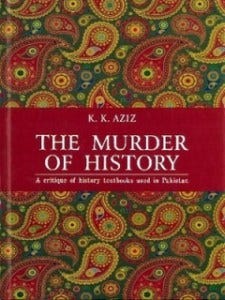
This was how Pakistani historian K.K. Aziz started his groundbreaking work The Murder of History: A critique of history textbooks used in Pakistan. The book was published 25 years ago (in 1993) and the only change in the role of textbooks since then is that provinces were granted the right to formulate their own textbooks under the 18th amendment to the Constitution. Another significant change in the last two decades has been the mushrooming of private schools that use textbooks different from the official ones.
History doesn’t start with Muhammad bin Qasim
While textbooks for natural science subjects — like Physics, Chemistry and Biology — or those pertaining to language studies are less likely to form a child’s worldview, textbooks for history and “social studies” (a mixture of history, civics and geography) are supposed to be the first step toward a social conscience.
In the textbooks that my father’s generation studied, history textbooks did not start with the year 712 A.D., when Muhammad bin Qasim invaded Sindh. They contained history of the Indian Subcontinent before that particular event. They were also devoid of chapters devoted to the ‘Ideology of Pakistan’ and other such vague ideas.
But the distortion of history in Pakistan started as soon as the country came into being. On the 17th of August, 1947, a mere three days after Independence, an article written by Mr. Abdullah Qureshi was published in national newspapers, titled “Textbooks of History and Need for Reform”.
The atrocity that was Abdullah Qureshi
In that article, Mr. Qureshi argued, “The person who knows the Islamic history accurately, would prove to the best citizen of Pakistan. He will not commit any act against the state of Pakistan. His heart would be filled with love for Islam and Muslims and he would not even think about treason. In my view, it is imperative that history of Muslims should be popularized as it will lead to strengthening Pakistan. Every citizen should be made aware of Glorious Islamic Traditions. Every Citizen should be reminded that straying from National Interest would lead to destruction of the Nation.”
He further wrote, “The history that is taught to our children in schools is not factual. It is based on propaganda spread by the British and it serves to justify British Imperialism. It is based on personal biases of British Historians. As a result, worthless events have been presented as glorious occasions. It promotes a false Hindu-Muslim parity, while the fact is that before arrival of Muslims, Hindus did not have any authentic history or collection of traditions. Due to need of the hour, British historians concocted false narratives to appease the Hindus.”
The British periodized Indian history
Now it is interesting to note that Mr. Qureshi rails against the biases of British historians, and yet, falls back on a form of Indian historiography invented by them. After all, as Dr. Mubarak Ali wrote in an article:
“The periodization of the Indian history as the Hindu, the Muslim, and the British was not done by any Hindu historian but by a British historian, James Mill, the author of the “History of British India”. He intentionally divided the history on religious basis, but did not call the British period a Christian period in order to keep a secular outlook, and to maintain a balance between these two opposite religious communities. This periodization is challenged and severely criticized by a Hindu Historian [sic], Romila Thapar. In India, historians no more use these terminologies whereas in Pakistan historians persist to use them”
Following the debacle of 1971, textbooks were modified to rationalize the separation of East Pakistan as a ‘Hindu Conspiracy’
Nevertheless, the project of historical revisionism proposed by Abdullah Qureshi was, indeed, put into motion in Pakistan.
Distortion of History to rationalize the Fall of Dhaka
K.K. Aziz analyzed history textbooks written during the period 1960–1990 and he found factual errors in most of these books. Distortion of history had started soon after Independence but the particular ideological tilt that we are today most familiar with started in the 1970s. Following the debacle of 1971, textbooks were modified to rationalize the separation of East Pakistan as a ‘Hindu Conspiracy’. This obfuscation was intended to whitewash the atrocities committed upon Bengalis starting from 1947.
Zulfikar Ali Bhutto came to power amidst political confusion with an Islamic socialist programme, promising to build a new Pakistan and to address the economic and political issues facing the country at the time. The result was an over-emphasis on a separate “Pakistani identity” and a new description of “the enemy” so as to unify the nation. The strategic use of Islam in education policy started during the era of General Ayub Khan and continued during the Bhutto period.
Manufacturing a false pride?
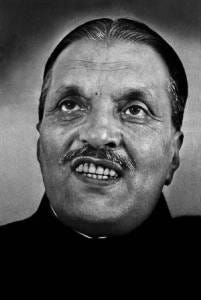
Gen Zia ul-Haq — PC: Dawn.com
The worst of the rot truly set in during General Zia-ul-Haq’s regime during the period 1977–88. Dr. Parvez Hoodbhoy and A.H. Nayyar mention in their book “Rewriting the History of Pakistan” in Islam, Politics and the State: The Pakistan Experience (published in 1985):
“In 1981, General Zia-ul-Haq declared compulsory the teaching of Pakistan studies to all degree students, including those at engineering and medical colleges. Shortly thereafter, the University Grants Commission issued a directive to prospective textbook authors specifying that the objective of the new course is to ‘induce pride for the nation’s past, enthusiasm for the present and unshakeable faith in the stability and longevity of Pakistan’. To eliminate possible ambiguities of approach, authors were given the following directives:
To demonstrate that the basis of Pakistan is not to be founded in racial, linguistic, or geographical factors, but, rather, in the shared experience of a common religion. To get students to know and appreciate the Ideology of Pakistan, and to popularize it with slogans. To guide students towards the ultimate goal of Pakistan — the creation of a completely Islamised State.
Islamization of Science books
As a result of this ideological onslaught, even the books of science were “Islamised”. Specific chapters have been dedicated in books of Physics, Chemistry and Biology, introducing young students to Muslim Scientists. Most of these “Muslim Scientists” were a product of the Mu’tazilla tradition in the medieval period, a fact that is not included in any of the introductions.
Any effort to reform the current textbooks should ideally cleanse all the waste material that the books have accrued in the last 65 years.
The ideological propaganda that has plagued the textbooks has also contributed to a confused state of mind among the next generation of Pakistan. It is not a co-incidence that according to a survey of educated youth by Pakistan Institute for Peace Studies, “A sizeable percentage of the survey population believed that religion should be the only source of law in Pakistan.”
How distortion of History begets fundamentalism
The British Council released a report in November 2009 titled “Pakistan: The Next Generation” focusing on issues surrounding the youth in Pakistan. The report also noted, worryingly, that “Disillusion with democracy is pronounced. Only around 10% respondents have a great deal of confidence in national or local government, the courts, or the police. Only 39% voted in the last election.” Another report by the British Council in 2013 mentioned that “38% respondents expressed a desire for implementation of Shariah as opposed to parliamentary democracy with 29% respondents opting for continuation of Democratic system.”
Confusion has led to identity crisis
Any effort to reform the current textbooks should ideally cleanse all the waste material that the books have accrued in the last 65 years. It is expected to be a Herculean task and it requires a great deal of willingness from the provincial governments.
The insertion of exclusionary modes of thinking and petty ideological narratives in textbooks has resulted in the emergence of a confused, disillusioned and restless educated class of Pakistanis. Textbooks have become a contested space for ideological skirmishes in the last few decades. The educated youth of Pakistan faces a dilemma when confronting realities on the ground — because they have been taught a very different narrative. This national confusion has led to a widespread identity crisis.
Meanwhile, in an Islamiyat textbook for undergraduate students in Punjab, the introduction to the book states, “Pakistan is an ideological state. It has been founded on the pattern established in Madinah.”
According to a Pakistan Studies textbook used in Punjab, something known as “Nazriya Pakistan” (Ideology of Pakistan) is based on Islam, which itself is claimed to be a complete code of life.
In an Islamiyat textbook for undergraduate students in Punjab, the introduction to the book states, “Pakistan is an ideological state. It has been founded on the pattern established in Madinah.”
A sociology textbook for the Intermediate level in Punjab paints the Baloch people, citizens of Pakistan, as ‘looters’.
These are but a few examples of the pernicious ideological conditioning that these textbooks perform.
ANP’s improvements to curriculum in KP rolled back by PTI
In the aftermath of the 18th amendment, provincial governments were provided an opportunity to make amends. In the case of Khyber-Pakhtunkhwa, the Awami National Party (ANP) government during 2008–2013 made some positive changes in the curriculum — driving the focus away from religious militarism towards an ideal of coexistence and peace. But, following the rise to power of the Pakistan Tehreek-e-Insaf (PTI) government in that province, most of those gains were reversed under the influence of religious parties allied to the PTI.
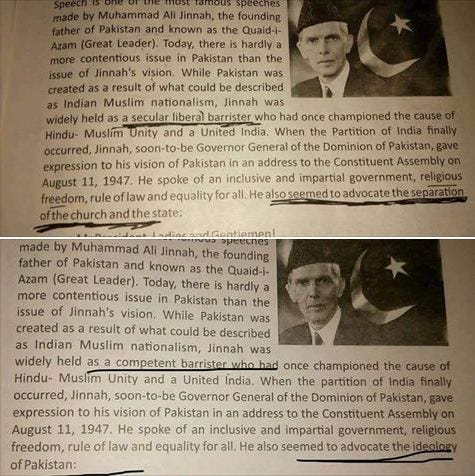
The upper one is a picture of a KP textbook from ANP era, terming Jinnah a ‘secular liberal barrister’ who ‘also seemed to advocate the separation of the church and the state’. Below is the current version of the same book where the ‘secular liberal’ has been replaced by ‘competent’ while ‘separation of the church and the state’ has been replaced by ‘ideology of Pakistan’. — Picture courtesy: Omer Qureshi
In Punjab, according to Dr. Hoodbhoy, textbooks have been “improved considerably”, moving beyond some of the worst dogma. One hopes that this experiment is implemented nationwide and Pakistan’s next generation is taught according to the finest international standards of education — where there is little room for deliberately conditioning young students into authoritarian, theocratic and racist mindsets.
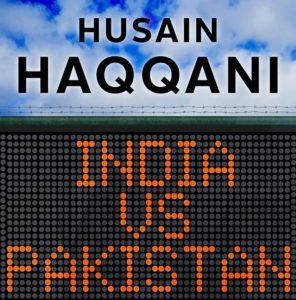
I was recently asked by AnAn to write a detailed post about Mr. Hussain Haqqani (henceforth HH) and his three books that I’ve read. I find it difficult to write about someone who is still active in his field of work and someone who arouses so much anger and partisanship among the commentariat in Pakistan. I decided to write about things that I know definitively, publicly available information about him and testimonies from two reliable witnesses about HH and then briefly discuss the three books (Pakistan: Between Mosque and Military, Magnificient Delusions and India vs Pakistan: Why Can’t we just be friends) that I’ve read (I just started reading his fourth one, ‘Reimagining Pakistan’). It is hard to label HH as a turncoat or opportunist because most major politicians in Pakistan changed course in their political life starting with Zulfiqar Bhutto, followed by Mian Nawaz Sharif, Benazir Bhutto(BB) and Imran Khan. People and their ideas evolve or else, they are ossified and become part of history while they are alive (Exhibit A: Most of the left-wing politicians of Pakistan).
HH comes from a Muhajir family based in Karachi and went to Karachi University where he was an active member of Islami-Jamiat-Tulaba (IJT), the student-wing of right-wing, religio-political party, Jamaat-e-Islami (JI). He claimed in Magnificient Delusions that he stopped students from burning down the American Consulate in Karachi in 1979 when Grand Mosque in Mecca was seized by ultra-Wahabi rebels and the conspiracy theorists put the blame on the US initially (the Embassy in Islamabad was burnt down by a mob of students). His claim has been debunked by several members of IJT at the time. He worked as a journalist for a few years after graduation. In the late 1980s, he was a media-consultant for Nawaz Sharif, the center-right politician from Punjab who rose to prominence as Punjab’s finance minister under General Jilani’s governorship (1980-85) and later served as the Chief Minister of Punjab (1985-90). Nawaz Sharif was part of an Islamist alliance, Islami Jamhoori Ittihad (IJI) which opposed Benazir Bhutto’s Pakistan Peoples Party (PPP) in the 1988 elections. It is beyond doubt that the character of Benazir Bhutto and Nusrat Bhutto was mercilessly attacked during the election campaign. Helicopters were used to throw fliers over major cities in Punjab with explicit photos of the Bhutto ladies to malign their reputations. According to witness number 1, he saw HH in New York during that campaign where HH was offering nudes of Benazir Bhutto to anyone who was interested to see them. IJI still couldn’t win the federal election and ended up winning in Punjab, where Nawaz Sharif assumed the Chief Minister-ship.
Due to Palace intrigues and constant bickering between Punjab and the Federal Government and unrest in Sindh, BB’s government was dismissed by Ghulam Ishaq Khan, the President, after twenty months. In the ensuing elections, IJI succeeded in winning the election (there was massive rigging taken place on orders of the Presidency and funds were distributed to various IJI politicians, details of which can be found by googling ‘Mehran Bank Scandal’). HH served as Sharif’s spokesman till 1992 until he was sent to Sri Lanka as Pakistan’s ambassador. In 1993, the Sharif Government was dismissed by President Khan (with prodding and backroom deals by BB and Co). HH flew back from Sri Lanka and became a spokesman for the BB government that followed (1993-1996).
In 1996, the second BB government was dismissed by President Laghari and Nawaz Sharif’s party started ruling again. It was toppled during October 1999 and General Musharraf became the ‘Chief Executive’ of Pakistan. According to witness number 2, he saw HH begging Musharraf (or one of his generals) for the Information Ministry. The request was denied and HH spent a few years running a consultancy. In 2002, he arrived in Washington DC, as a guest of Carnegie Endowment for International Peace. In 2004, he joined Boston University as an Associate Professor of International Relations. He also headed a project by Hudson Institute on Islam and Democracy. Post-9/11 was a time in which the issue of Islam and Democracy was selling quite well in the ‘West’.
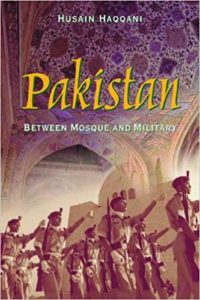
In January 2005, ‘Pakistan: Between Mosque and Military’ was published. It is a very good book detailing the history of Pakistan and the Mullah-Military Nexus that rules Pakistan today. The book was written with the help of Carnegie Endowment and the audience in mind was definitely American (with emphasis on post 9/11 understanding of Pakistan). It touches on all the relevant bases (quoting Ayesha Jalal, Khalid bin Sayeed, Margret Bourke-White, Stephen Cohen, Lawrence Ziring), the way Islam was used by Muslim League (and in certain instances, Jinnah himself) during the ‘Pakistan Movement’, the paranoia induced by newspapers and politicians about threats to Pakistan’s existence, the trifecta of Pakistan Ideology (Islam, Urdu, hostility towards India), suppression of dissent by ethnic groups using the tools of the Ideology (branding anti-state elements as anti-Islam is favored strategy even today), the way history was shaped from an anti-British perspective to an anti-Hindu perspective (since we got Independence from the British, not the Hindus), the first Kashmir War, the first Martial Law, attempts at a revisionist historiography, the disaster that was the 1965 war with India and so on. The book reveals very little new information (if you have read the liberal-secular version of Pakistan’s history) but is a very good collection of various liberal-secular and diplomatic sources and serves as a good primer on Pakistan’s political history. I’ve always maintained that HH’s writing is often much better than his politics or his past.
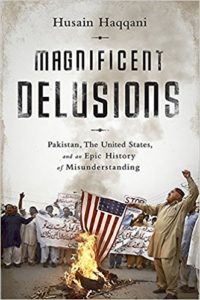
It is often said that Pakistan’s political landscape is dominated by 3 A’s (Allah, Army, and America). The discussion on US-Pakistan relations in the first book forms the basis of his second book, Magnificent Delusions. Four years ago, I wrote a couple of articles, titled ‘Good Ally, Bad Enemy?’ reviewing US-Pakistan relations with excerpts from HH’s second book alongside the works of Carlotta Gall, Gary Bass and Daniel Markey (1. here 2. here). I’ll mention some quotes from HH’s book that I used in those articles.
“Anti-western propaganda was often unleashed precisely so Pakistani officials could argue that the United States had to support Pakistan against India, so as to preserve its alliance with them. Few Pakistanis knew how much their country and its armed forces had become dependent on US assistance.”
‘James L. Langley, American Ambassador to Pakistan (1957-59) wrote, “Pakistan’s forces are unnecessarily large for dealing with any Afghan threat over Pashtunistan. Pakistan would be of little use to us should perchance worse come to worst and India go communist… One of the most disturbing attitudes I have encountered in the highest political places here is that the United States must keep up and increase its aid to Pakistan, and conversely, that Pakistan is doing the United States a favor in accepting aid, in addition to the Pakistani pro-Western posture in the Baghdad Pact and SEATO and the United Nations, when actually these postures are in part dictated by Pakistani hatred for India.”
“India’s Prime Minister at the time, Indira Gandhi, ‘tried to persuade [Henry] Kissinger to recognize the need for more robust US involvement. She said that Pakistan has felt all these years that it will get support from the United States no matter what it does, and this has encouraged an “adventurous policy.” India is not remotely desirous of territory, and to have the Pakistanis base the whole survival of their country on hostility to India was irritating.”
“When Zia was approached by an American diplomat who conveyed the anxiety on America’s part regarding Pakistan’s nuclear weapons development, Zia said: ‘I am an honorable man. We are an honorable people. I ask you to tell your President that I give him my word of honor as President of Pakistan and as a soldier, that I am not and will not develop a nuclear device or weapon.'”
In his third book, HH focussed on certain aspects of the thorny India-Pakistan relationship: History, Kashmir, Nuclear Bombs, and Terrorism. The book is peppered with anecdotes and is a useful read as a primer on the relationship and the difficulties therin. One gets the impression after reading the book that if it were left to the civilians, the two countries would have patched out most conflicts, however, Pakistan’s military and India’s diplomatic bureacracy took maximalist positions to thwart that ambition time and time again.
Why is HH so controversial in Pakistan now?
He was appointed Pakistan’s Ambassador to the US by the PPP-led government (2008-13). It was a turbulent time for Pakistan because barbarians were literally at the gates (Taliban in Swat and Al-Qaeda+TTP in Waziristan). HH has certain views about Pakistan that are not palatable for the military establishment/Deep State. Those views include his insistence on civilian supremacy in the country, deceptive attitudes towards the United States and over-reliance on religion in political discourse. In addition, HH was trying to be a conduit between Pakistan’s civilian government and the United States during his time as the Ambassador (as opposed to a majority of Pakistani Ambassadors to the US who are appointed only after a firm nod from the GHQ) and that irked the establishment even further. It was during his tenure that Osama bin Laden was found and killed in Abbotabad (May, 2011). HH, in an op-ed published last year in Washington Post (read here), took credit for helping the Obama administration in that endeavor (which, in light of Trump’s recent ascension to power, seemed an opportunistic move). Soon after the raid, a conspiracy theory was hatched by the Military Establishment in Pakistan implicating HH. It was alleged that HH had sent Admiral Mike Mullen a memo (on President Asif Zardari’s advice) through a shady in-between named Mansoor Ijaz asking for help from the US in case our generals tried to topple the government in the wake of the OBL raid. The case dragged on in the court and later, a judicial commission but the charge was not proven. HH had to resign as the Ambassador. He has since been at Hudson Institute. In recent years, he has started, with the help of another Pakistani-American, Dr. Mohammad Taqi, SAATH forum (South Asians Against Terrorism and Hatred) that gathers progressive voices in London every October to talk about the future of Pakistan. (Full disclosure: I have been invited to the last two versions of this forum but the first one i couldn’t attend because of visa refusal and the second because I was doing an internship in Houston at the time). I personally agree with most of his views regarding Pakistan but I think his name has been tarnished so much by the Deep State that it is hard to advocate for his name/ideas/books in Pakistan. I believe that he is worth-reading and worth-engaging. If only the military establishment could fight ideas with ideas instead of slander and mis-information.
P.S I have highlighted two events mentioned in the article that were based on stories shared with me by two people I have known for a while. HH presented his own version of events in two tweets last night (05/22/19). Here’s what he tweeted:
The piece contains some ‘I saw X do Y’ without cross-chekcing and is not accurate because of that. (https://twitter.com/husainhaqqani/status/1131390153400958977)
For example, witness no 1 claims he met in NY during 1988 election campaign. Browsing through my passports (all preserved since 1974) would reveal that I was never in US during that period. people lie for all sorts of reasons. That’s why corss-checking is so important. (https://twitter.com/husainhaqqani/status/1131391145546801159)
Witness 2’s claims suggest that he was present in meetings between Musharraf and I or between one of Musharraf’s minitsers and I. Again, should have been easy to verify veracity or lack thereof with a little effort. (https://twitter.com/husainhaqqani/status/1131395539835207680)
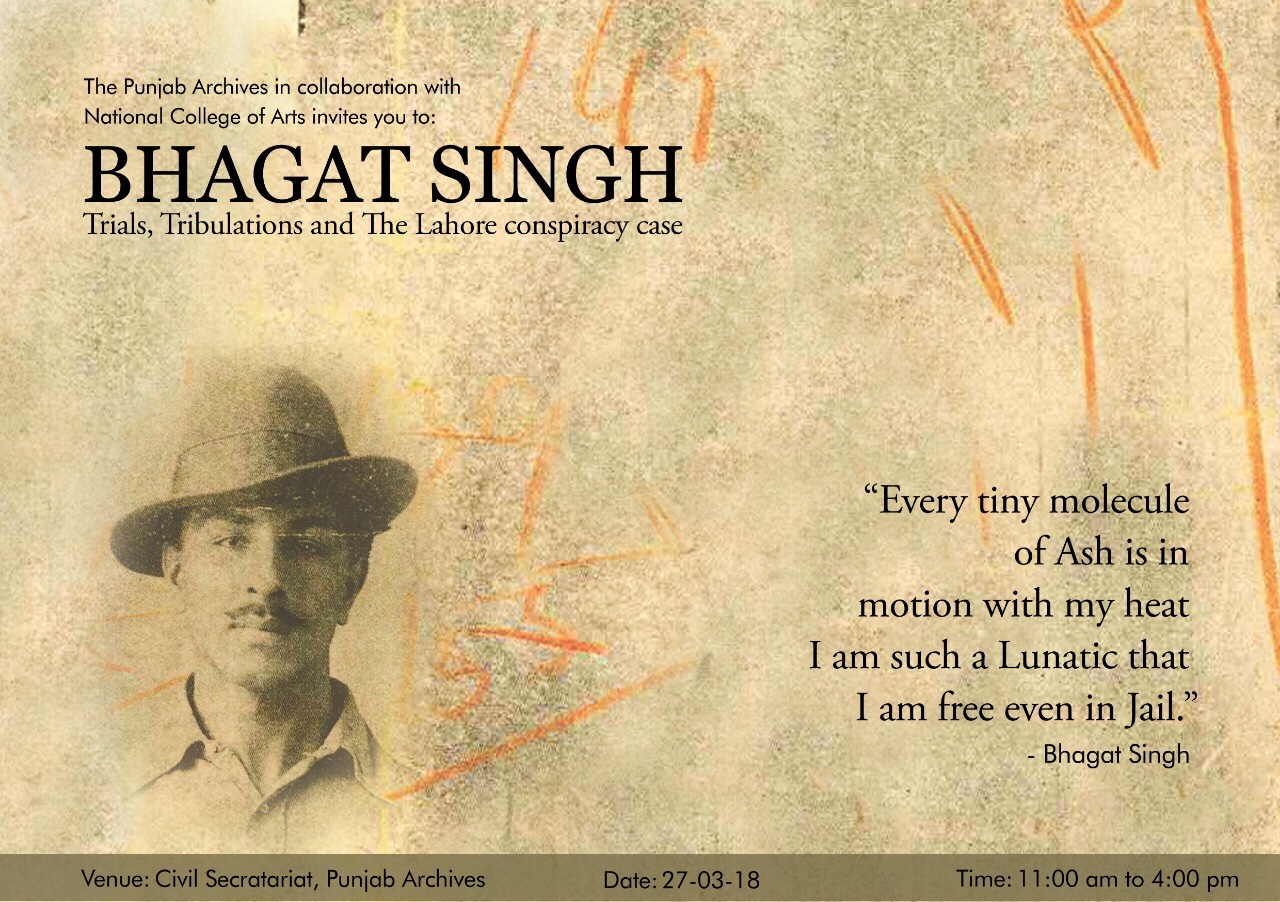
Good to see one of the greatest Lahoris honoured in Pakistan. It’s time Pakistan start to own its history (in a collaborative not confrontational way). I liked his saying though:
I’m responding to Kabir’s concerns that this blog is becoming far too Islam-focussed and not in a nice way.
I have been very busy so I’ve been following the threads quite lightly. Furthermore my perspectives are beginning to align online and offline (the advantage of blogging under your own name – difficult to troll).
So while I can appreciate why ethnic Pakistanis such as Kabir & myself may constantly refer back to Pakistan as a reference point, it’s becoming a bit obsessive on this blog.
If the whole point of Brown Pundits is for some commentators to bash Pakistan & Islam then that calls for introspection.
While there can be a healthy debate on whether the Islamic conquests, Partition and Islam are positive or negative influences on South Asia; the contention that Islam is the source of all misery is simply bunk.
Kerala, Tamil Nadu & Sri Lanka are probably the least Muslim regions in the Subcontinent since Islam was brought there by traders rather than conquerors. One could argue that it has much higher HDI than the rest of South Asia (Kerala & SL) but it hasn’t been all that more peaceful (Tamil politics in both countries has been turbulent).
One could of course counterclaim that the modern day polity of India was sullied by long periods of medieval Muslim rule. However Indonesia, Malaysia and even Turkey provide examples of very vigorous & even forward-thinking Muslim polities.
I’m not giving Islam or Muslims a clean chit but to dwell on them excessively, especially when one is not of the culture, smacks of Islamophobia. We have had some interesting discussions on Sri Lanka, caste politics, voting in Gorakhpur and other myriad topics however if the commentariat wants to obsessively continue to discuss Pakistan & Islam then let’s rename this blog to Paki Pundits so that we have a very clear focus..
A big ‘thank you’ to the boys at ISI & other instruments of authoritarian enforcement for helping with publicity for my book ‘Reimagining #Pakistan.’ Remember, release is on April 9. A case a day will be really good 🙏 https://t.co/EwGgBZtGo7
The year 2007 was eventful in Pakistan’s recent history. Political upheaval coupled with a rise in terrorism and a lawyers’ movement for the restoration of the judiciary gripped the country for most of the year. Musharraf, the military dictator, had forcibly removed the Chief Justice of Pakistan — sparking a movement led by lawyers across the country. Amidst all this kerfuffle arose a new band called ‘Laal’ with their song ‘Umeed e Seher’ (Hope for a new Dawn). The song became a sort of anthem for the lawyers’ movement alongside slogans against military dictatorship. The song was based on a poem written by Pakistan’s foremost progressive poet Faiz Ahmed Faiz and the band consisted of young academics who openly declared themselves Marxists. One of the band members was the General Secretary of a Communist Party in Pakistan. A communist party in Pakistan? That seems like an oxymoron, does it not?