
Kabir’s claim, is that much of the Saffroniate comes to Brown Pundits for one purpose: to litigate Pakistan, and to litigate the Muslim. Take that fixture away and the room goes quiet. The post on Hindustani classical music sinks without a ripple. The translated short story draws three comments and dies. Only the threads that arm the two camps against each other run to hundred+.
Is he right?
The Excuse for Failure
A people that can place the source of its troubles outside itself has bought something precious: a permanent excuse. The bribe demanded at the land-registration counter, the canal water that never reaches the tail-end farmer, the girl child wanted less than her brother, the stunted toddler in a country that exports grain, the sanitation worker still going down into the drain by hand in 2026. All of it can be referred outward, to a hostile neighbour and a treacherous minority, and so none of it need be referred inward. This is not an Indian disease alone. It is a human one.
So let us put the question to the only test that settles it, the counterfactual. Suppose Pakistan had never been cut out of the map in 1947. Suppose, harder, that there had never been a single Muslim in the subcontinent. Would caste dissolve? It would not. Caste predates Islam in India by more than a thousand years; it is ours, structural, home-grown, and it would outlive the disappearance of every mosque. Would the clerk return the bribe? Would the water reach the field? Would the daughter be wanted? Not one of these turns on the existence of a Muslim. To say otherwise is not analysis. It is an alibi dressed as an argument.
The Mythologisation against the Other
Here is the harder point, and Kabir’s critics will like it least. The unified Hindu identity that now speaks with such confidence is not as old as it believes itself to be. The civilisation is ancient, certainly: the temples, the Sanskrit and Tamil canons, the philosophical schools, the unbroken liturgies are the inheritance of millennia, and no one sensible disputes it. What is recent is something narrower and more political: the welding of a thousand jatis, sampradayas, languages and regions into a single bloc that votes as one, takes offence as one, and calls itself Hindu in the singular. That bloc is barely more than a century old, and it was assembled, in large part, against a foil.
A Bengali, a Tamil and a Marwari did not wake one morning feeling themselves one political people. They were made into one, and the making needed an other against whom the new self could be drawn. Precisely because the religion is old, people mistake the bloc for something equally old. The conflation is not an accident. It is the trick. Remove the foil and the construction sways. This is why the enemy can never be permitted to vanish. The enemy is not an obstacle to the project. The enemy is the essence of the project.
The Israel Parable
The exemplar is usually Israel: small, encircled, and rich. Asked to look inward, the nationalist looks outward yet again, this time for a model rather than a culprit. And even the model will not hold the weight he puts on it. Israel’s rise rested on a stack of external inputs no honest account omits: American underwriting on a scale extended to no other state, German reparations, a diaspora that arrived with capital and credentials already in hand, and successive waves of highly skilled immigration. Strip those away and the parable thins to very little. A nation may grow while defining itself against its neighbours. Whether it grows because of that stance, or in spite of it and on the back of other people’s money, is exactly the question the comparison is built to avoid. The dream, like the blame, has been outsourced.
The Saffron Liberal
We have never spared the Crescentiate here, and we will not start now: the regressive strain in that quarter is real, it is not a Western fabrication, and it has earned every word of criticism sent its way. But the Saffroniate liberal is a particular specimen, because his liberalism runs on a switch. It is summoned only when a Muslim is in the frame. The veil, the triple talaq, the treatment of women become matters of scalding principle. The same principle falls silent before the khap panchayat, the honour killing, the dowry death, the temple that still bars the menstruating woman at the door. A liberalism that activates only against the other is not liberalism. It is a stick that has been told it is a value.
The recent thread showed the mechanism with unusual clarity. A provocation was dangled, the bait was taken, and the comments filled. But watch what the inquiry then became. It became, entirely, an interrogation of how Islam treats its women.
Casting Stones
One does not expiate one’s own sins by casting stones at another’s. For a while it can feel like absolution: the stone is thrown and the crowd roars. But the sin sits exactly where it was, untouched, because nothing has been examined. A culture reforms only when it turns the interrogative eye inward, and inward is the one direction the externalising habit forbids.
Empire Comes for All
The Saffroniate, in its current form, has staked itself on Empire. It treats alignment with the great Western power as a kind of insurance, on the assumption that to stand beside the strong is to be kept safe by the strong. By a sharp irony, it is the traditionalist Muslim, the very figure paraded as the face of backwardness, who remains one of the last genuinely anti-imperial constituencies left standing, wary of the order the modern Hindu nationalist has chosen to embrace.
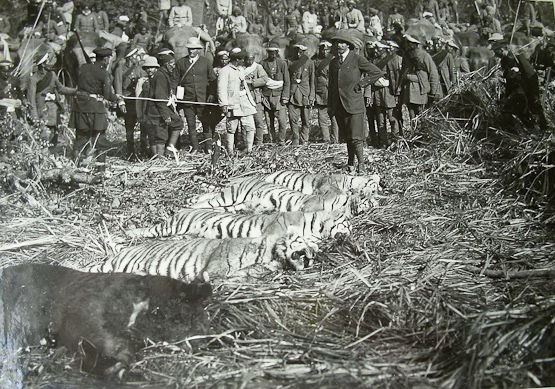
The arrangement is not new, and the historical rhyme is worth hearing. When George V came to India in 1911, the literary forms of the subcontinent were bent to receive him. A George-nameh was composed, the imperial monarch fitted into the mould of the Persian Book of Kings, Ferdowsi’s Shahnameh, as though he were a late heir to Jamshid and to Bahram Gur the hunter. The Persianate epic had long lent kings a borrowed grandeur, from the Qajars’ Shahanshah-nameh onward; now it lent the loan to an Englishman. And the single ancient royal tradition this particular heir can be said to have honoured is recorded, with admirable economy, by the archive itself.
A George-nameh was written for George V’s visit to India in 1911. The king honoured the ancient traditions of Persian rulers in at least one way: in several weeks his passion for hunting decimated the tiger population of Nepal.
Cambridge University Library, Royal Commonwealth Society Library, QM/21/67
The panegyric did its work, and the slaughter passed quietly beneath it. That is what glossing means in practice. The violence is not denied; it is dressed. A century on, tsubmission to the strong is presented as prudence, even as protection.
And then the order reminds everyone what it is. This week, enforcing its blockade of Iran, the United States put munitions into the engine room of a tanker in the Gulf of Oman. Three of the dead were Indians. Not soldiers, not combatants: merchant seamen, working men, killed by the very Empire whose favour the nationalist courts as a shield. India lodged its sharpest protest of the war and summoned the Americans. It will change nothing. The lesson, for anyone willing to take it, is plain. Empire does not pause to check the religion of the men in the engine room. Empire comes for us all, and it never asks whose side you imagined you were on.
The Beginning of the Cure
So Kabir is right, that the fixation is real. But it is not a bad habit to be scolded out of existence. It is a function, and it does real work. It supplies an enemy so that we need never supply an explanation, and it lends a young, assembled identity the solidity it cannot yet find from within.
The day this Commentariat can carry hundreds of comments on caste, or on water, or on the daughter who is not wanted, with not one of them reaching for Pakistan or Islam, is the day the patient has started to mend. We are not there. We are nowhere near. But to name the disease, as Kabir has done, is where every cure begins.
We take up the Shahnameh and its long afterlife, the George-nameh among its odder descendants, at greater length in a forthcoming BRAHM Newsletter.
No, most of us are not bothered about Pakistan. Many of us came here via Rajib. Many here will vote positively, if this janghi khusti between india and Pakistan is reduced to one article a month.
BB, RNJ, etc respond to kabir et al for provocation.
We need more on race, nature Vs nurture, IQ, a sort of Murphy’s bell curve for south Asia, brown sports, cuisine.
presumably you filled out the survey?
Yes
I’d be more interested other topics not involving the ‘green bros’ – history, archeology, culture, etc etc But like you said, the constant stream of “passive aggressive” silliness is provocative and invites response.
BP is not Substack – for instance SS is littered with specialists.
We are exceptionally community driver and Commentariat-led.
So for instance we are writing on the Shahnameh and its influence on Iranian art for the newsletter.
We also wrote on this piece during quiet week for our own Collection:
https://www.brahmcollection.com/blogs/stories/our-best-sellers-indian-wall-art-and-brass-sculptures
and that’s good. I like having BP curate content at times that I otherwise wouldn’t see. Just pointing out that engaging with commentary and ‘discussion’ is going to be a subset of the content that folks have ‘more’ interest in…
No one would be happier than me if the “jangi kushti” between India and Pakistan is reduced to one article a month.
As for who provokes whom, that is obviously subjective. Any neutral party can observe the constant pictures from “Dhurandhar” and things like “Mauka Mauka”. If that is not intended to be provocation than what is it?
Anyway, as far as I am concerned, the ceasefires are working beautifully. The less I see and hear from certain people the happier I am.
As XTM noted in his post, Hindutva needs an “other” and that “other” is obviously the Muslim. The same thing applies on the other side. TNT requires an enemy and that enemy is the Hindu. It’s sad but that’s where we are.
Yes this feels the nub alas.. we would like to have to eventually with ceasefires altogether but they keep the peace and quality high..
It would be great if you could write on any of these.
Btw, the Tata Sons issue is getting more and more interesting. Would you be interested in writing a simple analysis as a post?
>The same principle falls silent before the khap panchayat, the honour killing, the dowry death, the temple that still bars the menstruating woman at the door.
yeah…..Naah.
?
Its ‘aussie slang (I think) for ‘I disagree’.
I think you have a tendency to paint with too broad a brush when it comes to the … “Saffroniate”.
X.T.M’s issue is that he does too much monkey balancing to maintain equivalence.
The countries are not even comparable.
For all the talk of khap panchayats, Haryanvi women wrestle in thongs and have won medals including at the Olympics. Pakistan women’s sport is non-existent.
Not like these issues don’t exist in Pakistan and aren’t worse there.
Talking of temple barring menstruating women, aren’t mosques segregated anyways?
I don’t think temples actually bar menstruating women. Societal conditioning ensures that bit. Which again is an unfortunate legacy of the requirement attributable to ritual purity.
Yes how would they know for one..
Exactly 🙂
Do we?
Since last October where there was under immense pressure to remove Kabir from BP; we have understood that Kabir remains the most invested member in BP.
Thus we pay special attention to what he says. After ceasefire he tried to life up the tone of the blog and you essentially disappeared since there was no fodder for anti-Pakistan material..
Not really. I said I was busy with other stuff and would be doing a post soon.
I sadly don’t have a substack whose posts I can keep reposting nor do I see any benefit in reposting articles from The Wire/Scroll.
Rather ironic and shallow reading of current circumstances considering it has been the traditional Muslim that has been the most loyal steward of the empire. Springing forth to battle the Soviets and Afghans to protect the frontiers of the western empire. The truth has been that the Saffroniate if it even exists has been suspicious of the west for as long as it has been. Even at the peak of its convergence with the west it refused to get into any explicitly military network with the west (QUAD), it maintained a degree of strategic autonomy and it remained wary of the west.
By the later half of the Biden term the paranoia regarding the American coup in Bangladesh had solidified any doubts regarding western intentions. Relations have been in a tailspin since then.
I think I’ve got the perfect Dhurandhar analogue for this “Hamam mein utarna hai toh nanga hona padega”. We are simply paying the cost of the fact that around 1/3rd of all merchant marines are Indian, they are bound to get caught up in any incident affecting merchant shipping. As India begins to dominate more sectors of expertise internationally it will find itself embroiled in incidents around the world.
Earlier the Chinese used to find their engineers staying behind in middle eastern nations going through wars and coups to maintain their telecommunications networks. Many Chinese engineers ended up dying in those posting, but their sacrifices created modern behemoths like Huawei. We simply have to live with the fact that loss of life of the innocent is the price of engaging in this game at all.
The assumption is actually that by becoming strong you can keep yourself safe
I used to be here around 2020 or so. I left because of India vs Pakistan, Hindu vs Muslim, Aryan vs Dravidian.
I came back and its still the same, although not much about Aryan vs Dravidian. Possibly because Rajib doesn’t post much.
Nevertheless, lets not reduce ourselves to these small number of brown topics.
Be the change you want to see..
Unfortunately, some people enjoy “India vs. Pakistan, Hindu vs. Muslim”.
That kind of discourse takes no effort and is by far easier than contributing anything substantive on art, literature, history, science etc.
The Commentariat don’t seem to understand we don’t just weigh view points.
For instance we disagree with you on a lot of viewpoints but also u have been the most influential individual in shaping this Blog.
The Commentariat seem to assume we can’t be collegial with those who we can disagree with ..
Brown Pundits is not a place to stamp on the face of Pakistani forever; if anything your interests, views and perspective attest to the complexity of being Pakistani.
It’s interesting that’s why you are the object of particular ire in a way Q & EK are not.
It is because you love English literature, reflect on Pride Month & love Pakistan..
It is fascinating that you held the line when the Cresceniate was just you (and Sbarr who had his own politics) the extreme diversity we now have (Calvin, Flydie – the “CrossComments”) emerged from your insistence that BP must not be an echo chamber.
Everyone knows our own particular views are *fairly* Saffron (for instance we are fairly offended by Q’s insistence on the invention of “Hinduism” but we defer to our Admin Team on that) but we also must be fair.
If we simply wanted Masala the Ceasefires would not have been instituted.
This is not limited to the Saffroniate brigade, but this disease spreads across time and space, cuts across caste lines. All Indian nationalists are obsessed with Pakistan, whether they be Hindutva or of the Secular bent. The only people not so obsessed with Pakistan are South Indians although you can find many characters coming out from there as well these days since there is easy money to be made to take that position.
This is not just on this blog. You get this on every social media website that is open to Indians to participate, you get the obession with Pakistan and we Pakistanis have been dealing with it for the best part of this century. On Reddit, you literally get downvoted for criticizing India in a post even on Pakistani subreddits because the Indians are always lurking their in mass numbers, reading everything even when not posting. On X this is even worse, since 90% of the comments under any Pakistani cultural post are of Indians being mad, Pakistani fashion posts always go viral because half of the commenters are seething about ”stealing Indian fashion” while the other half are making thirsty comments on Pakistani women.
I seriously think it was a big mistake spreading cheap internet in India because that has completely wrecked any Indian image outside of India and spread a lot of Indian hate.
The unified Hindu religion was created by the British in 1871 census and the Hindutva movement was started soon after. We blame the British for Divide and Rule and perhaps they wanted to do this to remove Muslim power from India at the time, but what they created was a Frankesntein’s monster that is gradually devouring most ancient local Indian religions and is replacing them with Western culture and Western religious values. And that’s fine by me as long as the Indians realize that irony, because they continue blaming the Muslims even today for trying to do that (unsuccessfully) while the British already achieved it.
“The Saffroniate are engaging in ‘hostile commentary’ against Islam and Pakistan”.
😀
Saying Indian women should concentrate on delivering babies instead of delivering whatever this is (https://x.com/Babygravy9/status/2058834887650443722) does not mean they are getting Talibanned. The above video proves the second pointIf you deny any association with it, it will prove the third point as well.
You have a high opinion of your own opinion. Rarity to find many others if any.
RNJ engaging with Q is pointless. He is a proven misogynist and a bigot. Even his last comment proves that to be true. His elitism is so ass backwards that he can’t even the see the advantages of having cheap telecommunications for most of the world’s population.
We won’t edit this unless Q complains.
Q claims not to be offended by anything and he does seem to enjoy being provocative.
Hinduism is the most ancient and complex belief system on the planet; we were touching on its relatively recent emergence as a political catalyst.
Strawman replies get strawman replies.
But I am not provocative here, this is the view of Indian historian Romilla Thapar who hereself has implied that the British standardized Hindu religion after which its idenity formed as a collective. Grouping together various beliefs and groups together under a ‘Hindu’ monicker, defined as ‘not Muslim’. This was a pretty standard view before, but history is being changed in modern times to suit political narratives. Similar, India was never one country or nation, but we have to bear that narrative because a billion people have been brainwashed into believing in it and suffer their Akhand Bharat fanatsies.
well Mythology became reality pretty quickly.
India seems a very well-defined and organic nation.
we of course disagree with your historical analysis and Romilla Thapar is a left-liberal
India doesn’t have one race
India doesn’t have one langauge
India doesn’t have one religion
India isn’t a common state until the British.
It’s as much of an ‘organic’ country as ‘Europe’ or ‘Africa’. Probably at the same level of Pakistan.
Since Indians are very wary of these facts, they tend to define themselves now as one ‘civilization’ but they aren’t even one civilization.
Only someone from the diaspora would complain about “image amongst wignats”.
Even random small villages in India have UPI now, enabled of course by the internet rollout.
Like I said – diaspora always has a blind spot.
And what positive image does Pakistan have in the world due to their lack of internet infrastructure lol.
Pakistan is the world’s diplomat?
It isn’t though.
that’s……..something even hardcore Pakistan patriots would hesitate to assert. 🙂
I don’t bother ‘engaging’ with him, because yes it is pointless. But the occasional push-back, calling out of silliness or ridiculing his …wild-eyed assertions? Yes, I think that’s fair play.
Yes btw we defer this to the Admin Team since Q’s comments are pretty out there tbf.
We also have had no email complaints ..
Q is both deliberately provocative but is also so sure he’s absolutely correct that there’s really no point engaging with him.
To be fair to both BB and RNJ, it takes two to tango. BB was the one to have requested the ceasefire with EK and Q.
I don’t think Kabir is the target of everyone’s ire because of literature etc. Most of us can’t reconcile the widely divergent views he espouses depending on the topic under discussion.
Of course it’s in nobody’s interest to constantly fight about topics where there is never going to be agreement. I’ve had my fair share of disagreement with him but both of us have simply arrived at a mutual ceasefire of sorts and can still engage cordially on other topics of interest.
Q and EK are consistent in their outlook across the board.
See, I don’t think nutty comments are worthy of ‘complaints’. But the occasional call-out or refuting should be fine.
Its when you try to somehow coddle rabid extremism and ‘normalize’ it, that becomes an issue.
Nothing is permanent but change.
Truer words were never spoken
Betteridge’s Law of Headlines applies here, because the answer is no.