Wag the dog?

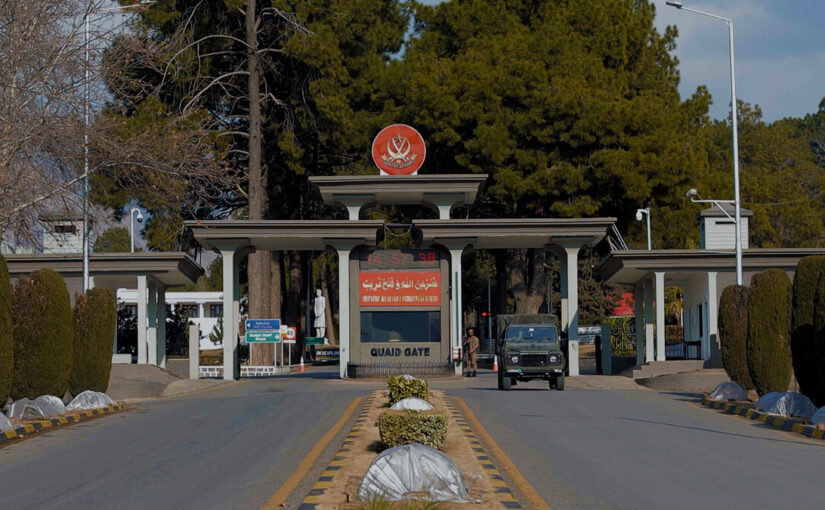
This idea came to me randomly when two people, separately, asked why they should pay taxes if half the budget supposedly goes to the army—a claim that is factually untrue. I am here trying to play devil’s advocate. While writing this, I consulted people to understand why the proposition, “The establishment is the root cause of every Pakistani problem,” is so widely taken for granted, especially after Imran Khan’s exit.

By “establishment,” I am specifically referring to the military, the way it is colloquially understood nowadays, not the “elite” in the class or socioeconomic sense. I presented sector-wise facts to them, and most had no answer. That prompted me to pen this piece. Since mainstream discourse now often takes an anti-establishment position, I decided to challenge that perspective.

https://www.thenews.com.pk/latest/1354698-wag-the-dog
Continue reading Wag the dog?

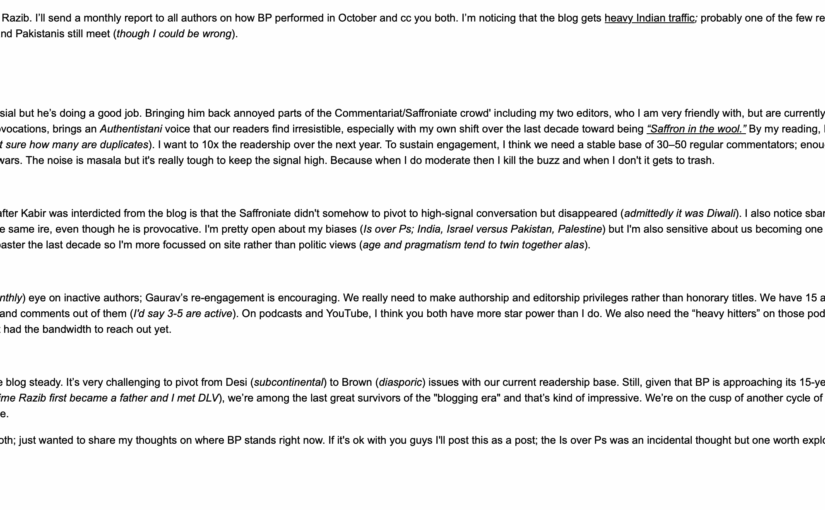
Co-Founders Confer

I sent this email to the CoFounders of the Blog (Omar | Razib) and tomorrow I will send through the Monthly Author Report.

Continue reading Co-Founders Confer

Genetics open thread

On popular request — or curiosity. Two recent studies are making the rounds:

I’m generally skeptical of population genetics papers, what is their point exactly? But presumably this will awaken the Commentariat, who have been quieter lately.

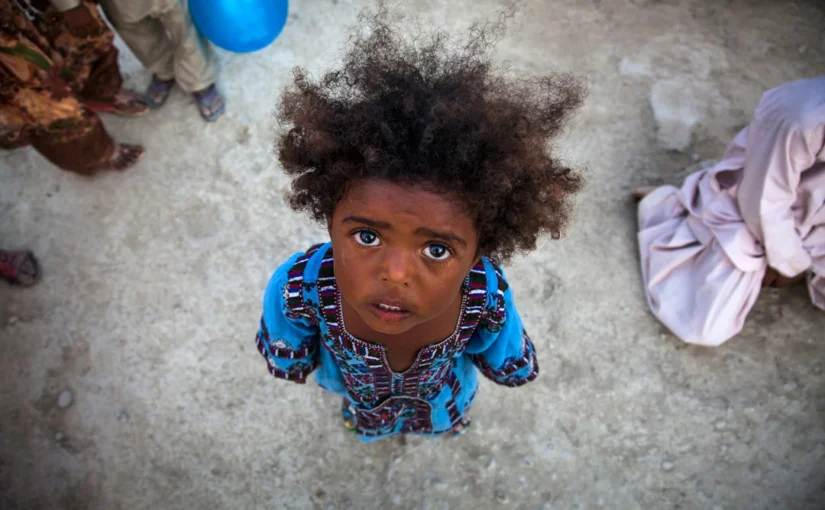
If nothing else, consider it intellectual cake; open to everyone, rich in speculation. As an aside the young girl featured is a Baloch.

The Earth’s Lost Industrial Heart

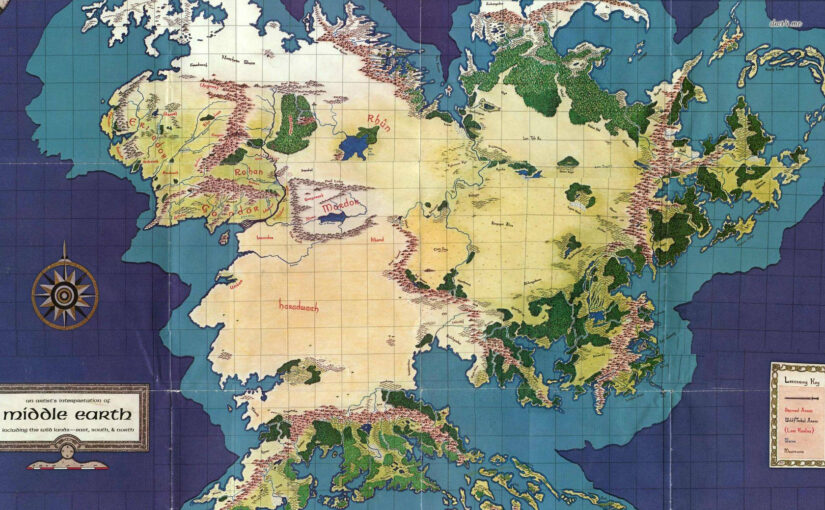
After our discussion on industrialisation in India, I began to wonder: if the Earth were one country, one government, one infrastructure grid, one economy, where would its industrial heart lie?

Geographically, the answer is obvious. The natural centre of the world, for energy, labour, and trade routes, isn’t London, New York, or Beijing. It’s the triangle between the Persian Gulf, the Indo-Gangetic plain, and the Red Sea.

Deserts rich in hydrocarbons. River basins dense with labour, water, and grain. Seas that touch every continent. If the world were united, this belt, Arabia to India to the Nile, would be the Ruhr, the Great Lakes, and the Pearl River Delta combined.

The Natural Order of Geography

Before empire, this region was the planet’s connective tissue. Spices, silk, horses, and steel moved from India to Arabia to Africa. Energy, grain, and knowledge flowed through the Red Sea and the Persian Gulf like the arteries of the Earth. It was not the “Middle East”; it was Middle Earth. Continue reading The Earth’s Lost Industrial Heart

Review–Social and Political Concerns in Pakistan and India:Critical Conversations for College Students

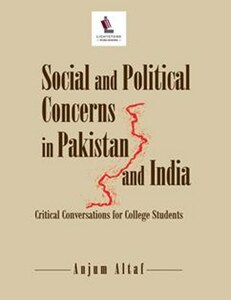
Sharing this review of Dr. Anjum Altaf’s book Social and Political Concerns in Pakistan and India: Critical Conversations for College Students.  The book is a collection of essays originally published as blog posts on The South Asian Idea.    The mission of the blog was:

The South Asian Idea is a resource for learning, not a source of expert opinion. The posts on the blog are intended as starting points for classroom discussions and the position at the end of the discussion could be completely at odds with the starting point. Thus the blog simulates a learning process and does not offer a final product. The reader is invited to join the process to help improve our understanding of important contemporary issues.

The heyday of the blog was from around 2008- 2018.  It hosts hundreds of essays about issues relevant to South Asians–many of them about Partition, Hindutva, Pakistan etc.   At a time when Indians and Pakistanis are barely able to interact in a civilized manner (as we have seen on this blog), it is a record of an earlier time when the hope for better relations still seemed possible.  It is also an example of the work that goes into running and moderating a blog aimed at teaching people how to argue well about humanities subjects.

Here are an excerpt from the review in DAWN:

All in all, Altaf’s tome deserves praise for courageously, convincingly and argumentatively questioning the dictatorship of mainstream discourses. Fanaticism has reduced the Indian Subcontinent to an Absurdistan. Altaf’s book shows that a patient argumentation in the tradition of Enlightenment is the only way to reverse the course.

Here’s a link to the post mentioned in the review (entitled “The Road to Partition”)

Currently, the book is only available in Pakistan. However, it is available on Kindle for those in India.


Islam the religion of Peace

He also brokered the fragile ceasefire between Thailand and Cambodia after deadly border clashes earlier this year – he stepped in after Trump threatened to impose tariffs on both sides if the fighting didn’t stop.

Some called it a diplomatic victory for Malaysia, while others said Anwar was simply in the right place at the right time – this year, it was the Malaysian PM’s turn to lead Asean.

Two Theravada Buddhist neighbours go to war over a Hindu Temple Complex and come to peace because of a Muslim & Christian President.

I know the Commentariat – Saffroniate are a bit miffed by my sudden change of tone; but as you can see I would be intellectually dishonest if I didn’t cover all sides of the story. This is where Dharmic civilisation, which is ordinarily peaceful, had to be *helped* by Abrahamic one.

On closer interrogation; I think when the Blog becomes dominantly “one-tone”, I then flip to ensure we maintain a parity of sorts.

Who is Anwar Ibrahim


New writing ideas

G’s future posts:

« I am thinking on a longish post on how the Hindu Epics actually made Geographical India into cultural India – more than wars of Ashoka or Gupta’s or Mughals. »

A very high Signal Comment by G again:

Guys discussing high HDI and Low HDI of North and South without discussing coastal connectivity?

All states which have a sea barring Odisa are doing well. Bengal used to do well but has gone to shit due to 70 years of Communist and bad economic strategies.

Among “Northern” states GJ has a long coastline.
HR PJ are doing fine due to connectivity to capital and extremely high irrigation and other stuff.

The only places which comprise the “backward” north are UP,Bihar – badly governed since independence and landlocked and JH and CH which have extremely difficult terrains and very very dense forests along with being landlocked.

Geography, historic and economic reasons often supersede cultural though people who want always focus on those.

Zia-Era Pakistan & Today’s India

There are actual leftists and other folks who don’t regurgitate PakMil propaganda – of this I’m aware. But even amongst those, illiteracy on India is rife. I laugh with bemusement at the number of times self-appointed Pakistani intellechawals sagely nod their heads and compare Zia-Era Pakistan to present-day Hindootva. I ‘get’ that such comparisons soothes Pakistani insecurities vis-a-vis its larger, democratic neighbor, but it really destroys their credibility.

Kabir removed three of Dave’s comments, and while I felt it was over-moderation, I’ve kept my promise not to interfere unnecessarily in his threads.

The excerpt above, though, is interesting — the comparison between Zia’s Pakistan and Modi’s India. What’s striking about both is the twin emphasis on capitalism and cultural conservatism: the promise of economic growth wrapped in moral revival. It raises a deeper question — whether right-wing politics are, paradoxically, the only antidote societies find to extreme inequality.

Class, even more than caste or creed, is the fundamental distinction in any society. The bottom half ultimately has more in common with each other than with the top half. Yet society endures only when that bottom half is so compromised that it cannot mount effective resistance. When the Establishment promise uplift but depend on the passivity of the lower half, then the “distribution of prosperity”, twinned with ideology, itself becomes the subtlest form of control.

Saffron Strike

The silence on BP these past few days feels deliberate; a kind of Saffron Strike. If so, let it be known: this space was never meant to cater to ideological comfort.

It seems uncommonly quiet; I think I have been misunderstood. I do not care about the traffic and commentary of BP as much as I care about the integrity of the space.

For instance when I felt that Kabir had done wrong; interdiction was the answer. When I realised the narrative was being twisted so that I became his moderator (Kabir generally knows my red lines) then I realised I was wrong. Kabir’s recent postings and commentary have been very high-signal. Continue reading Saffron Strike

Sunday reads

I recently read a piece I’d like to share: about the life of Bacha Khan and how he initiated an anticolonial school, the Azad School in Utmanzai, in 1921. It was a Pashto-medium institution where Manmohan Singh, the former Prime Minister of India, also studied. Nehru and Gandhi visited the school as well — Nehru in 1937 and Gandhi in 1938 — delivering speeches and spending time there. Due to his dissent against the British, he had to spend about 37 years in jail out of his 93-year life.

The Genius of Bacha Khan

“Most geniuses have one masterwork for which they are famous.  For Che and Fidel, that work was surely the Cuban Revolution and its international humanism, just as it was for Lenin, the Russian.  For CLR James, we can list “The Black Jacobins” as an extraordinary work of genius, as well as the underground Marxist group he co-led, known as the Johnson-Forest tendency.  For Selma James and many other women of the 1970s Marxist Feminist movement, it was about recognizing the economic contributions of housework and children and establishing organizations that advocated for fair compensation for caring and reproductive labor.  Their slogan, ‘invest in caring, not war’, remains the blueprint. For Spivak, it has been to chart a path for activism while working beyond Eurocentric Logocentrism.

The list is long, but I never thought that a tall, six-foot-three, broad-shouldered, soft-spoken Khan from Utmanzai, Hashnagar, a mere graduate of King Edward’s School, Peshawar, would, before he turned 30, have three works of genius to his name. Abdul Ghaffar Khan, honorifically known as Badshah Khan (King of the Khans) and also Bacha Khan, a title bestowed upon him at the mere age of 27, created three masterpieces. In order of creation, they were: Anjuman-i-Islahul Afaghina (The Society for the Reform of the Afghan), Pakhtun magazine, and the greatest non-violent organization the world has yet known, the Khudai Khidmatgar.  Here I want to write only of the first, Anjuman-i-Islahul Afaghina. “

Continue reading Sunday reads

Brown Pundits