BP’s two Factions in light of its “Bharat” underpinning?
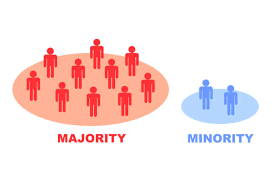
What defines the “Majority”?
What does Courtesy Mean in an online forum?
The majority, described
Now that we are Brown, that is Bharat, Pundits, all of us who are the majority share things in common. Five come to mind, and they should be front and centre:
Hindu by birth or Hindu by marriage (broadly Upper Caste social milieu).
India’s borders can never be reduced. Some, myself included, are very much in the Akhand Bharat camp; I see Iran to Indonesia as one vast Indic, Hindu Continental sphere.
Hinduism was oppressed under the Anglo-Islamicate legacy, which has been a mixed blessing at best (that is a most charitable view). The LeLi Brahmin view that we should have been grateful to be chattel under Despots, who professed Islam, is odd.
Dharma has space for all, and that more Hinduism does not mean less secularism; as well as an inclination for more Hindu-Indic symbology in the national discourse.
Broadly supportive of the current government of India and sceptical towards RaGa.
Partition was a mistake and the two-nation theory was not a good idea. Pakistan has not succeeded.
That defines the majority to a very strong extent, and the minority is defined by being against these positions, in whatever combination. We have such a strong majority that all of us agree with it, including the full admin team.
It just so happens that even if I’m not Hindu by birth, I’m definitely Hindu by marriage. My entire social reality, where I engage with Brown people, is Hindu, so I have become an acculturated Hindu. A fortnight ago I said the divide here was ideological, not sectarian; the last week taught me the map is older than the ideology. It’s not Saffron or Crescent, left liberals or right wing. It is the majority versus the minority, and in a weird way we are converging towards what is modern-day India, and really mapping that.
Comments of late have drifted, as they sometimes do here, into territory where the Bahá’ís are invoked as a rhetorical chess piece by people who know very little about them. We believe in free speech, and on this blog more than most, in authorial autonomy; contributors and commenters speak for themselves, and we are not in the business of policing opinion. But because the question of Palestine sits adjacent to much of what has been said, we thought it worth setting down what the actual position is.
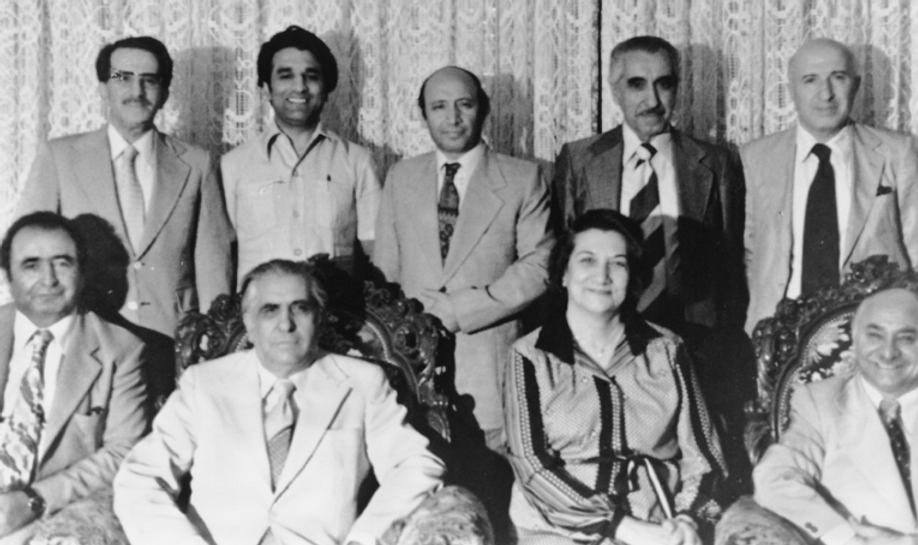
“Members of the National Spiritual Assembly who disappeared in August in 1980. All are presumed to have been killed” by Bahá’í Media Bank.
One caveat first. When we write or administer here, we do not speak for our Faith in any official capacity. We are members of it. That is the limit of our standing.
The clearest statement of the Bahá’í position comes from the pen of the Beloved Guardian of the Faith, Shoghi Effendi, who in July 1947 was asked directly by the United Nations Special Committee on Palestine to clarify the relationship of the Bahá’í community to the country and its political future. His reply, written from Haifa and reproduced in The Bahá’í World, Volume 11, is as close to a foundational text on this question as exists. We quote it at length, because paraphrase would not do it justice.
On July 9, 1947, Shoghi Effendi received a letter from the chairman of the United Nations Special Committee on Palestine requesting a statement on the relationship, which the Baha’i Faith has to Palestine and the Baha’i attitude toward any future changes in the status of the country. From Shoghi Effendi’s reply, the following paragraphs are quoted in The Baha’i World, Volume 11 (1946-1950), pp.43-44.1
HAIFA, ISRAEL—15 July 1947
“The position of the Baha’is in this country is in a certain measure unique: Whereas Jerusalem is the spiritual center of Christendom it is not the administrative center of either the Church of Rome or any other Christian denomination. Likewise although it is regarded as the second most sacred shrine of Islam, the most Holy site of the Muhammadan Faith, and the center of its pilgrimages, are to be found in Arabia, not in Palestine. The Jews alone offer somewhat of a parallel to the attachment which the Baha’is have for this country, inasmuch as Jerusalem holds the remains of their Holy Temple and was the seat of both the religious and political institutions associated with their past history. But even their case differs in one respect from that of the Baha’is for it is in the soil of Palestine that the three central Figures of our Religion are buried and it is not only the center of Baha’i’ pilgrimages from all over the world but also the permanent seat of our Administrative Order, of which I have the honor to be the Head.”
“The Baha’i Faith is entirely nonpolitical and we neither take sides in the present tragic dispute going on over the future of the Holy Land and its people nor have we any statement to make or advice to give as to what the nature of the political future of this country should be. Our aim is the establishment of universal peace in this world and our desire to see justice prevail in every domain of human society, including the domain of politics. As many of the adherents of our Faith are of both Jewish and Moslem extraction, we have no prejudice towards either of these groups and are most anxious to reconcile them for their mutual good and for the good of the country.”
“What does concern us, however, in any decisions made affecting the future of Palestine, is that the fact be recognized by whoever exercises sovereignty over Haifa and Acre, that within this area exists the spiritual and administrative world center of a world Faith, and that the independence of that Faith, its right to manage its affairs from this source, the right of Baha’is from any and every country of the globe to visit it as pilgrims (enjoying the same privilege in this respect as Jews, Moslems and Christians do in regard to visiting Jerusalem), be acknowledged and permanently safeguarded.”
The most important thing to understand about the Pakistani voices on this site is that they are centrists, not extremists. Kabir, El Khawaja, S Qureishi: none of them is a fringe figure in Pakistani society. They are roughly where a literate, urban, employed Pakistani sits, and that fact deserves attention.
It deserves attention because India, over the last decade, has stopped engaging with Pakistanis altogether. Visas have collapsed. Cricket is gone. Cinema is gone. Academic exchange is gone. The everyday oxidation of one society against another, the slow correction by which extreme positions get rounded down through exposure to people who hold different ones, has been switched off. What is left is each side talking to itself about the other.
Brown Pundits is one of the few places where that has not happened.
The thread that prompted this note will illustrate. A week ago, S Qureishi observed that the only downside of the Islamic Revolution was that “there is no OnlyFans.” We were deeply offended by this line seriously enough to write the next piece on counterfactual analysis of Iranian society. Q then returned, under another post, with a fuller thesis: female sexuality must be controlled to sustain a civilisation. Pressed on enforcement, he listed disownment, violence, lawsuits, vandalism. Finally when pressed on honour killing, he admitted it was “horrible” and “immoral.”
Three voices took shape on the thread. The most salient asked that the comment be deleted as misogynist.
We are not deleting it.
We disagree with Q on almost every line he wrote. The thesis that female autonomy is the load-bearing crack in civilisation is one we reject in full. The post on Virginity Policing that triggered this thread was our own. But Q is not a Taliban spokesman. He is a Pakistani who, when challenged in writing by other commenters, was forced to articulate his position, defend it under hostile examination, and concede that violence is wrong. That is not platforming. That is engagement. It is the slow work India has decided it no longer needs to do.