Mid-Nov Circular

Dear all,

With everything going on in the last 48 hours, we wanted to send a short note to everyone directly. BP has sputtered back to life in the past year, and with that revival comes all the familiar subcontinental pathologies: everyone believes they’re right, everyone believes moderation is biased, and everyone believes someone else is being unfair. In that sense, BP is working exactly as it always has.

We want to restate something very clearly: we’re not going to run a hyper-moderated blog. It takes too much time, too much energy, and, crucially, it’s an unfunded mandate. Nothing is more dispiriting than a dead space. Our approach has been simple and consistent:

1. Authors control their own threads.

If things escalate on your post, you shut it down when and where you see fit. That’s the cleanest system and the only one we can realistically sustain.

2. No bans, shadow bans, or entrapment games.

Once we go down the path of micro-policing, BP loses its character. That’s not the direction we want to take.

3. We do not manufacture controversy.

If anything, the only thing we are biased toward is what the audience reads and engages with. That’s it. Everything else is noise.

Reflections:

Some of you will have seen the recent exchanges where accusations were thrown in both directions, and where intentions were questioned. Without going into details: this is exactly how online political communities melt down; by assuming the worst in each other and by escalating minor provocations into existential battles. It’s the same pattern we saw a couple of years ago at a public talk by Rahul Gandhi in Cambridge: someone asked a loaded, “gotcha” question, the out of context reply went viral, people got outraged, and the whole thing became a cycle of reaction and overreaction. We’re drifting into the same dynamic.

Let’s not.

BP works only when people post, comment, disagree, and move on. If that stops, the blog dies. And as Omar’s recent post highlighted, we want authors to write more, not less.

So our simple request is this: Calm down, carry on, manage your own threads, and do not fall prey to the outrage factory.

If you feel strongly about a situation, reach out; if you want more balance, we’re happy to add an additional admin to offset the load (BP’s editorial board already functions with more factions than the Lebanese Parliament); if something crosses a line, handle it on your post. But let’s not turn BP into a miniature Whitehall where everything becomes bureaucratised. We’ve done extremely well this past year. Let’s keep the energy without burning down the house.

Warmly.

Calm Down and Carry on.

Dear all,

I have not been busy elsewhere and dont get to pay much attention to the blog and unfortunately, we seem to be seeing a lot of harsh comments and blog posts and general unhappiness. I am not promising miracles (I think the comment section will remain something of a mess, but we will try to clean up even there) but I hope we can get on even keel soon. Please do stick around, we will try to make some improvements and if you are an author who has not written for a long time, please do write more so that the quality of the posts can go up..

Omar

Bangladesh’s ousted PM Hasina sentenced to death for students crackdown

Note: BP really needs a Bangladeshi contributor so we can get some analysis of other South Asian countries rather than interminable back and forth about India and Pakistan  

From DAWN:

A Bangladesh court sentenced ousted Prime Minister Sheikh Hasina to death on Monday, concluding a months-long trial that found her guilty of ordering a deadly crackdown on a student-led uprising last year.

The ruling comes months ahead of parliamentary elections expected to be held in early February.

Hasina’s Awami League party has been barred from contesting and it is feared that Monday’s verdict could stoke fresh unrest ahead of the vote.

The International Crimes Tribunal, Bangladesh’s domestic war crimes court located in the capital Dhaka, delivered the guilty verdict amid tight security and in Hasina’s absence after she fled to India in August 2024.

Personally, I have mixed feelings about this. Sheikh Hasina was a dictator (and arguably an Indian puppet) so I’m not particularly fond of her. She does need to pay for her crimes.  However, I don’t believe in the death penalty.  This step seems to be an extremely problematic one for Bangladesh.


Criminal castes, religious conversion, and the idea of India ft. Nusrat F. Jafri

A clear look at how the criminal caste label continues to shape social life, how conversion becomes a route to dignity, and how these shifts speak to the larger idea of India. Nusrat F Jafri, author of In This Land We Call Home, joins to discuss the history, identity, and ground realities that still define the present.


What Is Not India Is Pakistan

As Dave mentioned, there is a lively WhatsApp group of BP authors and editors, and it inevitably shapes the comment ecosystem. But one comment on the blog stood out:

“The very foundation of Pakistan is an anti-position. What is not India is Pakistan. So isn’t it obvious?”

It’s an extraordinarily crisp description of Pakistani identity-building. What is not India is Pakistan. That is not a slur; it is, in many ways, a psychologically accurate frame for how the state narrates itself.

What I increasingly find misplaced on this blog is the recurring assumption that Pakistanis are somehow “Indians-in-waiting,” or that Punjab is “West Punjab,” Pakistan “Northwest India,” or Bangladesh “East Bengal.” These are irredentist projections that simply do not match lived identities. This is not “North Korea” or “East Germany,” where both sides continue to imagine themselves as fragments of one common nation.

Yes, Pakistan consumes Bollywood and Hindi music, which themselves derive from Mughal and Indo-Persian syncretic traditions. Yes, Pakistan is culturally embedded in the greater Indo-Islamic civilizational sphere. But emotionally, Pakistan has severed itself from the Indian Subcontinent as a cohesive landscape. It has constructed a hybrid identity; part Turko-Persian, part Islamic internationalist, part anti-India.

I don’t personally agree with this move, and my own trajectory has been toward a strong Hinducised, Dharmic identification. But my view is irrelevant here. What matters is that Pakistani identity is defined negatively; as the commentator put it, “What is not India is Pakistan.”

Whether that is healthy or sustainable is another matter. But identities can persist in unhealthy configurations for a very long time; the stock market can be irrational longer than your liquidity can survive.

The India of my dreams is yet to be seen: Dil Se with Kapil Sibal

Dil Se with Kapil Sibal, hosted by Kapil Sibal, presents its landmark 100th episode, reflecting on India’s economic journey and the challenges ahead. In this special edition, Kapil Sibal engages in a deep, insightful conversation with two distinguished guests — Shri Yashwant Sinha, former Finance and External Affairs Minister, and Shri P. Chidambaram, former Finance and Home Minister. Together, they discuss India’s economic direction, the credibility of government data, the global power–economy relationship, and the urgent reforms needed for India to truly become a Viksit Bharat. 


Multi Racial Multi Cultural Family in Ceylon

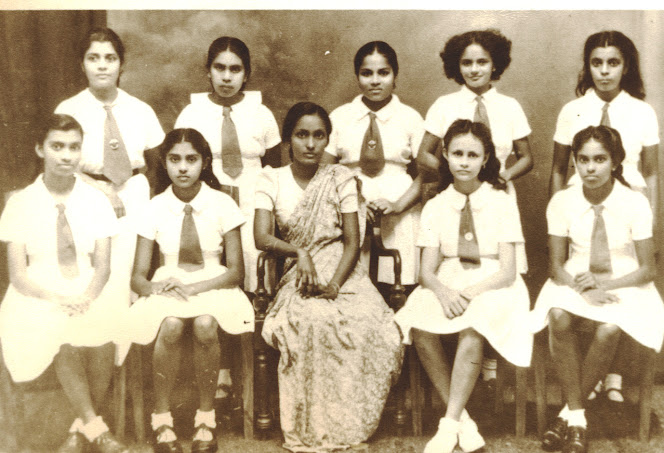
Banner Image: Photo from around 1940.
Standing far left: My mother Peace born 1926 (same age as Queen Elizabeth II) Standing one but Last with Afro, Estelle. Father a Judge from Barbados via England (African Heritage). Mother Eurasian
Seated. In Saree Miss Gnana (History Teacher, Tamil), Next to her: Miss White, Eurasian


This is about the maternal side of the family. My grandparents were one of the first inter racial marriage in the Deep South. It is also about how a children of an inter racial marriage do not belong and forge an independence of thinking (my mother and myself as examples). Even more so growing up in a cosmopolitan segment of Sri Lankan society

Let us start from the beginning. My Grandmothers mother was an Irish Nanny. Hearsay and rumor confirmed by my DNA tests. The Irish Nanny had my grandmother with my GreatGrandFather and left Ceylon. My GreatGrandfather did not have children so my grandmother was adopted by her father. Inherited all the wealth which was considerable. GreatGrandFathers family (Tillekeratnes) had been Administrators under Dutch and British times and were Sinhalese in the Deep South. Possibly were Anglicans during British times.
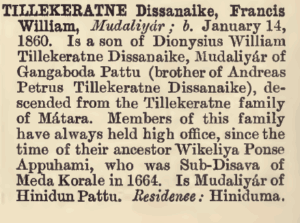

Tillekeratne Family of Matara.
From Golden Book of India and Ceylon (1900) Roper Lethbridge

My Grandmother married a Jaffna Tamil (from the North), a surveyor posted to Galle in the Deep South. My grandmother built a house in Galle so that it was convenient for work. Her ancestral home was even more deeper in the South in Matara.

Galle Town proper was very small, probably about 25,000 pre WW2. Still small about 150,000 now (2025), However, Galle was very Cosmopolitan because of the Harbor. It was the Main Harbor till the Colombo breakwater was built. My mother (and her sisters) attended a Catholic Convent, which was cosmopolitan. (a school photo and some names attached).

My mother and I dont really identify with any community in Sr Lanka. However, very Sri Lankan Nationalist. My mother never spoke about her opinions. Many in Galle thought they were Eurasians but they were not part of the Eurasian (Burgher) community. Burghers were a Fun crowd, parties dancing and Drinking (including women). (I would have liked to be part of that community) My mothers family were quite austere, their idea of nice time was probably singing hymns and big meal afterward. A lot of imported stuff from what I recall as a 6 year old. Edam Cheese, hams, sausage, puddings and homemade ice cream in churn. We inherited the ice cream churn after my grandfather died. Eventually rusted and was no longer usable.

Dual Six-Quart Ice Cream Maker
Old fashioned Ice Cream Churn.

Because we dont really “belong” to any community we dont have a need to behave as society demands. Mother would dress like a street sweeper, without footwear even to extent of going to nearby shops. On the flip side she would go to Colombo to get her dresses made. Wore platform shoes, high heels, pastel light shade dresses and sarees. (There were some in her wardrobe when we were children).
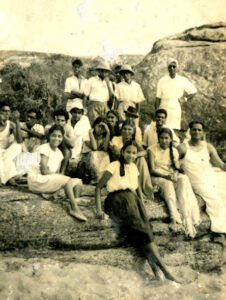

Mother in White Dress (left in image) on a Trip to Yala National when she was a teacher.  Probably around 1952
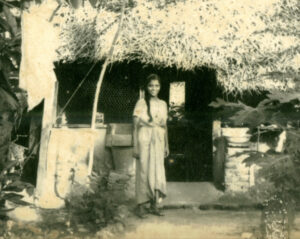

Mother in Batticola just after marriage. Parents lived there for 5 years.  I was conceived in Batticola just before they left.  Born in my grandmothers house in Galle. 

Another big issue was she traveled alone, without chaperones since an older teenager. I think she just couldn’t deal with the slow pace of Sri Lankans. One gets the impression that she was some kind dress up person. Anything but, workaholic like her father and mother. Mothers father died at 84 getting ready to go to work surveying. Most Stories told by Katrina Hamy who was about my mothers age. I think mother liked her more than her sisters, some of whom were big time gossips. Apparently even as a young teenager would come home and help in cleaning, toilets, drains washing up. Hated cooking but was a reluctant good cook when we were children. We did not have “help” as my mother didnt approve of “help”

Anecdote told by Katrna Hamy
Mother was the youngest in the family. Somewhere in her teens she took it upon herself to supervise some coconut properties that belonged to my Grandmother. She would get up at 4:00am and take the first train (5am night Mail). She was supposed to go with a chaperone. Mother does not wait for anyone. Once she is ready she leaves. The walk to the train station (about a mile) is dark and lonely. As she was walking there was a man following her. Mother probably heard the footsteps and turned and walked back to the man and he just ran. Probably thought my mother was Mohini a female demon who dresses in white.
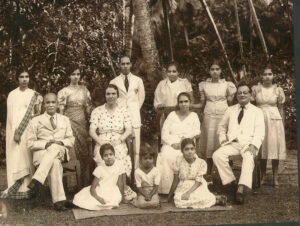

Mother family
Seated:  Sanford BeeBee (Jaffna Tamil), 2nd from Right Lilian Edith Tillekeratne (Half Sinhalese, Half Irish. note: No Jewellery). The two westerners are Mr and Mrs Graves. Missionaries
Seated on Ground. Peace BeeBee (my mother), next to her Katrina Hamy
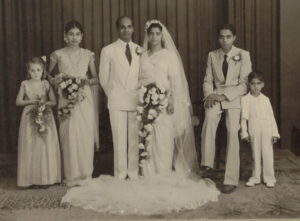

Parents Wedding Photo Galle, 1953
LR: Ms Anthin (Swedish Missionaries daughter), Sunethra neighbor and family friend, Sinhalese, AC Barr-Kumarakulasinghe (Jaffna Tamil), Peace Beebee (mother), Wilson Allegacone (fathers nephew, Tamil), Lal Liyanage (mothers nephew, Sinhalese)
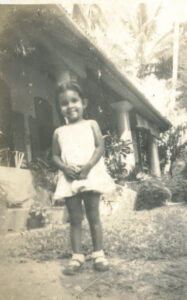

Grandmothers House in Galle


*For those who think this is boast. End of the line for my male Paternal line (about two males who carry the surname in Malaysia). The same for my grandmothers fathers line. The last in the male line was a classmate. As the Buddha says everything is Impermanent


Why we must talk about caste

Every few months (years?), Brown Pundits goes through its own small earthquake. A post lands wrong, a comment thread ignites, and the whole Commentariat erupts.

The latest rupture began with a mild jibe on caste. I pointed out, in passing, that caste shapes political instincts far more than many admit. The backlash was instant. A section of the readers declared a quiet boycott. The threads went cold. No one wanted to break ranks. The more one claims to have transcended caste, the clearer its caste blind-spots become. Silence itself becomes a shibboleth.

And when the silence hit, the blog froze. Continue reading Why we must talk about caste

Love Jihad Zohran

Congrats to Furan who was mentioned in this Five lessons for India’s Opposition from Zohran Mamdani’s triumph.

Born a Shia Muslim, he spoke to the Indian Eye of being raised in an interfaith family. “My mother’s side of the family is Hindu” he said, “and I grew up celebrating Diwali, Holi and Raksha Bandhan. Though I identify as Muslim, these Hindu traditions and practices have shaped my worldview
” His mother named him Zohran, which means the first star in the sky.

Zohran does seem to be a product of Love Jihad.


Brown Pundits