
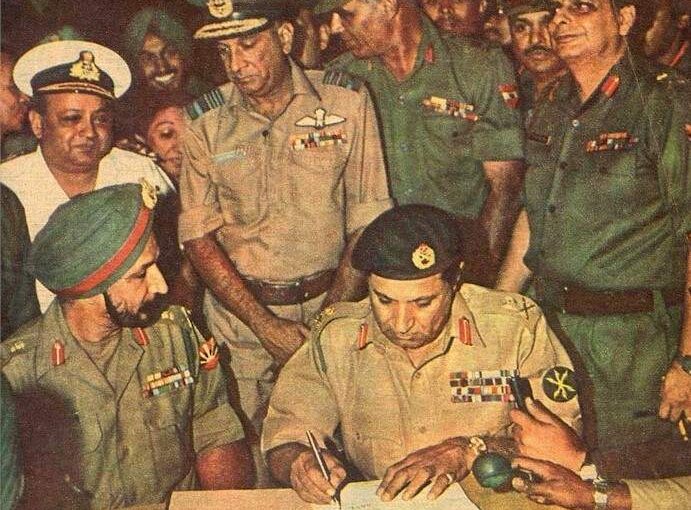
“Pakistan army remains the only one after WW2 to have carried out a large scale genocide. The comparison to the Nazis is a fact-based one. Mentioning this simple historical fact isn’t “anti-Pakistan”. RNJ
The events of 1971 in East Pakistan involved large-scale violence, mass civilian deaths, displacement, and grave violations of humanitarian norms. These facts are not contested. What remains contested is classification.
The term genocide is not a moral adjective but a legal category. It requires the demonstration of specific intent to destroy, in whole or in part, a protected group as such. Whether the actions of the Pakistan Army in 1971 meet that threshold has been debated for decades by historians, jurists, and international bodies. No international tribunal has issued a binding legal determination on this question.
It is therefore inaccurate to treat the classification as settled fact.
It is also inaccurate to claim uniqueness. Multiple post-1945 cases involve mass killing by state or quasi-state forces, including Cambodia, Rwanda, Bosnia, Indonesia in East Timor, Ethiopia under the Derg, Saddam Hussein’s Iraq, and others. These cases differ in scale, intent, structure, and outcome, but they collectively demonstrate that mass atrocity is not unique to any one army or state.
Comparisons to Nazism further complicate rather than clarify analysis. The Holocaust was a centrally planned, ideologically explicit project of total extermination, executed with industrial precision. Analogising disparate historical events to that case risks collapsing distinct phenomena into a single moral category, which weakens rather than strengthens historical understanding.
This does not absolve responsibility. It delineates it.
Criticism of military institutions, including allegations of political dominance, economic privilege, or abuse of power, is a legitimate subject of inquiry. Such criticism must, however, remain analytically separable from claims about national character or civilisational guilt. States are not monoliths, and neither armies nor populations are uniform actors across time.
The same standard applies across cases. If the use of maximalist language would be considered inappropriate or inflammatory in one national context, it should be treated similarly in another. Consistency is a requirement of serious analysis.
The function of historical discussion is not to allocate collective shame, but to establish responsibility with precision. When legal terms are used loosely, they lose their meaning. When moral language escalates without discipline, it ceases to persuade and begins to polarise.
The appropriate posture, therefore, is neither denial nor rhetorical excess, but restraint. Atrocity should be documented. Responsibility should be apportioned. Language should be exact.
Anything else substitutes heat for clarity.
The Holocaust was a centrally planned, ideologically explicit project of total extermination
I would think that the Israeli Genocide of Palestinians is the most horrific of this century. Centrally planned and explicit project of Total Extermination. Worse it is ongoing
In numbers
Gaza Killings: Since Oct 7th 75,000
Gaza Palestinians is 2.1millon
As a Percentage 2.1miil / 75,000 = 4%
So 4% of Gaza Palestians have been murdered.
This is the first time I have looked at the numbers
Gaza Palestinians = 2.1 million
West Bank Palestinians = 3.4 million
Israeli Arabs (Palestinians who have Israeli Citizenship) =2.1 million
============================================
Total Palestinian and descent Population = 7.6 million
Jewish Population = 7.8 million
No wonder the Jews want the Palestinians expelled or murdered. It is Demographic Time Bomb for the Israeli Jews. Kepp in mind there are a whole lot of Palestinians in Refugee Camps in Jordan.
no. it cannot be compared to hindu genocide of 1971 Jihad. so it is not the worst
Genocide is a legal term
Comparison of anyone with Nazis is always a red flag ; proxy for Godwin’s law : poor debating
But Is it a genocide/ethnic cleansing if it happens over 100 years ?
Data point :
in 1948 Hindus constituted 22% of East Pakistan.
in 2026 the numbers of less than 8%.
With current political reality : i don’t consider it very unlikely Hindus will constitute less than 5% of Bangladesh by 2047 years and became as irrelevant in Bangladesh as they’re in Pakistan.
This drop in proportion is not all killings but a combination of killings, forced conversions, coerced conversions, ethnic cleansing and disproportionate birth rates.
The stark reality of demographic change is Infront of everyone.
British India broke into 2: with minorities constituting roughly 10% of both parts (more in east pakistan : less is west).
75 years down the line:
Minorities in India are approaching 20%
Minorities in combined Pakistan approaching 5%.
Lets not call it Nazism or something inaccurate.
Lets call it what it is: the inevitable wheel of Islam.
This isn’t some grand plan or conspiracy: just inevitable outcome mixture of religion, modernity and politics.
If you look back over last 200 years the picture is even clearer:
After nearly intermittent 1000 years of Islamic conquests and rule: only 20% subcontinent had become muslim. We dont know how exactly but by a combination of elite conversions, forced conversions and coercion. (I think Omar Ali once mentioned how his ancestors converted for some business advantage).
In 100 years M proportion of subcontinent is closer to 35 (65-70crore vs 120 crore).
The Muslim population of Indian Punjab is approximately 2% (according to Google). Ethnic cleansing happened on both sides of the Radcliffe Line.
I absolutely agree with you that comparisons to Nazism are not acceptable. I don’t even like when Israel is compared to the Nazis. It is just a bad faith tactic ended to end debate.
People have been calling Gaza a “concentration camp” for years which I have always found unacceptable. Open-air prison is the more appropriate term.
Though perhaps post the current genocide in Gaza, “concentration camp” is not an inappropriate term.
That’s because the borders of modern day “Indian Punjab” were redrawn to the preferences of the Sikhs. At independence, Indian Punjab included entirety of Haryana, and large swathes of UP and Himachal.
That doesn’t change the fact that Muslims were essentially ethnically cleansed from what was then Punjab.
Ethnic cleansing happened on both sides of the Radcliffe Line. Entire trains arrived in Lahore with nothing but dead Muslims on board.
Shia Muslims in Pakistan constitute a significant minority, estimated at 10–20% of the total population, making it the world’s second-largest Shia community. While integrated into all aspects of life, they face severe security threats, systemic marginalization, and sectarian violence, particularly targeting the Hazara community in Quetta and during religious processions.
the above from wikipedia. kindly consider shias as a minority, preferably a prosecuted one.
those are good points; % are dynamic though.. for instance what is the composition of the elites (which is far more determinative than democracy)..
Just because some horrific act is not as bad as what the Nazis did during the Holocaust, or was not planned in as cold-blooded a manner, doesn’t make it not horrific or not condemnatory.
Yes, people should refrain from comparing anything and everything to the Nazi Holocaust of the Jews, but once someone makes that comparison, it gives naysayers an excuse to diminish that act and deflect from it. (This has been my observation.)
Case in point: there were several British massacres in India (most notably in 1857) as well as gross/criminal neglect leading to mass starvation (~1770, late 1800s). These are bad in themselves, and don’t put the British in good light. Yet, because several people compare the British Raj to Nazis, it gives British and imperial apologists an excuse to diminish these horrors and instead deflect to “British unified India, British built railways, canals, etc.” If the Nazis had not lost the war, I’m sure people in the future would have tried to minimize the Holocaust itself by singing praises of the autobahns in Belarus or whatever.
What “international tribunal” are you expecting a legal determination from? The ICJ? Wouldn’t someone have to go seeking for a ruling from them in order to get a legal opinion? And the ICJ is strictly less powerful than sovereign states, especially the great powers. Once India defeated Pakistan in 1971 and signed the Shimla Agreement, the Indian government was not interested in litigating the topic with entities that were subject to the politics of the great powers, and given the US’s attitude at the time, there was no way India would have gotten a sympathetic hearing.
Best we can do in these situations is do research, analyze the information, and come to conclusions without getting mired in legalese. Cause there ain’t no global cop or court that can determine and mete out justice in an unbiased manner among nation-states.
I think it’s a bit more nuanced than that. In the main hinge point of the movie, when the ISI handler is directing the 26/11 terrorists in Mumbai, the Baloch gangsters are acting as triumphant as anyone else in the room. Point being that whatever be the grievances of the Baloch against the Pakistani state, there is no daylight between their attitudes towards Indians and Hindus and that of other jihad-minded Pakistanis.
I know the movie is fiction, but I think this portrayal is likely accurate. The movie is trying to show that the Indian state is ready to use Pakistan’s internal cleavages against the Pakistani state, just like Pakistan has been doing in India for decades. AFAIK nobody in India knows much about nor cares about the Balochi “cause”, and if Indians learned more about Balochis and their attitudes (they are basically a tribal people with medieval values, just like in Afghanistan), they would care even less.
I have no idea if the Indian state is meddling in this like the Pakistanis allege, but the movie is basically escapist fare for Indians who are perennially depressed at our inability to prevent Pakistani terrorists from causing mayhem on our territory. The Indian viewer is meant to see the Balochis as an instrument in this regard, not as a cause celebre.
The Baluch share linguistic roots with the Kurds (Median origins) but very different geo-cultural expressions.
Among the Baluch in diaspora; there is a marked difference in religiousity between the Iranian Baluch & the Pakistan one.
Baluchistan is not an insurgency in the same manner as Kurdistan.
How would you describe the current state of affairs then?
Now that the admin of this blog has asked you to cease and desist from linking the Pakistan Army with Nazis please do so.
It is a fact that the founders of the RSS were inspired by European fascism.
The point is that anti-Pakistan rhetoric has been allowed on BP to an extent that anti-India rhetoric has not.
It is high time that this double standard is corrected.
I removed the comment. BB has to be careful otherwise I will also remove his other high signal comments since he shouldn’t lower the tone.
BB knows he crosses the line in a very obvious way.. I’m actually very tolerant of BB in general as I value his high-signal comments.
Kabir does have a point if he had made the Nazi – Holocaust reference; it would have been completely removed and I’d have cautioned him.
so bias runs both ways tbf.. I like to think I am fair where I can be
Arre, I am a very constructive guy.
Kabir’s fake facade makes me angry and I have to show him the mirror sometimes.
When upset take a stroll.. let’s all play fair
That is very odd; “Western content.” It does speak to being colonially co-opted
Calm pls
Obviously, your definition of what is anti-Pakistan differs from mine. I’m not taking movie recommendations from an anti-Pakistan troll.
For the millionth time: US citizens can live wherever they like. It doesn’t stop them from being US citizens.
I grew up in one of the wealthiest areas of the United States (Bethesda, MD). I’m sorry that makes you jealous.
Stop with the personal trolling. It is not appreciated.
Oh please! You’re jealous I have an American passport and you don’t.
Grow up.
Kabir calm please
Instead of inviting Iran – which has permanent representation at the United Nations – the Munich Security Conference invited Reza Pahlavi. He is the exiled son of Iran’s former US-backed shah ousted in the 1979 Islamic Revolution.
Pahlavi has supporters in the West, including among some Iranians in the diaspora, but the reality remains is that he is barely known among the Iranian populace. For the over 90 millions Iranians in the Islamic Republic, he’s not in reality a recognizable figure – but his last name is simply connected with history from a half century ago.
As expected Pahlavi used the platform to push for regime change and to appear at a rally. He went so far as to tell Reuters that Washington should bomb Iran rather than negotiate with it.
https://www.zerohedge.com/geopolitical/munich-security-conference-circus-iran-says-after-exiled-shahs-son-invited
you can post this as an open thread?