
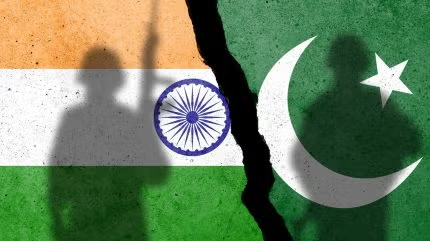
“No one wants a strong India. But PM Modi opened doors. He strengthened the military, advanced the economy, maintained balanced relations with the West, Russia, and China. That is serious statecraft” –Aleksandar Vučić, President of Serbia
India is richer
Strip away the noise and a simple asymmetry remains. India will almost certainly remain richer than Pakistan for the foreseeable future. The gap in GDP, fiscal depth, technology, and demographic scale is widening, not narrowing. On material indicators, India has the advantage. Yet material advantage does not always translate into strategic dominance.
India is louder
India is a mass democracy. It is electorally accountable, media-saturated, and sensitive to public opinion. Governments must justify escalation. Markets react to instability. Voters punish miscalculation. This imposes restraint.
Pakistan is tighter
Pakistan is structured differently. Power is narrower. Decision-making is concentrated within a smaller elite, with the military as the central institution. That creates rigidity in some domains but flexibility in others. Strategic continuity does not reset every five years. Public opinion matters, but it does not directly determine policy in the same way it does across the border.
Structural Differences
This structural difference shapes behaviour. India must think about global markets, coalition politics, and reputational cost. Pakistan can absorb economic stress more easily because its political system is already insulated from full electoral volatility. That insulation produces durability, even under strain.
The list gets smaller. There are six countries who sent the head of state/government to all three: 1) Beijing military parade 2) Davos Board of Peace launch 3) Washington BOP 1st meeting They are: Armenia | Azerbaijan | Indonesia | Kazakhstan | Pakistan | Uzbekistan
Like Israel
The comparison to Israel is imperfect but instructive. Pakistan sees itself not merely as a normal state but as a mission-driven one; founded around a civilisational claim. That narrative has penetrated deeply, especially within Punjab, which anchors the state. Whatever internal divisions exist, the core idea of Pakistan remains intact among large segments of its population. That coherence matters.
Iran is different
Iran is different. Iran is an old civilisational state that experienced a revolution. Its legitimacy rests on both nationalism and ideology. Economic collapse pressures ideology because there is an alternative identity beneath it: Iranian nationhood. Pakistan’s founding identity is narrower and more defensive. That makes it, paradoxically, more resistant to ideological erosion.
Indian commentary misfires
Indian commentary often assumes that economic divergence will produce political collapse in Pakistan. History suggests otherwise. States with concentrated power structures can endure long periods of stagnation if the elite remains unified and the core population internalises the founding narrative. This does not mean Pakistan is stronger. It means it is structured differently.
Operation Sindoor
Recent crises illustrate the asymmetry. India may dominate on conventional metrics, but limited engagements allow Pakistan to frame survival as success. In strategic competition, narrative often substitutes for parity. If an operation does not decisively alter the balance, as 1971 did, it risks reinforcing the opponent’s domestic cohesion. That is not a moral judgment. It is an institutional one.
Strength versus Weakness
India’s strength is scale, openness, and economic dynamism. Its constraint is democratic accountability and reputational sensitivity. Pakistan’s weakness is economic fragility. Its advantage is strategic continuity and insulation from electoral shock. Analyses fail when they assume both systems operate under identical incentives. They do not.
Two different worlds
India and Pakistan are not mirror states. One is a continental democracy managing diversity through electoral churn. The other is a security state anchored in a founding idea and sustained by a narrower power core. Economic trends favour India. Structural resilience favours Pakistan in certain forms of confrontation. Understanding that asymmetry is more useful than arguing about which country is “better.”
Who is India’s Daddy
India’s heroic heart could not stand it. After US threats, India gave up Russian oil
Map showing the movement of Russian crude tankers.
The majority of Russian tankers are seen heading to China, which is an entirely different picture from just a few months ago, when the majority of Russian crude would arrive in India on large discounts, notably at the Jamnagar refinery.
Under US pressure, India has almost halved Russian imports from 2 million barrels per day, mb/d, to just 1.1 mb/d, with the target of further reduction to 800 thousands barrels per day.
Despite the massive discounts on Russian crude, India has submitted to the US pressure, and in return, China is using the rerouted cheap Russian oil to fill the gaps of the lost Venezuelan crude.
https://x.com/Megatron_ron/status/2024080390189707738?
I think Modi made an excellent deal with the US fwiw; he’s been very adept in the Global Policy arena.
Here is a different view. Of course some people will dismiss “The Wire” as being “anti-national” etc but the analysis is based on facts:
https://thewire.in/history/modis-skewed-trade-deal-with-trump-demolishes-the-idea-of-swaraj-envisioned-by-dadabhai-naoroji-and-gandhi
I think Modi is adept on all things except when it comes to Pakistan because that’s when the Indian electorate become emotional ..
There are plenty of Indian analysts who believe that this trade deal is a surrender to the US.
Perhaps some of them are inclined to be anti-Modi but their analysis is still based on some facts.
Just one example (from the article I linked above): If India buys US cotton, who is going to buy Indian cotton? Bangladesh recently made a trade deal with the US in which they promised to buy US cotton. Traditionally, Bangladesh has bought Indian cotton.
Kabir you sound more and more like BB tbh
In what way?
This is not my original analysis. The people writing in “The Wire” are Indian.
You could argue that they are inclined to find faults with the deal because they are anti BJP but generally they present facts in support of their analyses.
Questioning this trade deal is not an “anti India” act.
Hahahahaha
Where is the US-Pakistan “trade deal”?
Reality is that Pakistan is not important enough to warrant one.
Trump used Pakistan for his Gaza security guard force and then banned immigration visas lol.
Aukaat.
For your information, Pakistan has not contributed any troops for Gaza.
“Aukaat”– How cute that you know one Urdu word! Buzz off.
For now. Everyone remembers how Zia killed Palestinians in Black September.
let’s avoid “killed” and deaths
Black September is a documented historical event, yes?
I think Modi made an excellent deal with the US fwiw; he’s been very adept in the Global Policy arena.
Specifics please
Even the Tariffs was a bad deal for India
.
18% is objectively better than its peer Asian competitors.
India continues to purchase S400 and other Russian arms, along with Russian oil – without using the USD, without any significant blowback. The ‘commitments’ to reduce Russian oil is being spun as some sort of ‘concession’ when in reality, India always has been beholden to the US-dominated global oil market. This isn’t a ‘new’ concession. India in the past agreed to suspend/reduce oil purchases from Iran as well, and Venezuela.
18% is objectively better than its peer Asian competitors.
India does not get to charge Tariffs on US Exports/
Check your objectivity. with Image
India is SL’s daddy. SL is just a playground for Indian tourists.
.
Lol no it was the Sinhalese who paid for the LTTE.
You are just coping now.
Anyway, two hoppers please with crab curry. Go easy on the spice.
Major Abhay Sapru on LTTE (Tamil Tigers) Explained In 18 minutes by Indian Commando.
1:32 shattered the myth of the Martial Races, Gurkhas , Sikhs
One of the training camps was in Chakarata, in Uttarakhan state up in the Himalayas. Thats asbout 100 km north of Deheradun, the capital of Uttarakhan. Population 800 million about the size of Colombo.
Even Prabhakaran was one time guest of India in Dehradun/Chakarata.
Apparently Chakarata was established with the CIA and trained Tibetan terrorists among many others.
https://www.youtube.com/watch?v=dLuzM7iHm8U
.
You don’t need to always hit back; if it is egregious just let me know and I can review
The comment on Indian Army deaths should be redacted.
Which one
https://www.brownpundits.com/2026/02/20/pakistan-will-remain-poorer-but-may-outfox-india/#comment-126587
sorry yes I missed this
thanks
How hypocritical! You constantly celebrate Pakistan Army deaths.
Don’t play the innocent when it is done to you.
“Don’t play innocent”.
The “the” is not necessary.
LOL! Whose English are you correcting? English is my NATIVE language. My ancestors have been speaking English for more than a hundred years. My parents went to the finest convent schools in Lahore.
You do not belong to the social class I belong to.
“Don’t play the innocent” is very much correct English. Don’t play this game with me.
“tu jaanta nahi mein kaun hoon” – Exhibit n
I firmly REJECT post-colonial pathologies about whose family has been speaking English.
English is nothing but a lowly functional language that was imposed by colonisers.
nothing to be proud of how long one’s ancestors were deracinated.
Watch Black Panther
You are entitled to your views on English. I think they are wrong. And ironically this whole blog is being run in English.
English is the language of Shakespeare, Austin, Dickens.
I will not stand for my social class being mocked. BB has called me a “taxi driver” and said that I ride a “motorcycle”.
In that context, I bring up the facts that my family were doctors and lawyers under the British. We are not chauffeurs. Rather, we have chauffeurs.
This is simply a fact.
social class is one thing
replicating post-colonial pathologies is another. there is a clear distinction
Pakistanis have an identity crisis. Not having much to inspire them, they look to other people for inspiration.
Kabir looks to England and America. Some look to Saudi etc etc.
.
@XTM: This is once again personal trolling.
I am not anyone’s driver. I have a driver.
.
.
.
.
.
.
.
stop getting personal with Kabir
Thank you.
There is really no need for it and it doesn’t add anything substantive to the conversation.
“Two hoppers please”– This is incredibly offensive.
.
it’s ok Kabir – I don’t want to hyper moderate BB
If he is allowed to troll people, we should be allowed to troll him back.
But that’s going to lead to a very bad place.
it’s not tit for tat Kabir.. I’ve been very considerate of you; BB & RNJ are writing very high-quality pieces for the blog.
even if they are anonymous (to some extent), they are not trolls.
I don’t want to manufacture offence. Also I don’t think they are aware that they can ask me to also moderate as you do.
Sbarrkum was indelicate in how he spoke about Bharat’s military prowess and deaths. After all the only undisputed military victory in the Indian Subcontinent, post-Partition, has been India that is Bharat.
I don’t think I have ever asked for Kabir’s……..silliness to be moderated. Because I do not believe in censorship, and to be blunt, his childish ‘attacks’ hurt his own credibility and don’t really bother me. His personal insults and rudeness demonstrate his prejudice and agenda effectively.
I think a ..spirited discussion has space for disagreement, and calling out of the counterparty’s position, biases and logical fallacies. Only the immature fail to do that with civility and resort to …silliness.
“personal insults and rudeness”– You used the word “taqqiya” towards a Muslim. That is Islamophobia.
You constantly question my center-left credentials. You showed great disrespect towards musicology.
I’m not going to forget. The list goes on.
Anyone who uses terms like “hate boner” in the public sphere has no business ever complaining about anyone else’s “rudeness”.
let’s not rehash the past
I have repeatedly asked RNJ to desist from interacting with me.
I have a right to bring up his record each time he accuses me of “rudeness”.
don’t respond to him or alert me
So it’s not acceptable to speak about India’s military losses (which I’m not defending) but celebrating Pakistani and Muslim deaths is less egregious?
This is a bit of a double standard.
BB and RNJ come here only to troll Pakistan and/or to troll me personally. Any neutral party will have noticed this pattern.
I have always moderated those comments when it comes to human life..
but of course it goes without saying India has been the military victor in every conflict in the Subcontinent outside of the China encounters
It is not acceptable to take Muslim deaths lightly. BB repeatedly does this.
I can’t keep up with the moderation
Of course. I don’t expect you to.
BB repeatedly tests red lines even when he knows perfectly well what they are. He clearly has no respect for me but one would think he would have some respect for you.
This is why I protested his being made “author”. Anyway….
Btw, where is Gaurav? I thought he was an “editor”?
if I see low-signal behaviour; people are going to lose author rights .. whoever it may be. everyone knows how to keep above board.
but of course it goes without saying India has been the military victor in every conflict in the Subcontinent outside of the China encounters
In SL it was India that lost badly. The IPKF left with their tail between their legs. Then the LTTE went into India and killed Rajiv Gandhi with the help of Indian Tamils.
That was in retaliation of all the rapes of SL Tamil women by the IPKF
You can check the deaths of IPKF in the wiki below
https://en.wikipedia.org/wiki/Indian_Peace_Keeping_Force
@X.T.M – Glorifying the death of an Indian PM. Please delete.
badshah
Poor little cry baby.
If you like making nasty comments take the answers like a man, not a wimp.
@X.T.M – Please delete this comment
Pakistan might not collapse but they will get poorer vis a vis India and those will have effects.
As much as @sbarrkum plays the anti-India heel here, SL is very pro India.
Recently there was a cricket match between Ind-Pak in SL. Pakistani nationals had to apply for a visa and wait for approval. Indians, on the other hand? Just book a ticket and fly in. No visa required.
Indians are a huge tourist market for SL &
Thailand ?
Yup. Largest in SL, 2nd or 3rd in Thailand.
Will be no 1 in all of SE Asia in 10-15 years.
Thailand, Philippines, Malaysia are all visa-free. Indonesia VOA. Vietnam e-visa.
I expect Europe, Latin America, Japan, Korea, Australia/NZ etc to be visa free by the 2040s.
Basically as strong as the Malaysian passport.
iA
.
.
.
Please, let’s not get into comments about peoples’ in-laws.
.
But we still have a higher HDI than India.
Here is wiki to prove my point
https://en.wikipedia.org/wiki/Indian_states_ranking_by_prevalence_of_open_defecation
Not greater than South Indian states.
These are old figures you are using.
This is 2026.
South Indian states have greater HDI/gdp pci with much larger populations.
.
You are making the argument.
You give us the numbers.
India’s Urban Water Crisis: Sewage in Taps, Deaths Across Citieshttps://youtu.be/MKreipm7qH8
Let’s not get into “street shitting”. BB is trolling but there are some lines that shouldn’t be crossed.
@XTM: BB calling Sbarr “boy” is reminiscent of racist Whites referring this way to African-Americans.
BB has nothing better to do than to troll me and Sbarr. Simply because he doesn’t like Pakistanis and Sri Lankans.
Naah, I like Lankans and they like Indians too.
He has a perspective based on India’s interference in SL’s internal affairs.
I am “public enemy number one” on this blog and Sbarr is “public enemy number 2”. It is what it is. But it certainly is a comment on the intellectual quality of people who comment on BP.
You are an author now (however misguided I think that is). Please move beyond trolling individuals.
.
Amen
.
.
.
.
.
.
I have no complex about not being White. The last time I thought about this I was seven years old and thought being blond and blue-eyed would help me fit in better in the US. Some of us do grow up and move beyond that.
.
You aren’t American, boy. Don’t hide behind wignat talking points.
Thanks Kabir, did not notice the “Boy”
Incidentally “wignat” is A more openly Nazi white nationalist. Had to look it up.
Quinn Dale the comedian in anything but that.
yes I don’t see why BB has to respond constantly; he can just ask me to moderate
This one needs to go too
https://www.brownpundits.com/2026/02/20/pakistan-will-remain-poorer-but-may-outfox-india/#comment-126665
done!
.
.
South Indian states are richer (just like North India is richer than Pakistan)
South Indian states are richer (just like North India is richer than Pakistan)
South Indians (Tamil Nadu and Kerala) are like Sri Lankans. More AASI and egalitarian
.
SL got its ass saved by india.
India keeps giving us loans. Does not want China to step in, Thats the reality
.
.
.
BB stop pls now ..
Please ask sbkarrum to as well and remove his comments as well.
It’s not a tit for tat.. I’m not following the exchange but you always insist on winning every encounter.
Take RNJ’s cue pls
.
.
.
Stop pls
Sbarr please don’t insult India as I find that personally very offensive
Sbarr please don’t insult India as I find that personally very offensive
XTM You care about insults. I care about what India did to Sri Lanka. Sponsored the LTTE terrorist SL ended up with a 30 year civil war.
Sbarr – calm now, that was an incredibly offensive comment you made about my relatives.
.
I meant as a tourist hotspot. You were the one whose mind wandered to prostitution and gambling.
I didn’t even know there was a Thailand like scene in Sri Lanka.
Projecting too much.
I meant as a tourist hotspot.
Most Indian “tourists” are single middle aged men hitting the casinos with the intention of sampling “fair and lovely” Thai and Filipino hostesses.
Most of the younger demographic dont visit the big tourist hot spots, the beaches. Simple reason most Indians cant swim. They also dont want to get dark skinned.
@X.T.M – delete this please
.
@X.T.M – delete this please
Agreed
Iran however is undoubtedly the underdog in this fight. It can not win a war against a country that is several thousand miles away from its shores. The damage a sustained U.S. air campaign will cause will be real and very painful. The real threat is not a one off campaign but a constant deterioration of the Iranian state should the U.S. decide to wage a long campaign of attrition against it as it did against Iraq between the two Gulf wars.
The only way to prevent that is for Iran to use the economic power that comes with its control of the Strait of Hormuz. A blockade of the Strait would raise global oil prices to the north of $100 per barrel. With energy prices going through the roof, and the collateral economic damage cause by it, the chance of the Republicans winning the midterms will go down to nil.
It is doubtful though that Trump still cares about that.
https://www.moonofalabama.org/2026/02/u-s-israel-ready-to-strike-at-iran.html
Yes, I’m very concerned about Iran.
I’m planning to read and review Vali Nasr’s book Iran’s Grand Strategy.
This is why I said that there are plenty of other issues in the world than “India vs. Pakistan”.
The US is in “active negotiations” with India, which it hopes to persuade to import oil from Venezuela instead of Russia, the American ambassador in New Delhi has said.
If India surrenders to big daddy USA it is big loss. Heavy Venezuelan oil is VERY HARD to refine. Existing refineries in India will have to be re configured. Huge capital expense.
Even US oil companies are backing away from investing and repairing existing Venezuelan Refineries because of the large cpital needed
https://www.rt.com/news/632836-us-india-oil-venezuela/
Except for the fact that Indian refineries can already process it.
Not quite as simple as that
Overall, a complete pivot away from Russia could raise India’s import bill by $9bn to $11bn – an amount roughly equal to India’s federal health budget – per year, according to Kpler.
https://www.aljazeera.com/economy/2026/2/4/can-india-switch-from-russian-to-venezuelan-oil-as-trump-wants
Al jazeera lol
I trust the math of Indian accountants on whether the net-net cost-benefits are in India’s favor, over….propaganda.
It is very expensive being Big Daddy Policeman to the world.
Now we have some number as to what the US owes to the UN.
The money (160 million) is a small fraction of the $2.19 billion the US reportedly owes for the UN regular budget and $2.4 it owes for current and past peacekeeping missions. The US is responsible for around 95% of the overdue payments to the UN’s regular budget,
https://www.rt.com/news/632850-us-massive-un-debt/
Guess who is Trumps Big Daddy, Gods Chosen Ones who should not be names.
All in retaliation for Issuing arrest warrants to Netanyahu and other Israelis.
Since Trump returned to power last year, his administration has worked steadily to hobble the Hague-based court. To date, 11 of the court’s officials – including the chief prosecutor and eight judges – have been placed under sanctions
When the Canadian Kimberly Prost learned Donald Trump’s administration had imposed sanctions on her, it came as a shock.
For years, she has sat as a judge at the international criminal court, weighing accusations of war crimes, genocide and crimes against humanity; now she is on the same list as terrorists and those involved in organised crime. “It really was a moment of a bit of disbelief,” she said.
The fallout was both material and psychological. As her credit cards, Amazon and Google accounts were cancelled, she reeled from what she described as a “direct and flagrant attack” on one of the world’s most prominent courts.
https://www.theguardian.com/law/2026/feb/18/international-criminal-court-icc-judges-trump-sanctions?
Guess who is Trumps Big Daddy, Gods Chosen Ones who should not be names.
All in retaliation for Issuing arrest warrants to Netanyahu and other Israelis.
Since Trump returned to power last year, his administration has worked steadily to hobble the Hague-based court. To date, 11 of the court’s officials – including the chief prosecutor and eight judges – have been placed under sanctions
When the Canadian Kimberly Prost learned Donald Trump’s administration had imposed sanctions on her, it came as a shock.
For years, she has sat as a judge at the international criminal court, weighing accusations of war crimes, genocide and crimes against humanity; now she is on the same list as terrorists and those involved in organised crime. “It really was a moment of a bit of disbelief,” she said.
The fallout was both material and psychological. As her credit cards, Amazon and Google accounts were cancelled, she reeled from what she described as a “direct and flagrant attack” on one of the world’s most prominent courts.
https://www.theguardian.com/law/2026/feb/18/international-criminal-court-icc-judges-trump-sanctions?
Article written by a young 40 something Sri Lankan who grew up in Canada.
The spoil behavior isn’t limited to Indian soil. Indian owners in the Hundred league in England and the South African league have effectively banned Pakistanis as well. Only for the players nationality, or religion really. It’s honestly disgusting. It’s not in the spirit of cricket at all. India has risen to the pinnacle of the sport, but they’re being terrible sports about it, and it tells.
More people are getting into the game, but at the same time India is actively pushing Muslim countries and Muslim players out, which is a same. Sport is supposed to be an escape from real divisions into artificial ones, but there’s no escaping India when it comes to cricket. People call the International Cricket Council the Indian Cricket Council as a joke, and it’s no joke.
As I’ve said, there are many Indias, and you simply don’t have this petulant prejudice in Tamil Nadu and Kerala. It’s a North Indian thing, but it unfortunately infects the national team, which has now become a vehicle for this toxic nationalism.
Not Cricket: How Indian Racism Is Infecting The Sport
https://indi.ca/not-cricket-how-indian-racism-is-infecting-the-sport/
Naah.
Pakistani origin players play ipl as do pakistani ex-citizens who have surrendered their passport.
>you simply don’t have this petulant prejudice in Tamil Nadu and Kerala. It’s a North Indian thing,
Yet again, we have Barr leaking his personal prejudice, when facts very easily point to the oppposite. For more than a decade, Sri Lankan cricketers in the IPL were de facto banned from playing in Chennai, Tamil Nadu due to the violence inflicted on Tamil Lankans. I’m quite surprised that you are unaware of this. But then again, when it comes to prejudice, its almost always fueled more by ignorance than facts.
He is allowed to link to an article?
I am challenging his oft-repeated, subjective, inaccurate prejudicial trolling on the so-called North Indians being “different” and “evil”. This exchange is highly clear, not sure how you are missing my point.
all four of you are authors; please be civil to one another otherwise I’ll arbitrarily remove authorship rights.
no foul language, no overuse of provocative terms (genocide is not a legal definition).
don’t be subjective and don’t abuse one another countries.
This is exactly why I banned RNJ and BB from my threads. I know that it’s not “freedom of speech” but I got tired of dealing with anti-Pakistan comments and/or personal trolling. If they calm down in future, I may rethink that policy.
In general, I think the constant “India vs. Pakistan” thing is getting rather repetitive.
genocide is not a legal definition).
I think you are becoming like Trump, Laws, Rules all being thrown out.
Genocide is a strict legal definition under international law, defined by the 1948 UN Genocide Convention and the Rome Statute of the International Criminal Court. It requires the intent to destroy, in whole or in part, a national, ethnical, racial, or religious group
The context is that the Indian commenters constantly use the term “Bangladesh genocide”. This is done only to trigger me as the only Pakistani on this forum.
“Bangladesh genocide” is an Indian and Bangladeshi term. It is used for political reasons. It’s not objectively determined.
That’s what XTM is referring to.
.
I meant genocide is legally defined
Yes.
In the case of 1971, the use of this word is political and not objective.
It is very triggering to Pakistanis.
.
I think you are trolling me but just this once I’ll answer this question as if you are operating in good faith:
Of course, there are many Israelis who don’t want the events of the past two years referred to as “genocide”. I prefer not to make this into a religious issue since there are many Jews around the world who do recognize it as a genocide.
The International Court of Justice has recognized that Israel has committed genocide in Gaza. People are literally buried under rubble. Children have starved to death.
Gaza is internationally recognized as Occupied Territory.
East Pakistan was unequivocally part of Pakistan. What happened there was a civil war.
Hope that clears it up for you.
https://hmh.org/education/bangladesh-1971/
You are entitled to your point of view.
The fact remains that as a patriotic Pakistani, I will never accept the Indian and Bangladeshi framing of “genocide”. It was a civil war and excesses were committed both by the Pakistan Army and by the India-sponsored Mukhti Bahini.
XTM has asked you to desist from using provocative rhetoric such as “genocide”. If you have no respect for me at least have some respect for him as the admin of this blog.
It’s nothing to do with Patriotism, Kabir. It is to do with legal definition; get a grip.
.
I strongly believe its deeply unpatriotic to obfuscate the mistakes of one’s government. Its 2026, tribal circling of wagons only serves to give refuge to scoundrels.
..
that is not your right when genocide is a legally defined sensitive erm.
I disagree with Kabir and edited his comment
since what you wrote is offensive I removed it.
Genocide is a LEGAL definition; if it is decided by the ICJ that Bangladesh was a genocide, your patriotism would have no bearing on it.
.
I didn’t know about the ICJ; but I removed BB’s
Comment as it felt deeply Islamophobic tbh.
I wouldn’t say it was Islamophobic as such.
But I don’t think that the comparison between Gaza and East Pakistan was made in good faith.
For one thing, Gaza is internationally recognized as Occupied Territory. East Pakistan was unequivocally part of Pakistan.
This is a low signal comment
I misspoke I meant genocide is a legal term