
A dispatch from a quieter Brown Pundits
The Observation
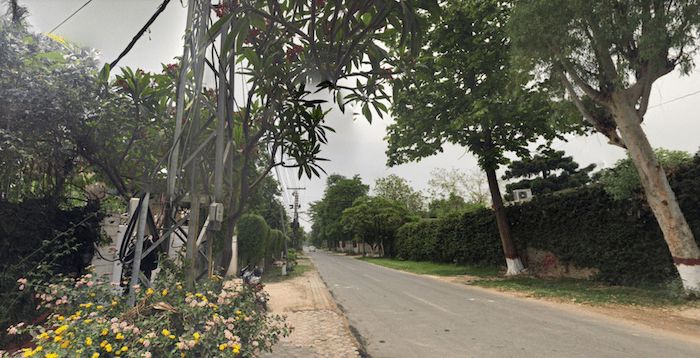
My Urdu teacher said something that lodged itself in my brain. India is vastly richer than Pakistan; and yet Pakistan’s Punjab, in his experience, feels cleaner. More ordered. Less like South Asia. I pushed back. Then I stopped.
The Numbers
In 2024, India’s GDP per capita was $2,695 against Pakistan’s $1,479; roughly 1.8 times higher on a nominal basis, and India’s total economy at $3.9 trillion is approximately ten times Pakistan’s $372 billion. Until 2008, Pakistan was actually richer per person; India led that measure for only 14 of the 60 years after independence. The divergence is real but recent and accelerating.
The sanitation data cuts against the perception: 81% of Indians have access to basic sanitation versus 72% of Pakistanis (WHO/UNICEF, 2024). On paper, India leads. So the paradox isn’t statistical. It is visual. The question isn’t who has more toilets. It is why certain Pakistani streets feel more governed.
The Answer: 41 Cantonments
Pakistan has 41 military cantonments embedded inside its major cities; Lahore, Rawalpindi, Peshawar, Multan, Gujranwala. These are not barracks. They are independently governed urban municipalities under the Federal Ministry of Defence, legally outside provincial and city government jurisdiction entirely. Lahore Cantonment, established by the British in the 1850s, was described by one colonial planner as “a Garden City built half a century before the concept became popular in England.” It remains, today, one of the most ordered districts in Lahore; roads maintained, signals functioning, encroachments cleared, services enforced by a Cantonment Board that answers to the Ministry of Defence rather than to Lahore’s chronically underfunded Metropolitan Corporation.
Layered onto this is the Defence Housing Authority, DHA, formally institutionalised in 1980, now present in every major Pakistani city, run by serving and retired army officers. DHA enforces zoning rules, building codes and maintenance standards with penalties that are actually applied. Wide boulevards stay wide. Garbage gets collected. One Lahore property source describes it with accidental precision: “For people frustrated with the lack of rules, cleanliness, and discipline on Pakistani streets, DHA can be a breath of fresh air.”
The streets my Urdu teacher was walking, the streets most visitors photograph and compare, are cantonment-adjacent or DHA streets. They are not representative of Pakistan. They are representative of what happens when the military administers urban space.
India has 62 army cantonments too, but they cover far less of the urban fabric proportionally. More importantly, Indian civilian governments have progressively asserted municipal authority over cantonment land since independence. Pakistan moved in the opposite direction: the military’s urban footprint expanded, producing a parallel civic order that operates beside the civilian city rather than beneath it. The underlying civilian city, Lahore proper, outside the wire, struggles with the same sewage crises, the same air quality disasters (Lahore regularly tops global pollution indices), the same infrastructure deficits as any comparable South Asian metropolis. Pakistan loses an estimated 6.5% of GDP annually to air pollution-related health costs alone.
The observation is real. The explanation is structural, not cultural. In Pakistan’s Punjab, enforcement wears a uniform.
The Hybrid Regime Effect
Since 2008, political scientists have formally categorised Pakistan as a hybrid regime: elected governments operating under sustained military oversight, with the army setting policy on India, Afghanistan and CPEC while civilian institutions manage the margins. This arrangement is, by any democratic standard, a serious problem. But it produces one visible side effect; a stratum of urban Pakistan that functions because the institution running it is insulated from the pressures that typically weaken South Asian municipal governance.
Islamabad crystallises this. Built from scratch in the 1960s to a master plan by Greek urbanist Constantinos Doxiadis, administered with unusual coherence, it reads less like a subcontinental capital and more like something placed there from a different regional register. That is not coincidence. It is administrative continuity; what a hybrid regime buys when it decides a boulevard should stay wide.

Pakistan did not build cleaner cities. It built cleaner enclaves. The hybrid state is what endows them with structure.
Punjab Is Not Pakistan
Precision matters because imprecision is exactly how this kind of conversation becomes useless heat rather than useful light. Pakistan’s Punjab, 52 million urban residents per the 2023 census (75 million rural), Lahore at 14 million, is the geography where this observation lives. Outside it, the country fractures differently. Balochistan operates through tribal power structures formalised under British colonial officer Robert Sandeman from 1877 onward and never fully dismantled. The Sardars, not Waderas, who are the landed feudal class of Sindh; these are not interchangeable; represent around 70 chiefs across 46 major Baloch tribes. Bhutto announced the abolition of the Sardari system in Quetta on 8 April 1976. It was never implemented. The Balochistan insurgency, currently in its fifth cycle since independence, is a story rooted in that structure. It is not a Punjab story.
The “clean Punjab” perception is a military-administration story localised to one province. It is not a national one.
Sri Lanka, for Comparison
Sri Lanka sharpens the point usefully. With a GDP per capita of $4,516 in 2024, three times Pakistan’s, Sri Lanka’s cities feel organised without depending on military-administered enclaves to achieve it. It reads less like the Indian subcontinent and more like Southeast Asia: functional civic institutions at a higher income level. That contrast flatters neither India nor Pakistan. It simply shows what sustained municipal competence looks like when civilian governance has had time and resources to mature.
The Indus, Briefly
Underneath the cleaner street is a material fact worth noting. The Indus Waters Treaty of 1960, brokered by the World Bank after nine years of negotiation, gave Pakistan control of the three western rivers: the Indus, Jhelum and Chenab. These carry roughly 80% of the Indus system’s total flow and irrigate approximately 80% of Pakistan’s arid land. Agriculture accounts for 23% of Pakistan’s GDP. The Indus basin is the material foundation beneath Punjab’s relative prosperity. India suspended the Treaty in April 2025 following the Pahalgam attack, the first disruption in 65 years, currently before an international court of arbitration that India has declined to recognise.
Where This Leaves Us
The observation my Urdu teacher made was not a provocation. It was a data point that demanded an honest answer rather than a hedge. The answer turns out to be the cantonment, the DHA, the hybrid regime, and sixty-five years of military urban planning hiding in plain sight on a wide, clean boulevard in Lahore. Step off that boulevard and the illusion dissolves. But on the boulevard itself; it holds.
.
I removed this comment because of the last sentence, which was spiteful
What was it? I didn’t mean any spite. Was a very factual comment.
reread ur last line
I don’t have access to it.
Is it the percentile thing?
That is a fact.
Jio has revolutionized the internet in India and given access to poorer sections of society for cheap. Pakistan has nothing of that sort so obviously that segment doesn’t have access to the internet.
You said they are illiterate and don’t even know what the internet is.
None of these points are incorrect.
I did not say that all Pakistanis are illiterate but considering the 60% literacy rate of Pakistan, it wouldn’t be too far off to assume that poorer/rural people are illiterate.
And considering internet penetration, again wouldn’t be far off that they don’t know what the internet is.
I would have said the same of India circa 2010-ish.
That’s just absurd
This point about poorer Pakistanis “not knowing what the internet is” is ridiculous.
Anecdotally, even my servants (who are either illiterate or not very educated) have smartphones and know how to use WhatsApp, Facebook etc.
TikTok (which I am not on) is full of Pakistanis making videos. Presumably, many of them are not educated.
let’s try to ease on the Aristo language where we can 🙂
I mean I can use the term “employees” but that doesn’t change the reality no?
Since you are learning Urdu, the words we normally use are “naukar” (which I guess is literally “servant”) and “mulazim” (which is more polite and i guess more like “employee”).
There’s nothing special about having servants in Pakistan. You either have servants or you are a servant. It’s pretty much a binary.
Kabir you can imagine this sort of language can be offensive to Westernised ears right?
If it’s that important to you, I’ll make sure to use “employees” going forward.
It doesn’t change the reality though.
And I know all about “western” sensitivities. Please don’t forget I was raised entirely in the US.
ok
We are not talking of Lahore but rural KPK, Sindh, Balochistan and even Punjab thbh.
Obviously the poor in Lahore will have access to internet and are literate.
With all due respect, you don’t know what you’re talking about.
People are making Tiktoks all over Pakistan not just in Lahore.
Drivers and cooks have smartphones. This is just reality.
agreed
I think you purport too much on Pk – BB
As it is said, Pakistan starts 20kms from Islamabad?!!
touche