The Meltwater Carries No Passport

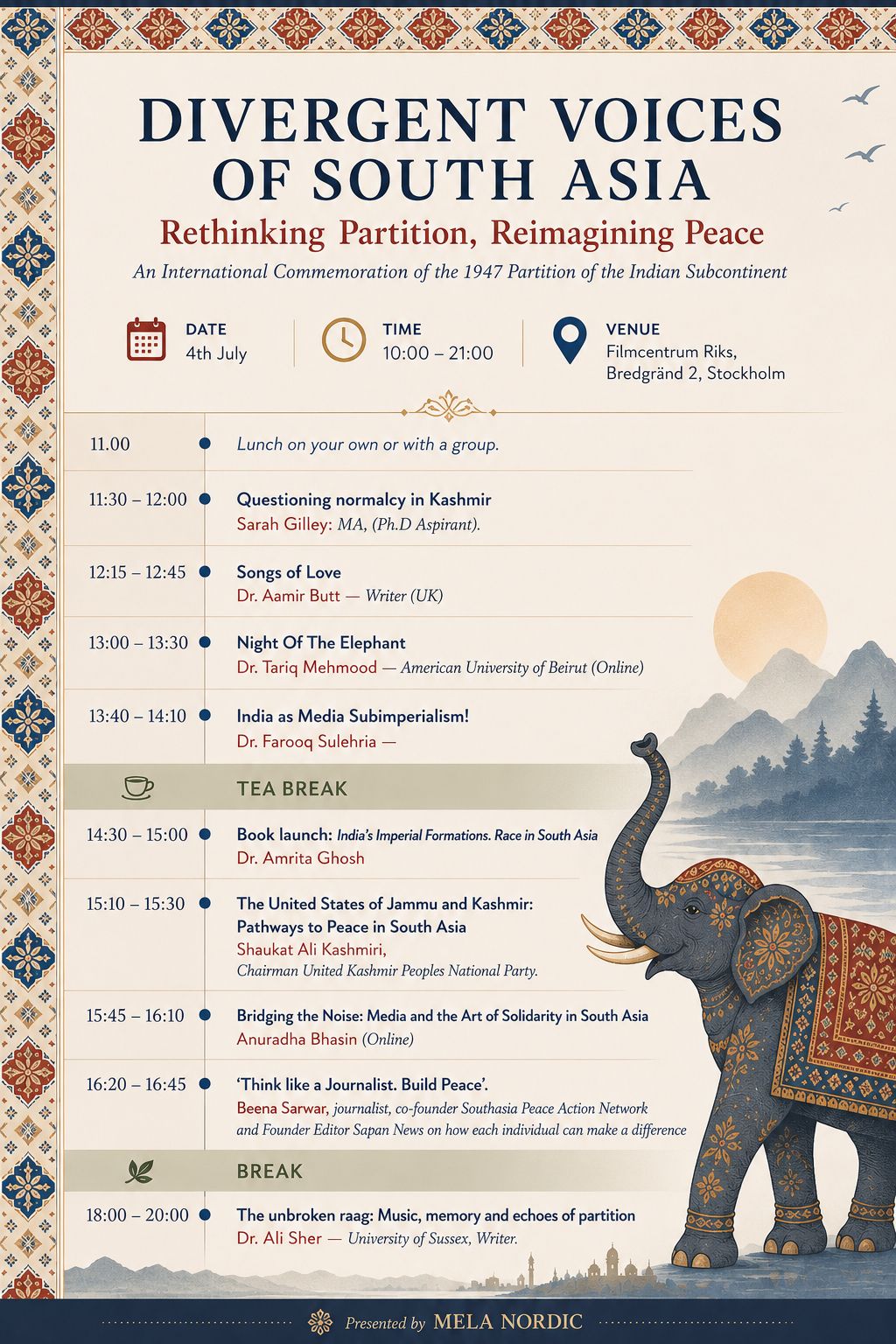
Notes on the closing talks of “Divergent Voices of South Asia: Rethinking Partition, Reimagining Peace” – Mela Nordic, Filmcentrum Riks, Stockholm, 4 July 2026. First of two parts.

(Quotes are drawn from a rough live transcript and lightly edited for clarity; read them as close paraphrase rather than verbatim.)


There was something quietly apt about the calendar. On the Fourth of July, the day one republic celebrates the border it drew for itself, a room in Stockholm spent ten hours mourning a border drawn for someone else. Mela Nordic’s day-long commemoration of the 1947 Partition, Divergent Voices of South Asia: Rethinking Partition, Reimagining Peace, earned its title honestly. The programme ran from Sarah Gilley questioning the manufacture of “normalcy” in Kashmir, through Farooq Sulehria’s provocation “India as Media Subimperialism!”, to the launch of Amrita Ghosh’s India’s Imperial Formations: Race in South Asia, to Shaukat Ali Kashmiri of the United Kashmir Peoples National Party; a man whose politics manage the rare feat of being equally inconvenient to Islamabad and to Delhi. Divergent voices in the strict sense: nobody in that room agreed on everything, and the organisers plainly did not want them to.

The late afternoon saw two back-to-back talks by two of the subcontinent’s most stubborn journalists. Anuradha Bhasin, executive editor of the Kashmir Times, joined by video link for “Bridging the Noise: Media and the Art of Solidarity in South Asia.” Hers is the name on the Supreme Court petition that forced the January 2020 ruling that indefinite internet shutdowns are impermissible and that any shutdown must answer to proportionality and be published; a judgment that wrote the rules without lifting the blackout, which tells you most of what you need to know about the terrain she works. She was followed, in person, by Beena Sarwar, journalist, filmmaker, teacher, co-founder of the Southasia Peace Action Network, whose talk is the subject of Part II.

Heard in sequence, the two talks assembled themselves into something neither quite was alone: Bhasin supplied the blueprint, Sarwar the working prototype. This first part takes the blueprint, and holds it up against the graveyard of everyone who has tried to build it before.

The one story

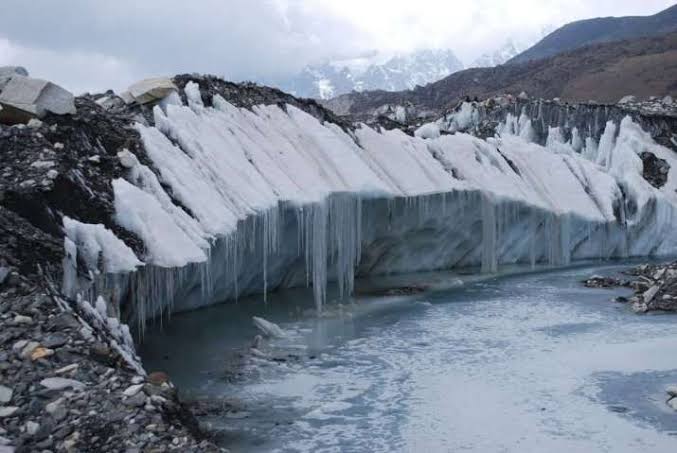
Bhasin’s talk built to a set of concrete proposals, and the sharpest of them was a reframing so simple it is astonishing how rarely one hears it. The single most important story in South Asia right now, she argued, is the melting of the Himalayan glaciers; and it is being covered entirely through national lenses. Pakistan’s floods. India’s heatwaves. Nepal’s vanishing ice. The poisoned politics of the Indus Waters Treaty. Four national stories, four national blame games. “These are not separate stories,” she said. “They are one story“; the story of a shared ecosystem under shared threat. The meltwater, after all, does not stop to have its papers checked at Wagah.

From that reframing flowed her first proposal: well-funded, editorially independent cross-border journalism collaborations; joint investigations, joint reporting on shared rivers and shared climate data, joint coverage of health crises, literacy, and what is actually happening inside each country’s universities and laboratories. Not from the nationalist angle, not from the blame angle, but from the angle of what is actually happening.

Continue reading The Meltwater Carries No Passport

Two House Precedents

We apologise for overriding 0M-3’s excellent post, on Geography is Power, but we are pushing it up and allowing it to breathe.

We also second Kabir’s proposal for a book club, with Midnight’s Children as our inaugural read ahead of India and Pakistan’s Independence anniversaries in mid-August.

One. Online-safety reports go by email. From now, any online-safety violation must reach us by email. That is the investigative channel. If it does not land in the inbox, it is not in front of us, and for our purposes a violation we never see did not happen. Send it to us directly.

Two. What Brown Pundits is about: biodiversity and bio-density. Two aims. Density: a 20 comments per post. Diversity: five voices per thread, not a closed loop of a handful names. A hundred comments from a small circle is a monologue. A hundred from ten is an ecosystem, and the ecosystem is what we are here to keep alive.

A post unlikely to reach either metric may be held in abeyance or returned for reworking.

We have felt the losses. BB stepping back, and Indosaurus before that, cost us more than volume. They were bridges. BB in particular always found the connective tissue to sports and the economy that the rest of us missed. So read this as an open invitation home. We will be reaching out, and if either of you is reading, the room is still yours.

Geography is Power

The goal of this post will be to act as a counter to XTM’s post about geography not being power. It will rely on realism as a doctrine of international relations to de-cypher the significance geography has had on the Indian Subcontinent and how it has affected the trajectories of the nations within it.

Geography initially reared its head in discussions of strategy during the times of Mackinder and Mahan in the early 1900s. Where Mackinder so boldly stated that “Who rules East Europe commands the Heartland; who rules the Heartland commands the World-Island; who rules the World-Island commands the world.”. However, these words were written in colonial era Britain as a device to fear monger about the Russians as they were the perfect counter to their strategy of controlling the world with sea power through internal lines of transportation through Cold Siberia. With that cold logic Russia which had been the ally of British through the two world wars became a target. Continue reading Geography is Power

Pink boots

1.oh God!! Germany out.
2. Brazil scrapping through. Japan gave Good fight.
3. Morocco hanging on. Netherlands out. What a game!! 
4. Can’t believe and understand why grown up men should wear pink boots.
5. Kick and run northern European football is out, south European irritating tiki-taka is the normal now.
6. People are commenting on the large number of African-descended individuals in the game.

Continue reading Pink boots

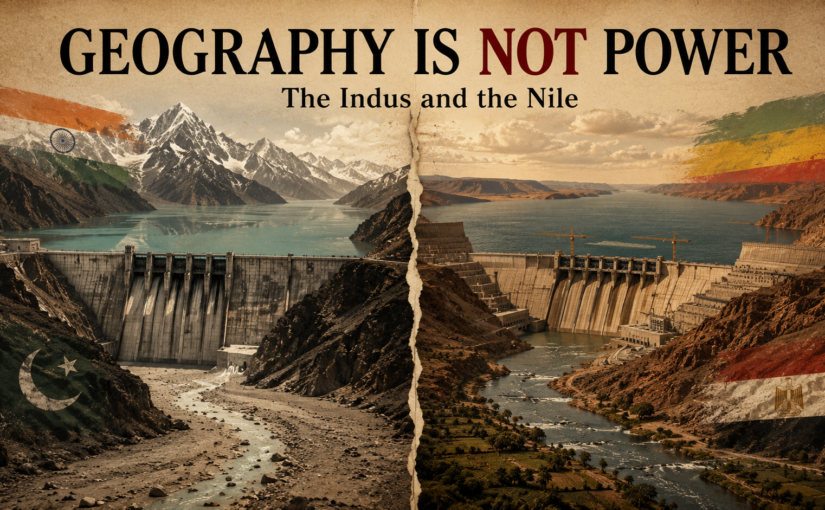
Geography Is Not Power

The Indus Waters Treaty and the Nile

While the previous thread argues about whether Panini held a Pakistani passport, a more useful quarrel is flowing past us. In April 2025, after the Pahalgam massacre, India held the Indus Waters Treaty in abeyance. It did this the day after the attack, a fortnight before the missiles of Operation Sindoor. The water came first. That order tells us something: New Delhi reached for the river before it reached for the air force, because it believes the river is the better weapon. We think it is wrong about that, and the reason why takes us a long way from the subcontinent, to the Blue Nile.

The instinct underneath India’s move, and underneath most of the commentary on it, is that the country upstream holds the whip. Sit at the top of the river and you control the tap. It is a tidy idea and it is false. Whether the upstream state is master or supplicant depends not on the map but on which side can make the other bleed.

India is running a bluff it cannot yet call. The treaty India suspended was built to survive exactly this. Signed in 1960 under World Bank mediation, it gave Pakistan the three western rivers and India the three eastern ones, and it contains no exit door. A party cannot lawfully walk away or hold it in abeyance; it stays in force until both sides agree to change it. India knows this, which is why, when it asked twice, in 2023 and 2024, to renegotiate, and Pakistan refused to come to the table, India was left with grievance and no remedy. The Court of Arbitration has since ruled, more than once, that the suspension has no standing and that the limits on India’s water control still bind. India calls the court illegal and presses on.

Continue reading Geography Is Not Power

Who did the Brits conquer India from?

We asserted that West crushed and humiliated the Mughals. 0M-3 answered that the humiliation was an inside job: it was the Marathas who broke Mughal power, and when Delhi passed to the Company in 1803 the treaty was signed with the Marathas, the emperor not even a party to it.

Did the British take India from the Muslims or from the Hindus? The empire the British inherited had already fallen apart, and it had fallen apart along lines that almost had nothing to do with faith.

The British conquered successor states, not an empire.

Aurangzeb died in 1707, and within a generation the Mughal map was a fiction. Hyderabad went its own way under the Nizam by the 1720s, Bengal and Awadh became nawabis in all but name, and the Marathas took the centre. The spectacular blows did not come from London. Nadir Shah of Persia sacked Delhi in 1739, carried off the Peacock Throne and the Koh-i-Noor, and left tens of thousands dead in the streets in a single day. The Afghan Ahmad Shah Durrani came back to plunder again and again after him. By 1788 the emperor Shah Alam had been blinded by an Afghan adventurer and was living as a pensioner of his Maratha keepers. When General Lake walked into Delhi in 1803 he collected a prisoner the Marathas had been holding, not a throne. The British did not topple the Mughals. They arrived to read the will.

The frontiers were not religious frontiers.

Press the communal map onto the eighteenth century and it tears at once. Tipu Sultan, the Muslim tiger of Mysore, ruled a country that was mostly Hindu and ran his revenue through a Brahmin, Purnaiah. Ranjit Singh, the Sikh lion of Lahore, ruled a Punjab that was mostly Muslim. The Maratha and Nawabi states alike were administered by Hindu clerks and financed by Hindu bankers. There was no Muslim India and no Hindu India waiting to be defeated. There were states, and the faith of the man at the top told you very little about the people beneath him, still less about the men who ran his treasury.

The conquest was paid for and fought by Indians.

Plassey in 1757 is remembered as a battle. It was closer to a purchase. Siraj-ud-Daula lost because his own commander, Mir Jafar, stood aside, and Mir Jafar stood aside because the Jagat Seths, the richest Hindu banking house in Bengal, had decided their Nawab was bad for business and bought his army out from under him. Seven years later at Buxar the Company beat the Nawab of Awadh, the deposed Nawab of Bengal, and the Mughal emperor himself, all three together, and then took the right to tax Bengal to pay for the next war. The armies that did this work were Indian, sepoy and Hindu and Muslim in the great majority, marching on credit raised against Indian land. The Company was paramount because Indians found it paid to make it so.

The disunity is the story.

The faith of each beaten ruler is almost beside the point. The British did not conquer a religion. They completed a hostile takeover of a bankrupt estate, with Indian money, Indian troops, and a long row of victories over rulers who were Muslim, Hindu, and Sikh by turns and who would never combine.

Pakistan, the Successor State to Islamistan

The settled view of Pakistan, is that it is the most ideologically Islamic state the world has ever produced, and that each decade carries it further into theocracy. We think the settled view is wrong.

The Pakistani elite has quietly secularised. And far from hollowing the state out, this is precisely how Pakistan became what it was always designed to be: the successor state to British India’s Muslims. Islam was the vehicle. Pakistan is the destination.

Islam remains the public language of legitimacy.

Privately, among the stakeholders who actually run the place, the operating priorities are entirely secular. The society on the ground is conservative and devout. The class at the top, the one that keeps the state alive, believes in Pakistan far more than it believes in Islam.

It helps to separate three things that we mean by Islam. There is Islam as faith, the private conviction of the believer. There is Islam as identity, the badge of who one is and whom one stands with. And there is Islam as state language, in which Pakistan explains itself to itself and to the world.

The elite has not surrendered the third, and it has not wholly shed the second. What it has let go of is the first as a terminal value: the notion that the purpose of the state is to realise Islam, rather than to deploy it.

Faith has gone from ultimate to instrumental.

This migration is what we mean by secularisation. This is not the familiar story of liberalisation. We are not saying Pakistan grew tolerant, or irreligious, or fond of gin. We are saying something narrower and stranger. Pakistan’s elite secularised the priorities of the state without secularising its language. Strip away the Islamic vocabulary and look at what the stakeholder class optimises for, and the list is unmistakable: state survival, strategic depth, military capability, sovereignty, national prestige, and the reproduction of the elite itself.

Continue reading Pakistan, the Successor State to Islamistan

High-Intensity Precedent

Brown Pundits runs on attention. When we put hours into the site, it hums; when work and travel pull us across three jurisdictions at once, it slows. We have a backlog of pieces we want to write and lives that keep getting in the way. The June survey took the wind out of the schedule. We do not want to run this place as full-time editors, and we should not have to.

First, a thing worth saying plainly. Brown Pundits is not a magazine. It is a discussion community with essays attached, and it always has been. The life of the site is the conversation, not the rate of publication. Everything below follows from taking that seriously.

The principle is high-intensity posts. A lot of writing is rewriting, and we want authors to work their pieces hard before they go up. We have noticed the same thing for years. A post that carries real thought and attention never dies at ten or fifteen comments. Fifty is our quiet benchmark. Past a hundred, the thread stops being ours at all and takes on its own life, because people come here to argue with each other and use the post as fodder. Signal pulls signal. Thin posts pull nothing.

The rules:

  1. Fresh original writing is the post. Work it hard, put it up on its own, and let the comments run. This is the essay, and it keeps standing where it always has.
  2. Reposts do not each get a post. Links, columns, reviews, the odd video, other people’s work: these stack into a single running thread, one per author or theme. The author upranks the newest entry to the top, refreshes the timestamp, and lets the curation gather in one place. One dense thread beats ten thin link-drops that die overnight.
  3. Open threads, where the general cross-talk lives, stay scarce. We open a new one only when the current thread crosses fifty to a hundred comments, or once a week, whichever comes first. Two or three live threads, not twenty.

The obvious worry is that a long thread walls out newcomers. It does not, because the newest entry always sits on top, and the open threads rotate weekly or at a hundred, so the live conversation is never buried under a year of history.

An example. A contributor who shares a steady stream of links, a column here, a book review there, the odd YouTube, keeps one running thread for the lot instead of a dozen one-line posts. Each new link goes to the top. The older ones stay underneath. The regulars know exactly where to find it and argue about it, and the thread grows heavier and more valuable every week instead of vanishing down the feed in a day.

That is the whole idea. Original essays worked harder, reposts gathered in one place, cross-talk kept to a few live threads. We stay a discussion community with essays attached. We are just building better rooms for the discussion to happen in. Less churn for us, more weight for you.

Brown Pundits