Reading Dawn in Delhi.

Notes on the closing talks of “Divergent Voices of South Asia: Rethinking Partition, Reimagining Peace”; Mela Nordic, Filmcentrum Riks, Stockholm, 4 July 2026. Second of two parts.


Part I of this essay took Anuradha Bhasin’s blueprint, cross-border journalism, a shared archive, the arts as empathy machines, and held it against the graveyard of prior attempts: Aman ki Asha, decapitated after 2014; Himal Southasian, strangled in 2016 by withheld paperwork.

As an aside Himal Southasian was re-registered in Colombo and continues to bring out a bold digital publication under its dynamic editor Roman Gautam.

The woman who followed Bhasin to the podium is, conveniently, the field test. Beena Sarwar, Boston-based journalist, documentary filmmaker, journalism teacher, helped run Aman ki Asha from the Jang side through its best years; the campaign’s achievements are credited in large part to her stewardship. She watched it stall. And in March 2021 she co-founded Sapan, the Southasia Peace Action Network, explicitly on the lessons learned, followed in August 2021 by Sapan News, a syndicated features service. The arc from mega-campaign backed by two media conglomerates to volunteer-driven network is not a decline; it is an adaptation to the kill mechanism. Her talk, “Think like a Journalist, Build Peace,” was the day’s answer to its own hardest question.

The minimum common agenda

Continue reading Reading Dawn in Delhi.

The Meltwater Carries No Passport

Notes on the closing talks of “Divergent Voices of South Asia: Rethinking Partition, Reimagining Peace” – Mela Nordic, Filmcentrum Riks, Stockholm, 4 July 2026. First of two parts.

(Quotes are drawn from a rough live transcript and lightly edited for clarity; read them as close paraphrase rather than verbatim.)


There was something quietly apt about the calendar. On the Fourth of July, the day one republic celebrates the border it drew for itself, a room in Stockholm spent ten hours mourning a border drawn for someone else. Mela Nordic’s day-long commemoration of the 1947 Partition, Divergent Voices of South Asia: Rethinking Partition, Reimagining Peace, earned its title honestly. The programme ran from Sarah Gilley questioning the manufacture of “normalcy” in Kashmir, through Farooq Sulehria’s provocation “India as Media Subimperialism!”, to the launch of Amrita Ghosh’s India’s Imperial Formations: Race in South Asia, to Shaukat Ali Kashmiri of the United Kashmir Peoples National Party; a man whose politics manage the rare feat of being equally inconvenient to Islamabad and to Delhi. Divergent voices in the strict sense: nobody in that room agreed on everything, and the organisers plainly did not want them to.

The late afternoon saw two back-to-back talks by two of the subcontinent’s most stubborn journalists. Anuradha Bhasin, executive editor of the Kashmir Times, joined by video link for “Bridging the Noise: Media and the Art of Solidarity in South Asia.” Hers is the name on the Supreme Court petition that forced the January 2020 ruling that indefinite internet shutdowns are impermissible and that any shutdown must answer to proportionality and be published; a judgment that wrote the rules without lifting the blackout, which tells you most of what you need to know about the terrain she works. She was followed, in person, by Beena Sarwar, journalist, filmmaker, teacher, co-founder of the Southasia Peace Action Network, whose talk is the subject of Part II.

Heard in sequence, the two talks assembled themselves into something neither quite was alone: Bhasin supplied the blueprint, Sarwar the working prototype. This first part takes the blueprint, and holds it up against the graveyard of everyone who has tried to build it before.

The one story

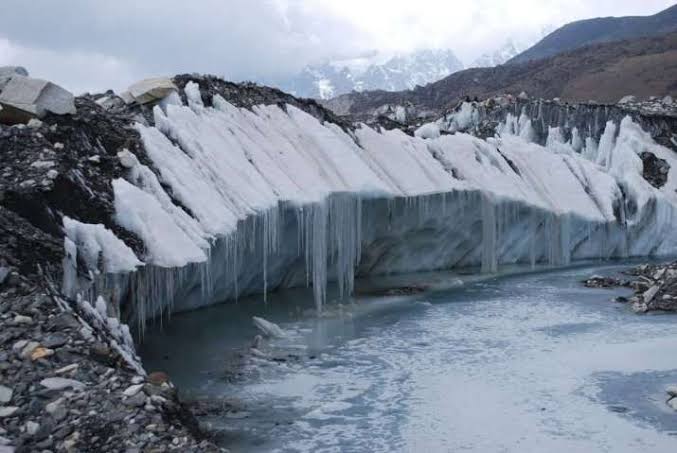
Bhasin’s talk built to a set of concrete proposals, and the sharpest of them was a reframing so simple it is astonishing how rarely one hears it. The single most important story in South Asia right now, she argued, is the melting of the Himalayan glaciers; and it is being covered entirely through national lenses. Pakistan’s floods. India’s heatwaves. Nepal’s vanishing ice. The poisoned politics of the Indus Waters Treaty. Four national stories, four national blame games. “These are not separate stories,” she said. “They are one story“; the story of a shared ecosystem under shared threat. The meltwater, after all, does not stop to have its papers checked at Wagah.

From that reframing flowed her first proposal: well-funded, editorially independent cross-border journalism collaborations; joint investigations, joint reporting on shared rivers and shared climate data, joint coverage of health crises, literacy, and what is actually happening inside each country’s universities and laboratories. Not from the nationalist angle, not from the blame angle, but from the angle of what is actually happening.

Continue reading The Meltwater Carries No Passport

Pakistan, the Successor State to Islamistan

The settled view of Pakistan, is that it is the most ideologically Islamic state the world has ever produced, and that each decade carries it further into theocracy. We think the settled view is wrong.

The Pakistani elite has quietly secularised. And far from hollowing the state out, this is precisely how Pakistan became what it was always designed to be: the successor state to British India’s Muslims. Islam was the vehicle. Pakistan is the destination.

Islam remains the public language of legitimacy.

Privately, among the stakeholders who actually run the place, the operating priorities are entirely secular. The society on the ground is conservative and devout. The class at the top, the one that keeps the state alive, believes in Pakistan far more than it believes in Islam.

It helps to separate three things that we mean by Islam. There is Islam as faith, the private conviction of the believer. There is Islam as identity, the badge of who one is and whom one stands with. And there is Islam as state language, in which Pakistan explains itself to itself and to the world.

The elite has not surrendered the third, and it has not wholly shed the second. What it has let go of is the first as a terminal value: the notion that the purpose of the state is to realise Islam, rather than to deploy it.

Faith has gone from ultimate to instrumental.

This migration is what we mean by secularisation. This is not the familiar story of liberalisation. We are not saying Pakistan grew tolerant, or irreligious, or fond of gin. We are saying something narrower and stranger. Pakistan’s elite secularised the priorities of the state without secularising its language. Strip away the Islamic vocabulary and look at what the stakeholder class optimises for, and the list is unmistakable: state survival, strategic depth, military capability, sovereignty, national prestige, and the reproduction of the elite itself.

Continue reading Pakistan, the Successor State to Islamistan

Pakistani Centrists, Not Muslim Extremists

A Precedent note

The most important thing to understand about the Pakistani voices on this site is that they are centrists, not extremists. Kabir, El Khawaja, S Qureishi: none of them is a fringe figure in Pakistani society. They are roughly where a literate, urban, employed Pakistani sits, and that fact deserves attention.

It deserves attention because India, over the last decade, has stopped engaging with Pakistanis altogether. Visas have collapsed. Cricket is gone. Cinema is gone. Academic exchange is gone. The everyday oxidation of one society against another, the slow correction by which extreme positions get rounded down through exposure to people who hold different ones, has been switched off. What is left is each side talking to itself about the other.

Brown Pundits is one of the few places where that has not happened.

The thread that prompted this note will illustrate. A week ago, S Qureishi observed that the only downside of the Islamic Revolution was that “there is no OnlyFans.” We were deeply offended by this line seriously enough to write the next piece on counterfactual analysis of Iranian society. Q then returned, under another post, with a fuller thesis: female sexuality must be controlled to sustain a civilisation. Pressed on enforcement, he listed disownment, violence, lawsuits, vandalism. Finally when pressed on honour killing, he admitted it was “horrible” and “immoral.”

Three voices took shape on the thread. The most salient asked that the comment be deleted as misogynist.

We are not deleting it.

We disagree with Q on almost every line he wrote. The thesis that female autonomy is the load-bearing crack in civilisation is one we reject in full. The post on Virginity Policing that triggered this thread was our own. But Q is not a Taliban spokesman. He is a Pakistani who, when challenged in writing by other commenters, was forced to articulate his position, defend it under hostile examination, and concede that violence is wrong. That is not platforming. That is engagement. It is the slow work India has decided it no longer needs to do.

Continue reading Pakistani Centrists, Not Muslim Extremists

Brown Pundits