This week two quick episodes with two sagacious repeat guests.
– With Jasper Gregory I revisit the situation in Vietnam. From coronavius, to BLM, to K-Pop.
– With Abhinav Prakash I discuss the Hathras rape, how it relates to caste politics in UP, and the various Dalit groups in that state.
You may notice a difference in sound quality. I decided to get a legitimate microphone. I think that will reduce the complaints about sound quality. Since it cost some money, I wouldn’t mind more Patreon subscriptions.
The Genomes Asia 100K has put their Indian paper out. It’s OK, and mostly focuses on the fact that Indians are enriched for inbreeding vis-a-vis other world populations. There are several layers to this. In some cases, as among South Indian Hindus and Muslims, there is cousin-marriage. But, in other cases, for example, Scheduled Castes and Scheduled Tribes, there seem to be extreme bottleneck effects due to delimited marriage networks. Finally, even among large population groups, such as Iyers, there seems to be some elevation of runs of homozygosity due to endogamy.
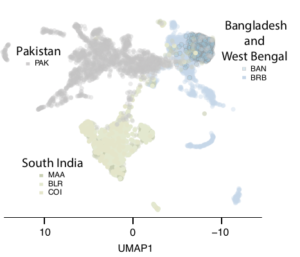
But that’s really not what I’m interested in. This preprint has a lot of Bengalis from Birbhum district in West Bengal of various castes. The UMAP (an advance over PCA in some ways) figures aren’t super informative, but you can see that their pooled sample recapitulates the Indian subcontinent. In fact, West Bengals on the whole are to the “west” of Bangladesh samples. Totally unsurprisingly.
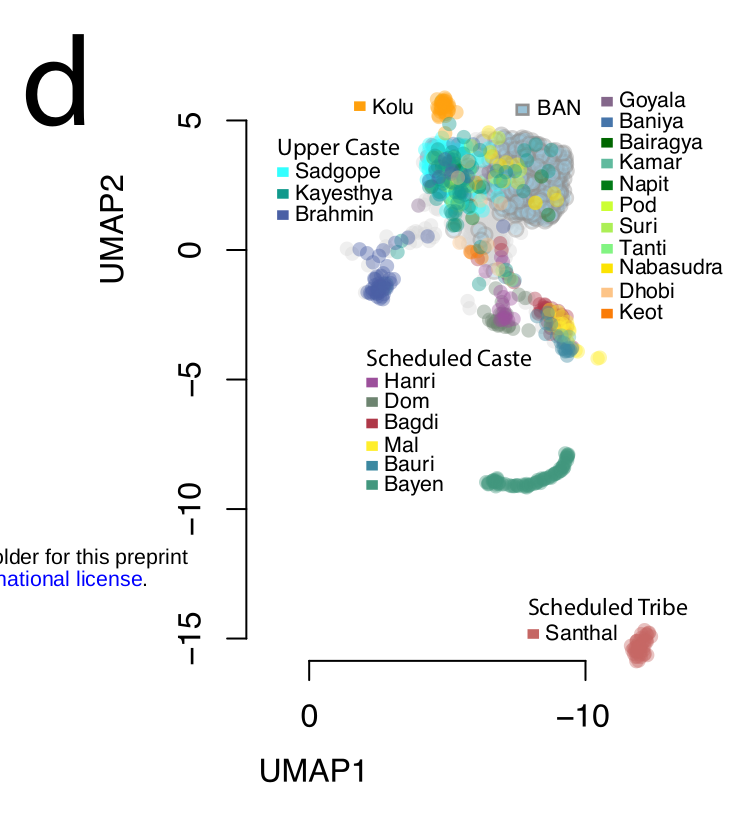
The main reason I’m putting this post up is the UMAP plot below. It’s hard to read (they will clean it up for final publication), and I don’t know all the castes (I’m assuming “Nabasudra” is a typo). But some things that jump out
1) Bengali Brahmins are distinct.
2) Kayastha are generic West Bengalis.
3) Some of the West Bengal samples are in the Bangladesh (collected from Dhaka) distribution. These are probably descendants of Bangal migrants from the east.
4) Some groups are very distinct. That’s partly due to strong endogamy, and in the case of Santhals high East Asian ancestry (they’re Munda). Other groups are less distinct. The “Namasudra” seem to be two groups. One overlaps with the main Bengali cluster (slight bias toward Bangladeshis), while a second group is shifted toward Scheduled Castes.
I assume readers can make more heads or tails of this, as I don’t know much about caste in West Bengal (and yes, the figure is very badly labeled/colored; this is a preprint)
Addendum: Not comments about Jatts please. I will delete them.
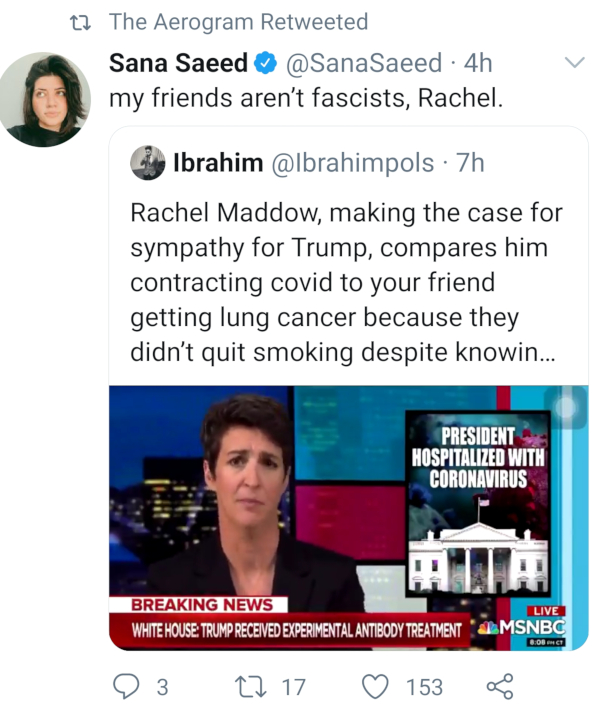
I am not a media person, so I do not understand the deal with AJPlus and its “woke” journalists.
AJPlus is owned by the Al Jazeera Media Group, which is a catspaw of the government of Qatar. Qatar is a Salafi petrostate run for the benefit of the Thani family and is run like a capitalist caste state. I’ve been to Qatar. It’s a fine place if you have money, but perhaps less fine if you one of the laboring classes.
I don’t begrudge Sana Saeed for making a living, but I doubt she would begrudge herself that opportunity if she was on the outside looking in.
The world is complicated. I dislike engaging in guilt-by-association but woke journalists at AJPlus do it constantly. It’s like they don’t see the glasshouses that they live in.
What’s going on in India with COVID-19? Both deaths and cases are now plateauing. Since India is really many nations, this might just be major population centers recovering, even if there are lots of local outbreaks?
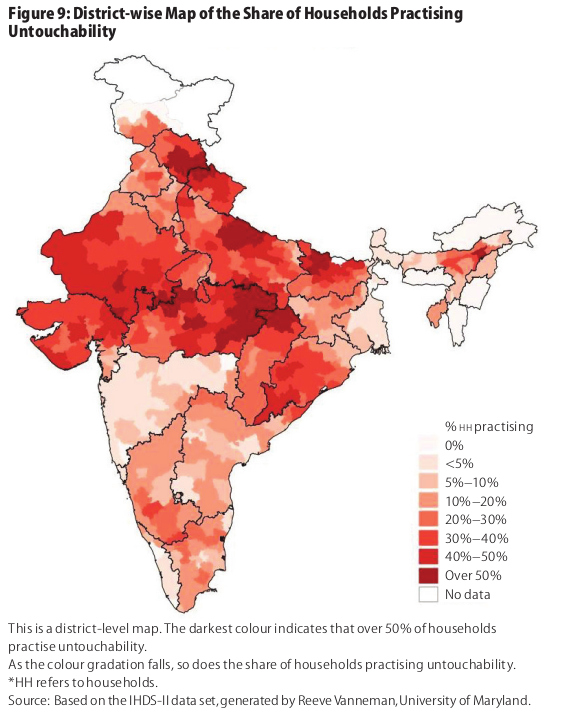
The regional patterns turn out to be the most striking. More than education, income, or caste status. You can even see the outline of states, which is indicative of the impact of regional governments on policy and culture.
I have mixed feelings about casting Dev Patel as Gawain. Though my feelings are not strong, they are similar to my feelings about casting white actors as non-Europeans in the past: you get over it, but it takes away from verisimilitude.
Please make sure that you subscribe to the podcast (there are links to various platforms on the main website at the link). We don’t always post show-notes due to being busy.
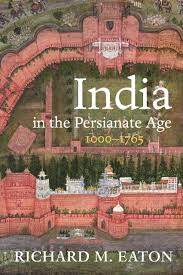
Finished India in the Persianate Age. This was a much more fluidly written book from Eaton than other stuff I’ve read from him, probably because the Mughal narrative “writes itself.” Recommended.
Probably will take reader advice and focus more on “primary sources” from now on. Though finding good translations is always an issue then…
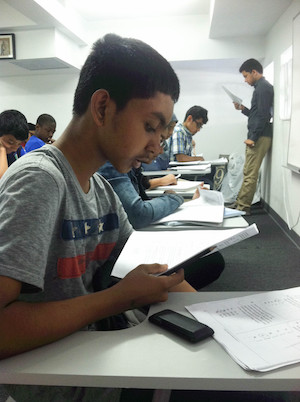
Bangladeshi American teens preparing for NYC selective school admissions exam
Since there has been rather persistent confusion about my Unherd piece I will clear up a few things. I am rather tired of talking about it now, as I “said my piece”, but sometimes things need to be done.
First, for many months (years), friends of various backgrounds (brown and non-brown) have been speaking to me of the issue of very self-righteous South Asian American (Indian, Pakistani, and Bangladeshi) “social justice warriors.” There’s nothing wrong as such being a social justice warrior and brown, but, the problem is that these individuals often accrue to themselves the full-weight of colonialism and centuries of oppression to add to their credibility and authority. The reason I finally punched out the Unherd piece is that an Indian scientist who I am familiar with made a reference to trauma and oppression on Twitter. This resulted in many “likes” and praiseworthy comments. It was a vague and amorphous statement and could mean anything, but the response made it clear that most people took it to be that they were alluding to the weight of colonialism and racism.
The problem I had with this is I know that this individual, a Brahmin raised in India, is from a literally rich family. Rich enough to pay undergraduate American tuition for international students in full. And, rich enough to pay graduate school tuition when otherwise this person would have to take up a teaching assistantship. This is not a person who is well-off in the Indian context. They’re well off in the American context.
This is an extreme case. But it illustrates a more general problem. People who by dint of their brown skin claim to be, or allow people to believe they are, marginalized and oppressed. The vast majority of brown Americans can tell you stories of racial discrimination and prejudice. That is true. But are these experiences determinative in their lives? Does their race define and limit them in a deep and powerful manner?
I would argue not. Today the Americans of brown background are flourishing. Indian Americans in particular are socioeconomically advanced, and now, becoming culturally prominent. Just like their white upper-middle-class peer, Indian Americans are benefiting from the system, and flourishing within it. Their realized outcomes are very different from African and Latino Americans. Some of the same is also applicable to poorer newer ethnic groups, such as Bangladeshis, who begin much lower on the socioeconomic ladder but are placing their children into elite public schools like Stuyvesant.
Second, selective immigration from India has resulted in a very atypical Diaspora. Many who responded to my piece argue that selective immigration is the whole story, so why bring caste into it? Because the criteria used have skewed the India Amerian community in a way where it is not representative of India at all. I am personally not bothered by this. But again, when issues such as caste oppression come up in the USA, non-Indians may not realize when talking to Indian Americans that they will almost never interact with a Dalit, who are 15% of India’s population (one could argue that except for Gujarat the “Cow Belt” is also totally underrepresented due to the way immigration has worked). Many Brahmin Indian Americans I know are vociferously against caste (sincerely, and in their actions!). But to me, this is a laudable idealism, not something that comes out of historical brutality, because their ancestors were willing executors of the system. In this way, they are like upper-class white people who wish for a more egalitarian economic system. Their views are sincere, but it comes from idealism, not trauma.
As a brown person from Bangladesh people who knew where I was from would always make assumptions about my background, as Bangladesh was the byword for incredible poverty for the second half of the 20th century. Those that did not know my family was of professional background would ask naive questions, such as “did you grow up in a hut?” I found it amusing, but I did make it clear that I couldn’t personally speak to the poverty and deprivation which were such serious concerns for everyone about the country of my birth. In Bangladesh, I was a very privileged person. In my day to day life in the USA, this was irrelevant, but I wasn’t going to go around speaking with authority about how horrible grinding Third World poverty was. It was just in many ways just as abstract for me as it was for my white classmates. Honestly, if I did grow up in a hut I’d probably brag about it since it would make my Horatio Alger story so much more inspiring.
Overall, the point of the piece is that when you make identity so important to the content of someone’s arguments and the force of their views, it creates a massive incentive for individuals to cultivate and shade their identity to add credibility. Ergo, a Nigerian American whose family is wealthy from brutal oil extraction which results in human rights violations and crimes in their ancestral homeland will likely not expose this fact when castigating a middle-class white American about their “white skin privilege.”
Brown American should just accept what they are in the main: a relatively privileged people from whom America works, who have to deal with some incidents of racism in their lives.
Last night I realized I’m not going to weigh in on history discussions on Twitter if they pertain to the Indian subcontinent. Even people who I know are not 13-year old incels behave totally emotionally and engage in shitposting posturing constantly. It’s really impossible to get a signal out of the discussion.
Indians and Pakistanis seem so intensively invested in various topics that it is literally and seriously impossible to get value out of any exchange, the swell of stupidity and bad faith (on all sides!) is so intense. There is a reality out there. There is a true history. But this is not what most of you really care about it, is it?
For example, reading India in the Persianate Age: 1000–1765 gives a nuanced and fully textured picture in outlines of the subcontinental elite in the premodern period. It aligns in broad sketches with what I know about human psychology and history elsewhere. But attempting to bring nuance seems like a fool’s errand in most of these debates.
Understanding the history of the Indian subcontinent is rewarding to me because there are comments here on the general human condition. I will not turn away from that. But, I do need to reflect on whether that is best done in solitude rather than engaging with the world “out here.”
Note: I don’t mind or care too much if particular truths are leveraged in some ideological manner. Rather, my suggestion is ideological priors are doing all the sifting of which truths are correct or not.

 This week two quick episodes with two sagacious repeat guests.