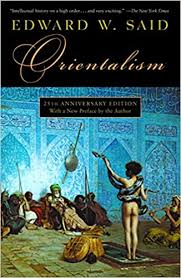
 Edward Said’s Orientalism was a work of scholarship. I think it was a very mixed work of scholarship (better as a critique than a plausible interpretation of the facts, in keeping with the author’s expertise as a literary scholar rather than a historian). But it was one of the later 20th century works which ruminated on the impact and power of the colonial experience.
Its influence has echoed down through the past two generations, and not to good effect. One could actually understand the argument of Orientalism. The argument of much of mass-level postcolonialism is inchoate, while its academic variety is insular and unintelligible.
Consider this piece from The Juggernaut, Keeping Up with Cultural Appropriation:
What qualifies as cultural appropriation is complicated — some advocate for cultural sharing, while others call it cultural theft. Cultural appropriation is “taking intellectual property, traditional knowledge, cultural expressions, or artifacts from someone else’s culture without permission,” according to Susan Scafidi, the founder of the Fashion Law Institute at Fordham Law School, in her book Who Owns Culture: Appropriation and Authenticity in American Law. This “taking” can occur in a variety of ways, from creative collaborations to cringe-inducing Halloween costumes.
Taking cultural elements without permission from a less predominant culture in a specific context is at the heart of appropriation. “It involves a culture with relatively more economic, social, or political power taking from a culture with less power, and so it involves an unequal relation,” explained Rina Arya, professor of visual culture and theory at the University of Huddersfield.
 First, as an empirical matter, the individuals of a “less predominant culture” who object to cultural appropriation are invariably privileged, deracinated, and Diasporan or Diasporic in their cultural influence. People who reside in Japan, for example, have no problem with white people wearing kimonos. Instead, it is Asian American activists. Therefore, you have the farce a few years ago of an Indian American woman explaining to a Japanese art curator why white people in kimonos is “problematic.”
There are two points of this post:
– Is there anything of value in 2020 in the way postcolonialist academia views the world? I’d stay no. What’s the “postcolonial” angle on Chinese aggression Ladakh? Yes, the British borders matter, but note that the Manchus invaded Nepal without the influence of white people. Academic postcolonialism is sterile, offers no novel insights, and frankly centers white people and Europeans to a degree that is idolatrous.
 – Second, mass-postcolonialism with its concepts such as “cultural appropriation” is not fertile toward cultural creativity. Rather, it promotes a vague and unclear essentialist idea of cultures, societies, and presumes a lack of dynamism and a static element of power relations. The Romans conquered Greece, but in their turn, they were conquered by Greek culture. One could say they “appropriated” Greek culture, but the synthetic glories of Greco-Roman art and thought would not be possible without the “appropriation.”
Contrast the above piece with another one from The Juggernaut, “Not Indian Enough”. Yes, it trades in some signaling to woke shibboleth, but it explores an interesting topic that is genuinely novel and not simply a rearrangement of cognitive furniture.


 Another BP Podcast is up. You can listen on