The ghost of empire and the origin of all repression

The New York Times published an op-ed, How British Feminism Became Anti-Trans, where India implicitly makes a showing:

It’s also worth noting that the obsession with supposed “biological realities” of people like Ms. Parker are part of a long tradition of British feminism interacting with colonialism and empire. Imperial Britain imposed policies to enforce heterosexuality and the gender binary, while simultaneously constructing the racial “other” as not only fundamentally different, but freighted with sexual menace; from there, it’s not a big leap to see sexual menace in any sort of “other,” and “biological realities” as essential and immutable….

These views are very common on the cultural Left. When progressive social activists make these assertions, and I argue that they are factually wrong, I’ve often encounter surprise and annoyance. There are two things I suspect going on here:

– These people are not genuine propagandists, they actually believe their own fictions. Faced with facts that are novel to them don’t know how to react. They live in a factual bubble where it is taken for granted that the idea of binary gender as a dominant paradigm was introduced by Westerners to South Asians, whose own conceptions were fluid, open, and tolerant.

– The facts of the history of non-Western cultures are fundamentally irrelevant because they exist only to support narratives relevant within Western cultures. Those narratives and the trajectory of Western culture is their true passion. Their fundamental Eurocentrism means that falsehood about non-Western cultures is not particularly of great concern. That is not “their history.” Minor details to be ignored and brushed aside.
Gibbon famously asserted that the Pope, and implicitly the Roman Catholic Church, was the “ghost of the Roman Empire.” A living, breathing, vestige of an institution and society long gone. Much of modern Western Left social progressivism, informed by critical theory and post-colonialism, is a ghost of 19th and 20th-century empire. It is the warped inversion and reflection of Western chauvinism and populism.

It is highly peculiar to me that on the precipice of the 21st Asian age Western intellectuals bask and wallow in the reflected glory of Victorian-era empires as if they are determinative of all the goings on today. Part of this is surely due to the reality that intellectual currents are lagging indicators, and empires always persist longer in memory and self-regard than in reality. And part of it is the human needs for “noble savages” and “pure” Others against which their own sins may be measured and contrasted.

The religious and genetic structure of Bengal & Partition

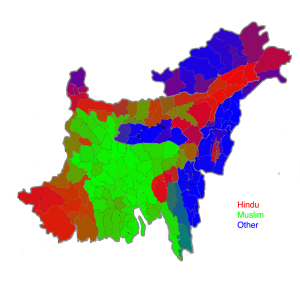
I was emailing with a friend of mine about population genetic history and Southeast Asia. I mentioned offhand that there is an east to west cline of Tibeto-Burman ancestry in Bengal. He expressed surprise, assuming Partition had scrambled everything.

As most readers of this weblog know, Partition was less traumatic for Bengal than it was for Punjab. The violence was less extreme, and the population movement also not as massive. And yet looking at the religious map it is clear that some sorting has occurred. The proportion of Hindus in the region that is now Bangladesh has gone from ~25% to about 10% over the past 70 years, or three generations. Though some of this is due to differences in fertility, the main driver has been migration of Hindus out of East Pakistan, and later Bangladesh. In contrast, there has not been much of a reciprocal migration of Muslims into Bangladesh.

This results in a peculiarity when I receive genotypes from people of Bengali origin: a large minority of people of Hindu background mention that one or both of their parents have origins in eastern Bengal, what is not Bangladesh. In contrast, I have never received a gentoype from someone who tells me that their family migrated from western Bengal into Bangladesh.

The genetic consequence is simple: there is a larger variance of East Asian ancestry in West Bengal than East Bengal because of more mixing in the west than the east. In contrast, one could probably infer the extent of the migration simply by doing genetic analysis and not looking at Census data!

BrownCast Episode 12: The global China, with Carl Zha

Another BP Podcast is up. You can listen on Libsyn, iTunes and Stitcher. Probably the easiest way to keep up the podcast since we don’t have a regular schedule is to subscribe at one of the links above. You can also support the podcast as a patron (the primary benefit now is that you get the podcasts considerably earlier than everyone else).

If you aren’t in a position to be a patron, please give us 5-star ratings and a positive review!

After this podcast was recorded and edited Carl Zha Informed informed me that he is no longer doing CLASH! and rather is starting a new podcast: Silk and Steel. This is actually the first post on Silk and Steel as well. A “cross-over.”

Continue reading BrownCast Episode 12: The global China, with Carl Zha

Open Thread – Brown Pundits

Please keep the other posts on topic. Use this for talking about whatever you want to talk about.

ZackNote: As per suggestions; I’m listing all the Posts Written since last week’s Open Thread (in Reverse Chronological Order):

  1. The Balto-Slavic & Indo-Iranian Connection
  2. Pakistani Psychosis
  3. Is it time for Asian Americans and Latino Americans to ask to be considered “white”? (b)
  4. Brexit and Democracy
  5. Indian Numismatics Browncast Podcast Coming Up –
  6. Notes on Brown Pundits “BrownCast”
  7. 1857: The Central Indian Campaign
  8. Watching Shtisel.. (and Turkish TV)
  9. Brown Pundits BrownCast episode 10, with Josiah Neeley
  10. the British “created” India according to this Coloniser
  11. Why doesn’t Arundhati Roy move to Pakistan?
  12. ‘In the milk of OBCs and Dalits, Muslims have added sugar’
  13. (Machine) Learning Biases
  14. American Muslims and Kamala Harris
  15. Various Asiatic raps
We average 2 posts a day making it a fairly prolific blog.

Brown Pundits BrownCast episode 10, with Josiah Neeley

The latest BP Podcast is up. You can listen on Libsyn, iTunes and Stitcher. Probably the easiest way to keep up the podcast since we don’t have a regular schedule is to subscribe at one of the links above. You can also support the podcast as a patron (the primary benefit now is that you get the podcasts considerably earlier than everyone else).

Continue reading Brown Pundits BrownCast episode 10, with Josiah Neeley

Notes on Brown Pundits “BrownCast”

I’ll be interviewing my friend Josiah Neeley tomorrow about politics and policy in Trump’s America. Since this is Brown Pundits my outline has a lot of brown-themed questions, but we’ll range. If you are reading this before ~2 PM PDT feel free to drop-in questions. Josiah’s podcast, Urbane Cowboys, has had several brown people on. Of these, three are Bengali American. Myself, Reihan Salam, and Avik Roy.

On Sunday I’ll be talking to Carl Zha, who produces the popular CLASH! podcast. Feel free to suggest questions for Carl.

To paid-up patrons: I am posting the podcasts ahead of time on the patron page. These two podcasts won’t drop until February, so if you want to hear them earlier, you know how. I’ve already posted Zach’s podcast on Indian numismatics. That will probably drop tomorrow or Sunday, when Zach writes up some show-notes and pushes it live.

Open Thread – Brown Pundits

Please keep the other posts on topic. Use this for talking about whatever you want to talk about.

One thing, thanks to everyone who has donated to the Patreon. Weirdly it makes me feel a little more appreciated when I’m editing these podcasts late at night after my work and family are over 😉 Since the “patrons” have some “skin in the game” definitely going to be taking input from them in terms of what the directions are that our podcast, and to some extent the blog, will follow. I started this weblog with Zach seven years ago without any real goal or endpoint, so it’s evolving….

The hammer of the All-Father


Unless you have been sleeping under a rock, a mildly slanderous piece in The New York Times Magazine has taken aim at David Reich and his band of paleogeneticists, Is Ancient DNA Research Revealing New Truths — or Falling Into Old Traps? I address this piece at my other weblog.

One of the major themes of the piece are the legends and myths of the people of Vanuatu:

I asked him about how the concept of Lapita migration to empty islands had been received by people whose oral traditions said they came from a stone or a coconut tree.

The reason this is relevant is that paleogeneticists have probed the history of Vanuatu. And yet this is the past. The future is that the Reich lab is collaborating with other paleogeneticists to crack the nut of the history of the Indian subcontinent with ancient DNA. They’ve been working on this for years, and they are working on it now. There are 275,000 people who live in Vanuatu. There are 1.7 billion people who live in the Indian subcontinent.

Within the next year I believe that the Reich lab will publish results which will falsify the beliefs of a substantial number of Indians about the nature of the origins of the native peoples of the region. This will shatter world-views, undermine mythologies, and rock peoples’ worlds. There will be sophists who live in denial, but the truth will be plain to those who see.

I understand that some of you reading this disagree with this assessment. Ultimately I don’t care because the data are coming, and if I’m wrong, that’s OK too. I don’t have emotional baggage invested in alternative models. But, I do wonder why the mythological traditions of “non-indigenous” people seem to warrant less attention than smaller nations or premodern tribes.

Brown Pundits