The latest BP Podcast is up. You can listen on Libsyn, iTunes and Stitcher. Probably the easiest way to keep up the podcast since we don’t have a regular schedule is to subscribe at one of the links above.
Thanks to everyone who reviewed the podcast! Please leave more 5-star reviews. If this podcasts interests enough people I’ll be getting us on other platforms.
Note: This post is a supplement to the podcast below.
People get hung up on particular words a lot. This post is to clarify some terminology from my own perspective. It needs to make clear here that I am a semantic instrumentalist. Words don’t have power or meaning in and of themselves but point to particular concepts and patterns. If we disagree on words while agreeing on the concepts and patterns, the disagreement is semantic.
To give an illustration about the “power of words,” I have read works on “Western history” which begin the narrative in Egypt and Sumeria. As the centuries proceed, the focus moves north and west, and eventually, the Near East is excluded from the West. Clearly, most people can agree that the Near East is, and became, very distinct from what we term “the West,” but if our history is to deal with Northwestern Europe, it will start with the Roman period, and its roots clearly owe something to the earlier Near East. The reality is that the West that the histories outline developed much later (arguably after the fall of the Western Roman Empire), but its roots are diverse and broad, inclusive of Near East antiquity.
When I use the world “Indic,” please keep in mind that I am focused in particular on the civilization which had crystallized by the Gupta period across South Asia. The civilization which gave rise to concepts which form the basis of the Dharmic family of religions. Moving forward, and moving backward, this is the reference cluster of characteristics.
The latest BP Podcast is up. You can listen on Libsyn, iTunes and Stitcher. Probably the easiest way to keep up the podcast since we don’t have a regular schedule is to subscribe at one of the links above.
Thanks to everyone who reviewed the podcast! Please leave more 5-star reviews. If this podcasts interests enough people I’ll be getting us on other platforms.
Netflix now has Arjun: The Warrior Prince on its stream. I watched most of it to get a feel for some of the details of the story. I know the general outline of the Mahabharata, but I know the Bible or the Iliad far better (in case you can’t be bothered to follow the link, it’s only a small part of Arjun’s early life).
Depending on the sources you trust, the events of the Mahabharata date to around ~1000 BC. They were probably refined at a later date, perhaps around 500 years later.
I watched a fair amount of Arjun: The Warrior Prince. In some ways, it reminded me a lot of the Iliad and the Odyssey. These two works are a melange of influences and time periods, synthesizing true recollections of the large polities with highly stratified social systems and literacy of the Bronze Age, with the simple chiefdoms of the Dark Age Greece. The issue is disentangling the different periods.
One assumes the same is true of the Mahabharata and Ramayana.
The “wild card” here is that the most recent work has now likely confirmed the arrival of agro-pastoralists from the steppe in the period between 1500 and 1000 BC. By the time the historical analogs of the Pandavas were settled in the Gangetic plain, they’d likely been there for many centuries.
Zach, Omar, and myself will do a podcast on Indian genetics next week. I already did one on this topic for my main podcast, so I’m curious what readers of this weblog want to hear about. We can’t guarantee we’ll use the questions, but it’s possible. I think the format will mostly involve Zach and Omar leading the conversation and I’ll try to talk as fast and concisely as possible.
Also, we got our first review on iTunes. Would still like to get some on Stitcher. And in case people want to hear more from me, I was a guest on the Two for Tea podcast. My episode should drop in the next day or so.
One of the problems with looking up pictures of the Kalash people of Pakistan is that photographers have a bias toward highlighting the most European-looking villagers. Let’s call this “Rudyard Kipling Lost White Races” syndrome. Therefore for your edification, I post the YouTube above which is probably more representative of what the Kalash look like.
The reason I post a link to what the Kalash look like is that it is germane to the answer to the question: what did the Indo-Aryans look like? The past tense is key since “Indo-Aryans” today means a lot of people in South Asia, in a literal sense.
In the post below Zach L. made a passing comment:
(1.) The AASI’s, which are sort of co-equivalent to the Negritos and Anadamese Islanders (one of the first coastal waves out of Africa that somehow also ended up in the Amazon). It’s interesting that they are substrate to every South Asian population (I think there are trace amounts in Central Asia, Afghanistan and even Iran).
(2.) the “Dravidian” farmers out of Iran. They are probably related to the J1/J2 types and might be an olive skinned population. Prominent in Sindh and Southern Pakistan through to South India (high % in Gujarat – must have been a locus of some sort).
(3.) our beloved Aryans who are especially prevalent among Brahmins, the Punjab and Haryana (though arguably the Haryanvis and East Punjab descend from Scythians to some extent). These look “European” but it’s a very different look to #2.
The Aryans are conventional European (light eyes, light hair, white skin) the ancient Dravidians would have (probably) looked like Middle Easterners (olive skin, dark hair dark eyes) and the AASI, ” looks like Papua New Guineans.
I can’t see any disagreement with point number two.
As for the AASI (“Ancient Ancestral South Indians”), we need to be careful here. They diverged from the ancestors of the people of Papua New Guinea ~40-50 thousand years ago. The divergence from the Andamanese, who probably migrated from mainland Southeast Asia, was not too much later. Aside from being very dark-skinned, the various extant “Australasian” people can be quite distinctive in appearance. The people of Papua, and native Australians, are quite robust. A substantial minority have blonde hair color due to a mutation common among Oceanians. The “Negrito” people of Southeast Asia and India all seem to be have adapted to a narrow relic niche, and may not be representative of their ancestors.
That being said, there is a particular non-West Eurasian look that many South Asians have which we can presume is the heritage of the AASI.
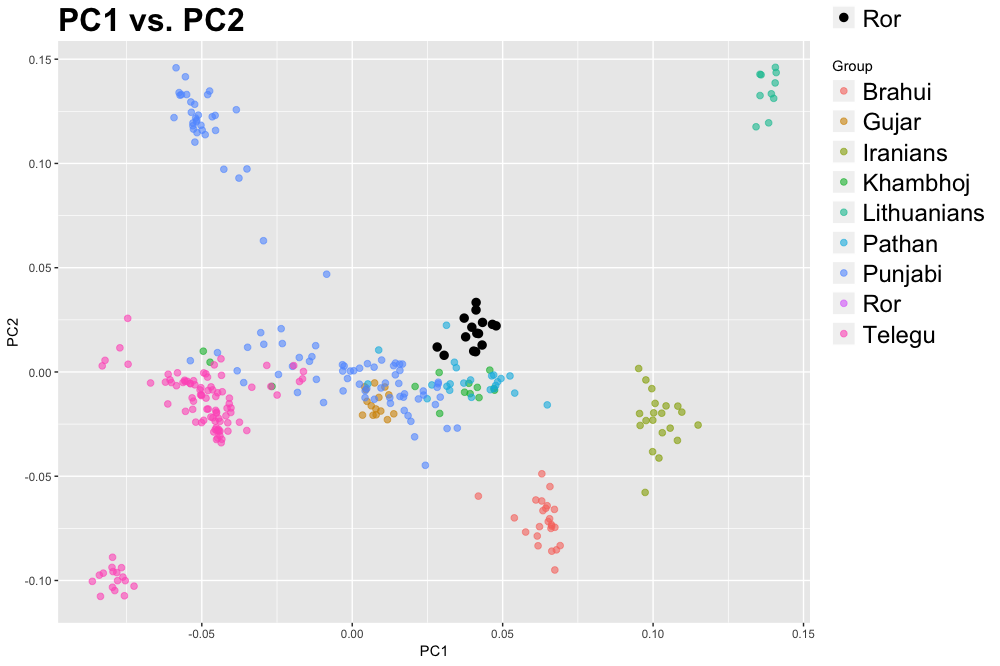
The comment about Aryans looking like Europeans raised my eyebrows a bit. This is a touchy subject, and to be honest my initial reaction was to be skeptical. But the more I read the primary literature to check up on Zach, the more reasonable this seemed to be. The dominant steppe signal into South Asia does resemble the people who were pushing into Central and Western Europe 1,000 years earlier than the Indo-Aryans, who were moving southward probably ~3,500 years ago. This is clear in rather simple statistical genetic analyses-populations such as the Kalash and Pathans for example show strong evidence of “European-like” gene flow.
Current work out of David Reich’s lab suggests that the Kalash are the best modern proxies we have for the “Ancestral North Indians,” the ANI. This population is modeled as:
– ~30% “steppe”, which is very similar to the ancestry which expaned westward into Europe between 3000 and 2500 BCE
– ~70% “Indus Periphery”, which seems the likely ancestral contribution of the people of the IVC, and is a heterogenous mix of Iranian-farmer and AASI
The mid-range estimate for the emergence of the Kalash mix is ~2,500 years before the present, but these usually have some downward bias, so it is reasonable that it would be greater than ~3,000 years. The samples from the Swat Valley dating to this period show gradual increase of “steppe” ancestry over time.
So one reason to be skeptical that the Indo-Aryans were “European-like” in appearance is that by the time they were flourishing in the lands previous inhabited by the IVC they may already have been more than 50% genetically like the people of the IVC. In which case, a minority would be very European-looking, but most would look vaguely West Asia, with some looking more stereotypically South Asian. If you look at the video above I think you do see the Kalash look this way.
One reason I’ve always been skeptical of the idea that the Indo-Aryans looked European, or, that their demographic impact was large, is that it seemed unlike both could be true. The expression of blue eyes among Indians was too low of a percentage.
Here is the frequency at a major SNP which predicts a lot of the blue vs. brown eye color.