
I recorded this interview a while back, but we just assumed the case would go down as it did, so it’s totally relevant…
Also, episode #2 of the IBW: Muslims vs. LGBTQIA+.
I recorded this interview a while back, but we just assumed the case would go down as it did, so it’s totally relevant…
Also, episode #2 of the IBW: Muslims vs. LGBTQIA+.
Making the Elite: Top Jobs, Disparities, and Solutions:
How do socioeconomically unequal screening practices impact access to elite firms and what policies might reduce inequality? Using personnel data from elite U.S. and European multinational corporations recruiting from an elite Indian college, I show that caste disparities in hiring do not arise in many job search stages, including: applications, application reading, written aptitude tests, large group debates that assess socio-emotional skills, and job choices. Rather, disparities arise in the final round, comprising non-technical personal interviews that screen on family background, neighborhood, and “cultural fit.” These characteristics are plausibly weakly correlated with productivity (at the interview round) but strongly correlated with caste. Employer willingness to pay for an advantaged caste is as large as that for a full standard deviation increase in college GPA. A hiring subsidy that eliminates the caste penalty would be more cost-effective in diversifying elite hiring than equalizing the caste distribution of pre-college test scores or enforcing hiring quotas.
No big surprise.
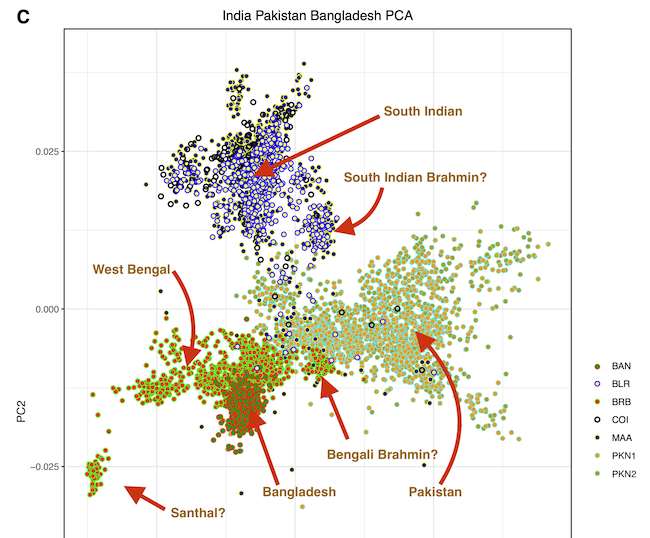
The full version of this paper is out, South Asian medical cohorts reveal strong founder effects and high rates of homozygosity. It’s not the best for understanding population structure because they focus on within South Asia variation, but it does seem to confirm that among Bengalis there is a cline from west to east, irrespective of religion (see the discussion where they note that Muslims in the west cluster with westerners). I found a PCA in the supplements where I added some explanatory notes. It’s really hard to parse their figures because they really didn’t care, and the Genomes Asia Consortium doesn’t release their data… (their browser sucks)
The image names can tell you the ethnicities. See if you can guess ahead of time.
Continue reading Midjourney v 5 and various Indian ethnicities
Finished my Iran sequence, Iran through the ages: civilization’s eternal crossroads, Pre-Persian Iran: from the invention of agriculture to the Aryan onslaught and We are all Zoroastrians: how Persian empires of the mind touched all humanity and One door closes, another opens: the Persian Empire’s end and the rise of the Persianate world.
Over at his Substack, Noah Smith has a pretty bullish take on India, Here…comes…INDIA!!!:
The United Nations estimates that India has now surpassed China as the world’s most populous country — or, as we colloquially say, the world’s “largest” country.
Obviously, crossing this threshold doesn’t mean much in practical terms. Being a tiny bit bigger than China doesn’t really change anything, and India has just about as many people as it did a year ago. But the flurry of news stories accompanying the event is a wake-up call for the world: India has arrived on the world stage, in a big way.
What does that mean? Well, a whole lot of stuff. More stuff than I can summarize or even mention in a single blog post. There was a quote attributed to Napoleon two centuries ago: “Let China sleep, for when she wakes, she will shake the world.” Well, China did wake up, and the world has been shaken. The whole economic landscape of the planet, the geopolitical balance of power, and even the Earth’s environment have been irrevocably changed in the last three decades by the addition of 1.4 billion human beings to the ranks of the (more or less) developed world. Now India brings another 1.4 billion, eager to join those ranks. Get used to seeing a lot more graphs with this basic format…
It’s a long post, but I think the major takeaway from the viewpoint of an economist is agglomeration. The co-location of producers and consumers and resources at such massive scale nations like China, India and the USA, result in a level of synergistic economic growth and power that smaller nations cannot match structurally. This is probably one reason that Britain punches below its weight vis-a-vis the US, it cannot scale.
But Smith is aware of human capital concerns, and this is probably the a signifier of the number one issue: Worthless Degrees Are Creating an Unemployable Generation in India. Fake credentialing just means firms will have to re-train or do their own intake (the obsession with credentialing shows up in funny ways on even on this blog; I don’t care what your credential is if you are a moron, something is common-sense to Americans working in tech).
Another issue that is focused on in the post is that India needs to focus on productivity growth through manufacturing. I actually thought a bit about India when I read this long and excellent piece in Palladium on the century-long failure of the British ruling-class on updating their nation for the 20th century.
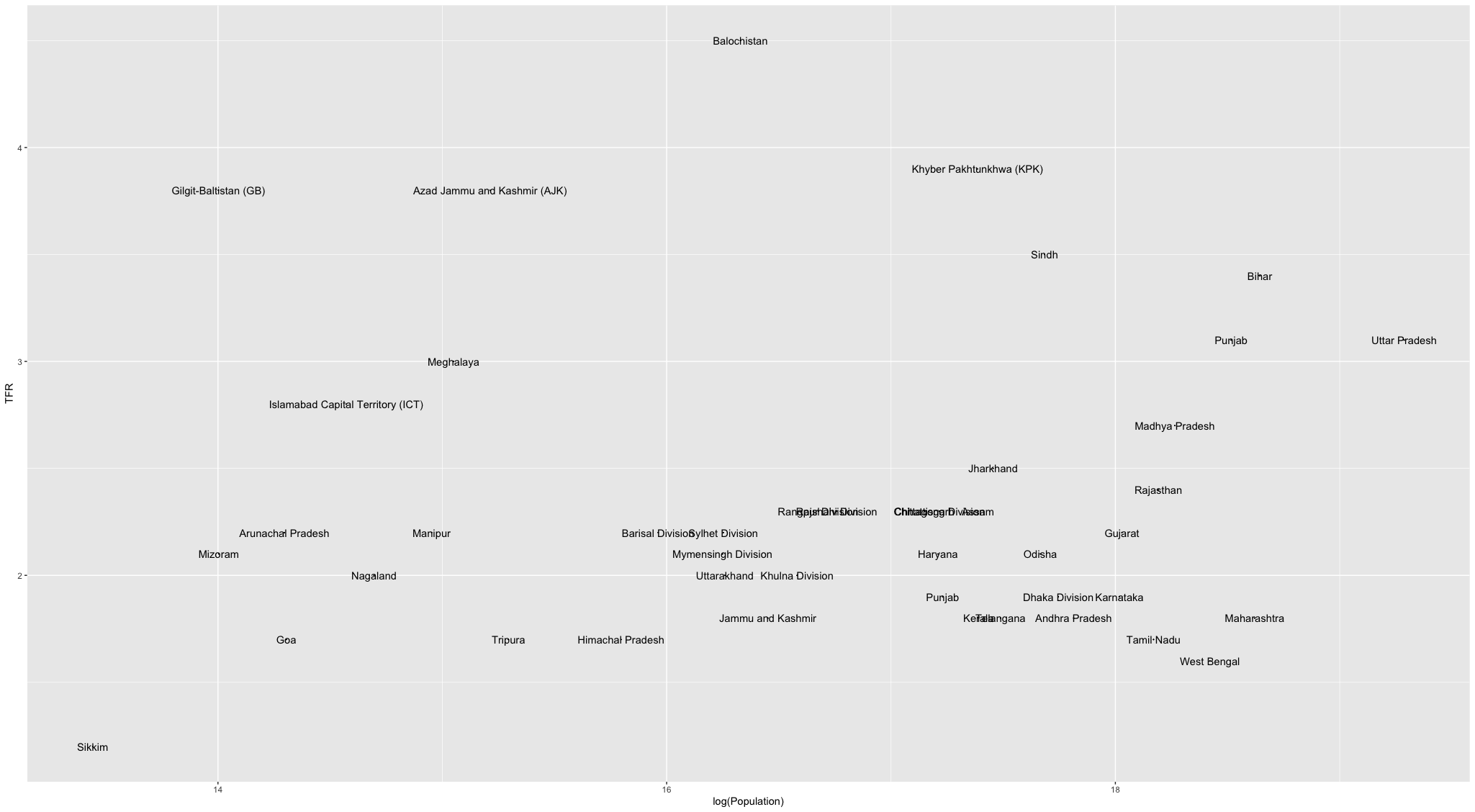
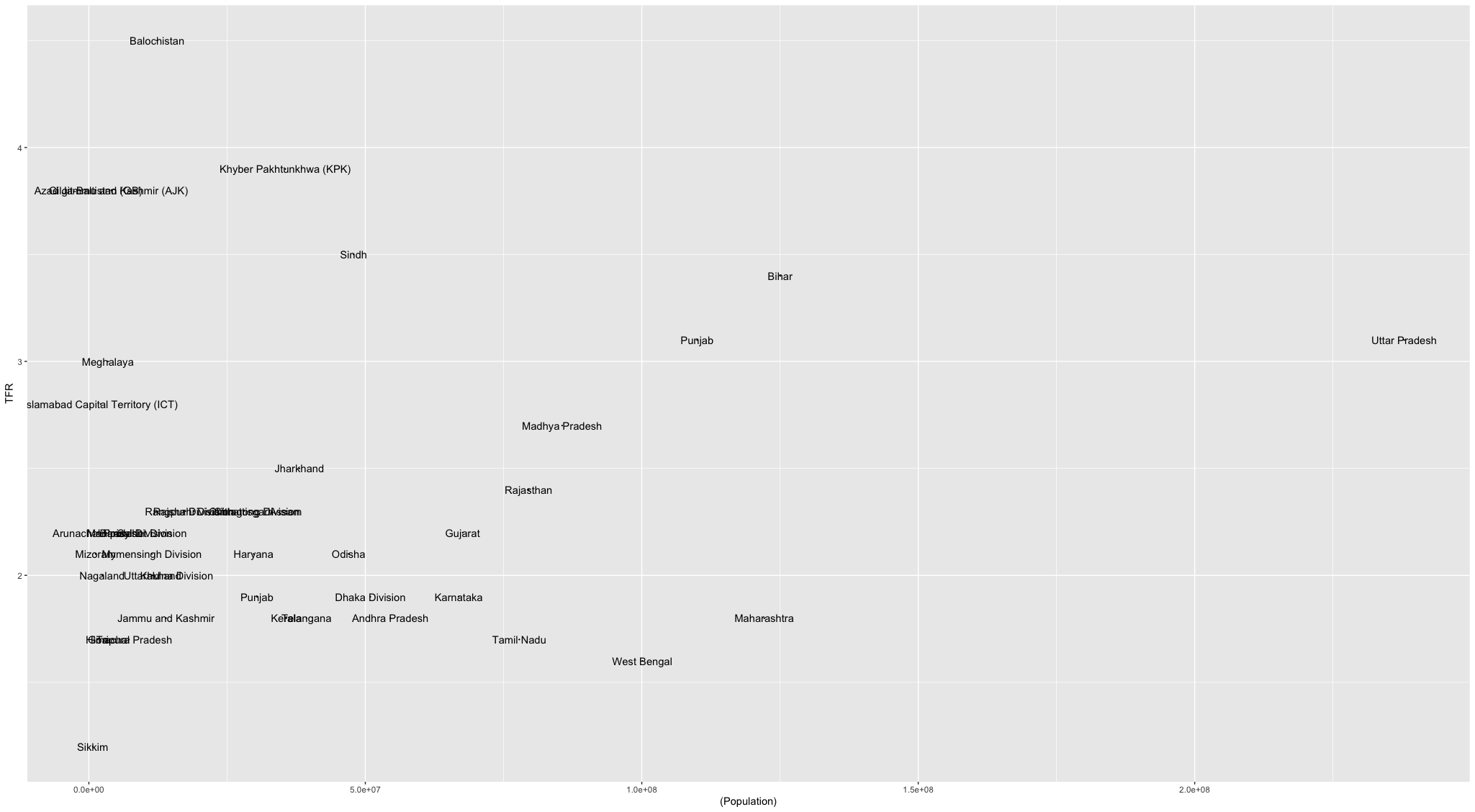
A lot of the media is writing about how India’s population is now, or will be any moment, bigger than China. The issue I always have with these narratives is India is a big country; UP has a total fertility rate of around 3, while West Bengal is closer to 1.5. I assembled data on TFR’s in administrative divisions across India, Pakistan and Bangladesh. I plotted by population and TFR (the second chart is log-transformed so you can see more of the labels). Click to enlarge.
Also attached the table below.
On the limits of fitting complex models of population history to f-statistics:
These results show that at least with regard to the AG analysis, a key historical conclusion of the study (that the predominant genetic component in the Indus Periphery lineage diverged from the Iranian clade prior to the date of the Ganj Dareh Neolithic group at ca. 10 kya and thus prior to the arrival of West Asian crops and Anatolian genetics in Iran) depends on the parsimony assumption, but the
preference for three admixture events instead of four is hard to justify based on archaeological or other arguments.Why did the Shinde et al. 2019 AG analysis find support for the IP Iranian-related lineage being the first to split, while our findGraphs analysis did not? The Shinde et al. 2019 study sought to carry out a systematic exploration of the AG space in the same spirit as findGraphs—one of only a few papers in the literature where there has been an attempt to do so—and thus this qualitative difference in findings is notable. We hypothesize that the inconsistency reflects the fact that the deeply-diverging WSHG-related ancestry (Narasimhan et al. 2019) present in the IP genetic grouping at a level of ca. 10% was not taken into account explicitly neither in the AG analysis nor in the admixture-corrected f4-symmetry tests also reported in Shinde et al. (2019).