
Category: Active Authors
The emergence of South Asia in human geography
I have not had the time to write my own piece on this occasion, so I will take this opportunity to add a few thoughts of my own before Dr Hamid’s piece; my own personal view is that there is a very strong likelihood that the so-called Babri mosque (which was probably NOT built by the emperor Babar, but may have been built by one of his leutenants or by a later Muslim general or emperor, we simply do not know for sure) was very likely built on the site of a Hindu temple. This was the conclusion of the ASI excavation of this site and since countless mosques were indeed built on the ruins of temples by invading Muslim armies, this would not be surprising in any way. It is also known that Ayodhya was a site of pilgrimage for Hindus and was revered as the birthplace of Ram. The Hindu inhabitants of India were subjected to many atrocities by their Turkic Muslim colonizers (more so by the earlier Delhi sultanate, less in the time of the Mughals, but both sets of rulers (Delhi Sultans and Mughal emperors) were classic colonizers). The conqureing Turko-Afghan colonizers were always far smaller in numbers than their Hindu subjects and as with other colonizers in other parts of the world, they used both terror and co-option to establish their ruler. Over time, especially in the later stages of the rule of the apostate emperor Akbar, many Hindu rulers were incorporated into the ruling elite in exchange for cooperation and “bending the knee”. But there was rarely any doubt about who was boss in that arrangement and later emperors, especially Aurangzeb, were more orthodox than Akbar and Aurangzeb re-introduced Jizya (a poll tax paid by all non-Muslim subjects) and tried (with mixed success) to establish a more “Islamic” ruling elite. Aurangzeb faced a very determined Maratha revolt that he fought for decades and finally suppressed at great cost, but without complete success. This Maratha revolt (particularly in the person of the first Maratha ruler, Shivaji) had a HIndu-revivalist color, though both sides freely used their opposite religious group as allies in subordinate positions (i.e. some senior Hindu generals fought on the Mughal side and some Muslims fought on the Maratha side). This prolonged conflict so weakened the Mughal empire that after the death of Aurangzeb the empire started to fall apart. It was dealt a death blow by the Persian invader Nadir Shah and thereafter it was the Marathas who became the largest empire within India, with most of the rest of the country in anarchy or ruled by smaller local rulers. Parts of the Muslim elite, feeling this loss of power, invited the Afghan ruler Ahmed Shah Abdali to “re-establish” Muslim rule, but while he won a crucial victory against the Marathas at the third battle of Panipat, he was not able to establish stable rule over most of India and even in Punjab (where he had tried to establish provincial authority since before the Panipat war) was snatched from him by multiple Sikh revolts. The end result was that by the late 18th century large chunks of India were ruled by Marathas and Sikhs. If this process had continued, it is likely that much of India would have been divided between resurgent Hindu and Sikh rulers, with local Muslims (whether descendants of the ealier Mughal and Turko-Afghan conquerors or local adventurers such as Haider Ali and his successor Tipu Sultan) ruling several smaller kingdoms. But by this time another, more advanced power had arrived on the scene, i.e. the East India company, who were able to take advantage of European superiority and Indian anarchy to establish a unique English empire that was owned by a trading company, albiet one supervised to an increasing extent by the British government. This British rule froze the 18th century Indian ruling elites in place as puppets or subjects of the British empire, saving the Muslim elite from further depradation at the hands of Marathas and Sikhs. After the Bengal army of the EIC mutinied in 1857, the British crown formally took over the empire, ending the period of company rule. By the early 20th century this British rule was firmly established, but two world wars in Europe and rising nationalism in India finally brought that empire to an end in 1947. At that point the latent divisions between the old Muslim elite and their former Hindu subjects again raised their head, as both parties tried to figure out what an independent India would look like. Many Indian nationalists, now armed with new European nationalist ideals, wanted a united Indian Republic, but given the history of the preceding 700 years, this Republic would include at least two major groups with very divergent views of the past (and therefore, of the future); on the one hand were Hindu nationalists who saw this period as a period of colonization, first by the Muslim and then by the British, and dreamed of a “Hindu rashtra” that would restore what they regarded as the “status quo ante”, a Hindu India. But the intervening 700 years had seen something like 20-25 percent of the population becoming Muslim. The majority of these Muslims were local converts, especially concentrated in the Northwest and North East of the country (forming a small majority in Punjab as well as Bengal), but their elites ( especially in the old Mughal heartland in the Ganga-Jamna region and to a lesser extent in Hyderabad and a few other Muslim ruled states) identified as descendants of the Turko-Afghan colonizers and saw themselves as the natural rulers of this land, unwilling to be subordinate to any democratic or autocratic Hindu rule. Meanwhile the Hindu side included several strands of Hindu nationalists who saw the Muslim elite as foreign colonists and local converts as barely tolerable at best and outright traitors at worst. As can be imagined, any post-British arrangement would have to bridge this divide and somehow create one India out of what had been a patchwork of conflicting states and communities. This was not out of the question, but it would certainly not be easy. The main pro-independence party (the Congress party) included Westernized secularists (both Hindu and Muslim, more Hindus than Muslims though, who felt these divisions would be overcome by a common non-demoninational Indian identity), moderate Hindu nationalists (who were willing to accommodate Muslims as fellow citizens, but who also espoused many traditional Hindu causes, such as cow-protection and a dominant Hindu cultural vision of India), moderate Muslim nationalists (who agreed that Hindus and Muslims will live together in a united India, but with Muslims holding on strongly to their religious identity and even retaining hopes of eventual Islamization of India, albeit by peaceful means)
Book Review: Baba Nanak Within Reach, by Muzaffar Ghaffar
Muzaffar Ghaffar on Guru Nanak
In the cultural wasteland that is our homeland these days, to be a man of culture doesn’t take much effort; you do some literary chit chat or somehow get your name printed with some work people assume as cultural or creative and you become a cultural or literary figure! Having known Muzaffar Ghaffar for over thirty years, he is an honourable and notable exception. He came to Pakistan with his savings and a couple of books in print, a book of English verse which has had a couple of editions published and a book On How a Government is Run . In my involvement with Punjabi we came together in the weekly “Sangat” in readings of Punjabi classic poetry held at the residence of Najm Hosain Syed and Samina Hassan Syed. Najm Sahib was already famous in Punjabi literary circles in both East and West Punjab. To give you some idea I often quote a well-known Sikh scholar of Punjabi who was Head of Punjabi Department at Guru Nanak University, Amritsar. He said, “There are two categories of Punjabis – those who have studied Mr. Najm Hosain Syed and those who have not; those who have not read him do not know much about Punjabi language or literature!” To those not familiar with Mr. Najm Hosain Syed’s work, this may sound like an exaggeration. But having attended weekly meetings at his house for nearly forty years and having read his poetry and books on literary criticism, plays and poetry, I venture to share this remark. There are almost forty books of verse and landmark works of literary criticism and four books combining half a dozen plays in Punjabi to his credit. He keeps his books small so that the price remains within reach of Punjabi readers. If you are not a serious reader of Punjabi language, these are in a difficult idiom. I have met many who express ignorance or adverse remarks.
Najm is Muzaffar’s guide and inspiration for the thirty volumes of the “Within Reach” series on Punjabi Classical poetry that are available to date, all in English. But neither in the US, nor in England and rest of English speaking world abroad have I seen these books in the market, although Punjabi literature is taught in many places in institutes of repute in these countries, with considerable Punjabi speaking public. Nor do I know of anyone abroad who talks of these books. In particular the worth and value of this remarkable volume “Baaba Naanak Within Reach” on Baba Nanak’s poetry is incalculable, and it is our enormous loss that this work of M. Ghaffar remains largely unknown.
These books of Mr. Ghaffar are the result of years of eight hours of daily hard labor with no interruption. This is the kind of routine that has to be seen to be believed. A sister of Mr. Ghaffar used to live with him, and occasionally came to the literary programs he arranged under the banner of LEAF (Lahore Arts Forum). One morning we heard the sad news of her passing away. Being that she was my wife’s college mate at Home Economics College, she wished we go and condole. With such a personal loss to reckon with, we were surprised to find him working with utmost dedication. This is only symptomatic of the style of life he had chosen. In addition to his daily writing routine, he was also arranging weekly poetry readings and singing of kafis and classical poetry by late Mrs. Samina Hasan Syed, wife of Mr. Najm Hosain Syed. These would be held at Alhamra Hall 3 in Gaddafi Stadium. In addition he arranged Punjabi readings, in which I was a member of his team. Poets and scholars were personally requested by him to share their work and many spoke by such invitation and literary audiences held LEAF in great respect. Sessions were repeated every week at Model Town Library. Being a Model Towner himself, he knew that the general audience there mostly stays confined to that township in the after-hours! He tried his utmost to expand the interested audience and readers.
I assisted him in my humble capacity at the Alhamra Hall 3 events. After a couple of decades in operation, literary programs in this hall were discontinued by the authorities. Having not seen any activity there, I think the governing bodies cater to wild birds, who too have no real access to the mostly locked up three halls and an open air stage!
Muzaffar’s daily labor of love come rain or shine continues ! A spectacular six volumes on Waris Shah’s Heer came out two years back, and two more classical texts are in progress. As a humble student and writer of Punjabi I can vouch this work will endure ! To encourage readers to not remain oblivious to its rich contents and do justice to this work, I am including a selection from the book under review. This will also give an idea of Muzaffar’s style of explication. I copy below a selection of Nanak’s poetry with a detail of its translation and notes as given in his book :
Notes on the above selected poetry : {Written by Muzaffar Ghaffar ; these are quoted here directly as appear in his book}
“Baaba Naanak used virtually all known forms of folk poetry. He used many metres and styles. He wrote long poems (vaars), kaafis (poems with refrains), ashloks (poems of several styles), dohrae (couplets), paoris (ladders), etc. He used available forms to suit his needs and purposes. This poem is a paori from a long vaar. Most of the poet’s work was named after musical raags.
In a paori, as in this one, the rhyming device is in the middle of the line, not at the end. In this poem Baaba Naanak uses two rhyming devices, one in the middle and one in the end. The usual way of using couplets is not used in the paori. Each line is complete in itself. The rhyme in the middle of the line is the same throughout the paori. The end rhyme used by the poet changes in every couplet. The middle rhyme maintains a relationship of the couplets. The metre is delicious and powerful. This promoted a specific style of reading. The second part of each line is shorter. This gives a special feeling.
lt includes many Pahari (of the hill regions) words, many Sanskritised words and also the special language of Sants and Saadhus (Hindu religious mendicants), which was called Sidh Bhaasha or Siddhokri. This language was used much in the Bhakti Movement (in which 3-5000 years of separation of ‘classical language’ and ‘folk language’ was increasingly seen). Here we see Arabic, Persian and ‘classical language’ melded together. That too had been happening for 4-5 centuries upto the poet’s time.
Line 1 :
Raajae raiyyat sikdaar, koi nah rahsi O
King, subjects, royal officers, none will remain at all
Kings, those who accept their kingship (the subjects), and royal officers, no one will remain, says the poet. All temporal authority and those who accept that authority are reminded of the transitory nature of authority itself and those who wield it. The end rhyme of this and the next line carries a tone that is strong and almost taunting – almost a sneer that is offered when someone resists a known fact or experience and has to be reminded forcefully.
Line 2 :
Hat pattan baajaar, hukmi dhaesi O
Shops, towns, bazaars, by Order will fall
Busy shops, flourishing cities, and much-frequented markets, all will fall. Here the poet brings in an essential ingredient of his beliefs and philosophy. All these are not only susceptible to natural cycles but also to the Order of nature. This will happen because it is so Ordained. We can see here a glimpse of Transcendental God, and his Order.
Line 3 :
Pakkae bank doaar, murakh jaane aapnae
Stylish, strong doors, fools consider their own
The doar (door) has a special meaning in the verse of Baaba Naanak. Getting to the door is the objective of cultivating the self. Only fools consider that the stalwart doors are theirs for the asking. There is also a concern here for considering whatever is made of brick and mortar as the door. The implication is that the door is reached through inward discipline and devoted practice.
Line 4 :
Darb bharae bhandaar, reetae ik khanae
Storehouses filled with treasures, in a moment will be empty
Warehouses full of treasures will be emptied in a moment (by others who are stronger and win wars; thieves; misfortune, etc.). Again the theme of impermanence of all that we cherish and hoard is present. The experience of Baaba Naanak – who had been a storekeeper in the service of Daulat Khan Lodhi, the governor of the Punjaab – showed him this phenomenon, time and again.
Line 5 :
Taazi rath tukhaar , haathi pakhrae
Arabians, chariots, chargers, elephants in armoury
Horses of all kinds – those which came from the east or the north (etc.) – as well as elephants in armour (will not remain) . The images of strong stallions and magnificently armoured elephants come before us. They too will not stay in these roles, says the poet, and could (indeed would) be put to other uses. The power they provide to their owners will be lost. The historical context here is of some Arabs and more Central Asians who came as conquerors. Then they were conquered by the land and stayed on. This cycle of history has happened before the Arabs and Central Asians came, such as the Aaryans, non-Aaryans and the pre-Aaryans who came to the Indus basin, mainly from Central Asia. But the more immediate invaders are focused on by the poet (which included his employer). He does this by mentioning the sources of the horses. And he puts in elephants to bring in ‘local’ invaders also.
Line 6:
Baag milakh ghar baar kithae syaapnae
Dominions, households, orchards, where will they be known
Gardens, dimensions, households (all that we recognize as our own), will not be recognized as such. The word Kithae (where) makes us consider the situation after the event as well as , ‘in other circles’ . Perhaps we are being told that they will return to nature. Or not recognizing our ’ownership’ others will take over.
Line 7 :
Tanbu palang navaar, saraaecae laalty
Pavilions, tape laced beds, little inns desirable
Pavilions and comfortable beds and inns which provide comfort (all will go away or we will not be able to use them). Upto now we may see what we today may consider as a collection of clichés. There is no particularly new thought or imagery (though the armoured elephants and rearing stallions stay in our minds). What then is special about this poem. We may find some answers in the last line.
Line 8:
Naanak sach daataar, shanakhat qudrati
Naanak truth is the giver, recognition natural
This line affirms that Truth is the giver. This is recognized by nature. Or that nature gives us the recognition of Truth. All the above is the recognition of excess. And Truth is the ultimate source of life. Truth is God. Another reading, that Naanak is the truth giver is read by some devotees but Baaba Naanak’s humility may not permit such a claim.”
The prices of books in the series produced by him are rather steep, but having read all the books, I can vouch for both their quality and the value of the translation into English verse, as well as the commentary and detailed glossary of Punjabi words and their literal as well as symbolic meanings. This is a classic work of which time and scholars of today and the future would be better judges!
Why you are not as smart as you could be and why I am smarter than I should be
 Recently regular reader and commenter “ScorpionEater” said something to the effect of “why do you bring up non-Indian history/phenomena in conversations where we are talking about Indian history/phenomena?” The simple answer is that you can’t understand the history and culture of any particular place without understanding the history and culture of other places. Without a cross-cultural perspective, history becomes “just one damned thing after another.”
Perhaps the bigger problem is parochialism in general. As an American, I am aware of this problem firsthand. When the terrorist attacks on September 11th occurred many Americans expressed shock at the proposition that there could be anger and the United States of America abroad. The fact is that most people are stupid and ignorant and don’t know anything, and Americans in particular, in their continent-sized nation, are simply unaware of how they are perceived by other peoples.
Americans have a high self-regard and many blind spots. I was raised as a child to believe that the Revolutionary War was unreservedly good. But as Dr. Johnson observed, “How is it that we hear the loudest yelps for liberty among the drivers of Negroes?” Reality is more complex than our imaginings and myth-making.
With a substantial proportion of the readership from this website coming from India, parochialism has now reared its head differently. My personal experience with Indians has been with the cosmopolitan Diaspora. Indians in India seem somewhat different, and frankly, more like Americans in their self-regard and self-centeredness. India is after all a continent-sized country, with its own long history and cultural predilections.
Sometimes we don’t need to talk about it
In millennial media there is the “We Need to Talk About” genre of “think-piece.” Quite often it’s navel-gazing
On the hyphenated American…
First things first, my mother was shot during the Bangladesh Liberation War. Though, as upper-middle-class Muslims who tended toward being in technical professions (medicine, engineering, etc.) honestly I don’t think we bore the brunt of the violence (I qualify technical, because an uncle-in-law who comes from an artistic family had several relatives shot by the Pakistani army due to their possible propaganda creating skills).
I was born in Bangladesh. That being said, my parents spent more time as Pakistani citizens than Bangladeshi citizens. And they’ve spent the most time as American citizens. I grew up nearly my whole life in the United States of America.
When I was a kid people would often assume I was Arab, Iranian, or, most often, Indian. Sometimes I would correct them, and explain my family was from Bangladesh..but then I would have to explain what and where Bangladesh was. So often I would just let it stand, as “Indian” is good enough for government work.
That being said, some people have objected to my relaxed attitude on this. Mostly, these are Indians and Bangladeshis. People born and raised in India and Bangladesh. Though a few people I know from Nepal or Pakistan or Sri Lanka also are perplexed at my relaxed attitude toward national identity. I think the major issue is that as an American, there is clearly brown provenance to my origins, but the crystallizing national identities in the subcontinent are detached from my own family’s historical experience, which hasn’t experienced much of the last 40 years.
Of course religion and such matters. People of Muslim origin from the subcontinent who are irreligious are very different in their attitude toward being brown from people who are religious, and these are very different in their attitude toward those who are very very religious (in some ways, the irreligious and the very very religious are more similar than to the group in the middle).
The Indian caste of mind
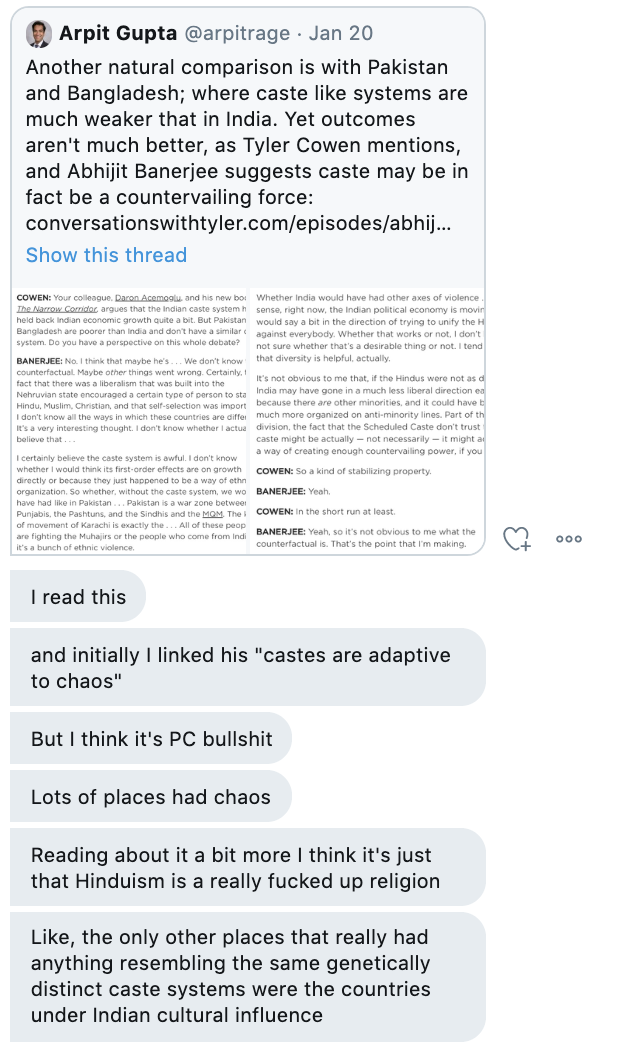 Because I’m am open-minded person many of my white liberal friends express to me their true views of Islam. Progressives do a lot of ‘solidarity’ with Muslims, but privately many think Islam is a regressive religion. Which, on the whole, is true.
But this is a general phenomenon. People will tell me things they might not tell others because I don’t judge (unless they are stupid). A friend who is a big player in Democratic and progressive politics has been trying to get a sense of why India has caste, and other regions do not. I can’t give him a good explanation.
Ultimately though, he concludes from the existence of caste that Hinduism is a messed up religion