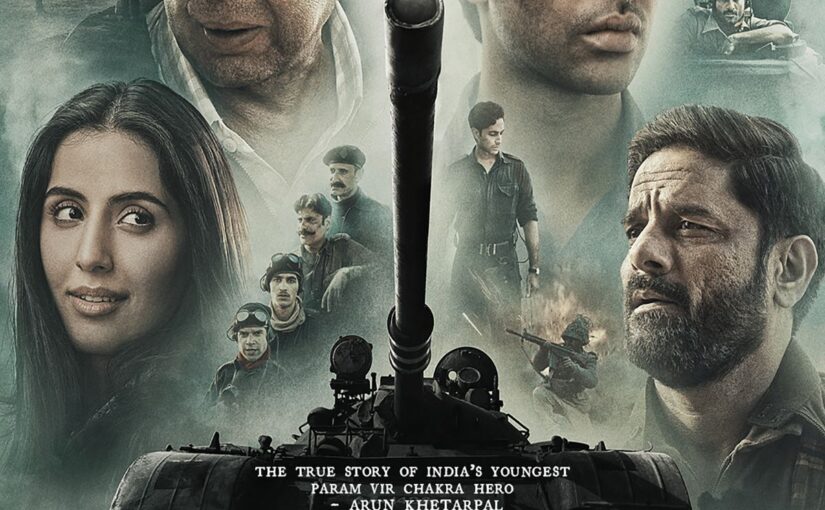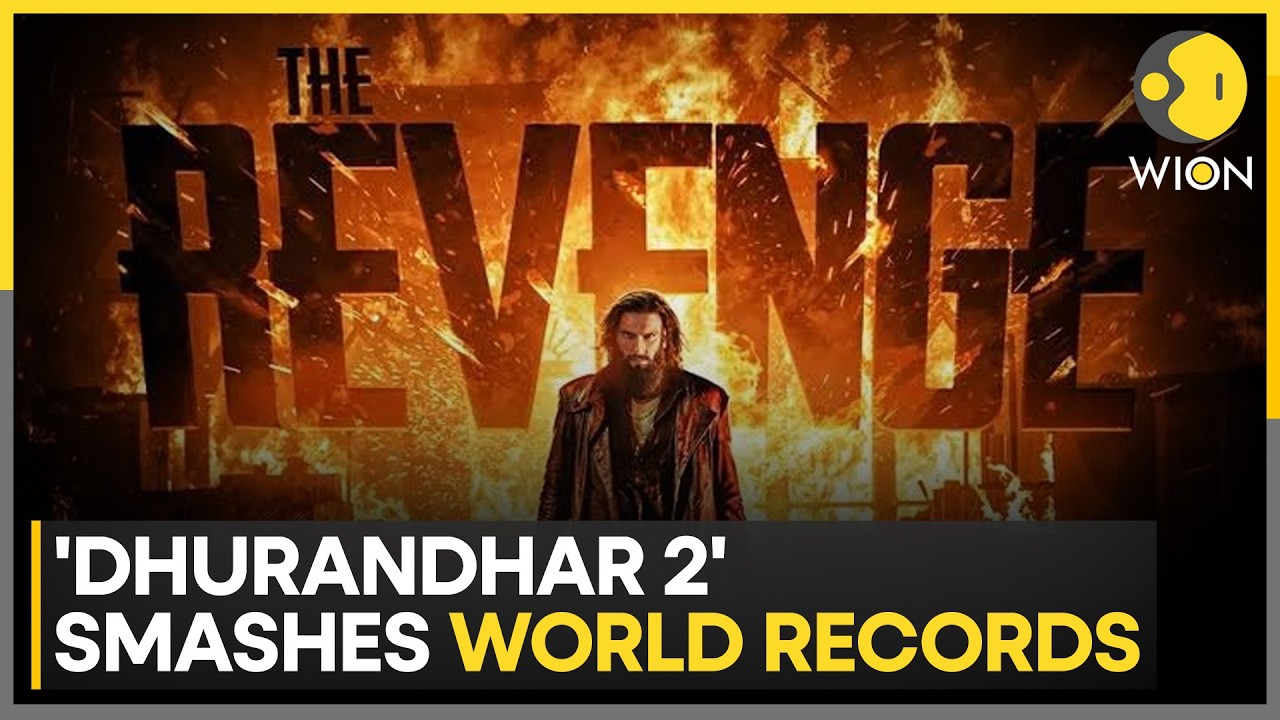
Dhurandhar, Politics of Bollywood & India Pakistan

I had avoided the Dhurandhar hype for the last four months. I finally watched the first movie on Netflix and then read XTM’s review and watched the 2nd part in theatre. I profoundly disagreed with it—especially the line:

“By routing this grief through an anti-Pakistan narrative, the film asks Hamza to deny his Sikhness in order to become fully Indian, and frames that erasure as redemption.”

I’m not writing a formal review of the movie, but I will try to respond to a few generic questions raised on this forum and across social media regarding Dhurandhar.


Is the villain missing?

I agree with XTM that a central villain is missing in Part 1, but perhaps we should see Dhurandhar as a 7‑hour film split into two parts, rather than a standalone first installment.


Part 1 vs Part 2

Personally, I felt Part 1 was more tightly written and better dramatized. While some reviewers saw the love story as a needless distraction, I viewed it as a way to explore Hamza’s humanity despite his profession.


Is Dhurandhar Anti‑Islam?

On the contrary, I felt the filmmakers went out of their way to separate the issue of anti‑India terrorism from Islam—despite the fact that some terror groups do draw on fundamentalist interpretations of religion.
The villains are not portrayed as devout Muslims; they are not shown praying before missions. Rehman Dakait’s wife lighting his cigarette as a good‑luck gesture is a good example.

One could even argue that Dhurandhar focuses almost entirely on political motivations within Pakistan, while ignoring any potential religious motivations behind the Indo‑Pak conflict. I don’t know exactly how the ISI thinks, but I would wager that at least some religious motivations do exist—it cannot be purely political.


Is Dhurandhar Anti‑Pakistan?

Obviously, it is—but I disagree with XTM’s assertion that it dehumanizes Pakistani Muslims.
I didn’t enjoy the montage of political killings by “unknown gunmen”; it felt shallow. But it wasn’t the sort of random, gleeful violence we saw with Gaitonde in Sacred Games during the 1993 riots.

The film definitely leans dark, but I would still call it shades of grey, especially because of Hamza’s conversations with his wife.

I also believe that Major Iqbal’s character is humanized. He carries the burden of his father’s sins, and the mental torture he undergoes—while still maintaining a link to his wife and child—would break almost anyone. We can see why Major Iqbal becomes who he is. Ironically, this humanization also makes him a less effective villain than Rehman Dakait, as many reviewers have noted.


Is Dhurandhar pro‑Modi propaganda?

I may be wrong, but I felt the film used real politics—like demonetization—to weave its plot. Using real events increases impact, and I think that’s what the filmmakers were aiming for.

Does this mean it has no propaganda effect? Of course not. But compared to the list of A‑list Bollywood movies I’ve seen over the years, this is nothing unusual. We will probably see Hollywood films justifying the Iran war in a decade or so—that has always been the pattern.

If you pay attention, the film also touches upon how previous governments—Indira Gandhi’s as well as Manmohan Singh’s—played roles in shaping certain outcomes. It is not a “Modi or bust” narrative.
However, it would be blind to deny that the film does portray the Modi government’s actions toward Pakistan and terrorism in a positive light.


Jaskirat’s Arc

While I found certain aspects of the film underwhelming, I thoroughly enjoyed Jaskirat’s arc. Here, I completely disagree with XTM. The movie does not celebrate Jaskirat’s transformation into a killer—it shows the cost he pays at every step. It also explicitly shows how he is used by the establishment.

Jaskirat doesn’t become an intelligence operative because Pakistan “earned his hatred.” He becomes one because it was the best choice available to him. The film wants viewers to see the price soldiers pay for their “jobs.”

Also i absolutely do not understand why XTM thinks Jaskirat’s Sikhness is erased in the movie. Rather Jaskirat choses to travel back to Pathankot as a tired  Sikh in full Pagdi not macho silky muscly Hamza. I think going beyond this straightforward narrative into the alleged drugs, land dispute, Khalistan angle while thinking erasure of Sikhness or History is something i absolutely do not get.


On Hatred Being ‘Installed’

XTM claims:

“The hatred is not earned. It is installed.”

I disagree. You do see Hamza’s transformation through Lyari’s horrific violence, the betrayal of the Baloch by Rehman, and 26/11. You can see a monster being born in Lyari, but even then he retains his humanity—which becomes evident again when he reacts to killing his friend.

The movie does not end with a “happily ever after” for either Hamza or Jaskirat. It wants you to examine that, not ignore it.


My Take

I enjoyed both movies. Like XTM and many others, I agree that Part 2 has more flaws while Part 1 is far more seamless. Still, Jaskirat Singh Rangi’s arc in Part 2 is the highlight of the entire seven hours.


On India–Pakistan

Contrary to what social media suggests, India as a whole has moved on from Pakistan. You can see this from the declining obsession with India–Pakistan cricket matches compared to the 1990s and 2000s.

Yet, a significant number of Indians derive a kind of sadistic pleasure from Pakistan’s struggles. You see this reflected in reactions to news, such as Pakistan mediating in the Iran crisis—where both the Hindu right wing and the opposition twist the narrative for political ends.

If you once hated your neighbour in the slum you grew up in, would you still mock his poverty after moving into a middle‑class apartment? Or should you aspire to grow on your own terms?

This attitude towards Pakistan is self‑defeating. I honestly pity it.
My message to fellow Indians: Grow up and move on. Look East.

What if Pakistan successfully mediates in the Iran crisis? What if Pakistan continues to punch above its weight diplomatically?

If their mediation helps solve an energy crisis—unlikely, but possible—shouldn’t I, as an energy‑deficient Indian, be happy? If Pakistan’s rise ever poses a genuine risk to India, I will worry about it then. Until that point, I prefer to leave it to the agencies and the government. If Pakistan becomes richer and doesn’t support terrorism against India why would that be a bad thing ? I am not being naive but i think there is a marginal chance of Ind- Bangladesh level relations with Pakistan in 20 years if not 10. Inshallah

nos ancêtres les Hindous

A pattern has emerged in these comment threads that deserves naming directly. When the Hindu hammer retreats, the space does not become neutral; it becomes anti-Hindu. The two are not the same thing, and conflating them is itself a form of intellectual dishonesty.

Hinduism is one of the most theologically complex systems humanity has produced. It is the root of Dharmic civilisation, the origin point of concepts, reincarnation foremost among them, that have radiated as far as East Asia, Southeast Asia, and arguably into the mystical strands of Abrahamic tradition. The sages, the philosophers, the vast literature: none of this coheres with the dismissal now fashionable in certain quarters, that Hinduism is simply a colonial administrative category, a British label slapped onto undifferentiated paganism.

This is the Pakistani foundational ideology speaking. It must deny Hindu civilisational continuity, because acknowledging it makes Temple destruction look like what it was: a pattern, not a series of unrelated incidents. It must deny that India had a civilisation, because if India had one, then the last pre-British colonisers of South Asia were Muslim; and that sits uncomfortably with postcolonial victimhood framing. The logic is circular and self-serving, but it is internally consistent. One cannot claim the mantle of the oppressed while being the penultimate oppressor.

The Dravidian Continue reading nos ancêtres les Hindous

Open Thread

Formerly Brown asked me to post this:

1. Six Ukrainians and one US citizen have been arrested by india while crossing over from Myanmar.  Apparently they were helping to create trouble in Myanmar,  an eventually trying for a Christian state there. Sheikh hasina had sounded about US interests in such a venture.

2. Tamilnadu elections might be closer than expected. Side show: seeman’s Tamil party is attracting Brahmins!! who are opposed to Dravidians.

3. LDF might pop UDF once again in Kerala.  Ironically both fronts are accusing each other of being B team of BJP,  who have 1 seat currently!!!

4. Indian lokasabha is to add 215 more seats reserved exclusively  for women by the 2029 polls. Modi has changed india for ever.

On Dhurandhar, Decorum, and Where BP Draws the Line

The review of Dhurandhar 2 has now been posted. Read it if you haven’t. The comment thread on the Ikkis post, which ran in parallel, illustrated the review’s central argument more vividly than any film still could.

A film that educates audiences to hate will eventually produce hateful audiences.

We have been moderating this site long enough to know that comment threads are a pressure gauge, not a debating society. What happened over the last 48 hours was not debate. It was escalation; predictable, cyclical, and ultimately ending where it always ends when people get sufficiently worked up: in the language of violence.

BB was on a Dhurandhar high. We understand this. There is something in the film’s rhythm, the josh of it, as he put it himself, that makes a certain kind of Punjabi Muslim-hating Bollywood patriot feel ten feet tall. We are not without understanding. He had just watched a four-hour film designed specifically to produce this effect. But understanding the cause does not excuse the consequence.

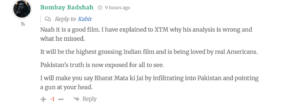
The line was crossed when he repeated, almost verbatim, dialogue from the film, the “ghar mein ghusega bhi, marega bhi” register, and directed it as a personal threat at Kair. Saying one will infiltrate Pakistan and hold a gun to someone’s head to make them chant a slogan is not josh. It is a threat. That it is practically unenforceable is beside the point. The language normalises exactly what we argued Dhurandhar 2 normalises: the idea that the other must be humiliated into submission, not merely defeated.

BB’s commentating rights are suspended until Thursday, 2nd April. Every comment he attempts in that period will be deleted. When the suspension ends, reinstatement of authorship will depend on whether the Saffroniate faction of our commentariat, can reason with him collectively that certain red lines exist even in the heat of subcontinental rivalry. Those lines are not about Pakistan. They are about the difference between argument and menace.

Kabir and Sbarrkum retain their authorship. Kabir was asked to stop and did not, and we say so plainly. But nothing in his conduct approached the violent register BB eventually reached. We are also honest about the asymmetry here: Brown Pundits tilts toward Bharat, that is India; everyone who reads this site regularly knows this. That soft tilt means Kabir, Sbarrkum and Qureshi operate in a forum that is structurally not neutral. The least we owe them is consistent application of the rules.

We want to say something about the Punjabi dimension behind all of this, because it is analytically interesting and not merely polemical.

Continue reading On Dhurandhar, Decorum, and Where BP Draws the Line

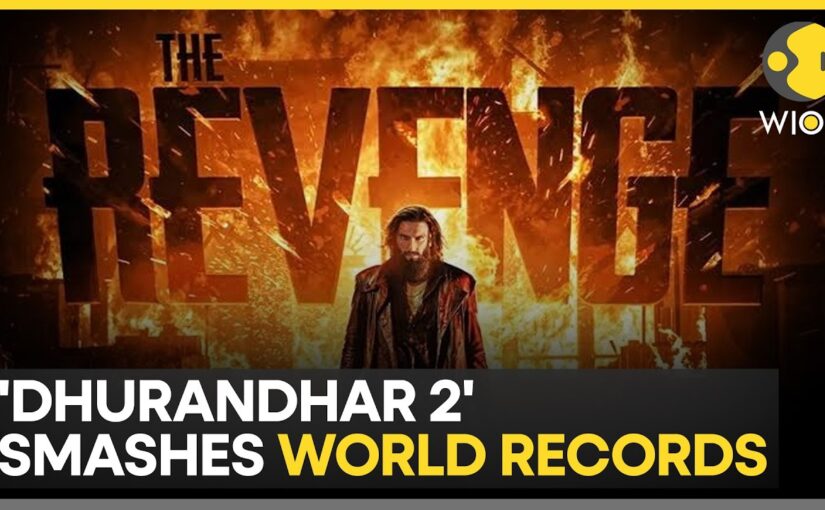
Dhurandhar 2: When the Villain Disappears, So Does the Film

We wrote in December that Dhurandhar perfected Bollywood’s new formula: the fetishisation of Pakistan as the subcontinent’s most glamorous disaster. Dangerous, broken, desirable, and always in reach. Three months later, the world has changed more than the franchise has. Iran has seized the Strait of Hormuz. Pakistan is psychologically vacating South Asia. And Dhurandhar 2 arrives as a cinematic relic of a paradigm already dissolving.

It is not good.

The first film worked because the villain was the gravitational centre. Akshaye Khanna’s Rehman Dakait, Baloch, charismatic, smouldering, made Ranveer Singh’s Hamza credible by giving him something worth the deception. A spy story lives or dies by its antagonist. Remove the antagonist, and you don’t get a hero. You get a man punching air for four hours. That is Dhurandhar 2. Angrier, louder, emptier; and at 3 hours 55 minutes, a film that confuses scale with depth.

The structural collapse is ideological as much as narrative. Dhurandhar 1 had grey. Hamza was a man genuinely lost between two worlds; the film understood that proximity to Pakistan produces desire, not only contempt. That complexity, that slippage between intimacy and danger, was what made it aesthetically serious. Dhurandhar 2 closes that gap entirely. The Pakistani Muslim is now simply a target, and the film is at pains to multiply them faster than they can be eliminated. This is the Hydra error; the same mistake Mossad has made in Gaza. Cut off the head and ten more appear, until the only logical conclusion the audience is being nudged toward is collective punishment. You cannot make a film that glorifies this logic and then claim it is merely entertainment.

The Hindutva-Zionism convergence is now visible at the level of cinematic grammar. Both traditions have arrived at the same endpoint: the innocents cannot be separated from the combatants, therefore the innocents must go too. It is a short distance from that premise to a football scene with a severed head, which Dhurandhar 2 includes without irony. This is not complexity. This is an audience being educated to hate, and that is far more dangerous than any amount of bad plotting.

Bollywood has always used Pakistan as its erotic shadow; familiar enough to feel intimate, foreign enough to feel forbidden. That formula depended on the Pakistani figure retaining some glamour, some interiority, some capacity to make the Indian hero sweat. Dhurandhar 2 strips all of that away. What remains is a shooting gallery. The irony is that by dehumanising its villains, the film also destroys its hero. Hamza becomes less interesting the more Pakistan becomes merely a backdrop for his competence.

The music, which in the first film gave us a Persian Gulf aesthetic that became genuinely anthemic, is a significant step down. The background score intrudes rather than elevates. And Ranveer Singh, who is a serious actor, is given a character arc built almost entirely around rage; which is a waste of an instrument that can do much more.

There is a deeper geopolitical irony the filmmakers did not intend. Dhurandhar 2 is a film about Indian dominance of the AfPak axis at precisely the moment that axis is reorienting toward Iran. Pakistan is stepping into its role as a Muslim power, mediating with Tehran, psychologically decoupling from the subcontinent. The Baloch and Pashtuns are the eastern Iranians; Punjab’s future is as a lowland frontier of a broader Persianate world, not as the last redoubt of a subcontinent fixation. Dhurandhar 2 is the cinematic expression of an India that has not yet noticed.

What Dhurandhar 1 understood, and Dhurandhar 2 has forgotten, is that the most dangerous person in any room is the one you cannot stop watching. Rehman Dakait was that person. His absence is not a plot problem. It is the film’s entire problem.

The sequels that matter are the ones that deepen what came before. Dhurandhar 2 only amplifies it, and amplification without depth is just noise.

⚠️ SPOILERS BELOW – Read only if you have seen the film Continue reading Dhurandhar 2: When the Villain Disappears, So Does the Film

Were You Colonised or Not? The UN Slavery Vote That Split the World

West vs the Rest

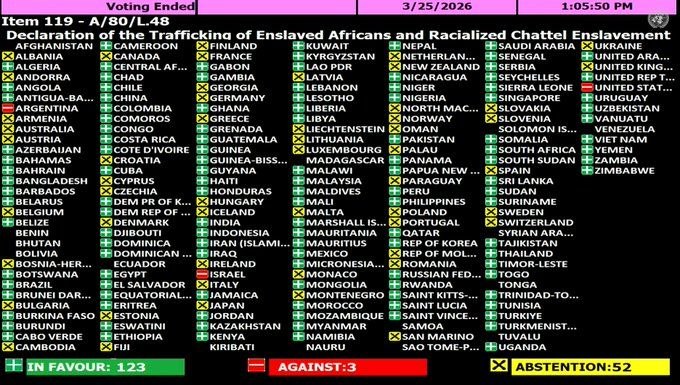
Today’s UNGA vote, 123 for, 3 against, 52 abstentions, is a clean ledger of where the world stands. The resolution declares the transatlantic slave trade “the gravest crime against humanity.” Three countries voted against: the United States, Israel, and Argentina.  The UK and all 27 EU members abstained.

The 52 abstentions are the more revealing column. The EU’s stated objection was legal: calling this the “gravest” crime implies a hierarchy among atrocity crimes, which has no basis in international law. That’s a defensible position. It’s also a convenient one for countries that ran the trade.

The US was blunter; its representative objected to the “cynical usage of historical wrongs as a leverage point to reallocate modern resources.” At least that’s honest about what reparations actually means in practice.

The UN is essentially asking whether countries whether they were colonised or not?

The 123 is the story. This isn’t Russia and China championing the Global South; it’s Africa, the Caribbean, and most of Asia doing it themselves. This marks the first floor vote at the UN specifically on transatlantic slavery as a crime, and a call for reparations.

The resolution is non-binding, so nothing material changes today. But the vote is a data point: on a question of historical accountability, the West is either against or abstaining, and everyone else is not.

That’s the fault line. West vs the Rest; and the Rest has the numbers. Gaza, Russia, Iran: all proxies for the same fracture. Russia ran an empire, but its Soviet collapse was so total it no longer reads as imperial. China likewise. So both get to stand on the other side of the line.

And underneath the EU’s legal objection, the “hierarchy of crimes” argument, is something unspoken: the Holocaust has long held the position of singular atrocity in Western moral architecture. This resolution is, implicitly, a challenge to that. The Rest is saying: your crime towards us was graver, or at least as grave. Europe couldn’t vote yes without conceding the point.

Ikkis: Thoughts on another Propaganda Movie

Second Lieutenant Arun Khetarpal is an Indian Army legend. A National Defense Academy (NDA) and Indian Military Academy (IMA) alum, Khetarpal was commissioned into Indian Army’s armoured regiment, Poona Horse and won India’s highest gallantry award the Paramvir Chakra, posthumously, for his heroism in the 1971 India-Pakistan war. Sriram Raghavan’s Ikkis is an autobiographical account of Arun’s life and the Battle of Basantar. A battle where Khetarpal’s Centurion tank took on the Pakistan army’s Patton tanks and fought valiantly before he succumbed to injuries on the battlefield. The movie stars Agastya Nanda, grandson of Amitabh Bachchan, as Arun Khetarpal with Dharmendra and Jaideep Ahlawat. The former plays the role of Brigadier Madan Lal Khetarpal, Arun’s father and the latter plays the role of Brigadier Nisar of the Pakistan army.

The movie recounts the visit of Brigadier Khetarpal, in 2001, to Lahore where he is hosted by Brigadier Nisar of the Pakistan Army. The senior Khetarpal is visiting Lahore for his college reunion and to visit Sargodha from where his family had to migrate in the aftermath of India’s partition in 1947. This story track runs in parallel to the story of Arun’s days at the NDA, IMA, days leading up to the battle and the battle itself. The senior Khetarpal, now in his eighties is all dewy eyed for his roots and the younger one, who has turned 21 (Ikkis is the word for the number 21 in Hindi) is eager and keen to prove his mantle on the battlefield. The retired Brigadier is serenaded by everyone, by his hosts, his former classmates and the family that now lives in his ancestral house. The young second lieutenant is learning the brutal nature of combat and the human cost of war as he rolls on towards Basantar. The dramatic arc of the movie ends with Brigadier Nisar telling the elder Khetarpal that he was the commanding officer of the Patton that shot the lieutenant’s tank and it was his assault that proved fatal.

I am a big Sriram Raghavan fan. His Johnny Gaddar makes it to every list of top 10 Hindi movies that I have ever made. Raghavan has the knack of writing stories and characters that are unconventional for commercial Hindi cinema, his plot twists don’t disappoint and nobody uses songs from Hindi movies of the 1950s, ’60s & ’70s like Raghavan. He eschews over the top dramatics and gets his actors to deliver pitch perfect performances.

Ikkis is handicapped by the fact that it is autobiographical. Raghavan has limited scope for crafting a story that surprises. This is his attempt at making a war movie and the stories of the two Khetarpals is a prop. He wants us to see that Indians and Pakistanis are the same people, there are no winners in a war, soldiers are common folk who pay with their lives for the idea of nationhood, there is common humanity that binds us all and the Pakistan army, just like the Indian army, is a professional force doing what is necessary. He uses all the tropes to make these points. Scenes of the elder Khetarpal with Brigadier Nisar’s family, his former classmates, the joyous outdoor dinner organized by the occupants of his ancestral home, the bullets ridden, lacerated bodies of soldiers and the depiction of Brigadier Nisar as an honorable gentleman who represents the best of Pakistan army. Continue reading Ikkis: Thoughts on another Propaganda Movie

Is Hormuz, Israel’s Suez but Pakistan’s Second Act?

Start with the uncomfortable question nobody in Washington wants to ask directly: how is this not a defeat for Israel?

Trump reposted Shehbaz Sharif’s offer to host US-Iran peace talks, and Bannon’s WarRoom picked it up within the hour. That’s the tell. When Pakistan’s diplomatic positioning lands on the most watched MAGA platform in America, amplified by the President himself, the “Second Act” isn’t a thesis anymore. It’s the news.

In 1956, Britain and France attacked Egypt alongside Israel. Militarily, they won. The Egyptian army collapsed. The canal was taken. Then Washington intervened, sterling cracked, and within weeks they withdrew — humiliated, permanently diminished, never again operating as independent great powers in the Middle East. They won the battle and lost the century. (As an aside, PM Modi made his allegiances clear from the very start of this conflict; the bombing was reportedly postponed for his visit to Washington. India, like Britain and France in 1956, has picked its side. The question is whether it has picked the winning one.)

That is the template. Now run the present war through it. Israel spent two years engineering this confrontation. Then, at the exact moment diplomacy began to work, the bombs fell. Oman’s Foreign Minister Badr bin Hamad Al Busaidi, a cautious, establishment figure from a cautious, establishment country, said it plainly: nuclear negotiations were making progress, Iran had agreed to no enriched uranium stockpiling and full IAEA verification, peace was within reach. Talks were due to resume on 2 March.

The strikes began on 28 February.

That is not coincidence. That is a choice: war over settlement. Now look at the structure that follows. Iran has not won militarily. Its air force is degraded. Its infrastructure is hit. Its Supreme Leader is dead, replaced by his son; a harder man, not a softer one, which is itself a signal about how decapitation strategies tend to end. But Iran has achieved the one thing that matters strategically: leverage over the Strait of Hormuz. Analysts are already describing any exit that leaves Iran as the effective gatekeeper of the Strait as a colossal strategic failure for the United States. That is the centre of gravity. The US can bomb, seize assets, escalate. But it cannot reopen the Strait on its own terms if Iran is willing to absorb damage and impose cost. Geography is doing the work. Patience is doing the rest.

Now watch Washington move.

A $200 billion supplemental request is already in play. Oil prices are moving. Trump has begun the political separation, “I might have forced their hand”, while his own Secretary of State had already said Israel led the way. That asymmetry matters. Trump wants a deal he can sell to American families at the petrol pump. Israel wants Iran broken. Those are incompatible war aims, and they are visibly diverging: Trump rebuked Israel over the South Pars gasfield strike; Israel assassinated Ali Larijani, seen by some as a key potential negotiating figure, just as back-channel possibilities were opening.

The same negotiations torpedoed in February are now the only viable exit. Trump says Iran wants a deal. Iran denies it. Neither side is behaving like a defeated power. This is not surrender. This is endurance; and endurance, historically, beats air supremacy.

That is Suez. It does not require retreat under fire. It requires something subtler: the moment when the patron begins calculating its costs independently from the client, and reaches a different conclusion. When that happens, the war ends regardless of battlefield position. Britain and France didn’t lose in 1956 because they ran out of soldiers. They lost because Washington ran out of patience.

The American public will eventually ask whose war this was. That question is already forming. And it is precisely here, in the gap opened by Washington’s growing ambivalence and Israel’s strategic overreach, that the second story begins.

While the US and Israel have been consumed by a war that is proving harder to exit than to enter, one country has quietly stepped into the resulting vacuum. Not China. Not Russia. Not Turkey, though Ankara is watching closely.

Pakistan.
Continue reading Is Hormuz, Israel’s Suez but Pakistan’s Second Act?

“What did Op Sindoor actually accomplish”?

23rd March 2003. Twenty three years ago today, a Pakistani Operative Zia Mustafa of the Laskhar-e-Toiba walks into the village of Nadimarg, Jammu and Kashmir. Wearing fake uniforms, Zia and his accomplices wake up the the village, and then proceed to murder 11 men, 11 women and a boy after lining them up. Walking away, the terrorists hear a baby crying, and order to silence him. The baby becomes murder victim #24. Link

23 March 2026, I read a comment on a BP thread discussing the West Asia war and Iran’s defiance, and the question that is the the topic of this post is asked.

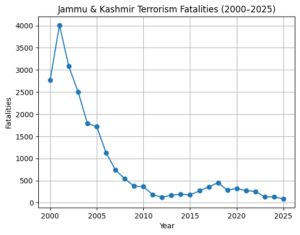
I feel obligated to answer it. The statistics of so-called ‘non-state actor’ victims inflicted by Pakistani groups on Indian soil, since the 1990s, into the 2000s and beyond are stark. For an Indian who has grown up to adulthood in these years, actually lived through multiple decades where hundreds if not thousands of Indians dying as a result of the Lashkars and Jaish of the world was just part and parcel of life – all given succor by the Pakistani military and state. The datasheet linked here shows the tragedy that has been slowly but surely being deterred – and this is only starting with the year 2000. According to SATP, more than 25000 deaths occurred in J&K between 1988 and 2000.

The change in the public response of the Indian government, starting with the surgical strikes in 2016, and then escalated with the Balakot Bombing raids, and the direct and sharp decrease in the number of terrorism incidents is unmistakable. Operation Sindoor, the 4 day skirmish that took place in May 2025 on the heels of unarmed tourists being murdered in cold blood – is the exclamation mark in a simple statement that demonstrates Indian resilience and response when challenged with terrorism. No more will such attacks go unanswered. And the ultimate sponsors of such evil – the Pakistan Military itself – will have to bear direct consequences delivered. Via Brahmos-Mail.

Nobody needs a degree in statistics, to spot the co-relation in the timeline – India starts executing public retaliation in the aftermath of terror attacks, the frequency of such attacks drops sharply.

As far as the spreadsheets accounting and the nuts and bolts of what targets were hit during Op Sindoor that would count as “actual accomplishments” – there is ample evidence available for any objective observer to get themselves informed. From satellite imagery of multiple PAF bases and runways ‘double-tapped’ into shutting down for months, to ‘hardened’ aircraft shelters being demolished and rebuilt months after the fact.

But what Op Sindoor accomplished goes beyond merely a largely one-sided ledger of inflicting losses to military bases and flagship bases of terrorist organizations – Op Sindoor was a demonstration of commitment by the Indian state – a resolve that no longer will the nuclear umbrella allow the Pakistani Military to continue waging its ‘jihad of a thousand cuts’ without the consequences of a military conflict. One that will inflict costs not just on the bankrupt Pakistani state, with FATF gray lists hurting its citizens. Send terrorists to murder Indians, and bombs will drop on Pakistani Military bases in response. Op Sindoor is a promise of resolve. The Indian government will respond militarily if you threaten the security of its citizens.

Post-script: Apart from making an unambiguous demonstration of Indian deterrence when facing up against terrorism emanating from Pakistan, arguably the greatest indicator of the success of Op Sindoor, is the Pakistani Military’s attempt at copy-pasting their own version on Pakistan’s Eastern Border. Unfortunately, the results for the second sibling that was birthed from ‘Cracking India’ in 1947, have been a lot more….mixed.

The Façade of a rules‑based international order

Politics is deeply ideological—but does ideology really matter in geopolitics at all?

A few modern (if that’s a fair word) Islamic countries—Turkey, Azerbaijan, and Pakistan—have adopted an increasingly anti‑India position. For Pakistan, this stance is ideological; for Turkey and Azerbaijan, it is clearly pragmatic. Meanwhile, India has become friendlier with the Taliban, Iran (the current war notwithstanding), and the Gulf states.

Similarly, India’s closeness to Israel is not ideological—though cheerleaders on social media often present it that way. It is strategic and does not depend on Jews being tolerant of Hinduism. I have zero insight into how Israelis view Hinduism (nor do I, as a resident of India who never intends to visit Israel, particularly care). But that should not matter, because Israel is one of the very few all‑weather geopolitical partners India has.

India needs weapons and technology, and it gets them from Israel—so Israel is important to India. India needs oil and gets it from Iran and Russia—so they are important to India.

These statements may sound childish or crude, but they capture how geopolitics actually works. It does not run on ideology or cultural history. Much of the cultural narrative that intellectuals and pop‑culture try to weave around geopolitics is post‑hoc justification meant for an idealistic public. Even dictatorships engage in such storytelling—not just democracies. There are exceptions, of course. For instance, when the Nupur Sharma controversy broke, it triggered a small geopolitical crisis for India.

Nation‑states are both products of culture and creators of culture. Cultural and political anxieties were the prime movers of the Pakistan movement. But the lived realities of Pakistan, India, and even Bangladesh as nation‑states have produced their own cultural trajectories and divergences.

So should an Indian cheer for the bombing of a friendly totalitarian theocracy at the hands of its friend which is a selective liberal democracy {only for the chosen people) ?

No—not only because Iran is a friend of India, but because emerging economies that are democracies need at least the façade of a rules‑based international order to function. Donald Trump doesn’t seem to like the façade but diplomacy of varying shades still ought to be relevant in politics for years to come.


Brown Pundits