What the internet is today

The troll above lives in Frisco, TX. If I spent $1 I could look up their name and identity. I have 35,000 Twitter followers, and blogs and newsletters that get tens of thousands of pageviews a day. I could make this person “famous” very quickly!

I (probably) won’t do this, but the lesson I want to put out there: be careful who you troll with appropriate “opsec.” Most of the time you people are beneath notice, but I am becoming aware I will have to “make examples” at some point soon to dissuade some of the more nasty behavior that crops up on the internet.

You don’t hide behind anonymity as much as you think. I “own” what I do say on the internet. Many of you lack courage so behave in a nasty manner under “pseudos.” But the day is something when monsters will get hungry, and even anchovies will appetizing.

They forgot who they were?

Romani girl from Czechia

Right now I am working on a piece about Romani for my Substack. The first clear mention of Romani in Europe is in Crete in 1322. This is certainly postdated their arrival, but there is a good amount of circumstantial linguistic and genetic evidence that they left the Indian subcontinent not much earlier than 1000 AD.

Genetically on the whole the Romani are ~30% South Asian in ancestry (some groups and individuals are closer to 50%, others to 20%). Even besides this fact, just physical inspection of some of the Romani makes it clear what part of their origins are. Their language is similar enough to other Indo-Aryan languages that a Hungarian Reformed theologian who learned some Sinhalese at a seminary in the Netherlands in the 18th century was the first to identify that it was Indo-Aryan because of its similarity. Some lascars did the same in the United Kingdom when they overheard Romani talking to each other in Wales.

But this brings me to a curious fact: the Romani seem to have forgotten their Indian origins by the time they arrived in Europe, after a sojourn of centuries in the Middle East. The Romani are nomadic people who have an oral culture. There is a great deal they remember. The term for a Christian “cross” in Romani is trushul. But they forgot where they came from.

How much steppe is there in Pakistan?

In the annoying dick-swinging competition that are the comments-board, someone asserted Pakistanis have a lot of steppe even on the maternal side. Really?

We have Sintashta mtDNA and the discordance was shocking to me. But there are some groups in Pakistan with detectable Sintashta mtDNA. These samples from Hazara, Kho, Pashtun, Kashmiri,and Kalash. They identify 8.4% steppe mtDNA. Pakistan as a whole has a lot more “West Eurasian” mtDNA, but that’s obviously due to the legacy of the IVC. Anyway, Complete mitogenomes document substantial genetic contribution from the Eurasian Steppe into northern Pakistani Indo-Iranian speakers:

In summary, based on available archeological and high-resolution mitogenome data from northwestern Pakistan, especially from Iranian and Dardic populations, who are suggested to be the surviving traces of early Indo-Iranian groups, we identified the genetic contributions of different dispersals from west Eurasia into northern Pakistan during the Bronze Age onward. Importantly, we identified five haplogroups as the genetic legacy of IE speakers from the Eurasian Steppe, likely dispersed along with the migration of IE-speaking populations during the Bronze Age into northern Pakistan, thus implying that IE language expansion into South Asia was not simply mediated by cultural diffusion. This migration contributed 8.4% of the gene pool of northern Pakistani IE speakers, suggesting this demographic connection, which is a possible source of IE language diffusion, could be one part of the complex demographic history of the region. Our results also provide implications on the two main hypotheses of IE language origination, viz. Anatolia and Steppe hypotheses. Considering that Steppe components were observed in all Indo-Iranian groups in northern Pakistan in our study, as well as in other regions in South Asia [10], while lineages possibly representing the genetic legacy of Neolithic farmers, e.g., R2e, K1, were either absent or not found in all of the IE-speaking groups in northern Pakistan, our results lend more support to the Steppe hypothesis, at least from a matrilineal perspective. Furthermore, these IE speakers, as evidenced by the genetic legacy identified here, also moved southward and contributed genetically, though to a rather limited extent, to the Indian subcontinent, suggesting northern Pakistan as a corridor in the spread of IE languages during the Bronze Age dispersals into South Asia. Since our study is only based on mtDNA data, which only reflect maternal histories of populations, more investigations based on genome-wide data are also needed to intensively dissect the expansion of IE speakers into South Asia.


Lakshmi


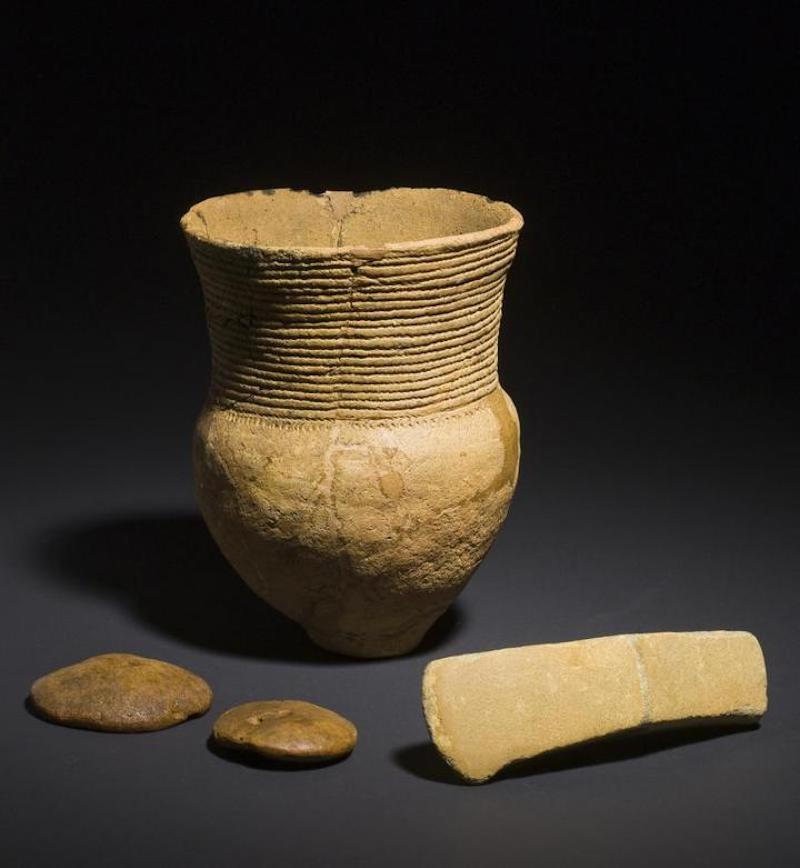
I’m spending a lot of time reading about the Corded Ware for my series on the steppe. The Corded Ware is a culture that appeared that abruptly in Northern Europe between 2900 and 2800 BC, covering a vast territory of Central and Eastern Europe in a century. The name derives from the unique marks left on their pottery.

For decades scholars have argued whether they were an indigenous development out of the farmers who occupied this region for thousands of years, or whether there was a mass migration out of the steppe. More realistically, there was a synthetic position between at some point. Perhaps the farmers were influenced by a few elite bands migrating out of the steppe?

Today due to ancient DNA we know more. The Corded Ware culture in its mature phase is about 70% Yamnaya and 30% farmer. The farmer’s ancestry almost certainly comes exclusively through women. The Y chromosomes of the farmers were G2. There is very little of that within a few generations. It is almost all R1a.

But that leaves us with the question: where did the new pots come from? The answer is straightforward: the men from the steppe took wives from the farmers. They killed their fathers and brothers and took them to their homesteads to bear them children. These women knew how to make pots because they did not come from nomadic backgrounds. They adapted their techniques to making pots that exhibited marks that made them resemble the baskets that their husbands brought in their wagons.

The miracle of the immediate emergence of a new pottery technique is due to the fact that the nomads didn’t learn to work in clay. Their wives already had the skill.

Why is this posted on this weblog? That’s a question that does have an answer…

West Bengal, TMC wins!!!

Modi鈥檚 BJP Suffers Setback in West Bengal State Elections:

Indian Prime Minister Narendra Modi鈥檚 party fell far short in its attempt to win control in a fiercely contested state election, one in which its aggressive efforts to get out the vote have been criticized as worsening the country鈥檚 surge in Covid-19 infections.

Official results coming in early Monday showed Mr. Modi鈥檚 Bharatiya Janata Party was poised to win as many as 77 seats in the West Bengal state legislature鈥攁 sharp pickup from its previous showings but well short of a majority of the 292 seats being contested.

The state鈥檚 governing Trinamool Congress party was on track to win as many as 213 seats. The party is led by Mamata Banerjee, a powerful regional politician who has at times been an outspoken critic of Mr. Modi.

– Does the TMC have an ideology?

– It’s weird that this is a state with 90 million people. India is so populous!

– Are regional parties going to have a lock on the south and east?

Multiple hearths of agriculture in ancient South Asia

Patrick Wyman’s Tides of History podcast is tackling South Asia and prehistory. He wrote up a Substack for it too, Ancient South Asia – Farming and People in India and Pakistan. I agree with Patrick here, though my confidence is low:

…It seems unlikely that a group living 1400 miles to the east would have chosen precisely the same suite of domesticated plants and animals as their related brethren in the Fertile Crescent. It鈥檚 intriguing that a fourth distinct group, as yet unsampled by geneticists, might have been living in the Fertile Crescent alongside their relatives 10,000 years ago or more. But the most likely, in my opinion, is that the group ancestral to later South Asians was living somewhere between the Indus Valley and the Zagros, perhaps on the Iranian Plateau: close enough to adopt some pieces of the Fertile Crescent farming package, close enough to head a short distance east, through the Bolan Pass, and into South Asia.

My confidence in this part is higher:

Yet they were not alone in South Asia, nor were they the only ones engaged in farming. Further to the east, along the Ganges River, the indigenous foragers were also experimenting with plant cultivation. In fact, there were no fewer than five places in South Asia where we see evidence of independent plant domestication. Mung bean, urd bean, horsegram, several varieties of millet, and rice were all cultivated extensively. These crops had the benefit of being able to grow during the summer monsoon season. South Asia was actually home to multiple Neolithics of its own.

In Southeast Asia and Europe, the hunter-gatherer populations contributed 20% or less to the ancestry of modern groups, who descend mostly from farmers and pastoralists. In South Asia the “Ancient Ancestral South Indian” (AASI) ancestry is ~50%. What’s the difference? I think the likelihood is that AASI populations were moving toward agriculture is a likely reason why they were much more demographically robust and impactful.

To the victors go the glory!

I have written an introductory post (it’s free), Entering Steppelandia: pop. 7.7 billion, to a series of posts (mostly paid) that I will write about the Eurasian steppe. So I’m thinking and reading a lot about this topic. This is relevant to “Brown Pundits” because we subcontinental people have been stamped by the steppe.

First, there were the Indo-Aryans. About 15% of the ancestry of modern South Asians comes from these people (averaged across region and caste). Then there were the Iron Age Iranian pastoralists, Scythians, and assorted other related groups. There is no strong evidence right now of a major genetic impact, but I think the statistical power is not such that I can definitively ignore this possibility.

Finally, there are the Muslims. They had the least impact. But they are most reviled. Why?

They lost.聽 The lesson is to not lose. The rest is commentary.

Brown Pundits