
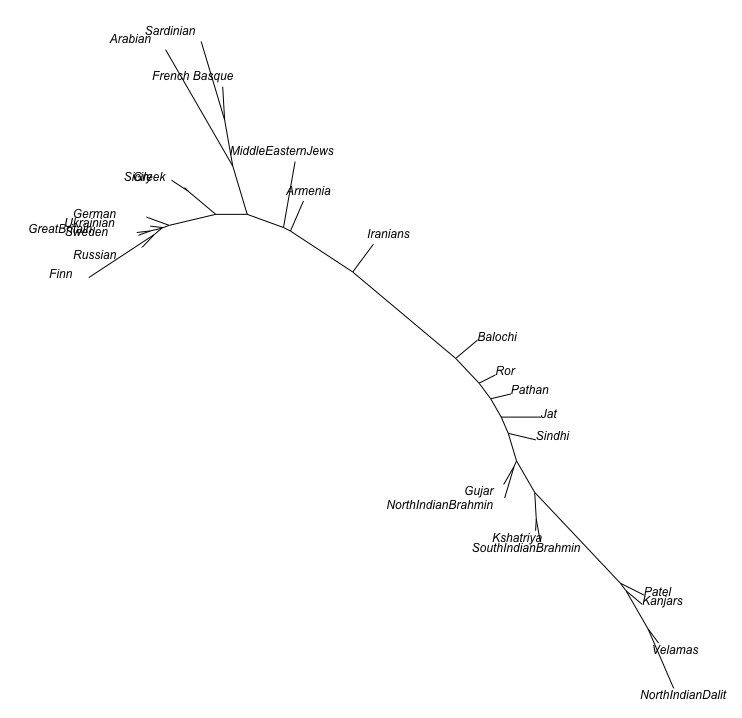
People always ask about genetic distance. Above is a NJ tree of a pairwise Fst.
Here is the raw table.
Please stay chill in the comments.
(used Plink’s Fst with 200,000 markers)
People always ask about genetic distance. Above is a NJ tree of a pairwise Fst.
Here is the raw table.
Please stay chill in the comments.
(used Plink’s Fst with 200,000 markers)
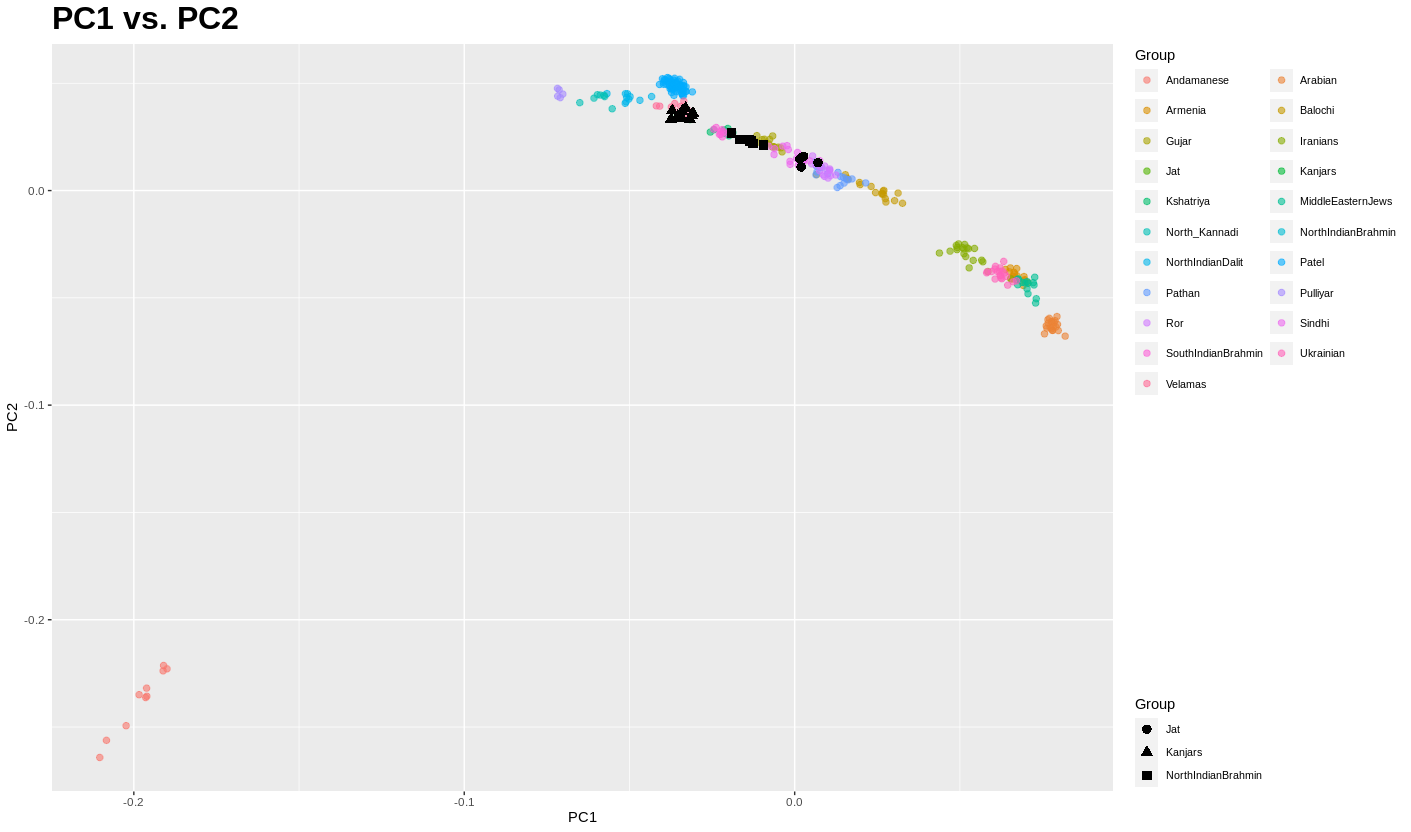
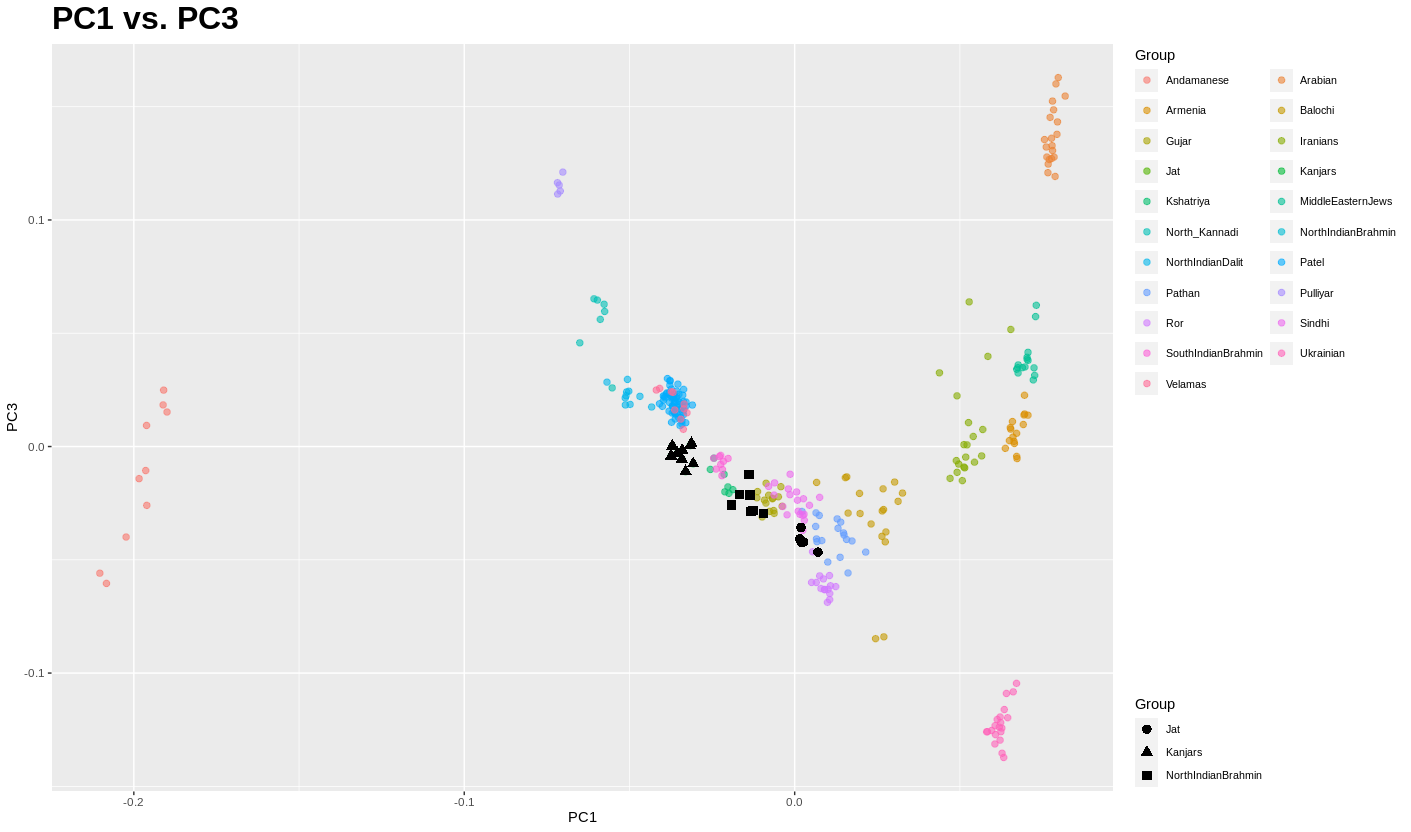 About 10 years ago there was a defunct blog called the “Jat Gene.” Standard stuff. Nothing super amazing discovered, but the Jats do seem on one end of the pole. I happen to have half a dozen Jats which cluster together. You can see where they are on the PCA plots above.
– no surprise that the Jat are on the ANI end of the ANI-ASI cline
– Please note that Jat and Ror and other such groups are distinct from Pathans and especially Baloch in that the latter groups seem to have more and later gene flow/contact from West Asian groups. Perhaps this is the Islamic period? Or perhaps this is just contact due to proximity. The Baloch and Brahui in particular are distinct because they have very little AASI. The Pathan are arguably an Iranian group with South Asian inflection, but the Baloch are just plain West Asian.
– You can see at the admixture plot below. The Jat are less (marginally) European-like than the Ror, but the Treemix indicates the Ror may actually be a mix of a very European-like group with native Indian (ANI-ASI mix). The Jat are probably the same but I don’t have the samples.
Continue reading The Jat Gene!
The film Panipat is on Netflix, and I watched a bit of mostly for anthropological reasons. It seems a typical melodramatic Bollywood gloss on this period, and I found the depiction of Ahmad Shah Durrani rather amusing.
But it brought to mind a broader issue that I’ve been reflecting on over the past few years: the re-pivoting of Indian historical imagination around the Maratha moment. Most recently my thoughts have been sharpened by the goings-on in the United States, as we reevaluate our own historical figures and events. History is what it is, but the interpretation is multi-layered, and the process of analysis is subject to an infinite chain of point and counterpoint.
For example, Ulysses S. Grant has been rehabilitated because broadly on the questions of racial justice he was on the “right side of history,” though ultimately his efforts failed. This, after a period in the 20th-century when Southern historians slandered his character and competence in a clever trick of defeating him long after his death through control of historical memory.
And yet, if you talk to a Native American their view of Grant is far less positive. This is due to the fact that Grant participated in and executed the American government’s wars against Indian tribes.
The final verdict on Grant and his legacy depends on where you stand. The elements of history which lead up to this judgment though are far more solid. The terminus of the analysis is conditional on the analyst, but the facts themselves are invariant.
So how should we view the Marathas and the Mughals? When I wrote Haunted by History I alluded to general issues I’ve noticed in Indians in relation to their past. I have read enough history to be aware of the Marathas as a factual matter. But my conscious understanding of what they meant to Indians, and what they could have been, was stimulated by the arguments of a Hindu nationalist friend of mine.
In the 19th and 20th century various nationalist movements rose up which recaptured the political system from cosmopolitan and/or alien elites. The Chinese took back their state from the Manchus. Across Europe, ethnic groups such as the Lithuanians and Hungarians, submerged, sublimated, or subordinated, rose up and asserted their national identity. Lithuanians and Hungarians, to give two examples, had great histories as nations in the past, but by the early modern period, their elites had become subordinated and assimilated. The Lithuanian nobility became totally Polonized after the Union of Lubin. The rise of Habsburgs, and the fall of the Hungarians to the Ottomans, resulted in a Magyar nation which was under German and Turkish domination for centuries. The Dual Monarchy period after 1868 allowed the Hungarian nobility more freedom and status, though ironically they continued to oppress and subordinate the ethnic minorities under their hegemony in the eastern part of Austria-Hungary.
The emergence of these new identities entailed a reinterpretation of the valence of historical events.
Before we get to that, let’s consider the Marathas, of all castes and persuasions. The debates I have seen often end up at two antipodes. On the one hand, the Marathas are depicted as proto-Hindu nationalists, defending themselves against Muslim oppressors, and giving their swords in the service of the broader pan-ethnic Hindu Rashtra. The contrasting position is that the Marathas were motivated by more prosaic concerns, and their Hinduism was a secondary or ancillary element to their identity. In fact, one might problematize what “Hindu” even meant in the 17th and 18th centuries. That is, they didn’t have a “Hindu identity,” but had a Maratha identity, and Maratha religious practices and beliefs.
Both of these views are I think wrong-headed in understanding this period and these people. Humans are complex, and not cartoons. Someone like Shijavi may have reimagined who he was, what he could become, over his lifetime. In the beginning, he fought to survive. By the end, he fought to conquer.
Certainly, it seems probable, to give a different example, that Constantine, the first Christian Roman Emperor, reconceptualized his relationship to his new faith over the decades and also reimagined what it might mean for Rome. This is a different reading than that of those who assert that Constantine was never really a Christian because in the early years of his acceptance of the new faith he seems to still have nodded to aspects of the Solar cult which he was once a devotee, or of those who assert that he was a zealous Christian as they would understand it after he issued the Edict of Milan.
Where does this leave us? I have spoken earlier of the fact that to be frank, many people from Uttar Pradesh who are Hindu seem somewhat “broken.” Perhaps I should use a different word, as what I’m trying to get at is ineffable. But I believe that hundreds of years of continuous Turco-Muslim domination, and the historical predations upon their sacred geography, has left an imprint. Their land was the heart of the Mughal Empire, the shining exemplar of Turco-Muslim civilization. Though the Indian religion and self-identity maintained itself in a resilient fashion, it was subaltern. Though never sublimated as the Lithuanians were, it was subordinated.
Mount Rushmore means a very different thing to Native Americans than it does to white Americans. To many Hindus from the Gangetic plain, the apogee of the Mughals means something different than it does to Urdu-speaking Muslims. One man’s glory is another man’s shame. One man’s seduction is another man’s cuckoldry.
Which brings me to the “Maratha mindset.” What do I mean by this? I mean a self-assured, self-confident attitude. The sense that the arc of history bends toward the Dharma. The Maratha project failed in the end, but its ultimate failure was due to the reality of European hegemony and the rise of white supremacy across the globe. It seems possible in an alternative history where European domination occurred later, or in an incomplete fashion, the Maratha polities would have served as the ultimate basis for what became the Indian nation-state. This does not mean that Maratha would be the language of the Indian nation-state, or that the culture of the northwest Deccan would be hegemonic. An analogy here might be the role that elites from the Chūgoku region of western Japan played in driving modernization in the Meiji period, before eventually ceding ground to the resurgent Kanto region around Tokyo. Chūgoku was the nucleus, but only the beginning, the “starter.” The final product is always richer and more multi-faceted.
The moral of this post is that the Hindus of the Gangetic plain resisted Islamicization through a process of fracturing into localities, with a broader civilizational identity. But the resistance and centuries of Mughal domination crushed cross-regional asabiya, which is necessary for nation-building. Obviously the nation is built, and Uttar Pradesh in particular is politically central. But the psychology of the Hindus of this region has to move from negation, reaction, to positive action. They need to shake off their history and move forward into the future. They need to adopt the Maratha mindset.
Another BP Podcast is up. You can listen on Libsyn, Apple, Spotify, and Stitcher (and a variety of other platforms). Probably the easiest way to keep up the podcast since we don’t have a regular schedule is to subscribe to one of the links above!
You can also support the podcast as a patron. The primary benefit now is that you get the podcasts considerably earlier than everyone else. This website isn’t about shaking the cup, but I have noticed that the number of patrons plateaued a long time ago.
 I would though appreciate more positive reviews! Alton Brown’s “Browncast” has 30 reviews on Stitcher alone! Help make us the biggest browncast! At least at some point.
This episode Razib has a very wide-ranging discussion with economist Abhinav Prakash.
Topics includes:
– The culture of UP
– The economic policy of the BJP
– The role of Hindu identity in India culture
– The long-term prospects of Hindu-Muslim amity in UP
– Regional differences within India
– The “Maratha mindset”
– Now non-Brahmin/Bania Hindus are changing the nature of Hindu nationalism today from what it has traditionally been.
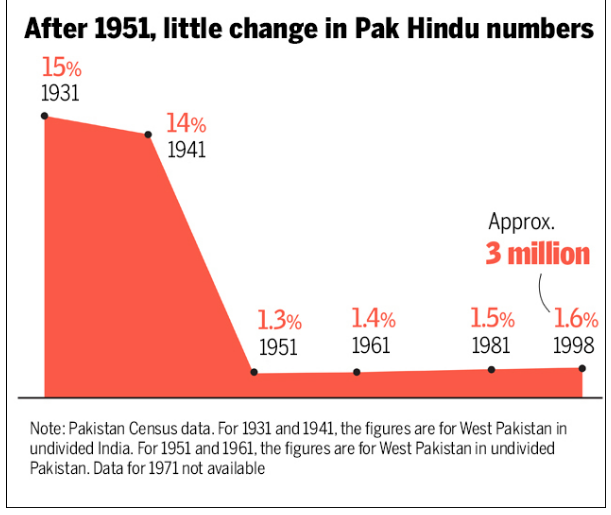
Most readers of this weblog will already know this story. Far more than I do at least: Construction work at Hindu temple site in Islamabad halted. This part jumped out at me:
The Pakistan Muslim League-Quaid (PML-Q), an ally of Prime Minister Khan’s ruling Tehreek-e-Insaf recently opposed the construction of the temple by claiming that it was “against the spirit of Islam.”
Let’s be frank: isn’t this correct?
Religions are what people make of them, and there are some latitudinarian Muslims who would object to the assertion that the building of a Hindu temple was “against the spirit of Islam.” But historically this action, the obstruction of the building (and repairing) of religious buildings of minority communities has been normative in many Muslim majority societies. Egyptians Copts, for example, have long had to obtain very high level dispensations to repair their churches.
The basic theory from what I recall from Islamic jurists is that minority communities under the protection of Islamic rulers were tolerated, but they need not be encouraged. Their religious liberties were provided at sufferance, and that was enough.
The issue with Hinduism is even deeper: Hinduism is rather explicit in that it is a form of shirk. Whether you conceive of your Hinduism as fundamentally monotheistic or polytheistic, from a Muslim perceived it is polytheistic, and therefore an abomination. The Pakistani polity is illiberal in its behavior, but it is operating squarely within the orthodox parameters of Islamic accommodation to some level of religious pluralism, which combines subordination with delimiting the purview of minority religious beliefs and practices.
This is not limited to Islam, as some readers will be aware that Late Antique pagan practice slowly reconfigured its outline into a shape less offensive to Christianity as the price of toleration (e.g., public animal sacrifice disappeared). In Indonesia Buddhism and Hinduism are both explicitly monotheistic religions, so as not to offend Islamic sensibilities (though in Indonesia Muslims can also convert to Christianity or Hinduism legally, unlike many Muslim nations).
What’s the solution to this illiberality? In the long term, the only answer is greater secularization. As long as orthodox Islam, looking back to the past remains central to Pakistani identity I can’t see any other reaction to the attempt by Hindus to practice and express their religion in the public domain, as opposed to private practice.
Note: There is a long tradition in Abrahamic religions which believes that the gods of polytheistic faiths are actually devils and demons. This is one reason that Christians in Korea have attacked Buddhist statues, and Muslims in Pakistan are expressing horror at the building of a temple to Krishna, who they believe to be a demon who actually exists.
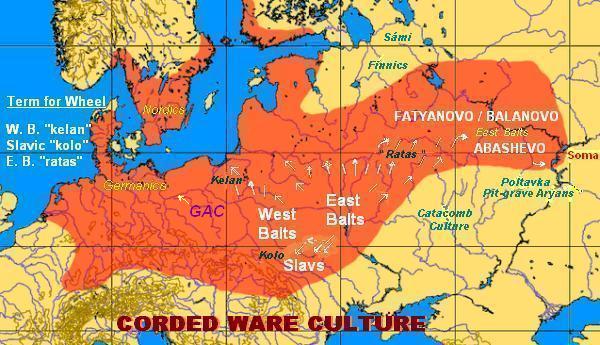
The Fatyanovo culture flourished between 2800 and 1900 BC. It seems they were part of a Central European “reflux” migration. That is, their forebears were related Yamna agro-pastoralists who migrated west out of the steppe and mixed with Central European farmers. Eventually, some of these people moved back east along the edge of the forest-steppe boundary.
The Fatyanovo is the name for a group of people who seem to have introduced agro-pastoralism to the region nearly up to the Urals in northeastern European Russia. A new preprint, Genetic ancestry changes in Stone to Bronze Age transition in the East European plain, confirms what we assumed:
Transition from the Stone to the Bronze Age in Central and Western Europe was a period of major population movements originating from the Ponto-Caspian Steppe. Here, we report new genome-wide sequence data from 28 individuals from the territory north of this source area – from the under-studied Western part of present-day Russia, including Stone Age hunter-gatherers (10,800-4,250 cal BC) and Bronze Age farmers from the Corded Ware complex called Fatyanovo Culture (2,900-2,050 cal BC). We show that Eastern hunter-gatherer ancestry was present in Northwestern Russia already from around 10,000 BC. Furthermore, we see a clear change in ancestry with the arrival of farming – the Fatyanovo Culture individuals were genetically similar to other Corded Ware cultures, carrying a mixture of Steppe and European early farmer ancestry and thus likely originating from a fast migration towards the northeast from somewhere in the vicinity of modern-day Ukraine, which is the closest area where these ancestries coexisted from around 3,000 BC.
The Fatyanovo culture seems to have given rise to the rival and later successor Abashevo culture, which flourished a bit further east (beyond the Urals in part). The Abashevo in their turn gave rise to the Sintashta culture, which flourished even further east, and somewhat south.
There are two things I want to highlight. First, the Y chromosome:
Then, we turned to the Bronze Age Fatyanovo Culture individuals and determined that their maternal (subclades of mtDNA hg U5, U4, U2e, H, T, W, J, K, I and N1a) and paternal (chrY hg R1a-M417) lineages…were ones characteristic of CWC individuals elsewhere in Europe…Interestingly, in all individuals for which the chrY hg could be determined with more depth (n=6), it was R1a2-Z93…a lineage now spread in Central and South Asia, rather than the R1a1-Z283 lineage that is common in Europe.
Here is the modern distribution of Z-93:
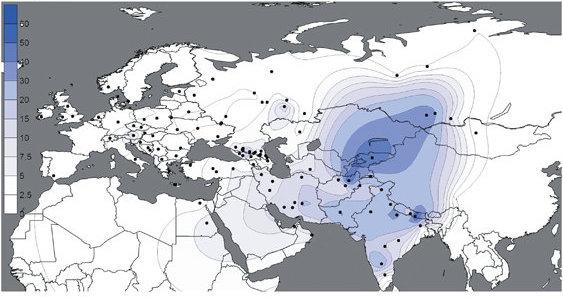
The reason Z283 is found where in ancient times Z93 was found is that over the past 500 years ethnic Russians have expanded eastward, retracing the biogeographic route of the earlier peoples along the forest-steppe frontier.
The steppe people seem to be highly patriarchal. Though there are some non-modal lineages, samples from a specific location are often dominated by a single haplogroup, indicative of a broader kinship-based society focused around descent from an ancestor. In contrast, the origins of females as evidenced by mtDNA, diversity seems to be rather catholic. Some of the mtDNA lineages above, and later in the Sintashta, seem to derive from farmer populations in Europe whose ultimate origins were in Anatolia.
Let me define gotra from Wikipedia:
In Hindu culture, the term gotra (Sanskrit: गोत्र) is considered to be equivalent to lineage. It broadly refers to people who are descendants in an unbroken male line from a common male ancestor or patriline. Generally the gotra forms an exogamous unit, with the marriage within the same gotra being prohibited by custom, being regarded as incest…The name of the gotra can be used as a surname, but it is different from a surname and is strictly maintained because of its importance in marriages among Hindus, especially among the higher castes
The second point is to show this table:
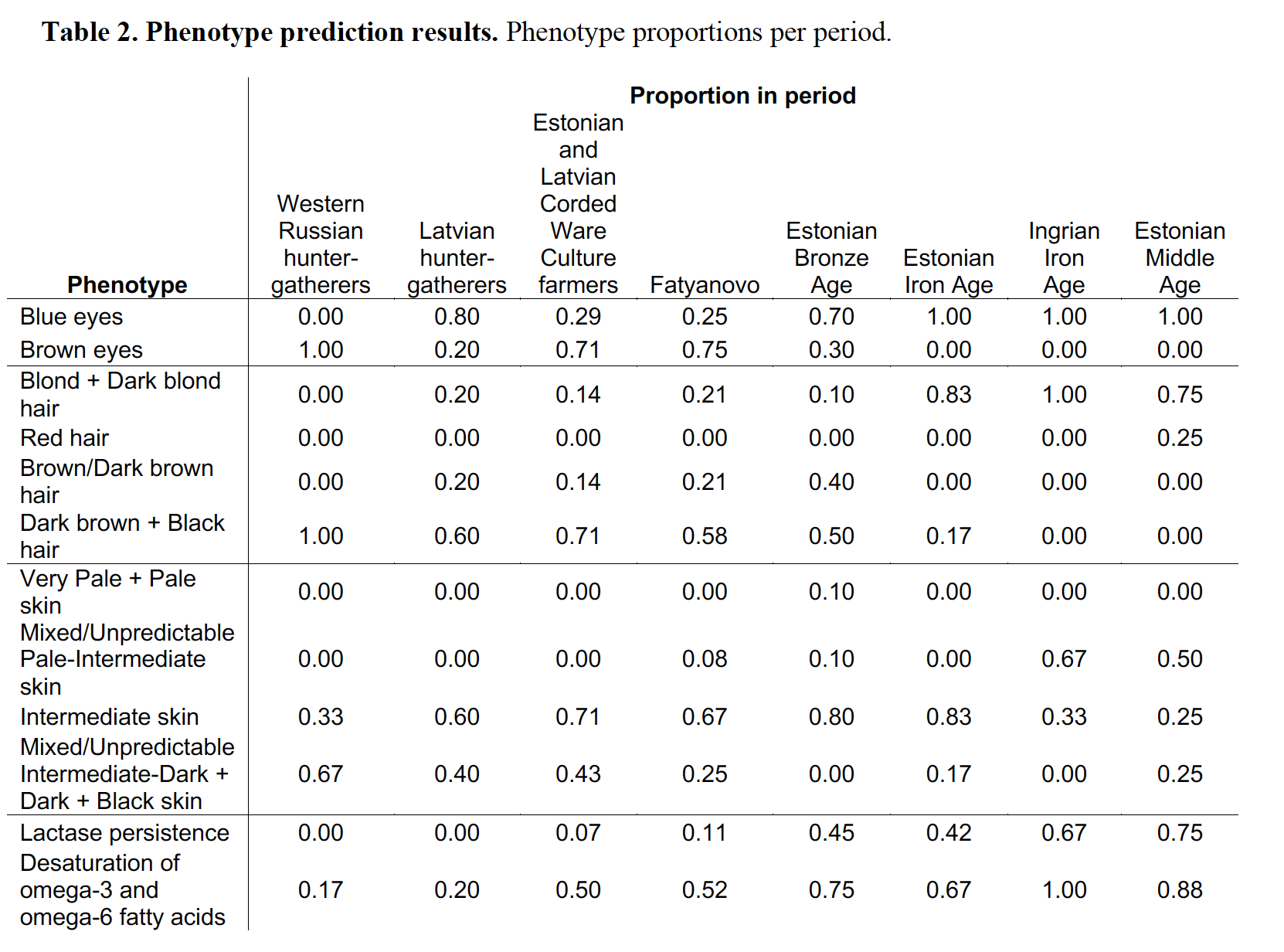
This group has been assembling a lot of data on phenotypic SNPs over time transects in Northeast Europe. One has to take these results with a grain of salt because the predictions are trained on modern samples. I do not think, for example, that European hunter-gatherers had “black skin.” I suspect that the Mesolithic populations were genetically different enough that their “light alleles” may not be in our panels, though my suspicion is that they’d be of darker hue as Inuit people are. That being said, selection work aligns with these results that Europeans, in particular, seem to have been getting lighter in many areas down to the present.
The eye color prediction I somewhat trust since it’s quasi-Mendelian (~75% of the variance is due to one genetic location in Europeans). For the pigmentation, I would focus on the trend, not the absolute value. Anyone who has been to the Northeast Baltic (I have) knows that these are amongst the fairest people in the world. It is very unsurprising that these people have been getting paler over time.
There have been various arguments on this blog and elsewhere as to what the Sintashta people would look like. I’ve posted the Narasimhan et al. data before. The results are broadly similar to the ones above for the Fataynovo.
The Fataynovo do not have the pigmentation genetic architecture that is similar to Nordic people. But, neither are they out of keeping with some European peoples. The Sintashta would be ~25% blue-eyed according to Narasimhan et al.’s data. In the 1000 Genomes about 10% of the alleles in Punjabis, Gujaratis, and Bengalis is the derived variant so common in Northern Europe, giving a recessive frequency ~1% of so blue-eyed, which is too high since other genes have an influence in these cases (though this allele is found in West Asia at appreciable frequencies, including in very old ancient DNA).
On the whole, these results confirm that the Aryans when they arrived in India were fair-skinned people. But, they were likely not as rosy-cheeked as the English who arrived thousands of years later, nor were their eyes quite often pale.
The major genetic risk factor for severe COVID-19 is inherited from Neandertals:
A recent genetic association study (Ellinghaus et al. 2020) identified a gene cluster on chromosome 3 as a risk locus for respiratory failure in SARS-CoV-2. Recent data comprising 3,199 hospitalized COVID-19 patients and controls reproduce this and find that it is the major genetic risk factor for severe SARS-CoV-2 infection and hospitalization (COVID-19 Host Genetics Initiative). Here, we show that the risk is conferred by a genomic segment of ~50 kb that is inherited from Neandertals and occurs at a frequency of ~30% in south Asia and ~8% in Europe.
The highest frequency is in the 1000 Genomes Bangladesh sample. 60%. In a study of Europeans all things equal the risk allele at this locus increases odds of respiratory failure by a factor of 1.75. This isn’t really the major factor; age and hypertension, all the things you know, matter more. But, it’s not trivial either to increase risk by 1.75.
If you are on 23andMe and got tested before the summer of 2017, the older chips has a marker for the locus that’s informative (in LD with the haplotype). This link should take you there. I’m TT homozygote. Modern human. A C is for Neanderthals.
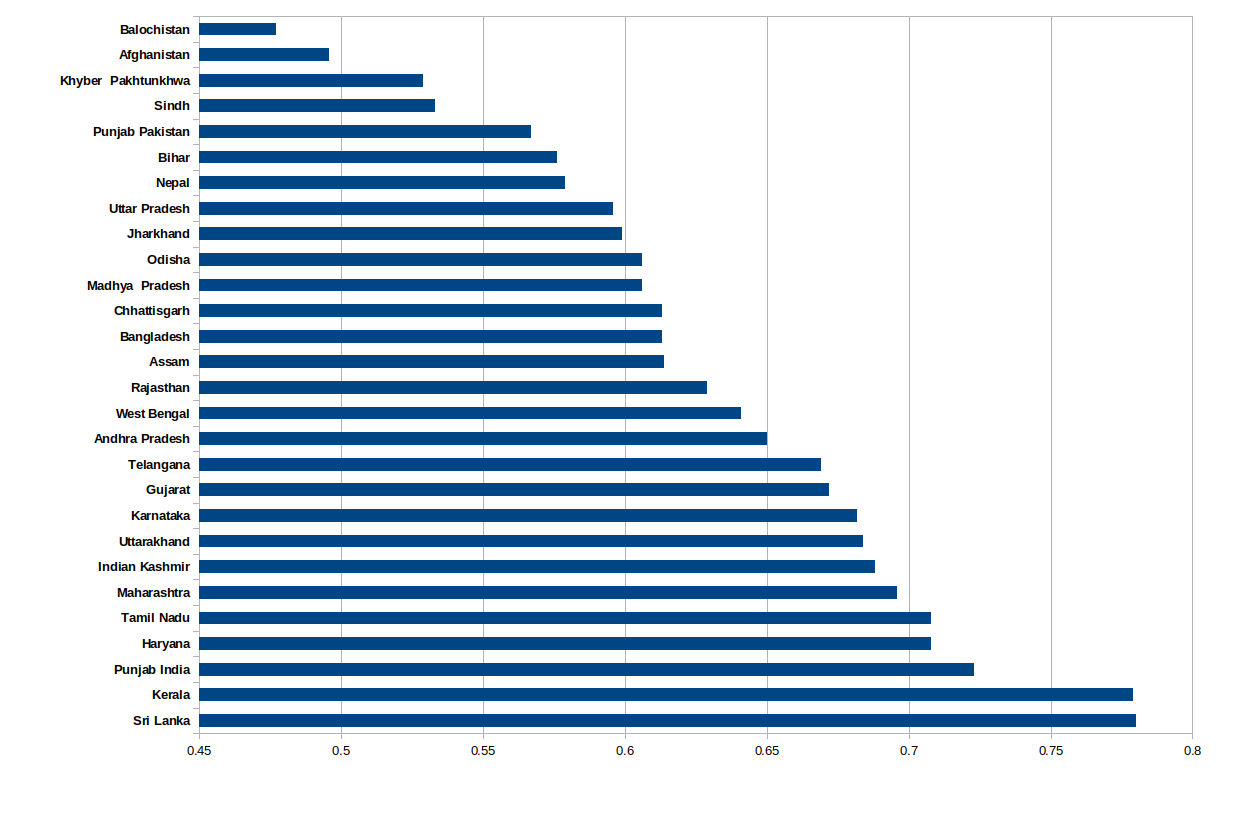
Data courtesy a reader.
If Dr. Alexander Semenenko’s analysis is right and damn seems so, this might be another foundation ripped from Aryan Migration or Invasion Theory. @themerumedia @brownpundits @omarali50 @TheEmissaryCo @razibkhan @kushal_mehra @thapli64 https://t.co/TCctzkcWNe
— Mukunda Raghavan (@raghman36) June 30, 2020
Readers know I do not like to watch YouTubes, but Mukunda is a member in-good-standing of the community, and a great host of the Browncast, so I did watch it.
My general reaction is “OK.” I don’t see how it changes my own views much at all. We know that the arrival of Kurgan people into Europe between 3000 and 2500 BC was not accompanied by the “light chariot.” Rather, they arrived in wagons. As it happens, the steppe people replaced 50-75% of the ancestry in Northern Europe, and 25-50% in Southern Europe. Contrary to I’ve been led to believe from Hollywood films apparently the primary utility of the chariot is as a transport vehicle, especially on flat ground. The light war chariot is presumably a major improvement on the cart, but the difference was presumably quantitative not qualitative.
Mukunda says that another foundation has been ripped from the Aryan migration/invasion theory. I don’t see it that way at all, because I don’t really know that this theory has too many detailed foundations. Mukunda’s response is pretty common, and I think some of the discordances here is that Indians have been educated in a way where many specific elements of the theory are presented as definitively and finally true. On the whole of course, real science does not work that way.
Here is what I know as a geneticist and have seen in the data.
– Genetic ancestry related to Corded Ware/Sintashta people of Eastern Europe and Central Asia contributes about 10-30% of the ancestry in Pakistan and Northern India (depending on the population)
– Y chromosomal lineage R1a1a-Z93 is ~15-25% of the subcontinental haplogroups. This lineage was discovered first in the “forest-steppe” of Europe’s southeast fringe with Central Asia and the Caucasus
– There are very few (though there are some) mtDNA haplogroups in South Asia that are found in Sintashta-Andronovo graves
The Sintashta seem to date from 2400 to 1800 BC as a culture. Additionally, the evidence from Turan and Khorasan in the ancient DNA does not indicate much steppe ancestry before 2000 BC.
To be frank, without genetic data I would not find a population admixture of 10-30% from a steppe group into the northwest subcontinent plausible on the face of it. Perhaps 1-3%. But the data are what they are, and we need to accept them. It is also plausible to me that the initial waves of migration into South Asia were not quite as male-biased as we think, as the proto-Indo-Aryans may have mixed with eastern Iranian/Indus periphery populations before arriving into Punjab. This would mean the population displacement is actually higher in demographic terms. The figures above only give percentages of “steppe”, and assumes pure admixture, which seems unlikely to me.
One hypothesis is that the IVC people already spoke Indo-Aryan languages. Perhaps the newcomers from the steppe assimilated into the local substrate, taking positions at the top of the caste hierarchy? I am skeptical of this. The Indo-European languages don’t exhibit the right structure for this model, as the European ones don’t form a natural closely related clade against the Iranian-South Asian ones. Rather, Indo-Aryan and Iranian seem closer to the Slavic clade.
As for all the rest, the details are interesting to me, but I don’t rest my inference on that. To be frank, some of the claims remind me of arguments I had with Creationists twenty years ago. It seems that they thought I had a very specific idea of what evolution is in all its details, so refuting one element refuted the theory. But that wasn’t it at all. Evolution is a broader framework, and many of the details have to be worked out.
That’s my general attitude to the Indo-Aryan migration into the subcontinent. It’s probably the right model. And we’ve pegged some details down. But a lot remains mysterious. Could the “Out of India” theory be right? The probability is definitely higher for that than that evolution is wrong. But on the whole, I am skeptical.
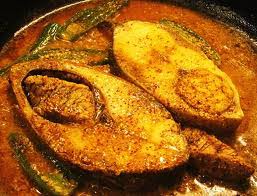 Two things related to food which I suspect readers are going to enjoy (though perhaps not on an empty stomach!):
– A Bengali Meal: 16th century
Check them out!