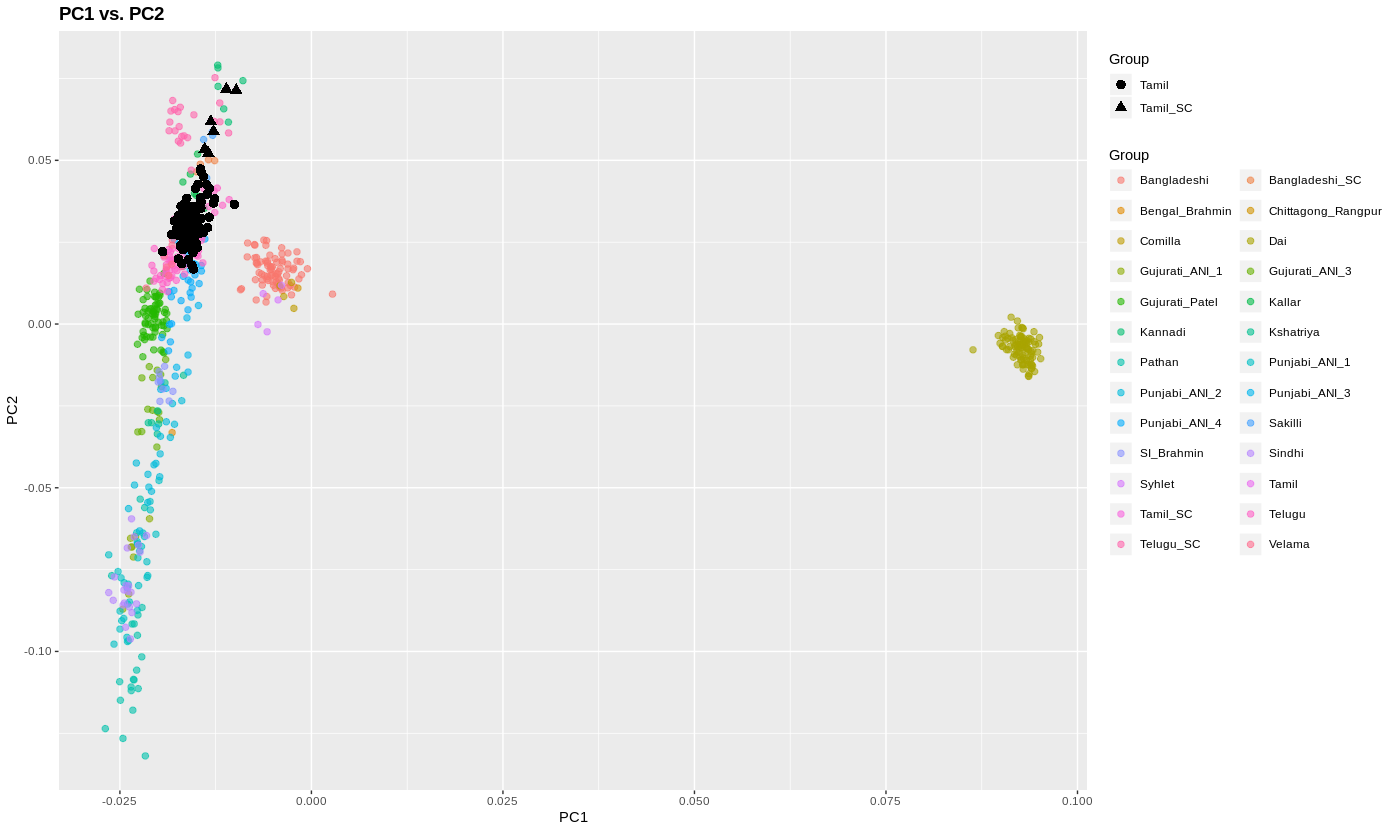
Bangladeshis are very East Asian, Sri Lankan Tamils are not quite as structured

Click to enlarge

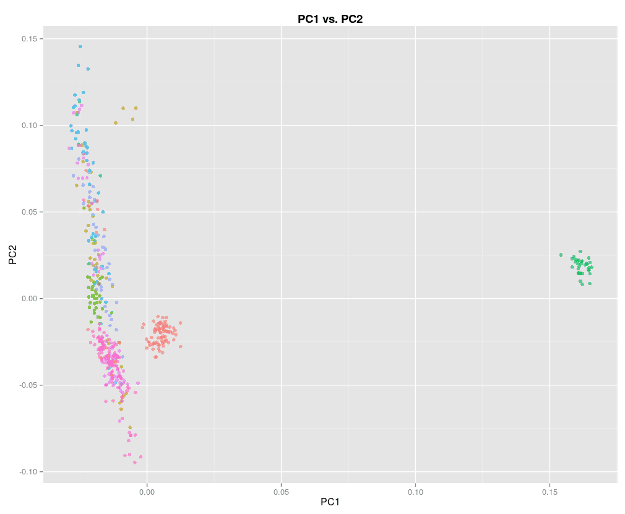
A very long post as my other weblog where I reiterate how East Asian Bengalis, and in particular East Bengalis, are. Aside from the existence of a Dalit/scheduled caste subcommunity, very little has surprised me about Bangladeshi genetics in the last 5 years or so. Rather than a novelty, some simple truths seem to be reinforced over and over. Two major takeaways:

1) the only “exotic” aspect of Bengali ancestry is that Bengalis are substantially East Asian (with the exception that this is sharply attenuated in Brahmins).

2) Though there is some evidence of West Asian admixture in a few Bengali Muslims, you have to look really close to see evidence of it. Though I can believe and do believe, that many Bengali Muslims have a genealogical connection to Iran and Turan through a distinct paternal lineage, that has left a minimal genetic impact.

But one thing I did not emphasize in the post: looking closely at the 1000 Genomes Sri Lankan Tamil samples from the UK I think it is clear that they are less structured than an Indian sample would be. The proportion of Dalits is far lower than in the Indian Telugu sample obtained from the UK. So I will have to update my assertion that the Sri Lanka Tamil sample is as structured as Indians. It isn’t. This is contrast to the Lahore Punjabi samples, which are highly structured. More so than the Sri Lanka Tamils.

Bhadralok are made not born

Tanushree Dutta is a Bengali Kayastha

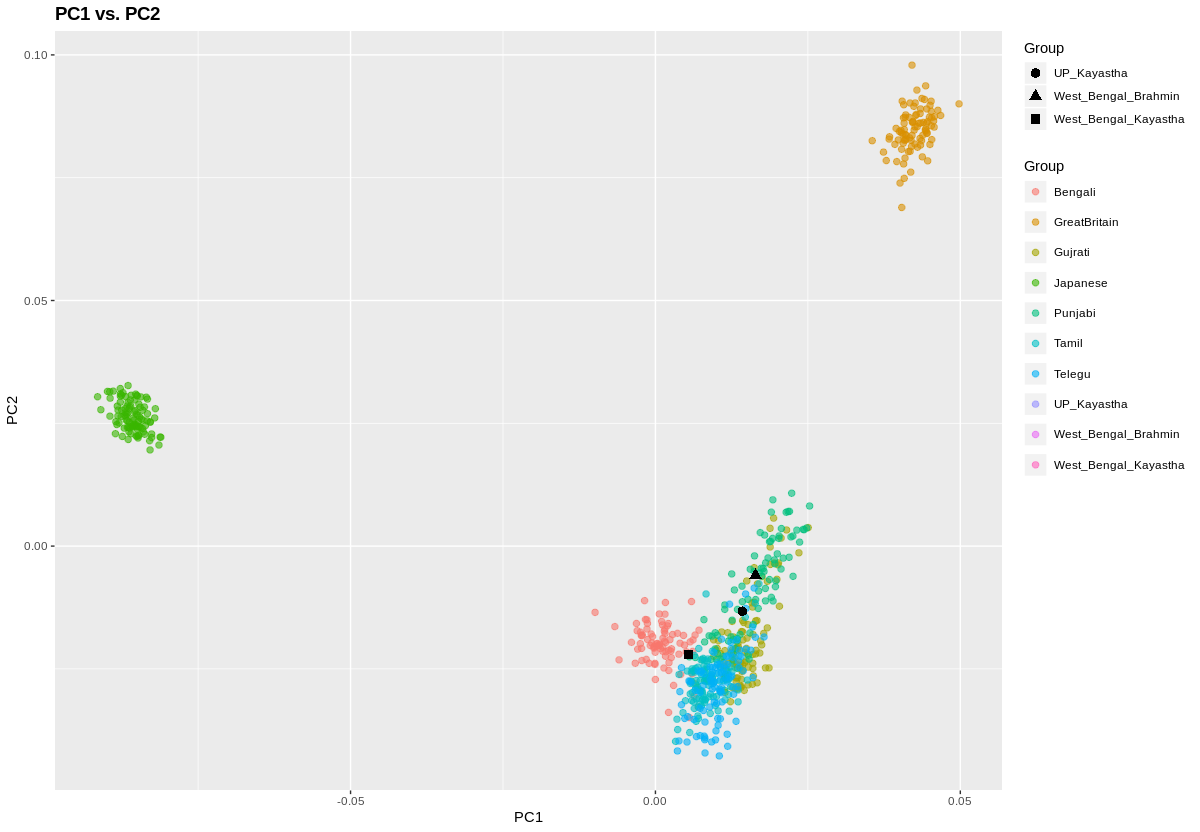
I have two samples of full ancestry from West Bengal. A Kayastha and a Brahmin. You can see where they plot.

Bengali Brahmins are very similar to North Indian Brahmins (often they have some “eastward” shift). In contrast, the Kayastha individual looks like the Bangladeshi samples, except with far less East Asian ancestry.

I do want more samples. Though I’ve gotten a few Bengali Brahmins and they exhibit the sample pattern as above. I am curious about non-Brahmin West Bengalis. But from the above, I think I will conclude that the hypothesis that Kayasthas are a cultivator caste which uplifted themselves occupationally is probably the right one.

Muslims and Urdu in India

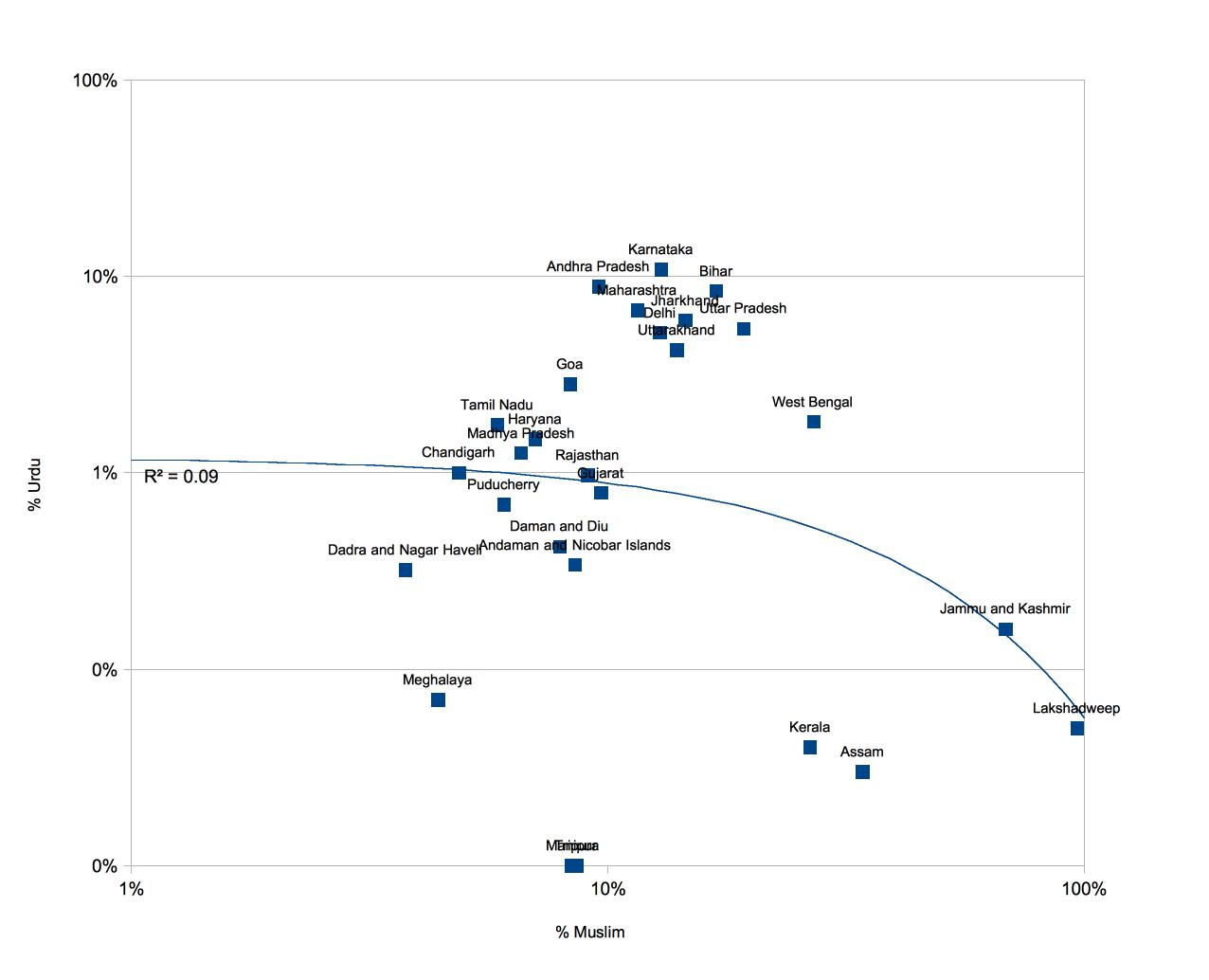
The plot above shows the % Urdu speakers vs. % Muslim in states where Muslims are 4% or more of the population. The data is from Census 2011 (thanks for Vikram of the language data). There are some interesting trends. Assuming that the vast majority of Urdu speakers are Muslim, it seems that in India the core Urdu-identified region is in the Deccan and to the east of its traditional heartland, in Bihar. In South India, 30% of Muslims in Tamil Nadu may be Urdu-speaking. But in Kerala the fraction is almost zero, while in Gujarat and West Bengal less than 10% of the Muslims are Urdu-speaking.

Below the fold is the table.

Continue reading Muslims and Urdu in India

Dalits in Bangladesh

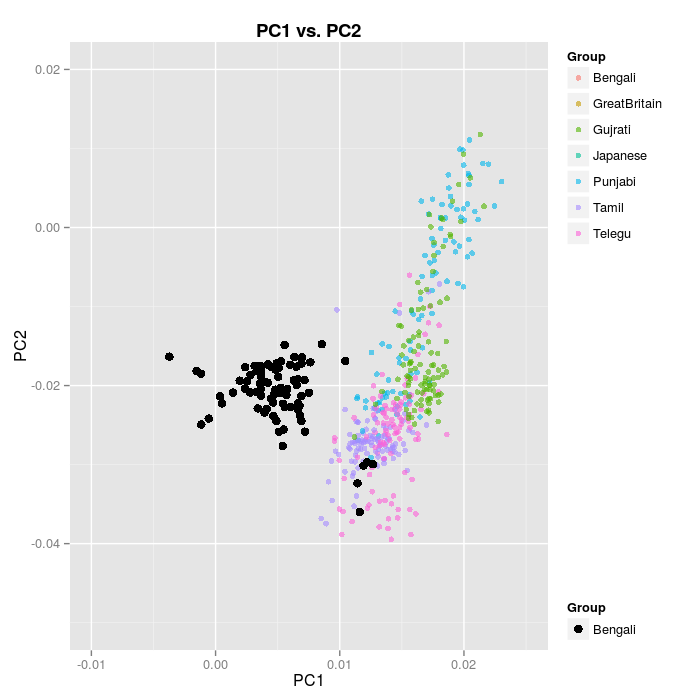
When I looked at the 1000 Genomes data five samples collected in Dhaka, did not align with the others. Most Bengalis are shifted away from other South Asians because of East Asian ancestry. These five individuals, in contrast, clustered with Tamil and Telegu Dalits. Importantly, their identification numbers indicate they were sampled at the same time.

This highlights the fact that a large community of Dalits live in Bangladesh, Dhaka Dalits push for anti-discrimination law:

A considerable number migrated into what is now Bangladesh between 1835 and 1940, during a British-sponsored urbanisation plan. They worked in jobs such as road sweeping, clearing sewage, shoe repair and tea harvesting. This historical legacy of working in low-paying, difficult jobs continues today.

The genetic data suggest to me that they are indeed descendents of migrants.

The decline in South Asian poverty

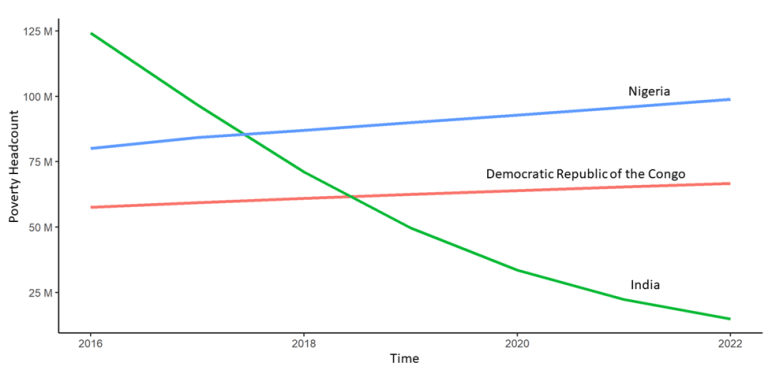
It has long been asserted that South Asia may make average strides economically, but it is still in absolute terms the locus of most of the world’s grinding poverty. This may not be true much longer. In particular, some estimates now suggest that India is no longer the world’s “leader” in extreme poverty in absolute terms. From Brookings, The start of a new poverty narrative:

According to our projections, Nigeria has already overtaken India as the country with the largest number of extreme poor in early 2018, and the Democratic Republic of the Congo could soon take over the number 2 spot (Figure 1 below). At the end of May 2018, our trajectories suggest that Nigeria had about 87 million people in extreme poverty, compared with India’s 73 million. What is more, extreme poverty in Nigeria is growing by six people every minute, while poverty in India continues to fall. In fact, by the end of 2018 in Africa as a whole, there will probably be about 3.2 million more people living in extreme poverty than there are today.

Bangladesh has been making progress as well, from the World Bank:

Bangladesh has made remarkable progress in reducing poverty, supported by sustained economic growth. Based on the international poverty line of $1.90 per person per day, it reduced poverty from 44.2 percent in 1991 to 13.8 percent in 2016/17. In parallel, life expectancy, literacy rates and per capita food production have increased significantly. Progress was underpinned by 6 percent plus growth over the decade and reaching to 7.3 percent in 2016/2017, according to official estimates. Rapid growth enabled Bangladesh to reach the lower middle-income country status in 2015. In 2018, Bangladesh fulfilled all three eligibility criteria for graduation from the UN’s Least Developed Countries (LDC) list for the first time and is on track for graduation in 2024.

Here’s GDP for South Asian countries in 2005 dollars:

I left Bangladesh in 1980. Not too long after I was born. I went back to visit in 1989 and 2004. In relation to 1980, per capita GDP was 1.15x. in 2004 it was 1.6x. In 2016 it was 2.9x. So over the past 14 years there’s been a 2x increase in GDP per capita in Bangladesh! The equivalent figure in the United States is 1.1x.

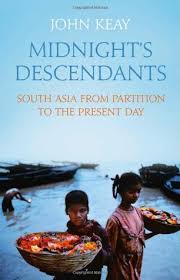
Midnight’s Descendants: A History of South Asia since Partition

I recently read John Keay’s Midnight’s Descendants: A History of South Asia since Partition. Like his earlier books on the history of India and China, this is a work written by a journalist, not an area specialist (though Keay seems to take a particular interest in South Asia judging by his oeuvre).

To be frank I’m not sure if I learned that much…and I don’t know much about South Asian history after 1945. But, it reaffirmed my intuitions that some of the ideologues who bandy extremely high casualty rates are doing a disservice to the real tragedies that have marred the subcontinent over the past century.

In any case, I do recommend this book to the 50% of the readers of this weblog who are not South Asian.

Note: I don’t have the time or interest to read Guha’s India After Gandhi. Also, my friend Reihan Salam has indicated to me it’s a more tendentious work than most are willing to admit.

The invention of Hinduism 1,000 years ago by a Muslim

On of the most annoying tropes in modern intellectual discourse, in particular of the postcolonial variety, is its Eurocentrism. That is, the focus on the Western colonial experience is so strong and unwavering that operationally the rest of history becomes prehistory, a formless period which we are ignorant of, when humans were different in fundamental ways.

Empirically this is of course false. Earlier I have mentioned that the Central Asian Iranian polymath, Al-Biruni, had much to say about India. His was one of the earliest extensive anthropologies we have about the subcontinent from the prespective of an outsider. Though Al-Biruni was from a region which had once had a flourishing Buddhist presence, by the 10th century this had faded from historically memory. Whereas earlier Islamic scholars from previous centuries allude to the persistence of Buddhists in what is today Central Asia and Afghanistan, by Al-Biruni’s lifetime non-Muslims were in sharp retreat (though in the fastness of area like Chitral paganism persisted for a thousand years).

In any case, here are some extracts of Al-Biruni on Indian religion:

The belief of educated and uneducated people differs in every nation; for the former strive to conceive abstract ideas and to define general principles, while the latter do not pass beyond the apprehension of the senses and are content with derived rules, without caring for details, especially in questions of religion and law, regarding which opinions and interests are divided.

With regard to God, the Hindus believe that he is one, eternal, without beginning and end, acting by free will, almighty, all-wise, living, giving life, ruling, and preserving; one who is unique in his sovereignty, beyond all likeness and unlikeness, and neither resembling anything nor having anything resemble him. In order to illustrate this, we shall produce some extracts from the Hindu literature….

This is what educated people believe about God. They consider the unity of God as absolute, but that everything beside God which may appear as a unity is really a plurality of things. The existence of God they consider as a real existence, because everything that exists, exists through him. It is not impossible to think

If we now pass from the ideas of the educated people among the Hindus to those of the common people, we must first state that they present a great variety. Some of them are simply abominable, but similar errors occur also in other religions. Nay, even in Islam we must decidedly disapprove of the anthropomorphic doctrines, the teachings of the Jabriyya sect, the prohibition of the discussion of religious topics, and such like. Every religious sentence destined for the people at large must be carefully worded, as the following example shows. Some Hindu scholar calls God “a point,” meaning to say thereby that the qualities of bodies do not apply to him. Now some uneducated man reads this and imagines that God is as small as a point, and he does not find out what the word “point” in this sentence was really intended to express. He will not even stop with this offensive comparison, but will describe God as much larger, and will say, “He is twelve fingers long and ten fingers broad.” Further, if an uneducated man hears what we have mentioned, that God comprehends the universe so that nothing is concealed from him, he will at once imagine that this comprehending is effected by means of eyesight; that eyesight is only possible by means of an eye, and that two eyes are better than only one; and in consequence he will describe God as having a thousand eyes, meaning to describe his omniscience.

Similar hideous fictions are sometimes met with among the Hindus, especially among those castes who are not allowed to occupy themselves with science, of whom we shall speak hereafter.

As the word of confession, “There is no god but God, Mohammed is his prophet,” is the shibboleth of Islam, the Trinity that of Christianity, and the institution of the Sabbath that of Judaism, so metempsychosis is the shibboleth of the Hindu religion. Therefore he who does not believe in it does not belong to them, and is not reckoned as one of them. For they hold that the soul, as long as it has not risen to the highest absolute intelligence, does not comprehend the totality of objects at once. Therefore it must explore all particular beings and examine all the possibilities.

The point of this post is not to show that Al-Biruni had a good idea of what “Hinduism” was, though I think if you read it on the whole he isn’t that far removed from how some moderns would characterize it. Rather, it is to show that the distinctiveness of Indian religious thought was noticed long before Europeans arrived to create a specific categorization system which we utilize today. The details of the system might deviate from Al-Biruni, or Adi Shankara, but in its broad outlines it’s describing the same thing.

(since some people are not subtle, the title is not to be taken literally)

Brown Pundits