The word “takfīr” (pronounced
“tuck – feer”) is one of the most fearsome words in the Islamic lexicon.
Deriving from the same root as “kāfir” – infidel – it refers to the act of
declaring someone who is nominally a Muslim to be an infidel. And, of course, as
the whole world knows by now, a Muslim who has become an infidel is worthy of being
killed as an apostate under strict Islamic law. The institution of takfir is
not new in Muslim societies, but it has generally been a marginal one. Today,
it is at the core of the jihadi extremism that has set the world on fire from
Nigeria
to
India
and from
Peshawar to
Paris.
The extremists do not kill based only on takfir – the cartoonists of Charlie
Hebdo were not Muslims to begin with – but this idea is central to their
ideology, which specifically targets Muslims who, in their opinion, have lost
the right to live because of their infidelity. Among these are numbered the 136
innocent children gunned down in Peshawar and the soldiers of the
largest army of any
Muslim majority country in the world. More broadly, its remit extends to entire
sects, such as the Shi’as and the Ahmadis, who have been targeted repeatedly in
Pakistan.
However, another version of
takfir is now afoot in the world. Call it “reverse takfir”. Unlike the militant
version, it is well-intentioned and self-consciously humane, but it is also
dangerous. This “benign” version of takfir is epitomized by the idea that the
acts of violence being committed by self-proclaimed holier-than-thou Muslims
are not the acts of “real Muslims” and do not represent “real Islam”. In
effect, it declares the terrorists to be infidels! The idea is widespread, and
is espoused in four different contexts: By well-meaning non-Muslims (such as Presidents
Bush and Obama) seeking to avoid stereotyping and the implication of collective
guilt; by ordinary Muslims wishing to dissociate themselves from the beheaders;
by Muslim sectarians wishing to separate their brand of orthodoxy from that
espoused by terrorists; and – most ironically – by Muslim governments and
security forces seeking an “Islamic” justification for attacking extremist fellow
Muslims, thus implicitly buying into the central jihadi argument of apostasy as
a capital offense. The urge to do this reverse takfir is understandable and not
without factual basis: Most Muslims are indeed not violent extremists who wish
to kill infidels. And it does help protect innocent Muslims from backlash,
which is rather important. The problem, however, is that it also feeds the
narrative of denial and deniability that allows the militancy to thrive.
As with most organized religions,
the foundational texts and beliefs of Islam can support both peaceful versions
and violent ones. Until people recognize and admit that all of these are, in fact, “real Islam”, the issues underlying the
problem of jihadi militancy cannot be addressed. If the violence is “not real
Islam”, the implication is that Islam – as practiced by most Muslims – needs no
reform. But that is manifestly not the case. The scourge of violence in the
name of Islam will be removed only when Muslims in general come to reject all instances of violence in the name of
Islam, including those that are celebrated in scripture and history. When
conquerors who killed “infidels” are regarded as heroes of the faith; when the
world is seen as divided into the “house of Islam” and the “house of war”; when
dying for God is considered better than living for the sake of fellow humans;
when non-Muslims are regarded as morally inferior; when many standard prayers
end by asking God for “victory against the infidels”; and when apostasy and
blasphemy are regarded as capital crimes – how can jihadi violence be seen as
anything but the logical conclusion of such ideas and practices? And yet, these
are all part of “mainstream” Islam – some of them derived directly from holy
texts. What the extremists are doing is merely taking these ideas more literally
and acting on them. The main thing separating most ordinary believing Muslims
from the extremists is not so much the narrowness of belief – which they both
share – but the willingness to match that belief with action. Small wonder,
then, that the militants see non-violent Muslims as hypocrites, which in many
ways is worse than being an infidel.
This raises a painful question: Can true
Muslims only be either militants or hypocrites? Is there no other alternative?
And that’s where the solution must begin. The only way to find an alternative –
“third way”, so to speak – is to move away from literalism and absolute
interpretations. Muslims must ask themselves why Jews don’t still stone
adulterers or Christians still conduct witch burnings. They made these changes,
not by rewriting holy texts, but by reinterpreting them for a different time
and context. If Islam and its texts are indeed “guidance for all times” as
Muslims believe, surely their interpretation must change with changing times,
or they will become obsolete. What we see unfolding before us is the refusal of
a whole faith to recognize the fact of such obsolescence and the need for
reinterpretation, which has to be the first step on the path to reformation.
And this cannot be done by outsiders preaching humanism at Muslims; it requires
Muslims themselves to liberate their faith from the clutches of regressive
clerics and begin viewing it more rationally. They can continue to be good
Muslims and revere the unchanging words of scripture, but they cannot continue
to be literalist reactionaries enforcing orthodoxy by force. That just isn’t
compatible with the real world – especially the modern world. People will have
to be allowed to make individual decisions with regard to their faith and live!
In other words, religion will need to become a private matter, and certainly
not something for the State to legislate or vigilantes to enforce.
The interesting – and tragic –
fact is that this dilemma is mainly a modern one. For the first few centuries
of Islam, Muslims were far less inhibited about practical reinterpretation.
Indeed, much of what is regarded today as Islamic law (the shari’ah) is derived
from the
interpretation of holy texts
by early leaders, jurists and scholars. They were certainly not liberal
humanists by today’s standards, but they were eminently practical people. Over
time, this practicality gradually gave way to rigidity, until the so-called “door
of interpretation” was officially declared shut. Even so, Muslim rulers were
seldom willing to be bound by rigid religious edicts, and significant movement
continued, albeit at royal whim. Some among the royalty, such as
Akbar and
Dara Shikoh in India, went
further, trying actively to move towards more syncretic and humanistic
interpretations of Islam.
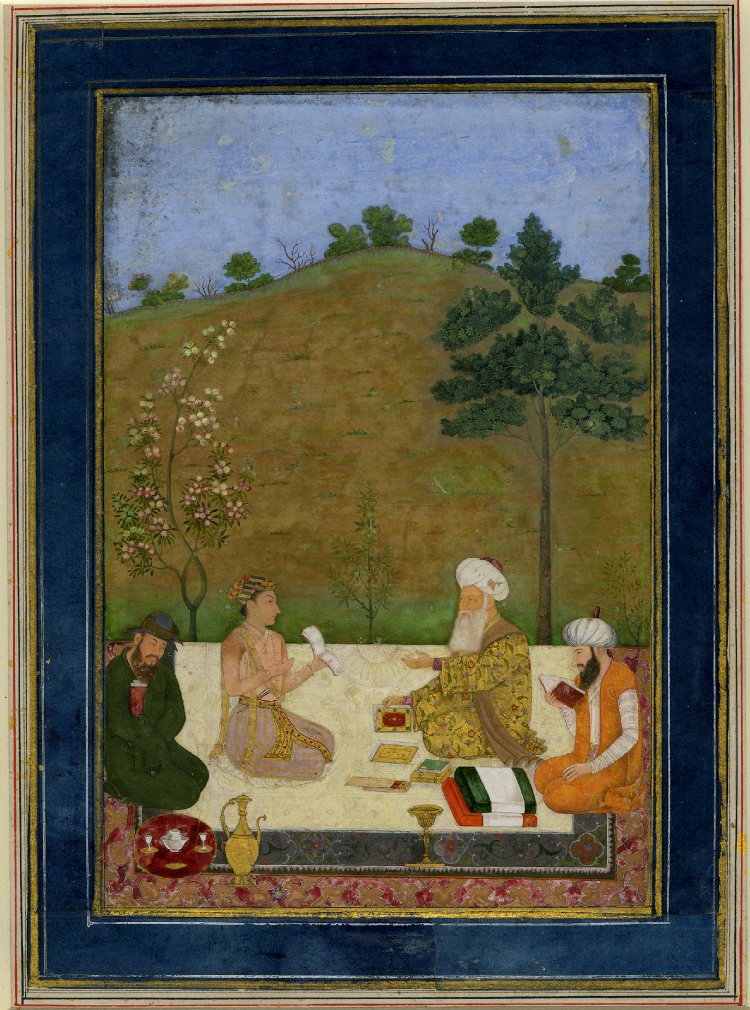
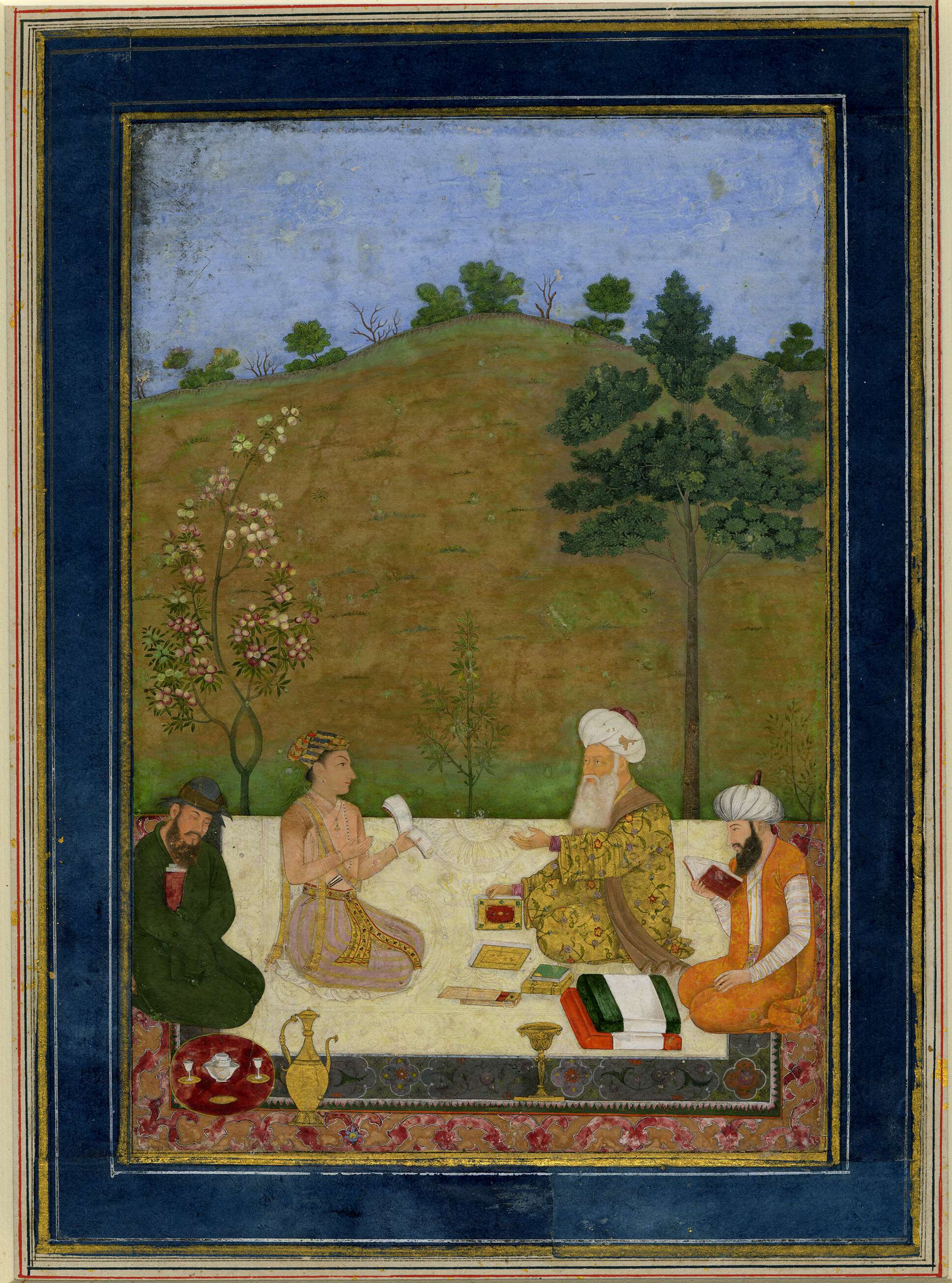
Prince
Dara Shikoh with three sages (Ascribed to Dal Chand India, Mughal scool, c.
1650)
The roots of the current
fundamentalism lie not so much in the early history of Islam as in its recent
history of disempowerment and revivalism. As Muslim societies lost power in the
face of modernity, the role of ruling elites in reinterpreting religious edicts
(mainly for selfish political reasons) diminished or disappeared, and the
process of reform became intertwined with Westernization and modernization. This
produced various responses, two of which are especially relevant today. First, during the colonial period and immediately after,
a re-emerging class of Muslim thinkers such as
Muhammad Iqbal,
Jamaluddin Afghani,
and later
Sayyid Qutb and
Mawdudi, sought
a revival through variations on the same theme: Creating a semi-mythological
and idealized version of a glorious Muslim past where near-perfect men acted as
the instruments of God’s will. And, in their own ways, all of them converged on
the notion of a single, ideal Islamic state – a “house of Islam” – ruled over
by the righteous. One concrete result of these neo-revivalist ideas was the
creation of Pakistan as an ideological Muslim homeland, though many ultra-orthodox
Muslim scholars opposed it. Another was the emergence of trans-national
ideological organizations such as the
Muslim Brotherhood
and the
Jamaat-e Islami.
All this laid the theoretical framework for today’s trans-national militancy.
The second response was the
empowerment of more fundamentalist schools of Islamic thought that already
existed but had generally been held in check by Muslim rulers and societies. A
fateful
moment occurred when one such movement – led by the originalist cleric
Ibn Abdul-Wahhab
in Western Arabia – made a
political
alliance with a regional ruling family: The future House of Saud. Over two
centuries, a nexus of mutually-influencing ultra-orthodox ideologies developed
from India to Morocco, but remained largely without political or economic power.
All that changed with the rise of Saudi Arabia as a rich kingdom with an
interest in exporting both oil and ideology. The ideal opportunity arose – less
by planning than chance – in the form of the Soviet invasion of Afghanistan,
which led to
the
revival of global Islamic zealotry as fuel for the Afghan jihad, the
empowering of
seminaries
preaching ultra-orthodox ideologies, and the inevitable seeping of these
toxins into the body politic of Muslim societies. The rest is a history that is
too well-known – and painful – to repeat.
Today, the two threads
generated in response to Muslim disempowerment and modernity have merged. The
resulting movement has inherited the trans-national character, anti-humanist
ethos and regressive ideology of its parent movements. It has also been strengthened
by the
strategic
calculus of
the Great
Game that has been afoot in South and Central Asia for several decades. Some
may consider it natural that the movement’s most vocal expression has occurred
in Pakistan, given its founding vision. However, such an assumption would be
incorrect. The areas that form Pakistan were, in fact, not very
amenable
a priori to an exclusivist ideology, and were pervaded by a
much
more syncretic and humanistic version of Islam. It took several decades and
great geopolitical events – such as the Afghan jihad – to bring Pakistan to the
point it is at today. All appearances notwithstanding, it is not a natural home
for a militant, ahistoric ideology. Obscurantism? yes; militancy? no.
Which brings us back to the issue
of “real Islam”. As someone in love with the cultural traditions of Islam and as
a diligent student of its history, I agree that the acts of the jihadis do
not represent the vast majority of
Muslims today or in history. Humans are a violent species and Muslims have
contributed their share, but it is completely asinine to think that Muslims
have been, historically, any more violent than other groups. However, it is
equally absurd to deny that the ideology underlying jihadism draws upon
mainstream Islamic beliefs and is, therefore, undeniably a form of “real Islam”
– albeit of a very extreme form. It is more accurate to say that this extremism
is “not the only Islam”, and, by historical standards, it is a version very
different from what the vast majority of Muslims have practiced. That’s why groups
espousing such puritanical and rigid attitudes were traditionally called
“khawarij” – the alienated
ones. At the same time, Muslims should acknowledge that they have not
constructed the logical and theoretical framework within which extremism can be
rejected formally. If anything, the opposite has happened in the last century,
with increasingly literalist attitudes gaining strength for political reasons.
And that is the core problem: A literal reading of even moderate Muslim beliefs
can, and does, lead to behaviors incompatible with modern society. Like
Christians, Jews, Hindus and others, Muslims have to turn towards a less
literal, more inspirational and humanistic reading of their sacred traditions,
drawing from them principles that can stand the test of time rather than
literal, ahistorical prescriptions. This does not require the invention of a “new
Islam”, or the imposition of an “official Islam” by states. Nor does it require
a rewriting of Muslim sacred texts any more than the Enlightenment needed a
rewriting of the Old Testament –
Thomas
Jefferson notwithstanding. What is needed is a change of attitude, of how
people relate to the texts and traditions. Strong strands of humanism, compassion,
diversity of ideas and acceptance of differences already exist within the
Islamic tradition – among Sufis, among poets, and even among scholars. The
trick is to rediscover, re-emphasize and reinterpret them for our times. And
even as we wring our hands in despair, brave individuals within Muslim
societies are
trying
to ignite just
such a change at great risk to their lives. The least we can do is to add
our voices to theirs.