Episode 17: Mughals-the socio-cultural milieu and their Decline


Another Browncast is up. You can listen onĀ Libsyn,Ā Apple,Ā Spotify, andĀ StitcherĀ (and a variety of other platforms). Probably the easiest way to keep up the podcast since we don’t have a regular schedule is toĀ subscribeĀ to one of the links above!

Episode 17 of the series of Podcasts on the history of Indian sub-continent.

Maneesh speaks to Jay and Omar on the socio-cultural milieu of the Mughals and their decline.

Across the two episodes on Mughals we haven’t talked about the Sikhs and the Rajpoots. We plan to do dedicated episodes on them.

A notable miss across both the episodes is Kabir Das. Perhaps an episode on the great spiritual figures of the millennium some day !


Sources and References:

1. Advanced Study in the History of Medieval India : Volume II by J.L Mehta
2. The History and Culture of the Indian People: Volume 7. The Mughul Empire
3. Akbar and His India by Irfan Habib
4. Culture of Encounters: Sanskrit at the Mughal Court by Audrey Truschke
5. The life of a text: performing the Rāmcaritmānas of Tulsidas by Philip Lutgendorf
6. Three Bhakti Voices Mirabai, Surdas, and Kabir in their Time and Ours by John Stratton Hawley
7. The Mughals and the Sufis by Muzaffar Alam
8. Did Aurangzeb Ban Music? Questions for the Historiography of His Reign
by Katherine Butler Brown [ARTICLE]
9. The Early Sūr Sāgar and the Growth of the Sūr Tradition
by John Stratton Hawley [ARTICLE]
10. Hidden in Plain View: Brajbhasha Poets at the Mughal Court
by Allison Busch [ARTICLE]
11. The Meeting of Musical Cultures in the 16th-century Court of the Mughal Akbar by Bonnie C. Wade [ARTICLE]


Journey Till Now – Who and What is The Indic Explorer?

On the 21st Episode of The Indic Explorer Show, my weekly podcast I do a monologue talking about my journey before YouTube, the manner in which I went about starting this channel and how has the story been so far since inception in the last 6 months.

I also take some of the audience questions and talk about future plans and show formats that I intend to experiment with over the coming year.

The Indic Explorer YouTube channel focusses on the interplay of Indic culture with modernity explored through different facets in the socio-cultural sphere.

Do subscribe to the channel at https://www.youtube.com/theindicexplorer

and follow me here

Twitter- https://twitter.com/theindicexplor1

Instagram- https://www.instagram.com/theindicexplorer/

Substack-https://digitaldharma.substack.com/

Best of The Indic Explorer Show – 2022 Rewind

On this End of the Year Special Episode of my weekly Podcast- The Indic Explorer Show on YouTube, you can get to see the best highlight reel moments of the show. It has been just 6 months since I started this channel and we have grown from strength to strength, clocking 1k subscribers this month.

Looking forward for your continued support.

The Indic Explorer YouTube channel focusses on the interplay of Indic culture with modernity explored through different facets in the socio-cultural sphere.

Do subscribe to the channel at https://www.youtube.com/theindicexplorer

and follow me here

Twitter- https://twitter.com/theindicexplor1

Instagram- https://www.instagram.com/theindicexplorer/

Substack-https://digitaldharma.substack.com/


South Asian nations

I dislike the “GDP wars” that sometimes crop up on this message board. Comparing India to Bangladesh or Pakistan is apples to oranges. India is economically a collection of nations, and the average can be misleading. That being said, a lot of the Indian commentators also seem to engage in a lot of cope when it comes to GDP comparisons between Bangladesh and India; on the whole I often agree with them…but the fact that there can be a comparison despite India having relatively dynamic economies in Gujarat, Maharashtra, and around Delhi, Bangalore and Hyderabad, should lead to some soul-searching about inter-regional inequalities, rather than arguing about statistics.

But, as a biologist I like looking at health indicators. Harder to fake (thought not impossible), and clearer in interpretation.

First, let’s be honest: Pakistan is now the “slow kid” in the subcontinent. Mind you, many South Asians will admit that they are more handsome people because they are taller and lighter skinned (let’s be frank here), the advantages Pakistan accrued through its Cold War alliance with the US and less strident adherence to socialism than India have been frittered away. Anytime India sees itself clustering with Pakistan, it has to wonder “what are we doing wrong???” (again, the story in India is inter-regional variation). Despite over a generation of war and strife, Sri Lanka still had a lead in these indices, but the other nations are catching up. Finally, Bangladesh’s status is a basket case still shadows some of the numbers, like the number of physicians per thousand and age at teen births and motherhood. All that being said, what’s the good of having physicians if your life expectancy isn’t that great?

Merry Christmas!

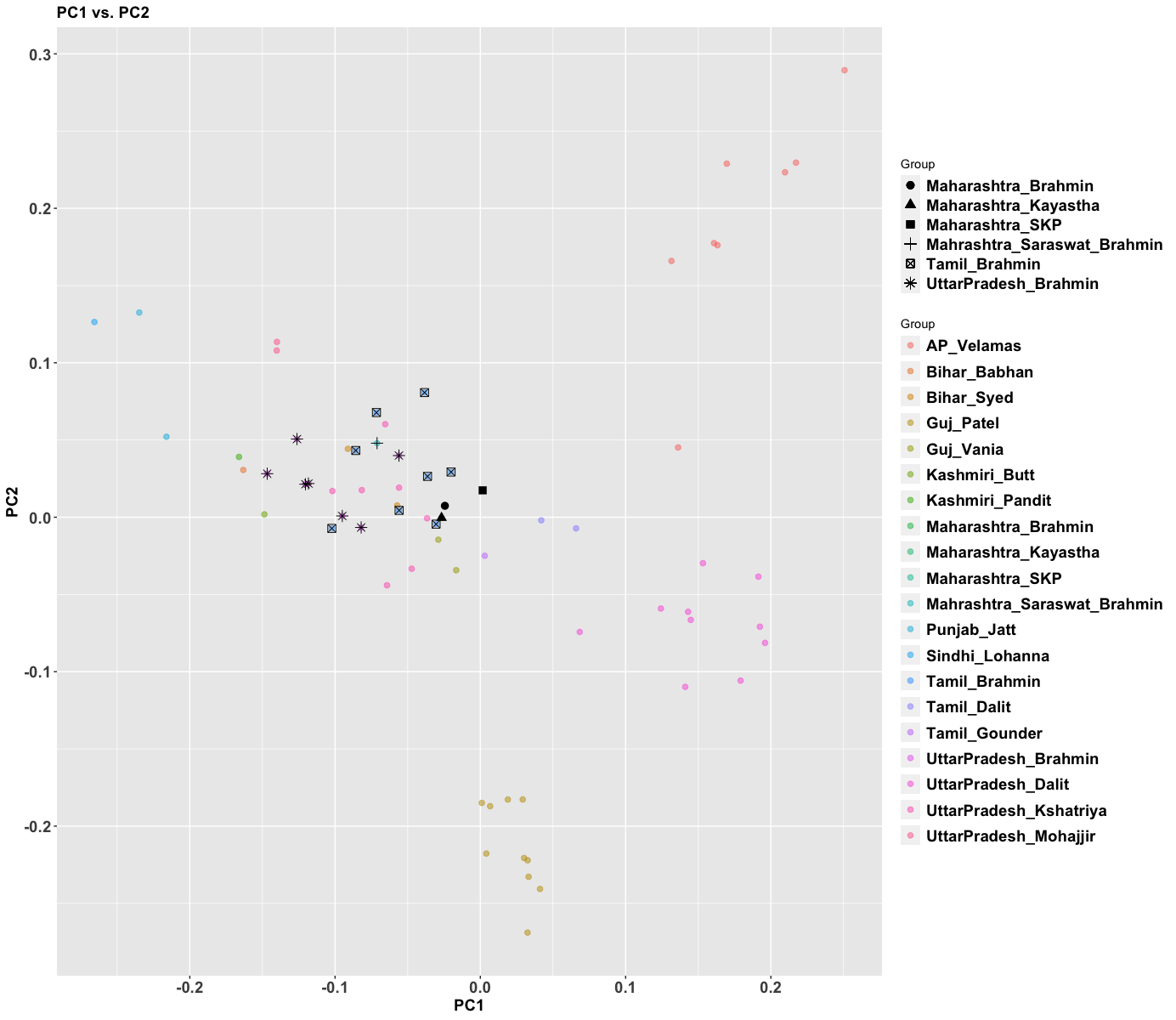
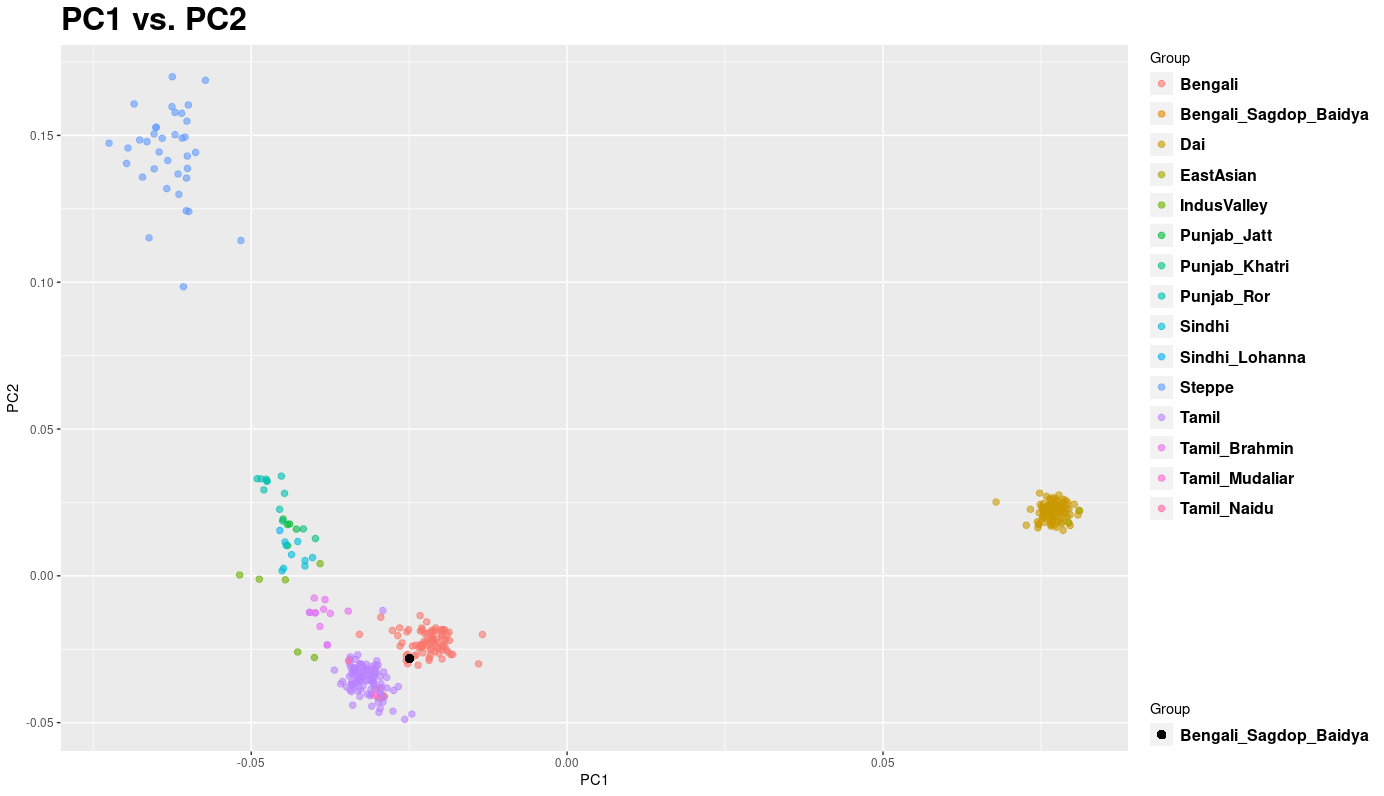
I got a sample from someone where one parent was a West Bengal Sadgop, and another parent a Baidya with family origins in East Bengal. One hypothesis that I’ve see is that Baidya are basically Brahmins who lost their caste. Genetically this does not seem to be the case. Bengali Brahmins shift considerably toward the steppe samples compared to average Bangladeshis, and this individual does not. Rather, their uniqueness is that they have very little East Asian ancestry compared to the median. This is typical of non-Bramin West Bengalis. It is plausible to me that this individual’s Baidya parent, from East Bengal (Bangal), had more East Asian ancestry than their West Bengali (Ghoti) parent, so you see an average.

Though there are some exceptions, it seems that the non-Brahmnin bhadralok castes did undergo ritual uplift from that of conventional peasant cultivators at some point in Bengal. This seems similar with regard to Kayasthas in UP, but not in Maharashtra, where CKPs seem to have an affinity with Brahmins distinct from the Maratha cultivators.

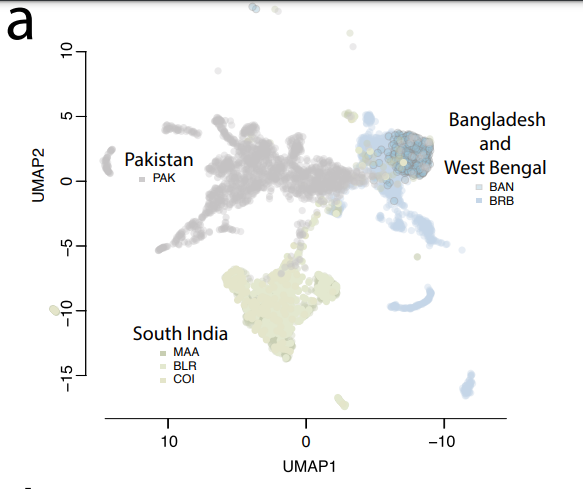
Update: I found a preprint that pretty much answers all the questions re: Bengalis.

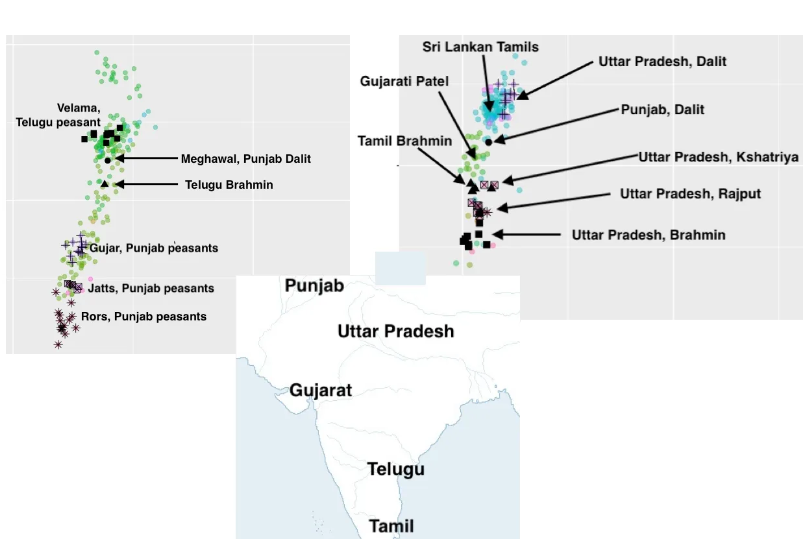
Here is a panel with a UMAP representation of genetic distance, and you see West Bengal is adjacent to Bangladesh. But there is a “tail” of individuals that are parallel to South Indians.

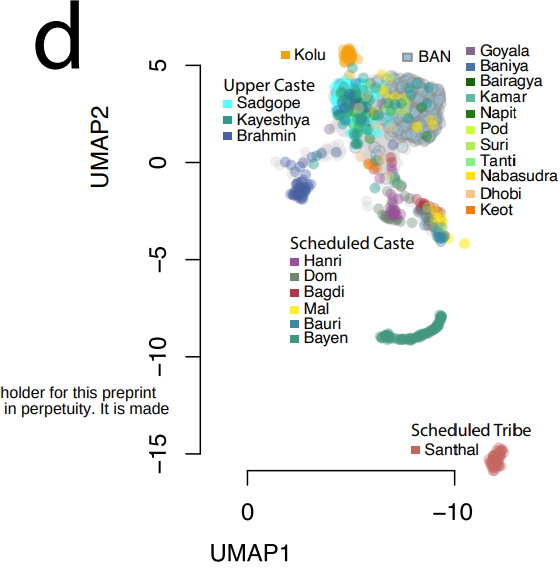
This UMAP makes clear Bengali Brahmins are distinct from Kayasthas and Sadgop. These populations seem roughly similar to most Bangladeshis except they are shift over, and I assume this means less East Asian ancestry, as PCA seems to how:

Sree Iyer on the Cultural Outlook of the Indian Diaspora

Sree Iyer of the Pgurus YouTube Channel came on the 20th Episode of The Indic Explorer Show, my weekly podcast to talk about The Cultural Outlook of the Indian Diaspora.

The Indic Explorer YouTube channel focusses on the interplay of Indic culture with modernity explored through different facets in the socio-cultural sphere.

Do subscribe to the channel at https://www.youtube.com/theindicexplorer

and follow me here

Twitter- https://twitter.com/theindicexplor1

Instagram- https://www.instagram.com/theindicexplorer/

Substack-https://digitaldharma.substack.com/

Caste in the Indian subcontinent: the wages of Manu


A new post on caste at my Substack. I don’t think I have much more to say on this topic on the high level; the DNA data is now what it is. More details will come in, but we have the general outline.

It is now up to social historians to make sense of it.

(also, a new phrase for Pakistanis: “Allah in the streets, Manu in the sheets”)

A Dialogue with Dr. Michael Altman, author of “Hinduism in America: An Introduction”

I just published an interview with Dr. Altman over on the Hindoo History substack. Posting an excerpt here but would encourage BP readers to read the whole thing. He’s also the author of “Heathen, Hindoo, Hindu: American Representations of India, 1721-1893”, a key contribution to the study of how the “Hindoo” has been represented in American history:


HH: Dr. Altman, first of all, thank you so much for doing this. As readers of #HindooHistory know, your work has been instrumental to this project. I really didn’t know what to do with all of these random newspaper clips that I was collecting until I fortuitously came across your first book, Heathen, Hindoo, Hindu: American Representations of India, 1721-1893. Your book gave me the intellectual scaffolding for the primary source material, so thank you for that! You can imagine how excited I was when I saw that you had written another book, Hinduism in America: An Introduction, which is the subject of our dialogue today.

To kick it off, in your introduction you note that you were hesitant to title the book Hinduism in America: An Introduction and would’ve preferred to call it Some Things Someone Somewhere Called ‘Hinduism’ in a Place Someone Somewhere Called America: An Introduction. I loved this, and I was reminded of your introduction to Heathen, Hindoo, Hindu, where you make a critical distinction: This is not about how “Hinduism” arrived in America, but rather about how it became conceivable in America. Can you elaborate on this methodological approach and explain how it informs your argument in Hinduism in America?

MA: Thanks so much, Vishal. I’m really glad you found my first book so helpful. You write these things and you never know who is going to read them or what they will do with it once they read it. Your work sharing the newspaper clippings you find is really important, and I really appreciate it. I’ve actually heard from other religious studies professors that they use your Instagram and my book together in their classes! So, thanks for the work you’ve done to bring public attention to this really interesting history.

The second book, Hinduism in America: An Introduction, was a really interesting opportunity to write a different kind of religious history. The book is part of a larger series of ā€œ in Americaā€ introductions and I wanted to write a book that could fit in that model but also raise some questions about the very idea of discrete unified traditions or religions (Christianity, Hinduism, Islam, Buddhism, etc. ) in America (or anywhere else for that matter). For me, the job of the religious studies scholar is not primarily to identify, describe, or define these traditions. Instead, our job is to pay attention to how individuals, communities, groups, institutions, nations, and other social formations define and identify these traditions. Put another way, many people who all call themselves ā€œHinduā€ or ā€œChristianā€ or ā€œMuslimā€ don’t all agree on exactly what it means to be ā€œHinduā€ or ā€œChristianā€ or ā€œMuslim,ā€ and it’s not my job to solve that. It’s my job to pay attention to how and why people use those terms to describe themselves or others and what is at stake in those processes of labeling people and groups. As I tell my students, we are not umpires and we don’t call balls and strikes. We are play-by-play analysts who describe how the game is being played and analyze why it’s being played the way it is. My approach to the study of religion is that religion is one way people create ā€œus and themā€ and my job is to figure out how and why that happens.

So for this book, rather than telling readers ā€œthis is what Hinduism isā€ and then ā€œhere’s where you can find it in America,ā€ I wanted to walk through the ways the categories ā€œHinduā€ and ā€œHinduismā€ have been used by a variety of people, groups, communities, and institutions in America. I also wanted to introduce readers to some basic analytical terms in religious studies (difference, Orientalism, diaspora, etc.). So, each chapter looks at a set of examples of how and why people in America described or defined or identified ā€œHindusā€ or ā€œHinduismā€ and then uses those examples to illustrate one of these analytical terms. The chapters are loosely in chronological order but it’s not a single historical narrative. Rather, it’s a variety of examples of how somebody somewhere called something ā€œHindu.ā€

Brown Pundits