
Modi?
Category: Uncategorized
Caste in America
UC Davis quietly added caste to its anti-discrimination policy. Will it cause others to do the same?
Yes, it will. American liberals will now start talking incessantly about caste. Some notes
– <1% of Indian Americans are Dalits from surveys I have seen
– 30-40% of 1.5 and 2nd gen. Indian Americans out marry racially. Most do not, in my experience, in-marry in terms of jati when they marry other Indian Americans
– 25% of Indian Americans are Brahmin, but they are not wealthier or more educated than other groups on the whole. The richest Indian Americans seem to have names like Agrawal from what I have seen in private data
South Asian ancestry in Tajikistan
Genetic continuity of Indo-Iranian speakers since the Iron Age in southern Central Asia:
To model Tajiks, all 2-ways admixture models were excluded and we obtained one 3-ways admixture model (p-value = 0.49) implying around 17% ancestry from XiongNu, almost 75% ancestry from Turkmenistan_IA, and around 8% ancestry from a South Asian individual (Indian_GreatAndaman_100BP) representing a deep ancestry in South Asia.
…
Finally, we used DATES18 206 to estimate the number of generations since the admixture events. We obtained 35±15 generations for the admixture between Turkmenistan_IA and XiongNu-like populations at the origins of the Yaghnobis, i.e. an admixture event dating back to ~1019±447 years ago considering 29 years per generation. For Tajiks (TJE, TJY, TJA) we obtained dates from ~ 546 ±138 years ago (18.8± 4.7 generations) to ~ 907 ± 617 years ago (31.2 ± 21.3 generations) for the West/East admixture. We also obtained a date of ~944 ±300 years ago for the admixture with the South Asian population.
Looks like most of the admixture from the Indian subcontinent dates to the period around 1000 AD, when the Ghaznavids were enslaving large numbers of Indians. This ancestry shows up in Afghanistan and eastern Iran.
Browncast: Peter Nimitz
Another BP Podcast is up. You can listen on Libsyn, Apple, Spotify, and Stitcher (and a variety of other platforms). Probably the easiest way to keep up the podcast since we don’t have a regular schedule is to subscribe to one of the links above!
Akshar and Razib chat with Twitter historian Peter Nimitz about obscure tribes, the Indus Valley, and other historical tangents.

Open Thread – 10/29/2021 – Brown Pundits
Please make sure to subscribe to the podcast. We’re still posting things and sometimes there isn’t a blog post associated with it.
The Sintashta horses!
The origins and spread of domestic horses from the Western Eurasian steppes:
Domestication of horses fundamentally transformed long-range mobility and warfare1. However, modern domesticated breeds do not descend from the earliest domestic horse lineage associated with archaeological evidence of bridling, milking and corralling…at Botai, Central Asia around 3500 BC3. Other longstanding candidate regions for horse domestication, such as Iberia5 and Anatolia6, have also recently been challenged. Thus, the genetic, geographic and temporal origins of modern domestic horses have remained unknown. Here we pinpoint the Western Eurasian steppes, especially the lower Volga-Don region, as the homeland of modern domestic horses. Furthermore, we map the population changes accompanying domestication from 273 ancient horse genomes. This reveals that modern domestic horses ultimately replaced almost all other local populations as they expanded rapidly across Eurasia from about 2000 BC, synchronously with equestrian material culture, including Sintashta spoke-wheeled chariots. We find that equestrianism involved strong selection for critical locomotor and behavioural adaptations at the GSDMC and ZFPM1 genes. Our results reject the commonly held association7 between horseback riding and the massive expansion of Yamnaya steppe pastoralists into Europe around 3000 BC driving the spread of Indo-European languages. This contrasts with the scenario in Asia where Indo-Iranian languages, chariots and horses spread together, following the early second millennium BC Sintashta culture.
The paper is open access. Basically the Sintashta seem to have triggered the equine revolution across Eurasia.
Open Thread – 10/18/2021 – Brown Pundits
What’s going on?
Kashmiris are just generic North Indians, and there is no difference between Pandits and Muslim Kashmiris
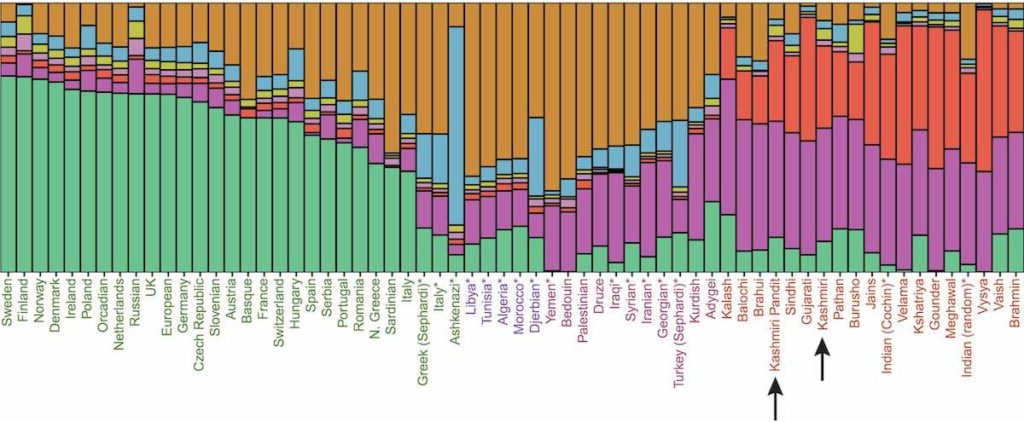
Since people ask me this I have to post this now and then. We have genetic data. So in short order
1) Kashmiris are like other people in the Northwest of India. They are not enriched in steppe ancestry, at least compared to many Punjabis or Brahmins from the Gangetic plain
2) There is no genetic difference I can see between Pandits and Kashmiri Muslims, indicating to me that one distinctive aspect of the Vale of Kashmir in comparison to the rest of the Indian subcontinent is that it does not exhibit the jati-varna structure common across the subcontinent
3) Some researchers and genetic genealogists have found some Tibetan admixture at low levels among Kashmiri Muslims and Pandits
4) It is probably correct that elite Muslims have low levels of Central Asian and Iranian ancestry, though that’s harder to detect than Tibetan background
Academic freedom, Hinduism, and the end of the age
We are at a tipping point,” said Rohit Chopra, one of the conference organizers and a professor of communication at Santa Clara University. He said the issue went beyond the conference. “It’s about the principles of freedom of expression, academic freedom and of a university being a space where people can speak for the most vulnerable.”
The online conference, Dismantling Global Hindutva, included panels on the hierarchical caste system, Islamophobia and differences between Hinduism the religion and Hindutva the majoritarian ideology. The event was co-sponsored by departments of more than 40 American universities, including Harvard and Columbia.
The whole piece is a mishmash. First, let’s stipulate that many Hindu activists are unsophisticated, illiberal, and nasty pieces of work. But someone like Suhag Sukhkla is none of those things. So the article focuses more on the former than the latter because the former is sensationalistic. Yet, many of the reported threats are credible to me because I myself have received various forms of these invectives from 15-year-old masturbaters in India on Twitter (though a little surprised adults behave like this too). But beneath the bluster and thuggishness, there’s a legitimate grievance. Imagine an academic conference on Islam that spotlighted its hierarchical gender system, religious dominionism, and the differences between Islam as a culture and Islam as a religion. Such a conference wouldn’t happen because academics would fear Muslim outrage and violence, and, they see Muslims as subalterns and marginal, and so above criticism.
The first issue illustrates why many Indians and Hindus are behaving like this: they’ve seen the heckler’s veto work on weak-spined academics before. They’ve seen it work for Muslims, and they’ve seen it work for left-wing activists. When Charles Murray was physically attacked at Middlebury it got results. Murray really can’t speak in public anymore at such venues because the cost of security would be prohibitive. The second issue is that academics don’t really believe in freedom of expression anymore, they believe in critiquing the powerful. They’re activists. Ideologues. What the Hindus are doing is turning the master’s tools against the master when they leverage identity politics and their status as people of color. The academics, who don’t really believe in freedom of expression, respond with most gusto when they try and smear Hindus by connecting them with Nazism and argue for their hegemonic status vis-a-vis Muslims in the subcontinent. It’s all who/whom here.
I believe in dispassionate analysis and Epoche. Many Hindu activists and believers are wrong on many things. And I tell them so when I think this. But I don’t do this because I want to “deconstruct Hinduism.” I don’t really care that much about Hinduism, or Islam, or any religion. I want to know what’s true. When humanities scholars gave up on the truth, they gave up on the high ground from which they could defend their viewpoints as part of free speech. This is the world they created. You told people that truth is subordinate is power. Your enemies now seek power to force you to speak their truth.
Open Thread – 10/02/2021 – Brown Pundits
My Substack post on caste is finally up. Thanks for your patience.
The podcast released three episodes in three days. An interview with Wahid Majrooh, Former Minister of Public Health of Afghanistan. Another with Pashtana Durrani, an Afghan activist. And of course the one with Shazia Ilmni. Just subscribe on Apple and Stitcher.