Browncast – Cliff Smith and Sam Westrop: The Origins of South Asian Islamism

Another BP Podcast is up. You can listen on Libsyn, Apple, Spotify,  and Stitcher (and a variety of other platforms). Probably the easiest way to keep up the podcast since we don’t have a regular schedule is to subscribe to one of the links above!

You can also support the podcast as a patron. The primary benefit now is that you get the podcasts considerably earlier than everyone else. This website isn’t about shaking the cup, but I have noticed that the number of patrons plateaued a long time ago.

This episode features Akshar and Mukunda talking to Cliff Smith and Sam Westrop of the Middle East Forum. We get into topics surrounding the relevance of the Deobandi movement, how Islamism percolates between South Asia and the West, and the political ramifications of Islamism in the US and the UK.

Open Thread – 09/19/2020 – Brown Pundits

The comments are open(ish).

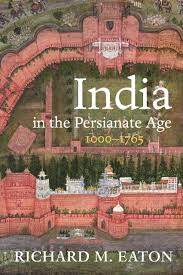
Finished India in the Persianate Age. This was a much more fluidly written book from Eaton than other stuff I’ve read from him, probably because the Mughal narrative “writes itself.” Recommended.

Probably will take reader advice and focus more on “primary sources” from now on. Though finding good translations is always an issue then…

Also, check out the podcast with Matt Yglesias. And another one with Anand Kadali on hunger in India.

America has been good to immigrants and we should be honest about who we are

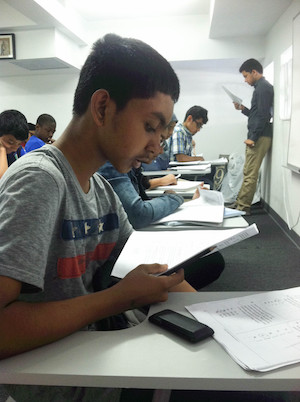
Bangladeshi American teens preparing for NYC selective school admissions exam

Since there has been rather persistent confusion about my Unherd piece I will clear up a few things. I am rather tired of talking about it now, as I “said my piece”, but sometimes things need to be done.

First, for many months (years), friends of various backgrounds (brown and non-brown) have been speaking to me of the issue of very self-righteous South Asian American (Indian, Pakistani, and Bangladeshi) “social justice warriors.” There’s nothing wrong as such being a social justice warrior and brown, but, the problem is that these individuals often accrue to themselves the full-weight of colonialism and centuries of oppression to add to their credibility and authority.  The reason I finally punched out the Unherd piece is that an Indian scientist who I am familiar with made a reference to trauma and oppression on Twitter. This resulted in many “likes” and praiseworthy comments. It was a vague and amorphous statement and could mean anything, but the response made it clear that most people took it to be that they were alluding to the weight of colonialism and racism.

The problem I had with this is I know that this individual, a Brahmin raised in India, is from a literally rich family. Rich enough to pay undergraduate American tuition for international students in full. And, rich enough to pay graduate school tuition when otherwise this person would have to take up a teaching assistantship. This is not a person who is well-off in the Indian context. They’re well off in the American context.

This is an extreme case. But it illustrates a more general problem. People who by dint of their brown skin claim to be, or allow people to believe they are, marginalized and oppressed. The vast majority of brown Americans can tell you stories of racial discrimination and prejudice. That is true. But are these experiences determinative in their lives? Does their race define and limit them in a deep and powerful manner?

I would argue not. Today the Americans of brown background are flourishing. Indian Americans in particular are socioeconomically advanced, and now, becoming culturally prominent. Just like their white upper-middle-class peer, Indian Americans are benefiting from the system, and flourishing within it. Their realized outcomes are very different from African and Latino Americans. Some of the same is also applicable to poorer newer ethnic groups, such as Bangladeshis, who begin much lower on the socioeconomic ladder but are placing their children into elite public schools like Stuyvesant.

Second, selective immigration from India has resulted in a very atypical Diaspora. Many who responded to my piece argue that selective immigration is the whole story, so why bring caste into it? Because the criteria used have skewed the India Amerian community in a way where it is not representative of India at all. I am personally not bothered by this. But again, when issues such as caste oppression come up in the USA, non-Indians may not realize when talking to Indian Americans that they will almost never interact with a Dalit, who are 15% of India’s population (one could argue that except for Gujarat the “Cow Belt” is also totally underrepresented due to the way immigration has worked). Many Brahmin Indian Americans I know are vociferously against caste (sincerely, and in their actions!). But to me, this is a laudable idealism, not something that comes out of historical brutality, because their ancestors were willing executors of the system. In this way, they are like upper-class white people who wish for a more egalitarian economic system. Their views are sincere, but it comes from idealism, not trauma.

As a brown person from Bangladesh people who knew where I was from would always make assumptions about my background, as Bangladesh was the byword for incredible poverty for the second half of the 20th century. Those that did not know my family was of professional background would ask naive questions, such as “did you grow up in a hut?” I found it amusing, but I did make it clear that I couldn’t personally speak to the poverty and deprivation which were such serious concerns for everyone about the country of my birth. In Bangladesh, I was a very privileged person. In my day to day life in the USA, this was irrelevant, but I wasn’t going to go around speaking with authority about how horrible grinding Third World poverty was. It was just in many ways just as abstract for me as it was for my white classmates. Honestly, if I did grow up in a hut I’d probably brag about it since it would make my Horatio Alger story so much more inspiring.

Overall, the point of the piece is that when you make identity so important to the content of someone’s arguments and the force of their views, it creates a massive incentive for individuals to cultivate and shade their identity to add credibility. Ergo, a Nigerian American whose family is wealthy from brutal oil extraction which results in human rights violations and crimes in their ancestral homeland will likely not expose this fact when castigating a middle-class white American about their “white skin privilege.”

Brown American should just accept what they are in the main: a relatively privileged people from whom America works, who have to deal with some incidents of racism in their lives.

History beyond the screaming

Last night I realized I’m not going to weigh in on history discussions on Twitter if they pertain to the Indian subcontinent. Even people who I know are not 13-year old incels behave totally emotionally and engage in shitposting posturing constantly. It’s really impossible to get a signal out of the discussion.

Indians and Pakistanis seem so intensively invested in various topics that it is literally and seriously impossible to get value out of any exchange, the swell of stupidity and bad faith (on all sides!) is so intense. There is a reality out there. There is a true history. But this is not what most of you really care about it, is it?

For example, reading India in the Persianate Age: 1000–1765 gives a nuanced and fully textured picture in outlines of the subcontinental elite in the premodern period. It aligns in broad sketches with what I know about human psychology and history elsewhere. But attempting to bring nuance seems like a fool’s errand in most of these debates.

Understanding the history of the Indian subcontinent is rewarding to me because there are comments here on the general human condition. I will not turn away from that. But, I do need to reflect on whether that is best done in solitude rather than engaging with the world “out here.”

Note: I don’t mind or care too much if particular truths are leveraged in some ideological manner. Rather, my suggestion is ideological priors are doing all the sifting of which truths are correct or not.

The religion of Hindus before Hinduism

India in the Persianate Age: 1000–1765 is a good read and I recommend it. But the author, Richard Eaton, is not a guru or a sheikh, and should not be taken as such.

A comment Eaton makes offhand several times is that the conflict between Turks and Indians should not be understood in confessional terms. This is a commonly asserted, and on some level, it reflects elements of the truth. Hindu Rajputs served under Muslims, and Turkic soldiers served under Hindus. You can’t reduce everything to confession.

But, it is clear that confession and civilizational identity did exist, and it was robust. Going from the specific to the general.

  1. A great deal of text given over to Man Singh’s glorification of his conquests as an Indian warrior, and his patronage of Indian religion, in particular Vaishnavism.
  2. Eaton highlights the rapid Indianization of practices and hegemonic motifs present among the Turks and Afghans who were born and raised in India. And yet despite the syncretistic tendencies which occurred, ultimately these ashraf elites remained identified as Muslims and often were pulled back to world-normative Islam over the generations.
  3. Vijayanagara persisted as a Hindu polity for three centuries. The cross-cultural analysis shows that recalcitrant pagan powers always convert to the religion of their enemies eventually. The leader of the pagan resistance in Saxony became a Christian. Pagan resistance to Christianity in Sweden, Lithuania, and ancient Rome were only temporary, as resistant lineages eventually were assimilated into the new order. Resistance to Buddhism in Japan and Tibet was initially violent, but futile. In iterative games, paganism is the eternal ‘beatable’ strategy.

The only point to posting this is that there is a common assertion that Hinduism as a religion or identity only emerged in the 19th century. I am now convinced that this confuses the name of the phenomenon for the phenomenon. The Indian religion of the Hindus was clearly bundled together in a way that allowed for their elite deployment as a meta-ethnic identity that separated them from the Turks and Afghans who ruled them. Similarly, the Islam of the Turks and Afghans (and variegated Ethiopians, Arabs, and Persians), separated them from the Indians whom they conquered to prevent full assimilation as an Indian elite with popular roots in early modernity.

There is a major issue where our conception of religion qua religion is conditioned on an intellectual revolution rooted in the Second Reformation of the Calvinists. But, I think it is important not to get carried away with this construct, and assert that Calvinist religion is qualitatively different from pre-Calvinist religion. I don’t think it is. Rather, it simply shifts some of the parameter values within the model. Similarly, the identity of a coherent Hindu Rashtra with a post-caste socio-religious identity is an invention of modernity, but its roots are ancient and indigenous, and not postcolonial fictions.

Hello, Nurse!

Aloha! Wassup? Kaisay ho yaar?

My name’s TheseLongWars, TLW for short, known for twitter.com/TheseLongWars, currently from these-long-wars.blogspot.com, formerly of theselongwars.blogspot.com (RIP: 2010-2020).

It is an absolute Goddamn pleasure and honour to have been invited to be here as a writer and opinion-ator at BrownPundits.com!

As you may have seen my tweets, I have been commenting in-depth about my native Pakistan for a decade now. I’m from the city by the sea, Karachi, and I am a happy partisan for that over-grown beach-hole. I’m not a big genetics or phrenology fan. However, I love talking politics, I love talking some culture, I love history, and I enjoy getting the chance to write.

But let’s not make this intro long-winded. Snappy posts are fine, but some effort later at longer posts, will come later.

For now, here’s where the catch-phrase my title is based on is from. Do read what I write; you’ll always learn something worth knowing 😉

Ciao!

Charles Cameron, R.I.P.


Charles Cameron, a contributor to this weblog, and an early guest on our podcast has died after an illness. I do not know any details (I saw a Facebook post), but I felt that it was important to mention his passing since his contribution to this forum was appreciated, and from what I knew of him he seemed a man with a great heart and boundless curiosity.

Death is inevitable, and a part of life. We too shall pass in our own time. All we can hope for in this one life is to leave memories that honor what we stood for after we leave.

On Language wars and the rise of the Vernacular in history

Language wars are a constant feature of Indian public life. Most recently there was much discussion on Language on Indian twitter triggered by the National Education Policy (NEP 2020). But amidst the language squabbles, we tend to reflect less on the root cause of all the language schisms –  The rise of the Vernacular. A relatively recent phenomenon in Indian history.

Back in 1000 CE, Sanskrit reigned supreme as the primary literary tongue of India. There was some Prakrit literature and considerable literature in some of the older Southern languages – Tamil and Kannada in particular.  But for the most part Vernaculars had a position secondary to Sanskrit.

The language of prestige and literary expression was undoubtedly Sanskrit, though it was hardly the mother tongue for a large percentage of Indians. Vernaculars reigned at home, and in common speech. Yet in an age of limited literacy, they never competed with Sanskrit for “prestige”. This was very much the case not just in India, but in much of the western world as well. In Europe, as late as 15th century, 70% of the printed literature was in Latin!

Continue reading On Language wars and the rise of the Vernacular in history

Some musings on the Bengal riots of 1949-50

While any discussion of Partition tends to focus a lot on the migrations and violence circa 1947, we tend to forget the mayhem that followed in Bengal with a lag. As late as 1950! In Bengal the violence peaked in late 1949 – 1950 unlike in Punjab. Particularly in East Pakistan.

The discussion of these riots and the agreements that ensued in 1950 in TCA Raghavan’s book “The People Next Door” make an interesting read.

The partition in 1947 had left both sides of Bengal with similar proportions of minority populations. West Bengal had five million Muslims in a population of twenty one million. East Pakistan was left with eleven million Hindus in a population of thirty nine million.

Unlike in the Punjab, a full-fledged ethnic cleansing did not occur in Bengal. Perhaps in part because of the presence of Gandhi in Bengal for a couple of crucial months in 1947. There could be other reasons that can explain why Bengal didn’t start with a blank slate unlike Punjab. I can only think of the Gandhi-factor as of now

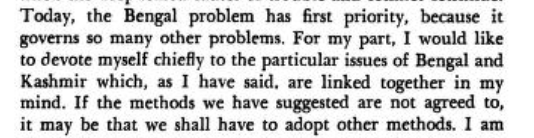
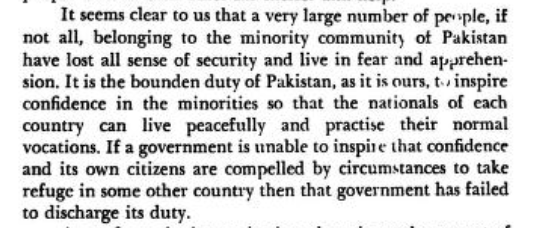
The violence festered in Bengal right up to 1950, but it peaked in the month of February that year, particularly in East Pakistan. The violence against Hindus provoked much political unrest in India, causing Nehru to assume stances that seem very hawkish to us today.

Jawaharlal Nehru addressed the Parliament on Feb 23rd of 1950, expressing outrage at the East Pakistan riots
Image

Then he went on to suggest a possible military action against East Pakistan while concluding his speech – Note the words – “We shall have to adopt other methods

Image

But then the invasion idea was dropped. It was not just a question of Nehru being pusillanimous. The President of India, Rajendra Prasad, a supposed right winger, wrote a letter to Nehru, suggesting that he drop the idea of attacking / annexing East Pakistan!
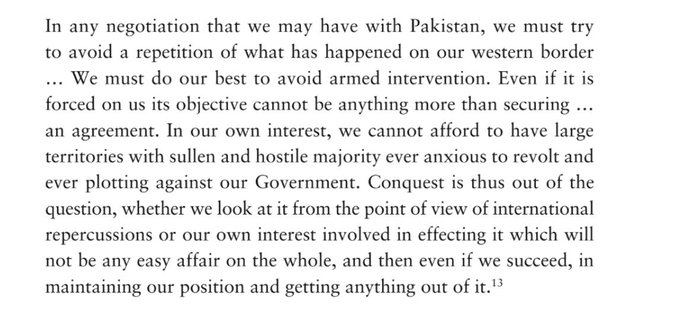
Image

I find this curious.

An interesting example of a “conservative” voice in India (Rajendra Prasad) persuading the supposedly more dovish and liberal Nehru to drop the idea of military action against East Pakistan

Another thing that I find curious about this episode is that the very large scale migrations that ensued in early 1950, were mostly undone by the end of the year by reverse migrations, following the Nehru-Liaquat agreement in April 1950.

Between February 7th and April 8th 1950, 1.5 million people crossed the borders! 850K Hindus from East Pakistan to West Bengal, and 650K Muslims from West Bengal to East Pakistan.

The agreement was signed on 8th April 1950, but it did not reverse the migration tide immediately. Between 9th April and 25th July, 1.2 million more Hindus left East Pakistan for India, while only 600K returned back to Pakistan prompted by the agreement.  That’s roughly a return-ratio of 1 in 2.

But it appears the ratio was much better for Muslims for exactly the same period (9th April to 25th July) following the treaty. In this timeframe, 450K Muslims left West Bengal for East Pakistan, but 300K returned back.  That’s a ratio of 2 in 3.

So it appears the agreement reassured the Muslims more than it did the Hindus. But nevertheless it did prompt Hindus to return back to East Pakistan in larger numbers by the end of the year.  A million Hindus had returned back to East Pakistan by December of that year.

One wonders if we could’ve had a more peaceful subcontinent in later decades, had the powers that be sat down and planned a more systematic population transfer, instead of idealistic reassurances to minorities, which did help stall the large scale transfer in the short run, but kept communal tensions simmering for several more decades.

References:

  • TCA Raghavan’s “The People Next Door”
  • Jawaharlal Nehru’s Speeches, Vol II

The author tweets @shrikanth_krish

Brown Pundits