Long long with caste be a bar? Perhaps more than three centuries!

In the 2000s I read a fair number of books such as Nicholas Dirks’ Castes of Mind. The impression one gets from these books is that jati-varna status and stratification are protean. Much of it a recent function of jockeying during the colonial and liminal colonial era. The “uplift” of groups such as Patidars and Marathas, for example. Or the emergence of Kayasthas as literate non-Brahmin service castes for Muslim rulers.

The genetic data that emerged in the 2000s though shocked me with two facts:

– There is within region a rough correlation, imperfect, but existent, of what we now call “steppe ancestry” and caste status

– Jati groups in a given region were shockingly distinct, and many exhibited a lot of genetic drift.

Endogamy was deep, ancient, powerful, and, genetic differences of the deep past persisted, rather than mixing away.

These are not perfect generalizations. The correlation between steppe and and status breaks down in the northwest to a great extent (thought still not totally). There are groups, such as Bengali Kayasthas, who approximate Brahmin status (even still being lower), but are genetically similar to non-elite non-Brahmins. Within the data there are castes which seem composites (Khamboj in some recent data).

This is a preface to the fact that I’ve gotten into recent arguments inadvertently online about caste, and its role in the Indian future. So I decided to look at the data. Here is my short conclusion: jati-varana is way more robust than I would have thought. Outmarriage rates were 5% as of 2011, and they didn’t vary that much by social status. At current rates it could take 500 years for caste not to be a big deal in India.
Continue reading Long long with caste be a bar? Perhaps more than three centuries!

Browncast Adjacent

Apple Podcast has a “Related” feature that shows up if your podcast gets enough subscribers.

If you look at “Related” for The Insight, the science podcast I host with Spencer Wells, you’ll see every “Related” podcast is science-focused except for the Browncast. The Brown Pundits Browncast is on the list because I’m involved with both podcasts.

Now that the Browncast is moderately popular it has an informative “Related” list. I’ve made a table below which shows by column:

– The podcasts suggested as “Related” for the Browncast
– If the Browncast shows up as “Related” for that podcast in a reciprocal fashion
– If someone involved with that podcast has been a guest on the Browncast
– If someone from the Browncast has been a “guest” on that podcast

Continue reading Browncast Adjacent

Browncast Episode 117: Meet the Maheshwaris!

Another BP Podcast is up. You can listen on LibsynAppleSpotify,  and Stitcher (and a variety of other platforms). Probably the easiest way to keep up the podcast since we don’t have a regular schedule is to subscribe to one of the links above!

You can also support the podcast as a patron. The primary benefit now is that you get the podcasts considerably earlier than everyone else. This website isn’t about shaking the cup, but I have noticed that the number of patrons plateaued a long time ago.

On this podcast, Razib, Mukunda, and Omar talk to Nikhil M., the cousin of Sima Taparia. Though a younger generation, Nikhil offers up his opinion on how accurately the show depicts Sima (he has met her and their families are close). But a 27-year-old young professional who grew up in California, the conversation ranges widely on topics of relevance to the young and brown.

Also, lots of stuff about Marwaris and the phenomenon of “Indian Matchmaking”.

If you want more podcasting about Indian Matchmaking, please check out Big Brown Army. DeCruz interviews three of the stars, Vyasar Ganesan, Vinay Chadha, and Manish Das.

Open Thread – 08/01/2020 – Brown Pundits

I think when we started the Brown Pundits Browncast we planned a ~1 time a week affair. As it happens it’s not that regular. The Browncast will be gone for 3 weeks, and then come back every other day for a week. Really you should subscribe at one of the options (just click the link in the strip above the latest podcast).

If you want to hear the podcasts early, please become a Patron. I do post them early. Sometimes hours. Sometimes days. Now and then weeks. And on an occasion here and there months. There is also a podcast you can’t hear unless you are a patron since the person interviewed was up for a government position, and they thought it would be best to remove all public opinions for the moment.

The open threads are getting super long, and I will try some non-WP option at some point. Also something with a killfile. I’m pretty relaxed on censorship with the open threads…but at some point, the nastiness is going to turn people off.

I am frustrated by the historical ignorance of many readers of this weblog and “India” Twitter. So a question, if there are three history books someone should read on the West, India, and China, what would they be? I have plenty of suggestions but I’m wondering what the reader would say.

I’m not going to post a separate show notes episode for Kushal Mehra and myself talking about caste, but it’s up.

Caste – bred to the bone!

Kushal Mehra and I had a discussion on the Brown Pundits podcast about caste. I will post for Patrons today and push it live tomorrow. I want to review a few things from my perspective on this issue related to what we talked about.

– The paper The promise of disease gene discovery in South Asia highlights a fact: jati has a very strong genetic reality. The stylized fact is that caste endogamy has been strong across southern Asia for 1,500 years. Genetically you can have two castes in the same village in Andhra Pradesh who are as distinct as people from Finland and Sicily.

Additionally, jati is not arbitrary. Brahmins across India may not be closely related, but they tend to have more “Ancestral North Indian” than their non-Brahmin neighbors, on average (true everywhere except for the Northwest of the subcontinent).

– Kushal asked if jati varna was an ESS. I have suggested that caste fragmentation made it harder for non-Indians to take over and assimilate Indian society. But, it is not the only ESS.
– The main contrast I give is to China. People who can read classical Chinese (which was the norm in the early 20th century) can still read oracle bones from the Shang dynasty 3,400 years ago. This is a civilization with continuity and integrity.

The Chinese are a population that has managed to absorb other groups and do it without caste endogamy. Rather, like Europeans, Chinese genetic variation is a function of geography, not class/caste. In fact, the Chinese never developed a blood nobility like Europe. The basis of Chinese civilization has unapologetically been the peasantry.

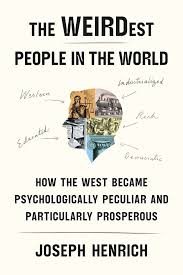
– In The WEIRDest People in the World Harvard’s Joe Henrich makes the argument that the Western Christian Church’s destruction of extended family networks led to the rise of the West. I won’t recapitulate the argument which I’ve outlined elsewhere. But the idea is rather persuasive.

It seems that the hostility and skepticism toward caste from some on the “Hindu Right” really has to do with Indian nationalism. Jati varna was a reasonable institution in a pre-modern context, but it doesn’t take a genius to understand that national cohesion is reduced when people view themselves as members of a “community” first and foremost, and not a nation-state.

From the traditionalist side, the idea that jati varna is a great functional system is really not the point. Let’s be frank: people are invested in their particular traditions and their purity. The rest is commentary.


Browncast Episode 115: Sean P. McCarthy, Come the Revolution!

Another BP Podcast is up. You can listen on LibsynAppleSpotify,  and Stitcher (and a variety of other platforms). Probably the easiest way to keep up the podcast since we don’t have a regular schedule is to subscribe to one of the links above!

You can also support the podcast as a patron. The primary benefit now is that you get the podcasts considerably earlier than everyone else. This website isn’t about shaking the cup, but I have noticed that the number of patrons plateaued a long time ago.

On this podcast Razib talks to someone from the economic Left or “Dirt Bag” Left, Sean P. McCarthy. McCarthy’s Twitter account is very funny, especially in the potshots he takes at the woke-Left. But contrary to what one might think, he has very strong and serious opinions on economic matters that challenge what he perceives to be the neoliberal consensus.

Browncast Episode 114: Brahmin Bannon

Another BP Podcast is up. You can listen on LibsynAppleSpotify,  and Stitcher (and a variety of other platforms). Probably the easiest way to keep up the podcast since we don’t have a regular schedule is to subscribe to one of the links above!

You can also support the podcast as a patron. The primary benefit now is that you get the podcasts considerably earlier than everyone else. This website isn’t about shaking the cup, but I have noticed that the number of patrons plateaued a long time ago.
I would though appreciate more positive reviews! Alton Brown’s “Browncast” has 30 reviews on Stitcher alone! Help make us the biggest browncast! At least at some point.

In this episode, we talk to Indian Bronson. The easiest way to explain who he is is that he’s an Indian American Brahmin who is a practicing Hindu vegetarian, who also happens to be on the same ideological wavelength as Steven Bannon.

A data scientist by data, and shitposter by night.

Browncast Episode 113: Richard Hanania

Another BP Podcast is up. You can listen on LibsynAppleSpotify,  and Stitcher (and a variety of other platforms). Probably the easiest way to keep up the podcast since we don’t have a regular schedule is to subscribe to one of the links above!

You can also support the podcast as a patron. The primary benefit now is that you get the podcasts considerably earlier than everyone else. This website isn’t about shaking the cup, but I have noticed that the number of patrons plateaued a long time ago.

I would though appreciate more positive reviews! Alton Brown’s “Browncast” has 30 reviews on Stitcher alone! Help make us the biggest browncast! At least at some point.

“I’m not insane at all”

In this episode, I talk to Richard Hanania. By heritage a dhimmi from the Levant, Hanania’s primary focus is on foreign policy. We discuss the “blob”, the importance of path dependency in American foreign policy commitments, and the impact of sanctions on Iran.

We also discuss his upbringing as an Arab American, and what it’s like to be right-of-center and an academic in 2020.

He has a very interesting and contrarian Twitter account.

Note, if you are a patron, I’ve already posted the interviews of Indian Bronson and Sean P. McCarthy.

Browncast Episode 112: Tarun Sridharan from Odd Compass – Rajas and Sultans

Another BP Podcast is up. You can listen on LibsynAppleSpotify,  and Stitcher (and a variety of other platforms). Probably the easiest way to keep up the podcast since we don’t have a regular schedule is to subscribe to one of the links above!

You can also support the podcast as a patron. The primary benefit now is that you get the podcasts considerably earlier than everyone else. This website isn’t about shaking the cup, but I have noticed that the number of patrons plateaued a long time ago.

I would though appreciate more positive reviews! Alton Brown’s “Browncast” has 30 reviews on Stitcher alone! Help make us the biggest browncast! At least at some point.

This episode features Razib and Akshar talking history with Tarun Sridharan, the man behind a very interesting Youtube Channel – Odd Compass. We discuss the Malacca Sultanate, Vijaynagara’s downfall, Maratha success, and various other topics in history. Make sure to check out his Instagram and especially youtube channel which has beautiful and well-researched videos on history (especially Indian!).

Check out his latest video on the history of war elephants:

Brown Pundits