Quaid, Modi, and the Operation Sindoor

On Pakistan’s second birth, India’s rising nationalism, and the politics of martyrdom

There’s a strange irony in history: the founder of Pakistan and the “strongest” Prime Minister of India may ultimately be remembered for the same thing—giving Pakistan life.

Muhammad Ali Jinnah birthed the state. Narendra Modi may have revived its soul. Because nothing steels a national identity like resistance. And nothing immortalizes a cause like martyrdom.

Blood in Pahalgam, Resolve in Islamabad

When civilians—children—are killed, as in the recent attacks in Pahalgam & Bahawalpur, the horror doesn’t demoralize. It clarifies. It creates martyrs. And martyrdom sanctifies. Pakistan, often in search of a purpose, just received one. What makes this even more striking is the dynamic behind it. Modi may need Pakistan—not as a partner, but as a perpetual foil. A pressure point. A mirror. A justification.Every strong nationalism needs its adversary:

  • Israel has Hamas.
  • The U.S. had the USSR.
  • India, increasingly, needs Pakistan.

Nationhood hardens in opposition. This is what the “failed” projects of Czechoslovakia and Yugoslavia lacked: no existential other. No enemy, no glue. Even the most successful Willensnation—Switzerland, a country built by choice, not ethnicity—engaged in intense nation-building during the 1960s. Its wealth today isn’t just neutrality—it’s the compound interest of skipping two world wars. But in today’s world, Dubai may inherit Switzerland’s darker mantle—as the future capital of hot money and global shadow finance. Meanwhile, across the Atlantic, Canada’s national identity has paradoxically strengthened in Trump’s wake—a quiet rebellion through civility, as if to say: we are what he is not.

The Strategic Misstep?

Operation Sindoor. Suspension of the Indus Waters Treaty. Visa blocks. High Commission closures. Are these pressure points—or accelerants? The danger is that such moves only validate Pakistan’s siege narrative. And that narrative fuels its resilience. You can’t bomb a martyr complex. You can only confirm it. Continue reading Quaid, Modi, and the Operation Sindoor

Let Pakistan Throw Stones. India Should Build the Skyline.

These thoughts emerged as I was replying to the 100+ comments on Omar’s post, India and Pakistan, Back to the Future..

Flight, Fragility, and the First Bollywood Snake

My first memories of Pakistan are tangled with flight and childhood fiction. In 1990, as we escaped Kuwait after the Iraqi invasion, our car crossed into Pakistani Baluchistan carrying five adults and three children. After over a month in Iran (the family gardens of Shiraz are a blurry childhood memory), where we were understandably low-key about being BahĂĄ’Ă­s, I remember yelling out the car window the moment we crossed the border, “I’m Bahá’í! I’m Bahá’í!” My family laughed (I was the youngest and always the most impetuous). The story has been retold so often I don’t know where memory ends and performance begins.

But the innocence of that moment gave way quickly. I remember the poverty at the border: raw, overwhelming on both sides of Baluchistan. And then, in Karachi, came my first exposure to India—through a Bollywood film featuring a dancing girl in a Sari transforming into a snake. That, more than any textbook, was my introduction to Hinduism. Try as it might, Pakistan is the ineffable portal to Hindustan, a mirror that reflects what it cannot contain. These memories—flight, fragility, and fantasy—etched into me the idea that culture moves where politics cannot.

Restraint Is the Strategy: Rethinking Peace in South Asia

South Asia is home to nearly 2 billion people. It’s a region of nuclear states, frozen conflicts, and postcolonial trauma. Yet every time a cross-border terrorist attack kills 20 or 30 civilians, it makes global headlines. That’s not just because of the violence—but because the violence is rare. This isn’t an excuse. It’s a signal: South Asia has already learned restraint. The question is whether it can remember why.

The Bug in the Democratic Mind

After 9/11, the U.S. was angry. George W. Bush gave the people what they wanted: a war. Two, actually. Instead of a tactical mission to dismantle a terrorist network, America destabilized entire regions, wasted trillions, and incubated future threats.

This is the paradox of democracy:

  • Populations demand retribution.

  • Leaders comply.

  • Strategy is hijacked by spectacle.

India must adopt a radically different approach. Treat Pakistan the way South Korea treats North Korea: sidestep, outperform, outgrow. Engagement legitimizes provocation. Retaliation restores parity. Indifference signals dominance. Continue reading Let Pakistan Throw Stones. India Should Build the Skyline.

Are You Sri Lankan?

Notes on Identity, Gharbzadegi, and the Azizam Effect

Yesterday, a Persian friend casually asked me if I was Sri Lankan. I wasn’t offended. Startled, yes — but not offended. I take pride in being Desi. And truthfully, there isn’t a stark difference between many South Asian and Persian phenotypes at the human level. But the interaction stayed with me.

Because while I can understand a Scandinavian confusing Indians and Iranians — my Danish friend, for example, couldn’t reliably tell them apart — it hits differently when Persians, especially non-Muslim, Westernised Persians, make the same mistake.

Immediately, another half-Indian, half-Iranian friend interjected:

“Zach doesn’t look Sri Lankan at all.”

For what it’s worth, when I was in Colombo over New Year’s, I fell in love with Sri Lanka — the island, the people, the everything. Also the phenotype range in Sri Lanka is extensive since there is so Dutch, Portuguese & Moorish ancestry in addition to the native ones. Some Sri Lankans even thought I was Sri Lankan myself. Truly, it is Serendib.

Continue reading Are You Sri Lankan?

The Myth of the British-Made India

Six years ago, I wrote an outraged post on BP when a British historian casually claimed that “the British created India” (we had a very thriving commentariat then); a breathtaking erasure of one of the world’s oldest civilizations.

Today, reading Francis Pike’s piece in The Spectator, I feel the same cold disdain. Pike repeats the same old colonial fantasy: that India was a “patchwork of principalities,” and that Nehru and Gandhi “invented” the myth of Indian unity. Let’s be clear: this is not history. It’s imperial nostalgia dressed up as analysis.

“India’s first prime minister, Jawaharlal Nehru, and Mahatma Gandhi both propagated the myth that India had always been a unified country.”

“More reflective commentators knew that this was hogwash.”

“It was the British who
 for the first time introduced the rule of law and a democratic form of government.”

This is colonial gaslighting at its most refined. Continue reading The Myth of the British-Made India

Caesar’s Pakistani wife must be above suspicion

May those who lost their lives in the Pahalgam tragedy rest in peace. May the injured find swift healing. And may the perpetrators be brought to justice.

False Flags, Fragile Ideologies, and the Weight of History

I don’t want to take away from Omar’s excellent piece, India and Pakistan: Back to the Future—he nailed it on the trajectory of Pakistan’s self-conception and the road ahead for India.

But what began as a comment evolved into something more. I wanted to briefly address the misinformed murmurings online about the attack on Pahalgam being a false flag.

Caesar’s Wife

There’s an old line: Caesar’s wife must be above suspicion. If you want to be taken seriously on the world stage, perception is half the battle. India has a clear civilizational and national narrative. Despite its contradictions, it’s attempting—seriously—to join the ranks of the U.S. and China. And it’s making real progress.

Pakistan, by contrast, seems increasingly defined by what it opposes rather than what it builds. Its civilizational narrative has, over time, narrowed into a single impulse: block India at any cost. There are dozens of Muslim-majority nations. But there is only one India. That asymmetry matters—culturally, strategically, metaphysically.

Zia’s Logic: Annihilation as Strategy

One quote making the rounds—attributed to General Zia-ul-Haq—offers a glimpse into a mindset that’s still disturbingly prevalent: Continue reading Caesar’s Pakistani wife must be above suspicion

Cheap Catharsis, Expensive History

Sathnam Sanghera recently alluded to a moment from his 2019 Channel 4 documentary The Massacre That Shook the Empire. In it, the great-granddaughter of General Dyer, the man responsible for the 1919 Jallianwala Bagh massacre, is brought face-to-face with descendants of the victims.

In the clip, Dyer’s descendant calls the massacre victims “looters” and praises her great-grandfather as an “honourable man.” Twitter was predictably outraged. KJo chimed in. Think-pieces bloomed.

But why does her opinion matter?

This wasn’t justice, it was television. And like most televised reckonings with Empire, it was a performance. One more entry in the growing archive of aspirational brown catharsis, where the goal is not transformation but temporary relief; therapy instead of revolution.

Yes, the Jallianwala Bagh massacre was horrifying. No one disputes that. But to repeatedly stage these moments of inherited guilt and symbolic outrage is to substitute emotional spectacle for actual change.

Britain is not closer to redress. The Commonwealth isn’t inching toward reparations. British Asians are not about to own a fairer share of land, institutions, or equity. But we are expected to feel healed by the awkward mutterings of a descendant who’s not even sorry; just embarrassed that another cousin openly defended their ancestor.

This is not about historical accountability. It is about managing the mood of postcolonial subjects. Keep us emotional. Keep us visible. Keep us grateful.

But don’t give us power.

That is the unspoken logic of these curated moments: mourn the wound, not the cause.

And it works — because so many of us still seem to want respect more than justice. To be seen, included, affirmed.

But history will not be rewritten through awkward Channel 4 moments. It will only be reckoned with through real structural change.

Until then, let the Twitter mobs rage. But some of us will remain quietly asking the harder question:

What are we really performing here?

A Postcard from Princeton

The symmetry, the wealth, and the mirage of American elegance

Dr. V had to give a talk at Princeton, and I tagged along. We expected an elite university (our milieu for the last decade). What we didn’t expect was how stunningly beautiful the town would be.

Everything felt curated: the neoclassical facades, the quiet wealth (it has a Hermes store for Heaven’s sake), the perfectly measured charm of a place that knows exactly what it is.

It made me think of how different America’s internal geography is from the UK or France. In Europe, the capital is the cultural and intellectual heart—London, Paris. In the US, it’s more like Germany or Italy: multiple regional power centers—city-states in all but name.

Living in Princeton, New Jersey | Princeton Plasma Physics Laboratory

And Princeton is one of them. Unlike either of the Cambridges:

  • Cambridge, Massachusetts is a behemoth, flowing into the urban sprawl of Boston, powered by MIT and Harvard.

  • Cambridge, UK is insular, its 31 colleges often more concerned with their individual legacy than the town around them.

But Princeton, somehow, has achieved a kind of graceful middle ground. It’s not sprawling, but it breathes. It doesn’t dominate, but it defines. Continue reading A Postcard from Princeton

Sizdeh Bedar, Identity Whiplash & the Gandharan Delusion

It’s been a minute—I’ve been quietly recovering from Sizdeh Bedar, the thirteenth day of Norouz when you’re meant to go outside and shake off bad luck. I chose to take it literally: less screen, more sky.

To be fair I did go for two consecutive daily outdoors runs, which I haven’t properly done since the late pandemic but instead of the customary picnic; I went to the Afghan restaurant, Helmand, which was excellent- Afghani cuisine is truly the dark horse of the Indo-Persianate world.

In the meantime, Razib’s dropped two excellent posts—one on Tibetans, the other on Great Men: is Trump the product of his age, or did he make the age what it is? It’s the kind of question that haunts our era, especially as 2024/25 starts to feel historically charged.

Meanwhile, the above is courtesy of Anand on our Global Politics chat & over on Twitter, a post’s been circulating about how South Asians are desperate to leave the desh, but the moment they do—they long for it obsessively.

It’s complicated. I love the homeland (Chennai is my vibe), but I’m 1.5 generation: I migrated at 14, but had spent meaningful time in the West beforehand. So what am I? Not quite immigrant, not quite native. That liminal space is familiar to many of us. It’s a tension you carry everywhere—between passport and memory, practicality and nostalgia.

On cue, our resident Pundit is once again being spammed by Pakistanis “discovering” they are the last Gandharans and telling a Kashmiri Pandit to back to the “Ganges” (the last Kashmiri Pandits who did come from the Ganges founded South Asia’s most prominent and enduring political dynasty so I guess that’s a wish for us to be under good Brahmin rule again).

Now, as a rule, you should never intellectually duel with a thrice-born. It rarely ends well. But here we are: Pakistan, in search of yet another usable identity, this time reaching deep into the vault and pulling out Gandhara. Continue reading Sizdeh Bedar, Identity Whiplash & the Gandharan Delusion

Twelve Days of Norouz

A Little Glimpse into our Norouz

Before diving into reflections, here’s a short clip from our Norouz gathering—a moment of rhythm, light, and quiet joy.

We cut the cake at exactly 9:01:30 PM, the precise moment of the vernal equinox. That instant—when day and night are perfectly balanced—is when Norouz truly begins. Not just a date on a calendar, but a celestial pivot point.

Spring Equinox, 2025 - Civilsdaily

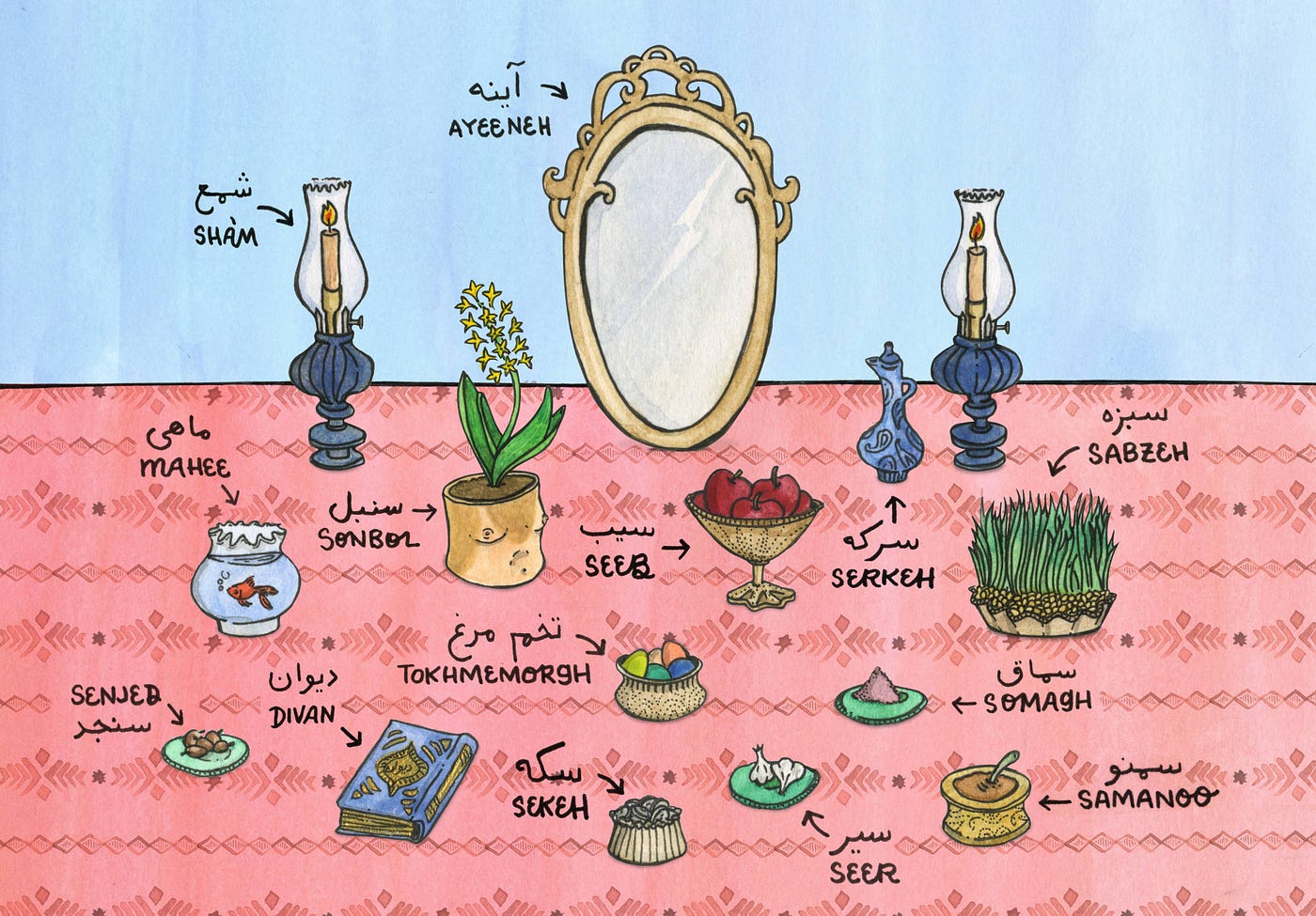
I’ve yet to attempt a full Haft Sin, but this year, I symbolized each element in a cake and cut it at that moment of cosmic symmetry. It felt right: a gentle innovation on tradition, one that reflects the layered nature of Norouz for me—part-Persian, Bahá’í, and of distant Zoroastrian descent. My festive rhythm has long leaned toward the latter part of the year—from Halloween to Epiphany, with near-weekly celebrations—but this year, Norouz found its center.

Seven Seens of Haft Seen. an illustrated guide to an Iranian ...

As I write this, it’s also Laylat al-Qadr—the Night of Power in the Islamic calendar, believed to hold the weight of a thousand months. A rare convergence: Bahá’í and Muslim fasting overlapping, Ramadan and Norouz intertwining. From next year, they’ll decouple again, but for now, the alignment feels sacred.

The camera caught just a sliver: flickering candles, a circle of loved ones, rhythmic clapping, and a moment more felt than spoken.

Sometimes, a few seconds of joy carry the weight of an entire season. Continue reading Twelve Days of Norouz

Indra – the dragon slayer

I recently coded up a python script (using Pythonista on my iPhone) in my spare time to speed up searches through the Vedic corpus and the Epics. It lets me search text patterns through the whole corpus, extract verses, cross reference it with translations and then create a text of Sanskrit verse with translations with clear citations. The inputs are text filters that can be combined to create excerpts on specific topics.

I did this partly to spend time on my morning commute to work but also because I wanted to research the old Sanskrit canon more. In the age of LLMs where the right kind of data is the real currency, I think textual analysis and research will be revolutionised with these tools. So, in that spirit, and armed with my script I curated a text with RV citations filtered on váč›tra​​​​​​​​​​​​​​​​ references and fed it to Claude 3.7, and after some prompting here is a great result. Be informed and enjoy!

Continue reading Indra – the dragon slayer

Brown Pundits