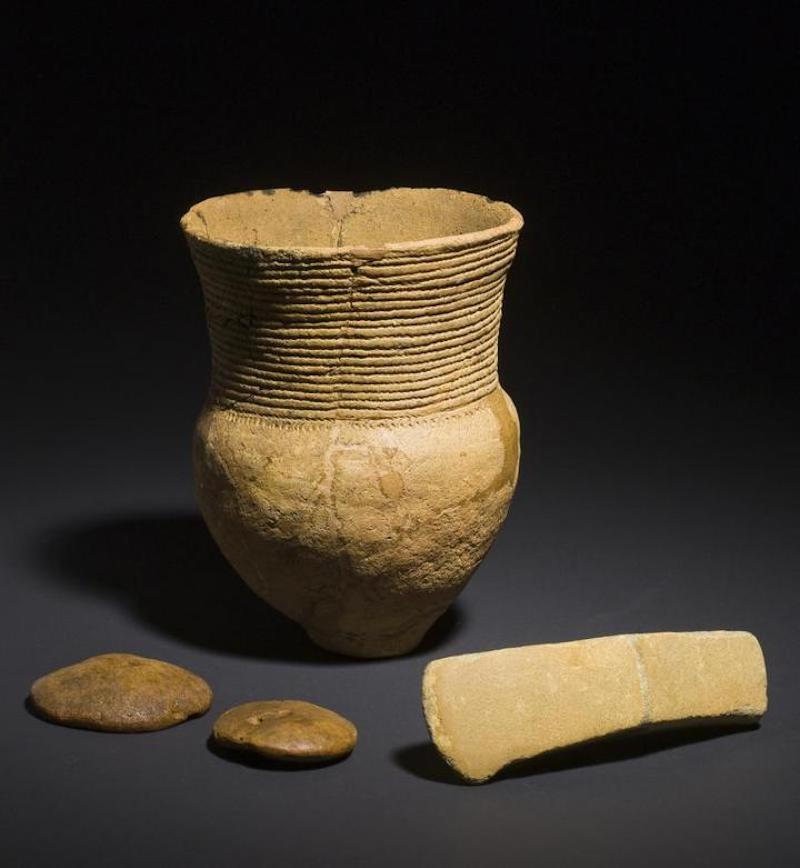
I’m spending a lot of time reading about the Corded Ware for my series on the steppe. The Corded Ware is a culture that appeared that abruptly in Northern Europe between 2900 and 2800 BC, covering a vast territory of Central and Eastern Europe in a century. The name derives from the unique marks left on their pottery.
For decades scholars have argued whether they were an indigenous development out of the farmers who occupied this region for thousands of years, or whether there was a mass migration out of the steppe. More realistically, there was a synthetic position between at some point. Perhaps the farmers were influenced by a few elite bands migrating out of the steppe?
Today due to ancient DNA we know more. The Corded Ware culture in its mature phase is about 70% Yamnaya and 30% farmer. The farmer’s ancestry almost certainly comes exclusively through women. The Y chromosomes of the farmers were G2. There is very little of that within a few generations. It is almost all R1a.
But that leaves us with the question: where did the new pots come from? The answer is straightforward: the men from the steppe took wives from the farmers. They killed their fathers and brothers and took them to their homesteads to bear them children. These women knew how to make pots because they did not come from nomadic backgrounds. They adapted their techniques to making pots that exhibited marks that made them resemble the baskets that their husbands brought in their wagons.
The miracle of the immediate emergence of a new pottery technique is due to the fact that the nomads didn’t learn to work in clay. Their wives already had the skill.
Why is this posted on this weblog? That’s a question that does have an answer…