
Anyone who is slightly familiar with Hindu mythology or Hindu cosmology knows that ancient Indians were fond of extremely large time periods. According to traditionalists the war of Mahabharata happened more than 5000 years ago (3102 BCE). A Yuga is supposed to last for 1.08 million years. A Yuga cycle, consisting of 4 Yugas, is 4.32 million years long. Who came up with these numbers ?
The story behind these numbers is quite interesting. Although the word Yuga goes back to Vedic age, Vedic texts do not mention these numbers. The specific numbers were first introduced by Aryabhata, who was born in 476 CE. According to his definition a new Yuga begins whenever all five visible planets along with the Sun and the Moon have zero celestial longitude (we are using the current terminology here, Aryabhata used the word Yugapda to denote a Yuga). The first verse of Aryabhatia, his only surviving work, states the following :
Aryabhatia 1.1 : In a yuga cycle the revolutions of the Sun are 4,320,000, of the Moon 57,753,336, of the Earth eastward 1,582,237,500, of Saturn 146,564, of Jupiter 364224, of Mars 2,296,824, of Mercury and Venus the same as those of the Sun.
The accuracy levels of these estimates are reasonably high, ranging from 99.9 percent (period of Saturn) to 99.999 percent (period of Earth’s rotation). It is possible to get this level of accuracy from 20-30 years of naked eye observations. Not surprisingly, the exact numbers are all wrong. Assuming an error margin of 0.3 degrees for an observation, one needs 3600 years of sky watching to count the exact numbers of revolutions in 1.08 million years. Aryabhata definitely knew this but he also accepted the traditional view that the current Yuga started during the war of Mahabharata (Aryabhatia 1.3). Seven astronomical objects having celestial longitudes close to zero is a very strong condition, and the initial estimates he obtained from 20-30 years of observations were good enough to rule out all years in the past few thousand years except 3102 BCE. So he concluded that the beginning of the current Yuga and Mahabharata war happened in in 3102 BCE.
Aryabhatia 3.10 : When three Yugas and sixty times sixty years had elapsed (from the beginning of the Yuga cycle) then twenty three years of my life had passed.
Since he could directly see the positions of the celestial objects during 499 CE vernal equinox, the assumption that they all had zero longitude in 3102 BCE meant having observations separated by 3600 years. This allowed him to make extremely precise claims about their periods. At the same time he was forced to increase the length of a Yuga to 1.08 million years to ensure that all the celestial objects make complete revolutions.
Why did he come up with the concept of Yuga cycle and how did he know that we are in the fourth Yuga of the current Yuga cycle ? This is related to two abstract points corresponding to apsidal and nodal precession of Moon’s orbit. Aryabhata wanted to include them in the list of celestial objects but his initial estimates showed that their celestial longitudes were closer to -270 degrees and 180 degrees in 3102 BCE. So he introduced a 4.32 million years long Yuga cycle and assumed that we are in the fourth Yuga.
How do we know all these details ? As remarked earlier, Aryabhata’s model was not accurate enough to go 3600 years in the past and detect a Yuga changing moment. However if we calculate the positions during 499 CE equinox using modern technology and apply Aryabhata’s model to go back another 3600 years, then celestial longitudes of the first seven objects become close to zero. The probability of this being a pure coincidence is less than one in a billion. The only logical conclusion is that Aryabhata was born in 476 CE and his definitions and methods were as described above.
What is Akhand Bharat ?
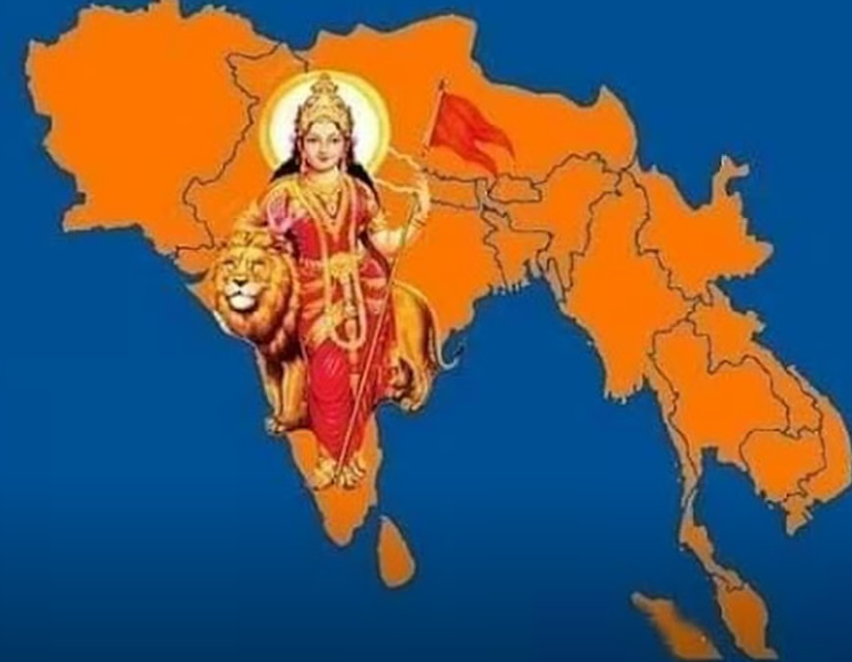
Anyone who is aware of the Hindutva project would have seen this picture (Commentators from outside India might not have seen this).
RSS and other Hindutvavadi organizations use this image or similar images for conveying the message of Akhand Bharat. As the extend of this image appear ludicrous, I would like to pose the question here – What would be the fair boundaries of “Akhand” Bharat from history?
What were the boundaries of Indian civilization? Where the Muslim kingdoms of medieval times part of this civilization? What qualifies a kingdom or area to be part of the Indian/Hindu civilization? or any other civilization for that matter.
@500 CE / 1000CE & 1500CE respectively?
Or to put it more correctively –
The post I am thinking of writing in the month of November will have a lot to do with this.
The issue i have with this thought is that due to its extravagant claim is that it can be refuted without much thought or effort like done here :
From Hindu Ocean to Sindhu Sea: Here’s what RSS-backed schools are teaching children about history
To be or not to be (Capricious)
The November circular was emailed earlier to all various stakeholders of BP. This will be sticky for a short period as unfortunately publishing all the drafts has pushed the current posts much further down.
You may also use this thread as an unmoderated Open Threads. Topics of interest include JD Vance’s comments, the stabbing in the UK by asylum seekers (presumably), and any other interest. I would suggest everyone engage with the email, after the jump; if you have been emailed it privately, I do expect private replies as well.
In Burma, of Burma, but not Burmese…yet
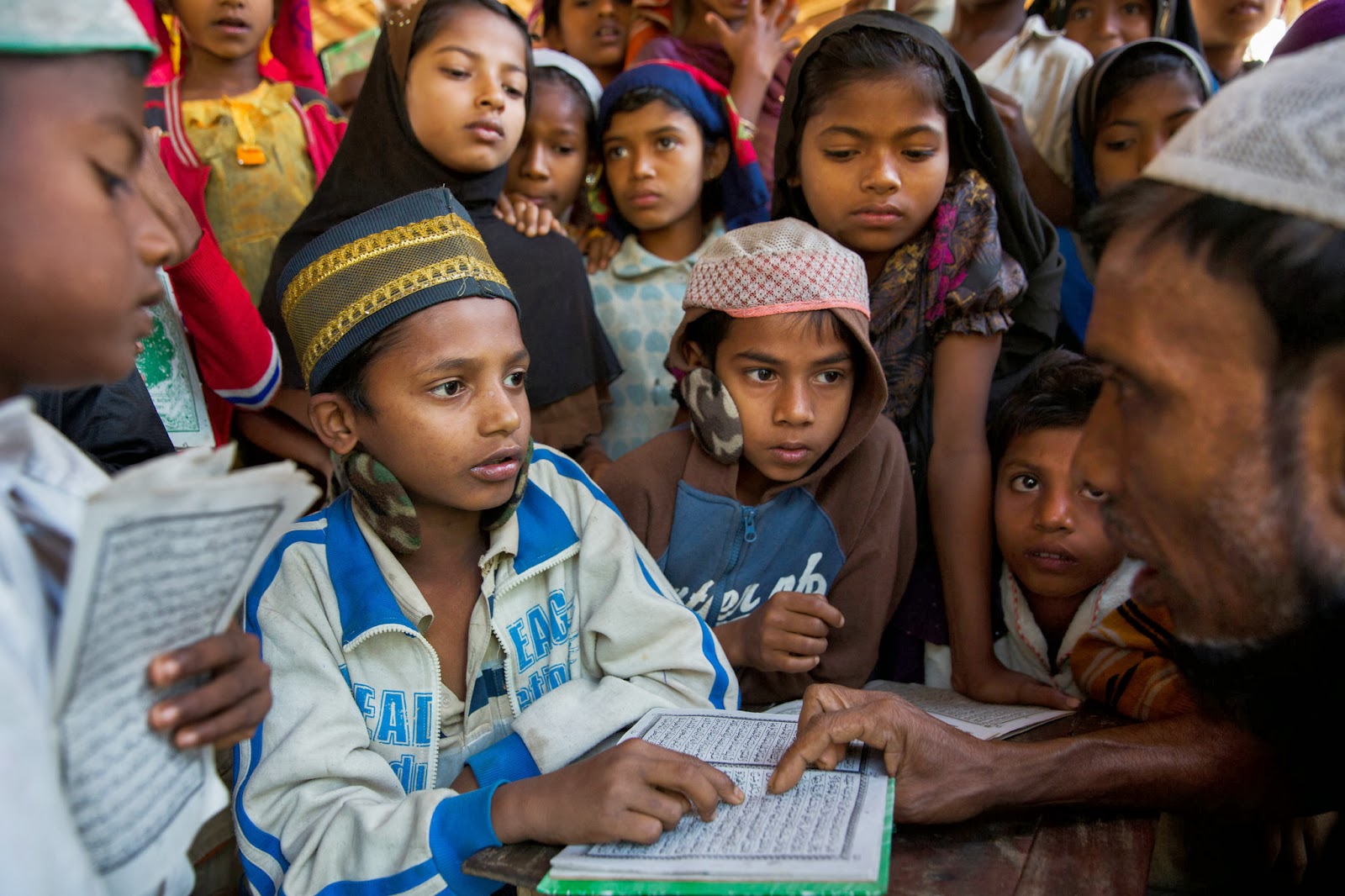
The New York Times has an article up which surveys the situation of Rohingya Muslims in Burma, which is without hyperbole perhaps analogous to that of Jews in 1930s Germany. The title, “Rise in Bigotry Fuels Massacre Inside Myanmar,” emphasizes I think the fact that this is not a conflict driven solely, or even primarily, by religious difference. Because of the lack of good data it is difficult to say with any confidence, but it seems likely that Rohingya are only around ~50% of the Muslims in Burma. Many of the rest are likely descended from people who intermarried with the majority Burmese community (I have read that Aung San Suu Kyi is descended in part from such a lineage), and exhibit no difference aside from religion. Though the ethnic Burmese (Bamar) are the majority of the population, it is not an overwhelming one. More unifying is the fact that on the order of 80 to 90 percent of the population adhere’s to Theravada Buddhism.
But the issue with the Rohingya’s is not just their religious difference, but that to all practical purposes it seems that they are Bengali peasants of relatively recent origins. This is the accusation that the Buddhists, who are mostly ethnic Rakhines, make in Arakan.
Last night on the Desi web
Last night I saw two things of note with regards
Dr Faisal Manzoor Shot Dead.
Gary Taubes and Sam Harris discuss the obesity epidemic

Guide 1965
Harmless Secular Activists “Disappeared” in Pakistan
Anywhere from 4 to 9 “secular bloggers” and human rights activists have disappeared in Pakistan last week (the exact number is hard to ascertain because several families are apparently trying to keep a low profile, in the hope that this will lead to a more intact recovery of their loved ones. A very reasonable impulse).
At least 4 were kidnapped in various towns by multiple people riding in cars (with at least one case where it is confirmed that the number plates were fake), which makes people think these “disappearances” are the work of the world’s finest intelligence agency. The fact that these events took place in different cities at around the same time, and that there are no signs of criminal activity, also supports this guess. That some well known “analysts” have shown up on TV to say that “if the agencies did this, then they probably had good reasons” also makes the “agency picked them up” scenario more likely.
But why? And why now?
I am not asking this because this is the first time such a thing has happened. Everyone knows (or should know) about the fact that 100s of people have disappeared in Pakistan in the past (mostly, but not exclusively, in Balochistan) and it is assumed that most were guests of the finest intelligence agency. Many turned up dead, though others have been released after only mild torture and some (not a lot) have even been handed over to the legal system for processing. While one high profile killing (Saleem Shahzad) occurred in Punjab and one high profile anchor (Hamid Mir) was shot at in Karachi, most disappearances have been in the “periphery” (geographically or socially). Those activists who belong to Punjab or Karachi, who are well known in English speaking circles, and especially those who limit their activism to social media and English journalism, still seemed to have something of a presumption of safety. Someone like Mohammed Hanif could (and very regularly, did/does) criticize kill and dump policies and has not (yet?) been “picked up” for re-education, or worse). This is not to deny the immense courage of people like Mohammed Hanif; this presumption of safety is never complete and all activists take a risk when they criticize the deep state or its pet ideological proxies, but nevertheless, there is a general impression that they will have to do something rather extreme before the men in white pay them a visit. In addition, there had been no wide crackdown on lesser known bloggers and commentators whose work was mostly or completely confined to social media. But that presumption of (relative) safety may now be over.
What is hard to figure out though, is why? Why pick on these people, most of whom are low profile and relatively unknown? (Salman Haider is the best known of the lot, but even his role was relatively small and certainly seems to have posed no serious threat to the powerful state). Perhaps relatively modest targets were chosen in order to send a message without causing a bigger backlash? But even then, why the need to send this message at all? The really serious and significant conflicts in Pakistan are between various “stakeholders” in state power (e.g army versus PMLN) or between foreign powers (and their proxies), or between powerful Jihadist gangs and the state, and so on. None of them are much affected by the (worthy, highly admirable) efforts of a few dozen secular bloggers or liberal/leftist activists. For example, secular and liberal writers have been writing about disappearances in Balochistan for years now, and this has not caused the smallest change in state policy in that province. The army and the PMLN have played various games with each other and we cannot seriously say that the outcome was ever significantly influenced by these activists. And so on. These are harmless people. At best, they may introduce some mild liberalism and humanism into the Pakistani public space. At worst, they achieve nothing at all. In no way are they a threat to CPEC, or whatever other policy the deep state is working on right now. Why arrest these people? And why now? I am genuinely curious and look forward to enlightening replies.
There is a theory that this may be what the finest intelligence agency has wanted to do for ages, but they felt restrained by the threat of their “soft image’ in the West being undermined. This is not to say that illiberal actions in general necessarily lead to Western sanction (after all, the West has worked with much worse human rights abusers when they felt some “real” interests were at stake; sometimes the interests were nothing more than banana farms) but the theory here is that we are already half-working against the West and this is a very tricky balancing act; loss of “soft image” may tip the balance and lead to real consequences (like cuts in aid).
But if this theory is true, why is this threat no longer felt to be significant? Has confidence in China’s ability to foot the bills reached a high enough level, so don’t need to kowtow to the West? or is the election of Trump taken to mean that liberalism will no longer be paid even lip service by the West itself, so we can get away with more blatant suppression? In this case, not because we don’t need the West any more but because we expect that whatever deals we make with Trump will be more explicitly mercenary and neither party will have to waste time and energy on liberal pieties?
Another theory is that they are