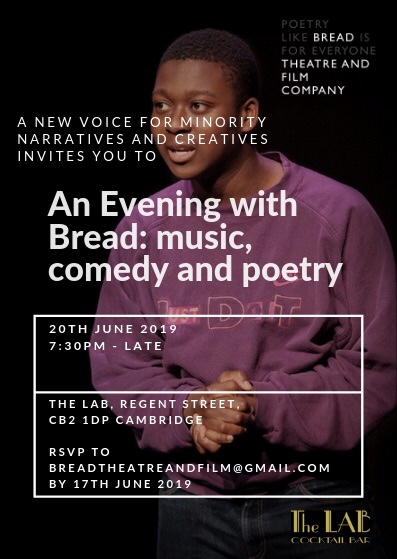
Launch of my theatre company

While I’m profoundly conservative I’ve been trying to find a space to channel my Social Justice Ghazi tendencies. I’m technically a co-founding trustee but my role is more administrative / organisational as opposed to creative.

I wanted to go more for “unheard voices” but as agreed it’s for anyone who “self-identifies” as a minority.

The Ideal and the Practical — the Practice

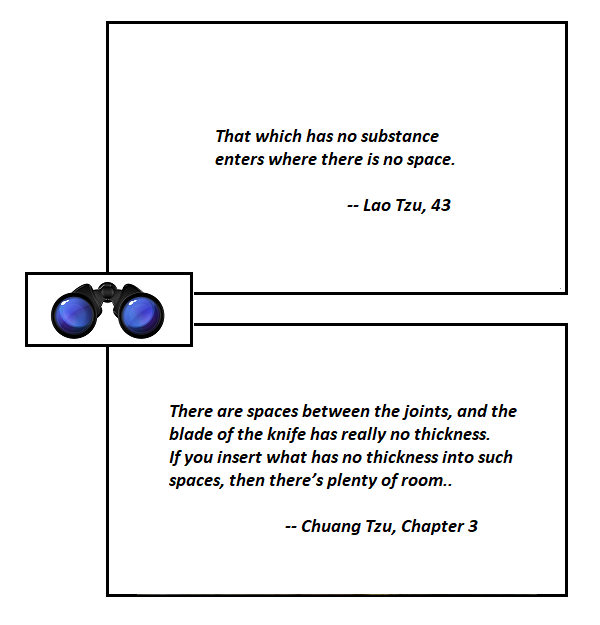
I’d written a response to @AnAn and included a quote from the Chuang Tzu’s chapter on Lord Wen-hui and what he learned from his Cook Ting, and wanted to throw in the following DoubleQuote — but graphics seem to be discouraged in the Comment sections here, so I’ve opened this post for the purpose:

The thing is, Lao Tzu offers us the ideal statement, formulated in terms of an impenetrable absence of space, and an absence of substance to the point of non-existence — while Chuang Tzu, peering over Lord Wen-hui’s shoulder right there in Cook Ting’s kitchen, offers us the same insight, couched in terms of there being “spaces between the joints” and his knife having “really no thickness” — Chuang Tzu’s measureless insight penetrates Lao Tzu’s impenetrable absolutes to show us there’s room for play there — “room — more than enough for the blade to play about in”.

If we bear these two versions of the same idea — formulated ideally and in practical terms by the two principle philosopher-poets of the Taoist school — in mind when our thoughts run up against the impracticality of an ideal, we may find, like Cook Ting, that we too have room enough room to play in.

Brown Pundits on Social Media-

We are now producing excellent content both on the blog & podcast; it’s time we really tried to push out our product on more platforms.

Please Like Brown Pundits On Social Media, spread the word if you can 🙂

Facebook Page

Facebook Group

Instagram

Twitter

Please subscribe and rate Brown Podcasts:

Apple

Libsyn

Spotify

Stitcher

Punditeers on Social Media (happy to add your name to the list):

Razib Khan Facebook Page

Xerxes Facebook Profile (I use it like a Page)

Omar Ali Twitter

Razib Khan Twitter

Xerxes the Magian Twitter

Ali Minai Twitter

Slapstik Twitter

Are all Arabs “honorary” Muslims?

Gibran of course was a Maronite and was inspired by his encounters with Abdul Baha. The Belle Époque seemed an especially sensitive time for Oriental spirituality (Grierson and Gandhi were somewhat contemporaneous).

At any rate most Pakistanis would internalise Gibran as one of their own and Tagore as foreign.

I used to be more skeptical about this Arabophilia; like all liberalstanis I used to say Khuda Hafez etc. However I’m of the opinion that pan South Asian nationalism has simply not made enough space for the two competing overarching identities.

In my podcast today with Professor Majeed; we briefly touch on the meta-aspect of Hindi and Urdu. It simply is the dividing civilisational fault lines.

When the Bengalis and Tamils needed to make their choice they were happy to prioritise their meta-identity In 1947 (Bengali were Muslim; Tamils were Hindu). However in 1971 the Bengalis in turn clarified their choice, which culminated in an “Indian-friendly” but distinct nationalism.

Tamil politics on the other hand, interacting and influencing no doubt with Sri Lanka (it’s fascinating that Tamil Muslims politically segregated during the Sri Lankan colonial era culminating in a distinct political identity as opposed to the mainland) is now grappling with the same choice.

It’s absurd to compare modern day India with 1971 Pakistan (the language question has been resolved in the 50’s with the adoption of Bengali so it wasn’t simply a linguistic matter) but the underlying tensions are the same.

Once a side picks their “civilisational” meta-identity then the demand for local identity starts to flourish in the wake of national homogeneisation.

I have begun to become very interested in the Seraiki question. It’s almost the equivalent of Cornwall getting separate constitutional state in the UK (Scotland is a Kingdom, so is NI – the remnants of one, and Wales is a Principality).

The only local or distinct identity Cornwall has in being the Duchy of Cornwall. This is the Prince of Wales’s subsidiary title hence why Camilla is addressed as the HRH the Duchess of Cornwall instead of Lady Diana’s previous and popular title as the Princess of Wales. It is important though since the Duchy Estates are the personal income of the Prince in a way the only other Duchy (of Lancashire) is not.

Interestingly the Duke of Lancaster is HM the Queen (the income from that estate reverts to the Crown, to which she is entitled 15% for the Royal Household’s running costs). The Duke of York is usually given to the monarch’s Spare son; it’s a title Prince Harry will eventually inherit. It’s fascinating to think that one of the oldest and most prestigious titles in the United Kingdom (the Duke of York) will eventually be held by an individual (Archie with Obama as his godfather) who would be considered as black in the United States (and so would his descendants).

But back on topic Lancaster is considered to be a fundamental part of England while Cornwall is an ambiguous territory; close to but not quite Wales.

In much the same way the emerging conversation on Seraikistan will emerge. It’s obviously not as distinct as Sindh but there is a formidable “Seraiki” ethnic identity.

Does that entitle it to a distinct Province? A separate Province would be very good for Pakistan because it would automatically re-jigg the Punjab’s disproportionate role in Pakistan. However as in the case of Andhra & Telangana; there is a fundamental unity to the region inasmuch as there is distinction between them.

It has taken centuries for Britain to express these Constitutional and regional quirks not to everybody’s satisfaction (the Brexit dilemma centres on the NI backstop). How will Pakistan accommodate this?

BP Podcast episode 49: Hindi as the lingua franca

Another BP Podcast is up. You can listen on LibsyniTunes, Spotify,  and Stitcher. Probably the easiest way to keep up the podcast since we don’t have a regular schedule is to subscribe at one of the links above.

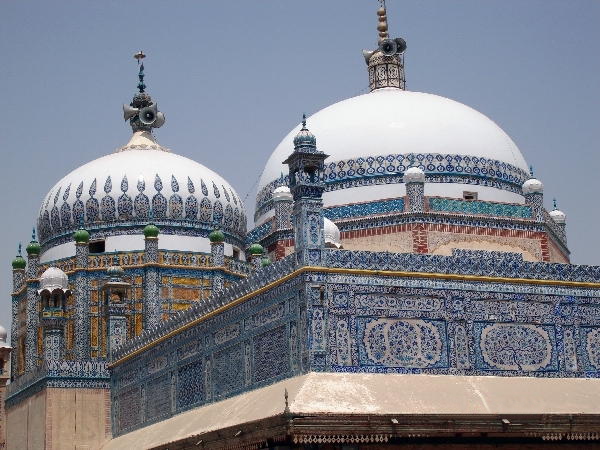
Tomb of Khwaja Ghulam Farid Korejo

Shoaib, Abhisek and Xerxes speak on the recent Tamil-Hindi controversy. Our podcast was limited to North India since Karthik (a South Indian) couldn’t make it. However it was still a fascinating discussion.

As as aside we just recorded the 50th BrownCast episode with Professor Majeed on Grierson’s LSI. We started on the 14th of October with Episode 1 (Episode 1 is actually Episode 2 since Razib & I recorded an episode that disappeared) but it’s nice to see how far we have come with the podcasts as a complement to the main blog.

My interests in the podcasts are veering towards the Lectures I attend (or “Live-Blogging” in my own particular lingo) and even though it’s not the most popular (as anyone with cursory knowledge of the blog knows that I can be quite the provocateur) it does lend some much needed intellectual heft to my own output.

As for Episode 49 with our Resident Linguists; it covered some very good ground. I also had personal sympathies for Shoaib as he was house-hunting in Delhi at time of the podcast and Renting while Muslim in India is as bad (or almost as bad) as Renting while Black in America.

Finally I hope everyone, irrespective of whether you have Netflix or not (I don’t watch TV but make exceptions), has watched the critically important “When they See Us.” A really seminal piece of work on Race in America by Ms. Du Vernay.

You can also support the podcast as a patron (the primary benefit now is that you get the podcasts considerably earlier than everyone else…). Would appreciate more positive reviews.

The world turned upside down


They are told it’s the Kali Yuga, and they rejoice!
The Dharma and the Dao are needful
As they are what not to do!
Striving to virtue is sin,
Abnegation of indulgence the ultimate betrayal of self.
There is no god above to glorify,
Just a feeling to glory in….

Genetic change, cultural coherency, and social structure

A stupid commenter (SC) below keeps opining that the high frequency of R1a across South Asia is due to non-paternity events (NPE). I’m not quite sure SC knows what NPE is. It is, “when someone who is presumed to be an individual’s father is not in fact the biological father.” The hypothesis presented seems to be that outside of the Northwest of the subcontinent, the high frequency of R1a among non-Brahmin populations is a function of cuckoldry.

I think this is a stupid hypothesis for several reasons.

  1. Star phylogenies tend to extend outside of their core sociocultural group (e.g., R1b in Basques)
  2. NPE events outside of ethnicity seem rare given how endogamous South Asian jatis are.
  3. NPE in Eurasian societies seem to be 1-3%.
  4. There isn’t autosomal variation in ancestry within South Asia jatis usually. E.g., autosomally Tamil Brahmins or Chamars don’t vary much. This is in contrast with Mexican Americans or African Americans, who show a great deal of biogeographic variation in ancestry because they are a recently admixed population.

But, in the interests of making lemonade out of SC’s lemon, it’s interesting to observe other cases of disjunction between genome-wide ancestry and Y chromosomes. For example, let’s look at the Hui, Chinese-speaking Muslims.

The most likely origin of these Muslims is during the Yuan dynasty. So about 750 years ago. They were probably originally Central Asian, and so a mix of West and East Eurasian. Around 40% West Eurasian Y chromosomes from the beginning is not totally unreasonable if Islamicized Turks were a substantial proportion of the Muslims. If 5% of their total genome is West Eurasian, it’s probably reasonable to assume that 10% of their total genome derives from Muslims, if the original Muslims about half West Eurasian and half East Eurasian in ancestry.

750 years is 30 generations. My back of the envelope calculations suggests that 7.75% exogamy with Han Chinese per generation would result in a 50% West Eurasian population become a 5% West Eurasian population.  Another way to frame this is about ~90% of the ancestry of the original founding group has been replaced. But what about the Y chromosomes? Even assuming 100% West Eurasian Y chromosomes, the decrease has not been of similar magnitude.

The answer is simple: the dilution could have been mostly female-mediated. China is a patrilineal society, and Central Asian Muslims are also patrilineal. Though there are exceptions (there is a Hui branch of the Kong family due to one of the descendants marrying a Muslim woman and converting to Islam), it seems reasonable to infer most of the gene-flow into the Muslim community was through women. And, women do not have Y chromosomes, and so do not replace that lineage, though they do contribute to the total genome.

This is not an isolated case. There are populations around Lake Chad which carry ~1% Eurasian autosomal ancestry, but with Y chromosomal fractions of R1b, which is Eurasian, on the order of ~20%.

The opposite case can also occur. Because of male-biased European gene-flow to Latin America, populations such as in Argentina can have a very high fraction of indigenous mtDNA, passed from mothers to their offspring, despite the total genome being mostly European.

Which brings us back to South Asia. Though R1a is associated with “upper caste” populations, the reality is that it is widely distributed in South Asia. Including tribal groups such as the Chenchus and Bhils.

The Chenchus are an interesting case. The only groups nearby with high frequencies of R1a would be South Indian Brahmins, who are genetically very distinct. In fact, Brahmins from the four southernmost states of the peninsula are very similar in their proportions of distinct biogeographic components. And, there is not much inter-individual variation. The Chenchus, in contrast, seem to be typical ASI-shifted tribal people from South India.

In an NPE model the ~25% R1a ancestry is due the fathering of sons by Brahmin males, who were raised by their Chenchu mothers as Chenchu (and presumably raised by Chenche males as their own sons). The problem is that then ~12.5% of the ancestry of Chenchu should be Brahmin. This introduces a noticeable steppe shift, and though 12.5% is a small fraction, one should be able to detect it. Additionally, if the R1a entered the population through introgression every generation, there should be variation in ancestry among the Chenchus as a function of biogeography.

I simply don’t see this in the data for the Chenchu. What could explain their high fraction of R1a?

There are two things to consider. First, these marginalized groups often have low effective population sizes due to extreme endogamy. This means the power of drift at a single locus, such as the Y, is strong in these groups. It is not unreasonable to posit some groups, such as the Chenchu, would drift to a higher frequency.

The second dynamic is the one alluded to above: the Chenchu descend from a compound of groups, and a core paternal lineage of R1a bearers was assimilated into a larger population. I see the expansion of R1a across South Asia as greatly synchronous with the development of the ethnolinguistic landscape we see around us. Tribal groups such as the Chenchu are not primal, but part of an ethnolinguistic tapestry which crystallized in the period after the fall of the IVC and the reemergence of India into history in the 6th century BCE.

Note: Will delete dumb comments

Why the Diaspora is not as interesting to me

A friend of the podcast mentioned with a bit of surprise that so much of it was focused on India as opposed to the Indian Diaspora (you can substitute “South Asia(n)” into “India(n)”). When this weblog was started at the end of 2010 it was probably more Diasporic in orientation. That was the era when Sepia Mutiny was winding down, after all.

Today I’m not as interested in Diasporic topics for two reasons. First, the Diasporic identity in the USA is pretty stable and clear. Most Indian Americans are basically Americans with their own particular cultural twist or accent.  This is widely understood. In particular, culturally young Indian Americans have assimilated to the same broad identity as liberal white Americans (with some exceptions). The big questions of who and what brown Americans are going to be seem to have been answered.

The second issue is that India is a bigger deal today than it was in the 2000s. From a purely anthropological perspective, what’s going on with 1.3 billion Indians (+ 400 million other assorted South Asians) is more interesting to me than the concerns of tens of millions of Diasporic browns.

(the exception is something like an interview with an India American going through the modern arranged marriage; in contrast, telling me you only date other South Asians is not too interesting, as it’s basically what everyone else does, but brown)

Brown Pundits