
The world turned upside down
They are told it’s the Kali Yuga, and they rejoice!
The Dharma and the Dao are needful
As they are what not to do!
Striving to virtue is sin,
Abnegation of indulgence the ultimate betrayal of self.
There is no god above to glorify,
Just a feeling to glory in….
Genetic change, cultural coherency, and social structure
A stupid commenter (SC) below keeps opining that the high frequency of R1a across South Asia is due to non-paternity events (NPE). I’m not quite sure SC knows what NPE is. It is, “when someone who is presumed to be an individual’s father is not in fact the biological father.” The hypothesis presented seems to be that outside of the Northwest of the subcontinent, the high frequency of R1a among non-Brahmin populations is a function of cuckoldry.
I think this is a stupid hypothesis for several reasons.
- Star phylogenies tend to extend outside of their core sociocultural group (e.g., R1b in Basques)
- NPE events outside of ethnicity seem rare given how endogamous South Asian jatis are.
- NPE in Eurasian societies seem to be 1-3%.
- There isn’t autosomal variation in ancestry within South Asia jatis usually. E.g., autosomally Tamil Brahmins or Chamars don’t vary much. This is in contrast with Mexican Americans or African Americans, who show a great deal of biogeographic variation in ancestry because they are a recently admixed population.
But, in the interests of making lemonade out of SC’s lemon, it’s interesting to observe other cases of disjunction between genome-wide ancestry and Y chromosomes. For example, let’s look at the Hui, Chinese-speaking Muslims.
- About 40% of their Y chromosomes are West Eurasian.
- About 5% of their total genome is West Eurasian.
The most likely origin of these Muslims is during the Yuan dynasty. So about 750 years ago. They were probably originally Central Asian, and so a mix of West and East Eurasian. Around 40% West Eurasian Y chromosomes from the beginning is not totally unreasonable if Islamicized Turks were a substantial proportion of the Muslims. If 5% of their total genome is West Eurasian, it’s probably reasonable to assume that 10% of their total genome derives from Muslims, if the original Muslims about half West Eurasian and half East Eurasian in ancestry.
750 years is 30 generations. My back of the envelope calculations suggests that 7.75% exogamy with Han Chinese per generation would result in a 50% West Eurasian population become a 5% West Eurasian population. Another way to frame this is about ~90% of the ancestry of the original founding group has been replaced. But what about the Y chromosomes? Even assuming 100% West Eurasian Y chromosomes, the decrease has not been of similar magnitude.
The answer is simple: the dilution could have been mostly female-mediated. China is a patrilineal society, and Central Asian Muslims are also patrilineal. Though there are exceptions (there is a Hui branch of the Kong family due to one of the descendants marrying a Muslim woman and converting to Islam), it seems reasonable to infer most of the gene-flow into the Muslim community was through women. And, women do not have Y chromosomes, and so do not replace that lineage, though they do contribute to the total genome.
This is not an isolated case. There are populations around Lake Chad which carry ~1% Eurasian autosomal ancestry, but with Y chromosomal fractions of R1b, which is Eurasian, on the order of ~20%.
The opposite case can also occur. Because of male-biased European gene-flow to Latin America, populations such as in Argentina can have a very high fraction of indigenous mtDNA, passed from mothers to their offspring, despite the total genome being mostly European.
Which brings us back to South Asia. Though R1a is associated with “upper caste” populations, the reality is that it is widely distributed in South Asia. Including tribal groups such as the Chenchus and Bhils.
The Chenchus are an interesting case. The only groups nearby with high frequencies of R1a would be South Indian Brahmins, who are genetically very distinct. In fact, Brahmins from the four southernmost states of the peninsula are very similar in their proportions of distinct biogeographic components. And, there is not much inter-individual variation. The Chenchus, in contrast, seem to be typical ASI-shifted tribal people from South India.
In an NPE model the ~25% R1a ancestry is due the fathering of sons by Brahmin males, who were raised by their Chenchu mothers as Chenchu (and presumably raised by Chenche males as their own sons). The problem is that then ~12.5% of the ancestry of Chenchu should be Brahmin. This introduces a noticeable steppe shift, and though 12.5% is a small fraction, one should be able to detect it. Additionally, if the R1a entered the population through introgression every generation, there should be variation in ancestry among the Chenchus as a function of biogeography.
I simply don’t see this in the data for the Chenchu. What could explain their high fraction of R1a?
There are two things to consider. First, these marginalized groups often have low effective population sizes due to extreme endogamy. This means the power of drift at a single locus, such as the Y, is strong in these groups. It is not unreasonable to posit some groups, such as the Chenchu, would drift to a higher frequency.
The second dynamic is the one alluded to above: the Chenchu descend from a compound of groups, and a core paternal lineage of R1a bearers was assimilated into a larger population. I see the expansion of R1a across South Asia as greatly synchronous with the development of the ethnolinguistic landscape we see around us. Tribal groups such as the Chenchu are not primal, but part of an ethnolinguistic tapestry which crystallized in the period after the fall of the IVC and the reemergence of India into history in the 6th century BCE.
Note: Will delete dumb comments
Why the Diaspora is not as interesting to me
 A friend of the podcast mentioned with a bit of surprise that so much of it was focused on India as opposed to the Indian Diaspora (you can substitute “South Asia(n)” into “India(n)”). When this weblog was started at the end of 2010 it was probably more Diasporic in orientation. That was the era when Sepia Mutiny was winding down, after all.
Today I’m not as interested in Diasporic topics for two reasons. First, the Diasporic identity in the USA is pretty stable and clear. Most Indian Americans are basically Americans with their own particular cultural twist or accent. This is widely understood. In particular, culturally young Indian Americans have assimilated to the same broad identity as liberal white Americans (with some exceptions). The big questions of who and what brown Americans are going to be seem to have been answered.
The second issue is that India is a bigger deal today than it was in the 2000s. From a purely anthropological perspective, what’s going on with 1.3 billion Indians (+ 400 million other assorted South Asians) is more interesting to me than the concerns of tens of millions of Diasporic browns.
(the exception is something like an interview with an India American going through the modern arranged marriage; in contrast, telling me you only date other South Asians is not too interesting, as it’s basically what everyone else does, but brown)
Live Blogging, China & the US; Destined for War
Forum on Geopolitics talk by Professor Graham Allison. He is a renowned Harvard Professor introducing his book “Destined for War”; Can America & China escape Thucydides’s Trap.
Continue reading Live Blogging, China & the US; Destined for War
Huawei and the shift to the East
I have been out of touch with tech for over 8 years, being in the boondocks, so please chip in. If necessary will do updates to post from comments.
———————————————————————————
Trumps plans are pushing and hastening countries to be less dependent, even independent of US products. The Huawei ban seems to be game changer.
So excerpts from an article linked below plus links other info.
Huawei, needs a new operating system (Mobile OS/Operating System) for its phones. There are few out there, almost all are based on Linux as is Android.
Android was Initially developed by Android Inc and Google bought in 2005.
Aurora is a mobile operating system currently developed by Russian Open Mobile Platform, based in Moscow. It is based on the Sailfish operating system, designed by Finnish technology company Jolla (for its smart phone), which featured a batch of Russians in the development team. Quite a few top coders at Google and Apple also come from the former USSR – exponents of a brilliant scientific academy tradition.
HongMeng also called Ark OS: Huawei’s own operating system, apparently Android App compatible (hmm, i will believe when I see it).
No Google? Who cares?Tencent, Xiaomi, Vivo and Oppo are already testing the HongMeng operating system, as part of a batch of one million devices already distributed. are not (yet) banned in the US market, and combined they sell more than Samsung. They could decide to move to Huawei’s operating system in no time.
The HongMeng system may also harbor functions dedicated to security and protection of users’ data. That’s what’s scaring Google the most; Huawei developing a software impenetrable to hacking attempts. Google is actively lobbying the Trump administration to add another reprieve – or even abandon the Huawei ban altogether.
The next step for Huawei and other producers is to go for Made in China processing and memory chips, breaking the stranglehold by Intel, Qualcomm, Broadcom, Micron Technology, Western Digital and the British ARM.
Final thought. What happens to India and its role in Mobile phones and Mobile OS’s. India was not a player in hardware such phone or computers Indirectly India’s software developers gained thru large software companies such as Google. Now it is possible some significant fraction of hardware and OS is shifting to China.
https://www.zerohedge.com/news/2019-06-15/huaweis-plan-b-meet-russia-china-os
Intellectual Dark Web (b)
Eric Weinstein is close to the intersection of science, math and spirituality (or religion). He is skeptical that someone can do multi-dimensional math and science in deep meditation (satori, samadhi, mystical rapture). I think this is possible (not yet figured out how to do it).
Many ancients in narrative stories are described as combining science, math and spirituality. Including the great 7 sages (of the east, Sumeria and Egypt). Including Vishwamitra. Including Hinanyaksha and Hiranyakashipu.
I hope that our current crop of science and math thought leaders fully self actualize.
Eric describes the many theisms that different groups of people have, including in physics, math, AI, liberal arts, silicon valley, local governance, national governance, international institutions, globalization, politics.
One of the goals of religion is to transcend all theisms seeking the truth alone. The goal of religion is atheism. Theisms being:
- irrationalities
- unverified assumptions
- patterns in the subconcious {Chitta}
- habits
- pre-religion
- all methods and paths and preparation for religion included in religious literature, including all sounds, words, music and the various levels of meditation.
Eric is exceptionally good at breaking all theisms. Sadly those who break all icons and assumptions tend to get demonized. The Intellectual Dark Web–including Eric Weinstein–are being attacked as predicted by beautitudes Matthew 5:10-12:
- Blessed are those who are persecuted because of righteousness, for theirs is the kingdom of heaven.
- Blessed are you when people insult you, persecute you and falsely say all kinds of evil against you because of me.
- Rejoice and be glad, because great is your reward in heaven, for in the same way they persecuted the prophets who were before you.
+++++++++++++++++++
Open Thread – Brown Pundits
Please keep the other posts on topic. Use this for talking about whatever you want to talk about.
What The All-Father Means
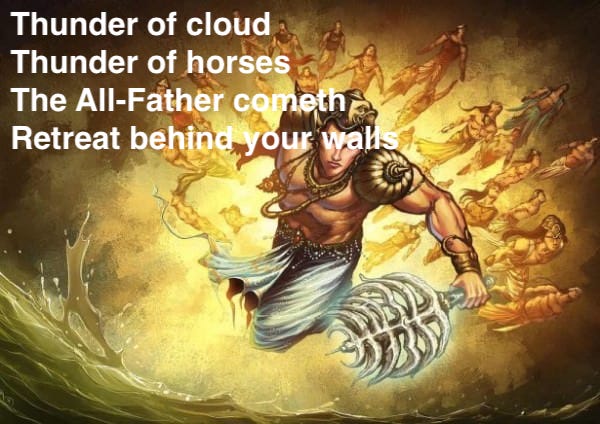
Readers of this weblog may sometimes notice that I break out in pompous and self-important declarations of being a “scion of the All-Father.” This is basically a joke. But, it’s a joke that draws from a legitimate basis of science and mythology. The “All-Father” is another name for Odin. I’m really talking about Indra, who is probably more like Thor. And obviously, Norse paganism is only distantly related to the mythology of the Indo-Aryans. As someone more familiar with the lineaments of Northern European mythology than Indian, of course, it’s easier for me to draw on the motifs of the former to relate to the latter.
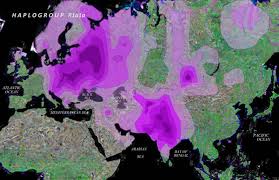
The scientific component has to do with R1a. Specifically, R1a1a, defined by the M17 mutation (discovered by my boss at my day-job 20 years ago). There are two very closely related “clades,” that is, families of pedigrees, of this Y chromosomal lineage, passed from father to son. One of them defines mostly European R1a1a, Eastern Europeans, and to a lesser extent Western Europeans. Another branch is found mostly in Central and South Asia.
When I first saw this distribution around the year 2000 it left me scratching my head. Of course, I knew about the Indo-European languages. But I had always assumed that the demographic impact of the original Indo-Europeans was relatively marginal. And yet this Y chromosome was found at frequencies in the 10-50% range across vast swaths of Eurasia.
Much of the 2000s was spent on arguments as to whether R1a was indigenous to South Asia or to Central Eurasia. Ultimately these arguments were not resolvable due to limitations of the data. To calibrate dates and diversity researchers relied on microsatellites, which are useful due to their high mutation rates, but also erratic for the same reason (not only were confidence intervals wide, some of the assumptions of the model parameters were guesses).
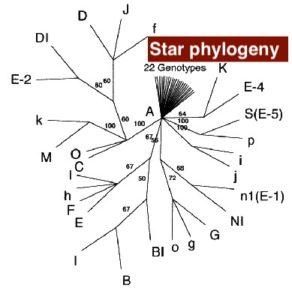 In the early 2010s, whole-genome sequences of Y chromosomes came online. It became very clear that the most common R1a1a lineages exhibited the “star phylogeny.” Demographically, what this means is that men carrying this lineage underwent very rapid population expansion for a short period of time. So rapid that a “father” lineage would give rise to numerous “son” lineages one mutational step away
You can see in the figure that node “A” has given rise to a “star phylogeny.” A large number of individuals are one mutational step away from that genotype. A more normal phylogeny would produce a complex structured tree which accrues mutations across the various branches gradually.
In the South Asian context, a paper from 2004, Independent origins of Indian caste and tribal paternal lineages, introduced a result which prefigured what we now know:
Analyses of molecular variance also suggest that caste groups are more homogeneous for Y chromosome variation than tribal groups, since the variance among caste groups (sampled from all over India) is 3-fold less than that observed among tribal groups and 2-fold less than that observed among all Indian populations grouped together (Table 3). Moreover, if only north caste groups are considered, the variance among populations is not significantly different from zero (Table 3), indicating that spread over the Indian subcontinent although they are located up to ∼1500 km away from each other, these populations have highly homogeneous Y chromosome compositions.
The implications of the lack of structure of R1a on the Indo-Gangetic plain is always something that struck me. It suggested that the paternal lineages only recently expanded since they didn’ have time to build up distinct regional mutations. In contrast, the adivasi populations had a wider distribution of Y chromosomal haplogroups, and they exhibit a lot deeper diverged lineages.
Which brings me to the personal angle. In the spring of 2010, I did my first personal genomic test. I got my Y and mtDNA results back first. It turned out my Y was R1a1a, and my mtDNA was U2b. I was surprised by both. Eastern Bengali has the highest fraction of mtDNA macrohaplogroup M in the world. R1a1a was less surprising. But, it was very strange to have a concrete, personal, connection to this lineage which had been on my mind for a decade or so.
My funny attachment to my haplogroup is probably a function of my upbringing. Growing up as brown in the United States, I wasn’t exposed to Indian culture, nor was I well versed in the details of South Asian communalism. My family is pretty conventional in being upper-middle-class Bengali Muslims, so there is not a jati identity or anything like that I could identify with (and though my parents are Muslim, they are not extremely so, therefore religious identity was a background and not foreground variable). When I looked at my overall genome in 2010 it was clear I didn’t have the “runs of homozygosity” that characterize many people from South Asian backgrounds who come from endogamous communities. I know some of my ancestors were Kayasthas, and my father has some Brahmin ancestry, but the most distinctive thing about me in hindsight is I’m a typical east Bengali with more than a usual dollop of East Asian ancestry (my family is from Comilla).
My Y chromosomal haplogroup, in contrast, is something clear, distinct, and precise. It is an anchor, something which I use to channel my preoccupations and concerns. I don’t have Omar’s Gujar tribal ancestry, or Zach’s Muhajir/Persian origins. I’m just a brown American whose parents did not instill him a patriotism about the “motherland” (Bangladesh), because they themselves didn’t even live a decade in that nation. Though there is a spectrum, it is clear that many South Asian Americans are less “coconut” than I am, and are attuned to fine differences of status, origin, and background. Growing up around only white people my identity was racialized, not ethnicized.
I have never felt superior or inferior to any community or ethnicity of South Asian because I never belonged to any community, have weak ethnic identity, and don’t believe in any religion. The religious prejudices I do have are probably Anglo-Protestant ones against Catholicism, because of the implicit assumptions and background facts of America’s Whig culture.
What R1a1a symbolizes to me is that I have a concrete connection to a semi-historical phenomenon between the end of prehistory and before the written word, which we have not grasped or understood very well. Though it is true R1a1a is found at higher concentrations in “upper castes,” as well as in the north and west of the subcontinent, and among Indo-Aryan speakers, the reality is it is found in almost every community in South Asia (the main exception being among Tibeto-Burmans and Munda). There are many communities, such as Chenchus, which have very little steppe ancestry but retain a substantial proportion of R1a1a.
For obvious reasons this haplogroup is associated with Indo-Aryans (the earliest find of R1a1a-Z93 is from the Bronze Age Volga Srubna culture), but its reach is far beyond current areas of Indo-Aryan speech. Its ubiquity is a testament to a broader South Asia cultural matrix that emerged in the centuries after 1500 BC, from north to south.
This is of course not a moral judgment. The expansion of this paternal lineage at the expense of others likely occurred through a process of aggression and social exclusion. This is nothing to be proud of…or ashamed of. It’s just a description.
Indian Female Academics of the Left
I’m at this talk, which touched on decolonisation and other such left-liberal ideology.
I’m quite privileged to be attending lectures and seminars at one of the best Universities in the world (even if it’s been coasting on its brand name).
The speaker in question is a Professor Emerita. She’s Trans but white. I find the discourse on the left increasingly driven by white LGTB+ activists. She is interviewed by a Indian lady (Reader level So tenure track Prof) and introduced by another Indian Lady Lecturer.
I’m noticing a few trends:
(1.) Indians in postgraduate humanities are acolytes of Arundhati Roy. They’re sort of blending into the global liberal intellectual circles in a way that Muslims don’t.
(2.) Left-liberal Indians have become entirely de-Hindufied in a way that left-liberal Muslims simply haven’t. So while there is an invisible barrier for Muslims to fully embrace the entire ideology (more likely than not they’ll have some sort of belief barrier) there isn’t one for Indians.
(3.) Postgraduate Indian women in the Humanities are at the vanguard of social action and use their ambiguous racial status to float between black & white space.
(5.) Postgraduate Indians in STEM are rightish, which is no really surprise and in line with trends.
(6.) Being vocally right is social suicide in the “coloured circles.” It’s suspected I have profoundHigh Tory views but I downplay it to my Social Justice Ghazi alter ego (I am a Magian after all) and join the activists IRL. My concession is that I try to be intellectually consistent and avoid Munafiqeenism.
(7.) the South Asia centre has only one coloured faculty member (albeit the director) the other 7 are all white. It begs the questions what should (or should there) be a racial balance for ethnic studies?
(8.) People in Humanities love their jargon; maybe it’s because their subjects aren’t as intense as STEM?