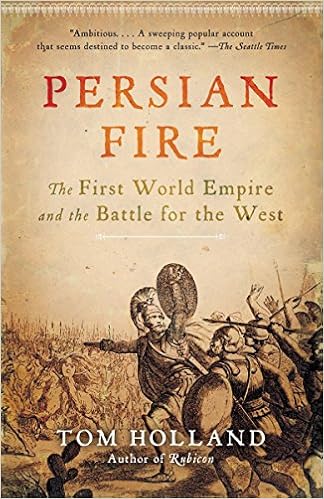
This book is basically a fun read. It covers both the Persian and the Greek side of the Greco-Persian wars quite well but I have to take away one star for Tom Holland’s (sometime mischievous or even tongue-in-cheek) propagandist style. But still, he has done his research and is fun to read, with quotes and anecdotes that enliven this history and bring it to life.
He describes the rise of the Persians and the creation of the first great world empire by Cyrus. This empire proceeded to conquer most of Asia minor (modern Turkey east of Istanbul) including multiple Greek city states (the Ionians). Holland describes the rise of the various Greek city states, with most of the attention focused on Sparta and Athens.The revolt of some of these cities against their Persian overlords and the burning of the Persian regional capital of Sardis triggered the first Persian invasion of mainland Greece, which ended with Athens historic victory at Marathon. The Persians came back with a huge army under Xerxes and as you may expect, battles like Thermopylae and Salamis get the full Tom Holland treatment; drama, suspense, objective facts and light-hearted propaganda. The book ends with the final Persian defeat and a brief survey of the (short lived) peace, prosperity and cultural efflorescence that ensued.
The book is an excellent account of the Greco-Roman wars and their background and ends on a high note. In a way, this is a bit misleading because a far greater and far more devastating war (the Peloponesian war) would break out within a few decades, so this book can be criticized for exaggerating the significance of the Persian invasion in Greek (and by extension, later Western) history. But that is a question for another day. If you have vaguely heard of Marathon, Thermopylae, the 300 Spartans, Themistocles or Salamis, but don’t really know what happened, this is the book for you. If you are ancient history nerd then you probably know all this and more, but even those who know most of the story may enjoy this effervescent and light-hearted retelling of this famous story.

Trevor Noah disses India?
It's sad when someone who's had a violent past mocks war through a Bollywood stereotype. @Trevornoah 's mother was shot in the head by her husband(Trevor's stepfather).Imagine someone making fun of it with a Xhosa stereotype – the tribe his mum belongs topic.twitter.com/pUFrm3Iavv
— Zainab Sikander (@zainabsikander) March 2, 2019
I wrote a rather incendiary post about the whole incident. However I posted it to my private blog as I’m trying to be less polemical. I’m surprised by how unnecessarily “personal” Zainab’s attack on Trevor was but that is a very Muslim thing to do*.
I would have said that he dissed South Asians but the fact is that if one parses his words; it’s directly targeted towards India.
I thought Omar’s analysis was the best I’ve read so far but I disagree with his conclusion. Trevor called the war for Pakistan; in the battle of global perception Pakistan, which is a bankrupt & failed state, has won a huge win as being seen as an equal & rival to economically ascendant India.
When a lion fights with a mouse, he makes the mouse his equal. India managed to do that in the latest round when she should pick her enemies more judiciously.
It really takes a particular type of strategic genius for India to have turned Pakistan back into a Sino-Arab Satrapy, echoing the Achaemenid ownership of the Indus, when it should have been India’s Muslim frontier.
India should have made turned Pakistan into an Austrian Bantustan**, an ineffectual state but exceptional useful respository of pan-South Asian High Culture, the demotic version of which is Hindustani.
BrownCast Podcast episode 19: Conversation with Saloni – a globalist centrist edgelord
Another BP Podcast is up. You can listen on Libsyn, iTunes and Stitcher. Probably the easiest way to keep up the podcast since we don’t have a regular schedule is to subscribe at one of the links above.

You can also support the podcast as a patron (the primary benefit now is that you get the podcasts considerably earlier than everyone else…). Would appreciate more positive reviews.
Nearly 20 episodes in, I thought it would be useful to gain some perspective. Here are the traffic trends:

In the next month or so I will be recording a podcast with Thomas Chatterton Williams and Shadi Hamid. The podcast explores what we’re interested in, but I have to be honest that I doubt this would have ever happened without reader feedback.
On this episode, I have a wide-ranging discussion about globalization, globalism, and being Steven Pinker’s bulldog with my friend Saloni. A graduate student in behavior genetics at KCL, Saloni grew up in Hong Kong, carries an Indian passport, and is a hanger-on in the neoliberal shill conspiracy. Somehow she became an “internet person.”
India and Pakistan; the Fog of War
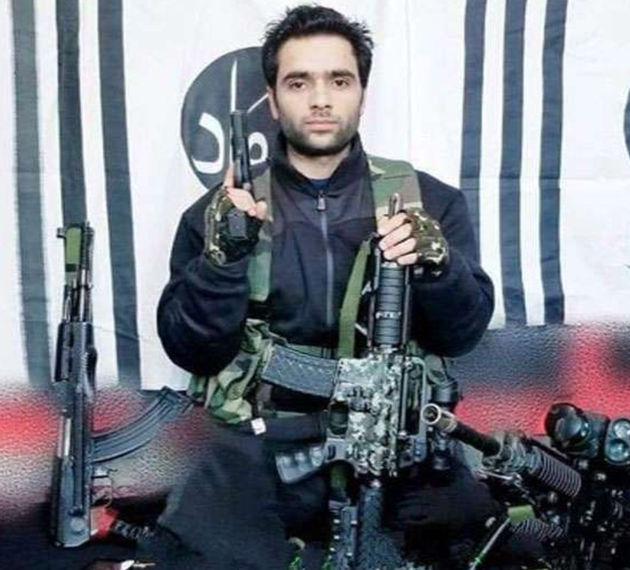
On the 14th of February 40 Indian paramilitary soldiers were killed when a convoy of the Indian Central Reserve Police Force (CRPF) was attacked in Pulwama (Indian Kashmir) by a vehicle borne suicide bomber. The attack was immediately claimed by a Pakistan-based terrorist organization called the Jaish e Mohammed (JEM, the army of Mohammed), who released a video of the suicide bomber, a local lad from southern Kashmir. JEM is led by a Pakistani cleric named Masood Azhar who had been captured by Indian security forces in the 90s in Indian Kashmir, but was released in exchange for the hostages on board an Indian airlines aircraft in December 1999. After his release he went to Pakistan and set up his Jihadist terrorist organization and has operated openly in the country ever since.
This is, of course, not the first major terrorist attack in India to be claimed by an organization based in Pakistan. JEM has been accused in the past of organizing an attack on the Indian parliament as well as many attacks in Indian Kashmir. And the biggest attack ever launched in India by Pakistani-based terrorists was the attack on Mumbai in November 2008, in the course of which ten terrorists wreaked havoc in the city of Mumbai and killed at least 165 people, including a few Israelis and Americans. Some of the more prominent attacks were followed by Indian threats of military action against Pakistan but in the end the Indian establishment opted on all of those occasions to try and isolate Pakistan diplomatically but stepped back from direct military action. This option was chosen not because of any residual Gandhian hangover in India but because of two interlocking factors: Continue reading India and Pakistan; the Fog of War
Religious change, genocide, and culture in the Indian subcontinent and Eurasia
Since many readers of this website refer to “genocides,” and all of them were born in the 20th or 21st centuries, I want to put a note here which I think will illustrate why it is important to be careful of the use of particular words and what their connotations are as a function of time. In the modern period, the term “genocide” has a particular valence. The Nazi killing of Jews, the Ottoman genocides of the early 20th century, and the killing of Tutsis in Rwanda. These were, I believe, expressions of the mass politics and mobilization. As such, they are not entirely analogous to ethnic and religious turnover in the premodern era, where death was often secondary or a side-effect.
Continue reading Religious change, genocide, and culture in the Indian subcontinent and Eurasia
Open Thread – Brown Pundits
Please keep the other posts on topic. Use this for talking about whatever you want to talk about.
Afghan Peace Process; Postscript
From Dr Hamid Hussain
Following was an exchange with an old Afghan hand of ISI. It may be of interest to some. His comments in normal font; mine in bold.
26 February 2019
Thanks Sir for opening more windows; My comments essentially of a wandering dervish in red in your main text;
Hamid
——-
Dear HH,
A very thought provoking analysis with indepth knowledge of situation in Afghanistan. My take:
- No party can have total control over Afghanistan particularly psuedo democracy.(You are correct that no single party is strong enough to impose its will on the whole country. In good old times, a chap like Amir Abdur Rahman put the fear of God by beheading a large number of tribal leaders and exiling others far away from their homeland. In this way, he was able to impose a central state on reluctant Afghans. Times have changed. It is time for a grand bargain and compromise although I’m not sure whether Afghans are ready for it.)
- Taliban will emerge as the largest group but will not be allowed total control by big powers. Fear CIS & Russians from fundamentalists will keep them supporting tajik and uzbek groups.(Correct. Interests of many countries are divergent and each state will support its own proxy. It is fine as long it is for political jockeying but all need to be mindful that one heated argument after endless cups of green tea can tempt one to reach for AK-47. This urge needs to be controlled. If not then;
aur ja’am toteein gein; iss sharab khane mein)
3.hazaras & other shia gps having tasted part powers will not easily succumb to Taliban rule. (Another reason for all Afghans to go for a bargain. Like many highlanders, Afghans of all ethnicities have a distorted sense of honor. They are willing to settle scores with gun for whatever perverted reason. However, their grandmother is begging on the street, young son is molested in coal mines of Baluchistan (Shahrag mining town in Baluchistan is the most heinous place in this regard where boys as young as 8 or 9 from FATA and Afghanistan are being molested on daily basis) or daughters going into prostitution to put food on the table in Pakistan & Iran, and their honor is nowhere to be found. Reminds me the words of an American who had worked in Afghanistan. He lived with his family among Afghans and worked in 1970s in Jalalabad for several years. In mid 2000s, he went back for a trip to Jalalabad. He said that Afghans were poorer then but had honor. Now they are richer but have lost their honor”. Hegel defined courage and bravery as “Courage among civilized peoples consists in a readiness to sacrifice oneself for the political community) Continue reading Afghan Peace Process; Postscript
Against being an intellectual subaltern
Over at my other weblog, The blood on brown hands is a legacy of all of history. Basically, a long essay where I fire broadsides at reductive postcolonialism in the context of Indian history and communal divisions. The motivation was straightforward: twitter is not really good to outline more subtle or detailed perspectives. But, it is a good platform for people to pepper you with many, many, questions.
Below is the first paragraph of the post:
Yesterday I put up a tweet which went a bit viral (I won’t embed since it has a vulgarity). It was the result of my frustration with a very liberal Indian American who was using unfortunate tensions in the Indian subcontinent to attack “white supremacy.” My frustration was due to the reality that a major conflict between India and Pakistan would not just impact India and Pakistan, though that is dire enough. In a globalized world, a war involving the world’s fifth largest economy, situated athwart the southern flank of Asia, would impact many people outside of the subcontinent. In the midst of this, the fact that someone was using this to promote their own ideological hobbyhorse was offensive to me.
Arundhati Roy on Kashmir; Pakistan is simply another Bantustan
A quick note on Ms. Roy’s thoughts:
NEW DELHI —With his reckless “pre-emptive” airstrike on Balakot in Pakistan, Prime Minister Narendra Modi has inadvertently undone what previous Indian governments almost miraculously, succeeded in doing for decades. Since 1947 the Indian Government has bristled at any suggestion that the conflict in Kashmir could be resolved by international arbitration, insisting that it is an “internal matter.” By goading Pakistan into a counter-strike, and so making India and Pakistan the only two nuclear powers in history to have bombed each other, Modi has internationalised the Kashmir dispute. He has demonstrated to the world that Kashmir is potentially the most dangerous place on earth, the flash-point for nuclear war. Every person, country, and organisation that worries about the prospect of nuclear war has the right to intervene and do everything in its power to prevent it.
I followed another link to this article, In Pulwama Bomber Adil Ahmad Dar’s Village, It’s Another Day, Another Death, and I was shocked to see that the bomber was a native Kashmiri.

Kashmir is on fire and the Indian government doesn’t seem to have realised just how much of an own-goal this incident has been.
India should be viewing Pakistan and Bangladesh as the West Bank & Gaza Strip of the Subcontinent. These Muslims Republics are a great place for India’s demographics to be absorbed and in retrospect 1971 was not the great victory for India.
India pretends to be Israel but Israel has a strict Jewish First policy whereas India is territorial focussed. Israelis don’t hunker for a land between the Sea & the Euphrates but stay within defensible borders and hold on to their cantonments.
India shouldn’t be fighting corrupt Pakistani generals and businessmen; it should be bribing them. If Pakistan tomorrow becomes 5 banana republics; the Punjab border would be overwhelmed with Muslim refugees.
Post 1971 India was left with:
An estimate made in the year 2000 placed the total number of illegal Bangladeshi immigrants in India at 1.5 crore, with around 3 lakh entering every year.
I imagine the majority of these illegal Bangladeshi immigrants are not Hindu.
Like Israel, India will soon have to decide whether it wants to have a solidly Hindu future (with compliant Hindufied minorities) or a “Akhand Bharat.”
But deep down Indians, of all stripes (Hindutva included), cannot bear to part with Pakistan & Kashmir. There is an atavistic bond Hindus/Indians have to this mythical Mughal fantasy, that they just can’t quit Pakistan.
Any sensible Hindu leader would be advocating partition upon partition to isolate and quarantine these bantustan Pakistans. Isolated, weak, divided and led by a corrupt Muslim elite drunk on Indian money; these little Pakistans would have been wonderful pawns of India.
Instead India’s loss will be China’s gain; Israel doesn’t do such mistakes.
Complete Victory For Imran Khan
I'll hopefully publish this imagery tomorrow.
That might indicate that the IAF was under pressure from Pakistani jets and released without a full lock-on, but considering the GPS guidance preloaded with coordinates I would say it was a political decision to limit escalation.
— Nathan Ruser (@Nrg8000) February 28, 2019

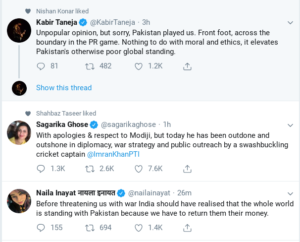
Pakistan is offering to return the pilot as a gesture of goodwill. Huge humiliation for India on every level.
I’m extraordinarily impressed with Imran’s handling of the crisis. This is the end of Modi, who should have been the Indian Benjamin Nethanyahu.
Pakistan has been cool, strategic and conciliatory while India has been bombastic, hotheaded and bloodthirsty. Completely outfoxed and to lose in a dogfight with Pakistan is a big shame on the Indian air-force. Continue reading Complete Victory For Imran Khan