Maududi and Iqbal: A Brief History

A few days ago, on the occasion of Allama Iqbal’s proposed birthday (November 9th was chosen by a committee created in the 1970s), Mr. Rafi, a Pakistani commentator on twiter tweeted that

“Iqbal chose Maududi to head Dar-ul-Islam in Pathankot to reconstruct Islam in a new light and eventually Maududi founded Jamaat-e-Islami (JI) so Iqbal is indirectly a founder of JI as well” (my translation, the original tweet was in Urdu).

Having written extensively on Jamaat-e-Islami and Maududi in the past and with a moderate knowledge of Iqbal’s poetry and prose, I was not thrilled by this simplistic association. In my opinion, it was a tenuous argument and required a bit more nuance and detail. To set the record straight, I went back to some of my source materials and re-read about the relation between Iqbal and Maududi. I wrote a brief blogpost about this issue in April 2012 for Pak Tea House blogzine (May it rest in Peace), which you can access here.  Following is a detailed look at interactions between the two gents. (For more, see Vali Nasr’s Mawdudi and the making of Islamic revivalism)

The first time Maududi and Iqbal crossed paths was in the 1927 when Maududi wrote a series of articles on the issue of the concept of Jihad in Islam titled”Islam ka qanun-i Jang” (Islam’s law of war), in twenty-two issues of his magazine Al-Jam’iat beginning in February and ending in May 1927. The articles were well received in Muslim intellectual and political
circles. Mawdudi was lauded for his service to Islam by Muhammad Iqbal;Muhammad Ali; Mawlana Ahmad Sa’id of the Jamiat-i Ulama-i Hind, who wrote a complimentary note about the first installment; and the eminent alim, Sayyid
Sulaiman Nadwi, who saw to the publication in 1930 of the articles in book form under the title Al-Jihad fil-lslam (published by Darul-Musannifin in Azamgarh). The first time Iqbal met Maududi was in 1929 in Hyderabad where he had gone to deliver a lecture.

In 1937, Iqbal wanted to establish a model ‘darul-ulum’ (house of knowledge) in Punjab to lay the foundation for a new Islamic worldview, which would in turn facilitate the creation of a Muslim national homeland. His friend Niyaz Ali, a retired civil servant, wanted to establish a waqf (endowment) using a piece of land he owned in Pathankot, a small town in Punjab.

Iqbal’s aim was evident in his letter to the rector of al-Azhar in Cairo, Shaikh Mustafa al-Maraghi, requesting a director for the intended darul-ulum; Iqbal asked the Egyptian alim for a man who was not only well versed in the religious sciences, but also in English, the natural sciences, economics, and politics. Al-Maraghi answered that he had no suitable candidate. Iqbal was disappointed and handed the task of selecting a suitable overseer to Niyaz Ali, but he remained firm about establishing the darul-ulum.

Niyaz Ali, meanwhile, searched for a suitable administrator for his waqf. He turned first to the famous Deobandi alim, Ashraf Ali Thanwi, but Thanwi rejected the offer. Niyaz Ali then tried to encourage Mawdudi to move to Punjab (Maududi at the time was in the state of Hyderabad working ), though he made him no firm offer and the two disagreed about the aim of the project. Niyaz Ali insisted Mawdudi consult with Thanwi, with whom Mawdudi was at loggerheads, along with the rest of the the Deobandi Jamiat-i-Ulama-i Hind. Disagreements, however, were soon overshadowed by mutual need.
The situation in Hyderabad was fragile, and Mawdudi had come to the conclusion that it was not the best possible place for launching an Islamic revival. This made him more interested in Niyaz Ali’s project, and he solicited
the job of administering the waqf. Unable to find any other suitable candidates, Niyaz Ali was inclined to agree, but the final decision had to await a response from al-Maraghi. Niyaz Ali asked Iqbal to write to Mawdudi and invite

Unable to find any other suitable candidates, Niyaz Ali was inclined to agree, but the final decision had to await a response from al-Maraghi. Niyaz Ali asked Iqbal to write to Mawdudi and invite him to settle in the Punjab. Iqbal arranged for him to come to Lahore and serve as the imam of the Badshahi mosque at a salary of 100 rupees per month and to partake in Iqbal’s plans for the revival of Islam, “umraniat-i Islami ki
tashkil-ijadid” (reconstruction of the social aspects of Islam). Mawdudi turned down Iqbal’s offer on the grounds that he did not want a payingjob that would restrict his freedom. Niyaz Ali then suggested Maududi as overseer of the waqf and secured Iqbal’s agreement to this appointment.

At the meeting , Mawdudi’s appointment was confirmed, but Iqbal did insist that he establish at Pathankot some form of educational institution with a clearly defined curriculum. Mawdudi accepted Iqbal’s scheme and agreed to use the
waqf to train a number of capable Muslim students and young leaders in Islamic law as well as modern subjects. Although the project was essentially educational, the imprint of Maududi’s politics was evident in its name, Darul-Islam (Land of Islam).

All this cooperation was uncharacteristic of the independently minded and self-righteous Maududi, especially since it was clear that by no means had he abandoned his political objectives. Accepting the position was, therefore, partly
out of respect for the celebrated poet and the appeal of being a close associate. Following their meeting with Iqbal, Mawdudi and Niyaz Ali agreed on the terms of Mawdudi’s position as waqf overseer, and Niyaz Ali included Maududi
in the waqf’s governing committee, the Darul-Islam Trust.
Niyaz Ali guaranteed Maududi the autonomy he had asked for, but not the permission to involve himself in political activity, because their agreement with Iqbal regarding the nature of the waqf’s projects precluded it. Mawdudi agreed
to these terms. In the November 1937 edition of the Tarjuman, it was announced that the journal would be moving from Hyderabad to Pathankot; Maududi arrived there on March 16, 1938.

After Iqbal’s death, JI cadres tried to cash in on Iqbal’s brand and called Dar-ul-Islam his brainchild but Maududi himself had a different view. Maududi argued that “the commonality
of views between ‘Allamah Iqbal and me are limited to our belief that Islamic law should underlie the revival of our religion; my thoughts and intellectual probing are my own.” Iqbal did not conceive of the Darul-Islam project as it eventually unfolded, and Maududi was not Iqbal’s choice to lead it. Even after the two met again in 1937, Iqbal’s opinion of Mawdudi was guarded. Mian Muhammad Shafi, Iqbal’s secretary, recollected that he referred to Maududi as
“just a mullah [low-ranking cleric] ,” someone more suited to lead the prayers at the Badshahi mosque than to oversee a pioneering educational project.

Now, in hindsight, did Iqbal’s poetry influenced Maududi and JI’s conception of Islam and the world? It depends on if you want to focus on Iqbal’s more Ummah-focussed poetry and his ideas about mixing of religion and Islam. You would find some overlap in ideas but it is hard to separate the threads in some instances. Whether Iqbal wanted it or not, JI cadres used his poetry for their propagands. But then, such is life.


Book Review: The Stan

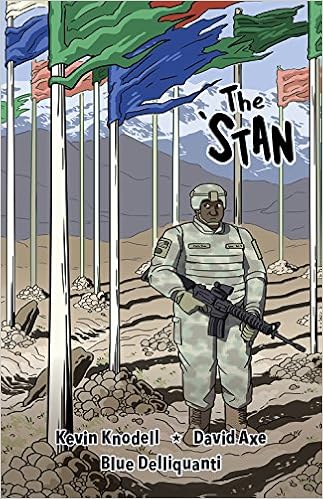
Dead Reckoning is a (fairly new) imprint of the Naval Institute Press that publishes military-themed graphic novels and books (e.g. they have published “All Quiet on the Western Front” as a graphic novel).   The Stan is a comic book based on stories collected by two American journalists (autors Kevin Knodell and David Axe) who have spent a long time covering the war in Afghanistan. The only story not based on their work is the opening chapter, which is a comic based on the life and words of former Taliban ambassador to Pakistan, Abdus Salam Zaeef. They use this first comic as a capsule history of the background to this war as well as a prediction of its futility and eventual failure.  This is the only comic that gives a nod, albeit a minimalistic and relatively simple one, to the “big picture” of the Afghan war and it is a strictly anti-war and anti-interventionist one. The other comics are all about the “little people”, ordinary soldiers, an Afghan interpreter, an Afghan soldier and an Afghan policeman. The last comic is about one of the authors (Kevin Knodell), who may have some PTSD, and his parting words are that “America’s longest war was going to stretch on longer”. Continue reading Book Review: The Stan

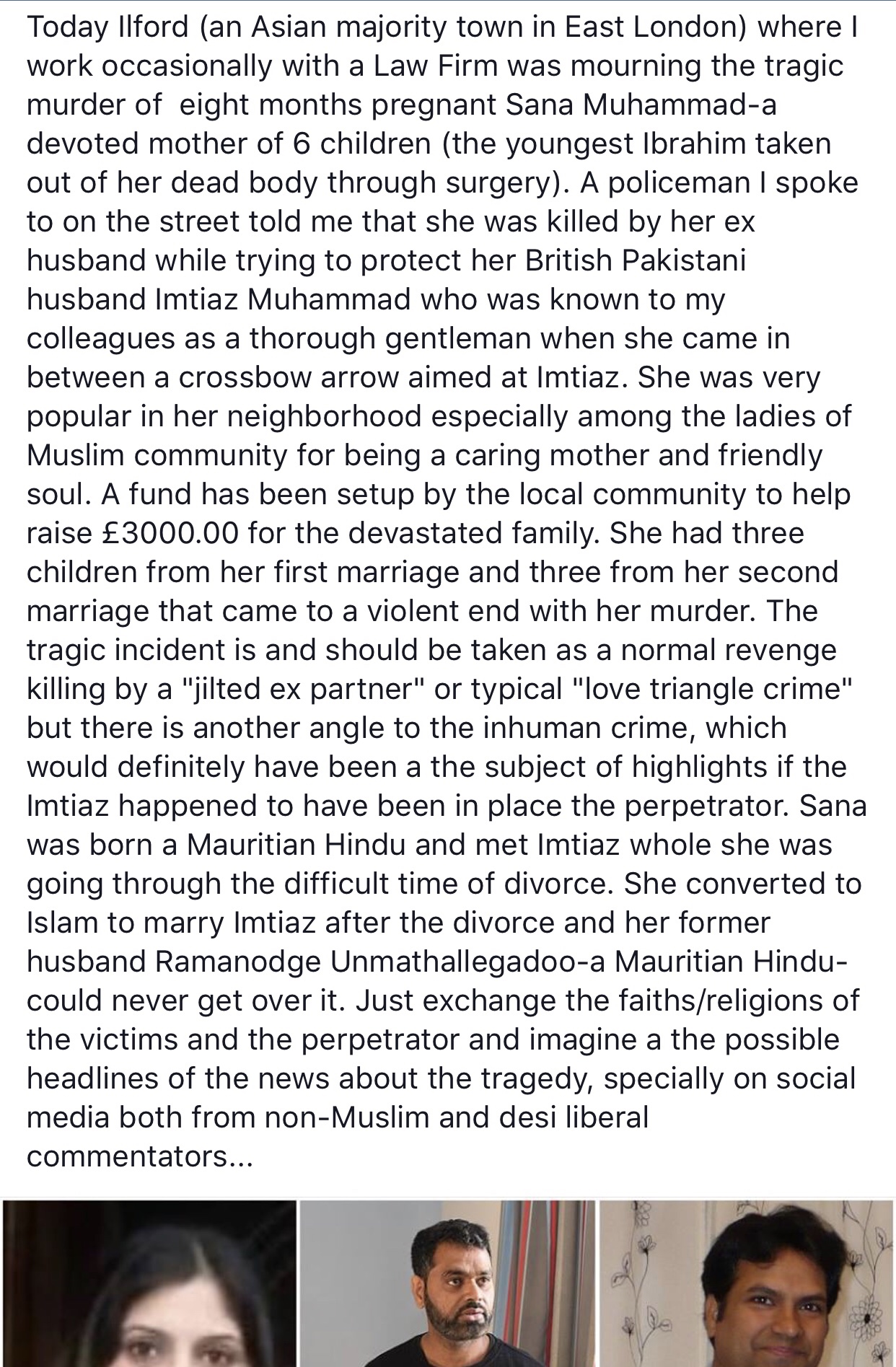
Hindu Wife killed by ex for marrying Muslim man

There was the sad news today of a mother of 5 being killed by a crossbow. At first I thought it was a local British Pakistani affair.

However it seems this was a bit of a twist as seen below. The lady who passed away was a Hindu lady who converted to Islam to marry her second husband (she had three kids with each husband and her last child was delivered off her dead body).

It’s obviously true that if it had been the other way around the “Muslim” angle would have been hyped up.

Indian culture started when the British arrived: tales of shadology

When looking at Google Scholar after reading the paper on South Asian pigmentation, I came across this work, The Unfair Selection: A Study on Skin Color Bias in Arranged Indian Marriages:

Underlying the growing popularity of skin-lightening or fairness cosmetics in India is one of the most baseless biases experienced and practiced. Yet, the overriding importance of skin-color especially in context of marriage has been largely unaddressed. This exploratory study examined the influence of skin-color on preference for potential marriage partner. A 2 × 2 (gender × skin-color) between-group experimental design was used. Mothers (N = 108) of individuals of marriageable age group were presented with an option of five marital profiles containing education and work information only. The participants were shown profiles of either males or females depending on whether they had a son or a daughter. Once a profile was chosen, the participant was either shown a photograph of highly attractive fair girl/boy or a highly attractive dark girl/boy. The light-skinned and dark-skinned photograph was of the same person, except their skin tones were manipulated with the use of computer software. Participants were asked to rate how strongly would they recommend the girl/boy as potential bride/groom for their children. As expected, fair-skinned highly attractive people received higher ratings than dark-skinned highly attractive people. However, contrary to our expectations, ratings received for dark-skinned woman were not significantly lower than the ratings received for dark-skinned man. This study shows that the color of skin has the potential to even overpower traits such as general competency and physical attractiveness in both men and women.

The subjects are from the Indian capital. The surprising result is no sex difference. I’m not too interested in the paper’s primary result, but the introduction and discussion, which frames the preference for light skin historically, is of interest.

From the introduction:

While Black scholars in the Unites States have thoroughly examined the link between racism and colorism, there is paucity of information tracing the historical roots of skin-color discrimination in India (Parameswaran & Cardoza, 2009a). Internalization of superiority of fair/white skin has been related to the combined influences of colonialism, caste system,
and globalization. Many South-Asian countries like India, Pakistan, Sri Lanka, Nepal, and so on were ruled by the British for around 200 years; “white” race was the ruler and the “dark” native were the ruled. This led to internalization of superiority and power of the “white” skin and inferiority and powerlessness of the “dark skin” (Speight, 2007). Internalized racism reveals itself in a variety of situations from work environment to social situations where people of color reject or denigrate those with dark-skin. The caste system in India is likely to have given impetus to the notion of superiority of fair skin-color brought by colonial rule (Parameswaran & Cardoza, 2009b; Shankar & Subish, 2016). Higher castes have been perceived to be “fairer” and superior while lower castes have been perceived to be “darker” and inferior. Today, in postcolonial world, globalization has led to increased spread and acceptance of Western beauty ideals in Asian and African cultures (Hunter, 2011; Peltzer, Pengpid, & James, 2016).

First, the Muslim West and Central Asians who arrived in South Asia, described it as a pattern where white people conquered black people. These people were quite aware that South Asians were not black in the way Sub-Saharan Africans were. There were black Africans in the armies of the Muslims, as the Siddi community demonstrates. Nor did the Iranians, let alone the Turks, consider themselves to be of the same people as the Europeans.

But when it came to the metric of skin color, the Muslim ruling class of South Asia was disproportionately very light in complexion and described themselves often as white. The natives were described often, though not always, as black (though more often obviously as “Hindus” or whatnot). When Europeans arrived they did not come as conquerors, but as supplicants to the great Mughal and the other powers. They perceived themselves to be white, just like the elite Muslims, as opposed to the dark-skinned native Indian population, which was mostly, though not exclusively, non-Muslim.

As the 19th century proceeded Europeans, and in particular the British, developed a refined, narrow, and simultaneously biological and cultural conception of whiteness which excluded West and Central Asian Muslims. But this was a process and does not negate the fact that the ruling elite of South Asia was disproportionate of the Muslim religion and very light-skinned in comparison to the populace as a whole for many more centuries than British rule occurred.

Second, “higher castes” are not perceived to be lighter in complexion. The data is clear: higher castes are on the whole on average lighter in complexion. Just as people from the north, and west, of the subcontinent, are lighter in complexion than people from the south and east. This is not a perception dictated by ideology, but biology.

As for whether Brahmins have become “higher” castes recently, my understanding is that they have always been a high caste, and that the British did not give them their high casteness. To be frank, Indian social heirarchies do not need the imprimateur of white Europeans to come into existence, ex nihlo.

And genetics makes it clear that castes seem to have been separated and distinct for around ~2,000 years or so in South Asia. Even before the Muslims!

Now, I don’t know enough about South Asian history and culture to comment on this part:

Thus, skin-color is related to social hierarchy in India; fair skin is often considered to be a mark of higher social standing. However, it is important to note that historically and culturally, dark not white skin was considered to be ideal and desirable in India. Some notable examples are the popularity of God Krishna (literally black) and Draupadi (also called Krishnaa), a character from the epic Mahabharata. Krishna is worshipped in many parts of India whereas Draupadi was considered to be one of the most desirable women in the world. The transformation of ideal skin-color from dark to fair can be traced to the influence of caste system, British imperialism, and global hegemony of whiteness. The caste system also called varna (literally color) accounts for the perceived superiority of fair skin over dark. Owing to the association of fairer skin with upper caste and darker skin with lower castes, skin-color came to signify the social position of an individual in our society. In addition, the racist construction of “dark native” by the British seems to have become a part of our unconscious and is often projected as strong dislike for the “dark other” (Parameswaran & Cardoza, 2009b).

I would be curious about the idea that dark skin was preferred to light skin. The historical genetics makes it clear that lighter invasive populations seem to have arrived and placed themselves on top of darker populations, with some mixing before caste crystallization.

Finally:

The popularity of some dark-skin colored Bollywood actresses like Bipasha Basu, Kajol, Deepika Padukone, and so on suggests that masses are likely to accept a dark-skinned woman if she is perceived as highly attractive.

I do understand that Indian actresses use make-up (or lightening cream) to make their complexion seem fairer than it would otherwise be…but it is clear none of these actresses are actually dark-skinned in the broader South Asian context. They are at best of average complexion.

Now, perhaps you will tell me that I spend time only with kala-batchas or something, I really don’t know. But this whole paper is soaked in postcolonial anti-Western delusional discourse…and then it ends in the shadological delusion that these average complexioned actresses are actually dark skinned! Average South Asians are not light brown, they are medium brown. Medium brown actresses are not dark-skinned, they are dark-skinned for actresses (which is fine, but a different thing than being representative of the population).

Go to Google Images and type “dark-skinned Indian actress” and then “dark-skinned black actress.” In the latter case, the actresses are genuinely dark-skinned. In the former case, only a minority are actresses with the complexion of Sharon Muthu.

Skin color of South Asian groups

A massive new review, Shades of complexity: New perspectives on the evolution and genetic architecture of human skin, pointed me to another paper on South Asian skin color, The influences of genes, the environment, and social factors on the evolution of skin color diversity in India. I was very interested because South Asians have been telling me about complexion my whole life. Usually, it is to suggest that their group is lighter than some other group. So I thought it would be interesting to post some data.

Solomon Islanders

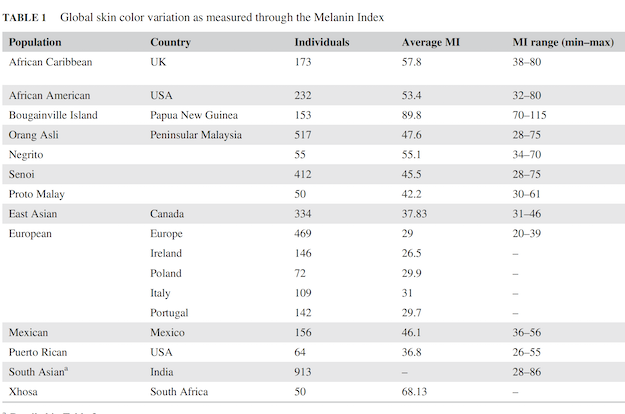
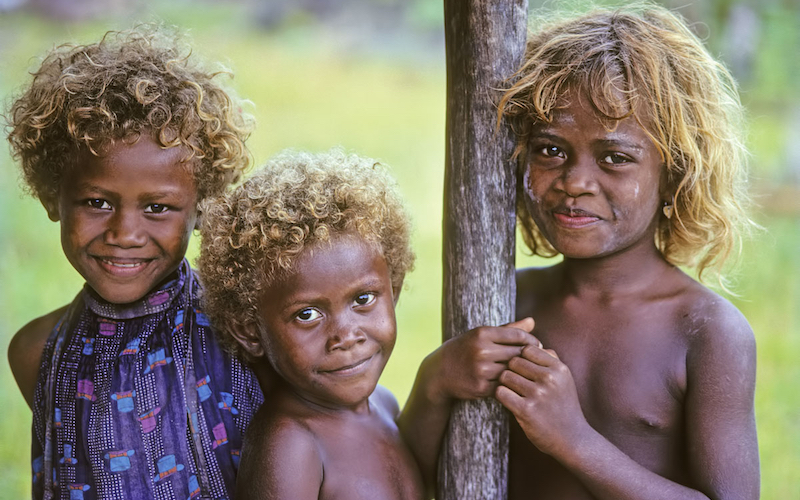
The figure at the top shows melanin indexes for a host of populations. The lower the value, the lighter the skin. So you see that Irish samples above have a melanin index of 26.5, while Italians have one of 31. East Asians in Canada have a melanin index of 38. Predominantly African ancestry populations have melanin indices >50, while the very dark Melanesian people of the Solomon Islands have a melanin index of about 90.

I’ve collected the Indian data from the paper:

Continue reading Skin color of South Asian groups

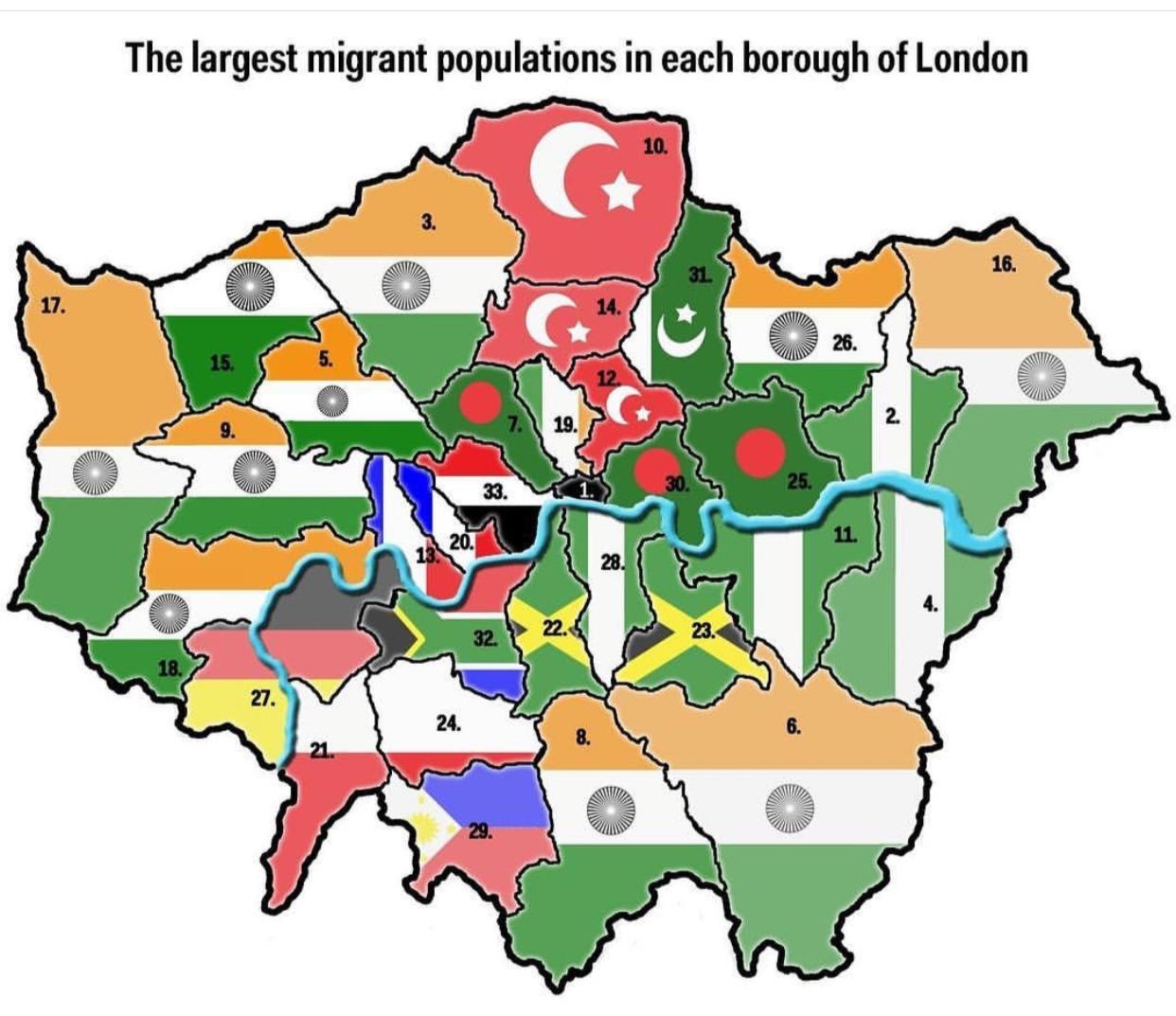
London(istan)

I don’t have much to add to this. I do notice however that in the Shires (which are still very English); the English are much more guarded about the “demographic transformation.”

It’s almost like a silent invasion (the Home Counties have changed irreversibly in a generation) and even though the terminology is somewhat loaded, the English are unused to being a minority in their own country (understandably so).

Scotland is still demographically very white British and accordingly their main animus remains with the English as opposed to immigrants (who they want).

What is interesting however (and Razib touched on this in our podcast) South Asians almost always perceive themselves to be a minority. India is so diverse that no one caste dominates and in Pakistan the birdaderi clan caste identity is important in parts of the Punjab.

So in a way South Asians haven’t internalised homogeneity as Europeans have done in the past few centuries (Treaty of Westphalia for Germany, Treaty of Versailles for the East).

Dynamics of the Saudi Royal Family

From Dr Hamid Hussain

This piece written in summer of 2017 is a backgrounder for Kingdom at a crossroad.  This will help in understanding the background to my upcoming piece about challenges faced by the Kingdom in the aftermath of Jamal Khashoggi murder. Stay tuned.

Hamid

Royal Rumble – Dynamics of Saudi Royal Family

Hamid Hussain

 ‘In a western democracy, you lose touch with your people, you lose elections; in a monarchy, you lose your head’.  Prince Bandar Bin Sultan, Former Saudi ambassador to Washington.


 In the last two years, Saudi Arabia has gone through many changes.  Absolute monarchies are not easy to decipher.  There are many opacities and it is very difficult for any outside observer to have a real sense of events.  Two main factors are very limited expression by Saudis in their own country and opaque decision making process in the form of decrees with flavor of palace intrigue.  A Saudi will not express his honest view in the presence of another Saudi due to fear factor.  In view of these limitations, the perspective of an outsider has severe limitations.

Current system of governance of the country is based on accession to throne of one of the sons of the founder of the country Abdul Aziz bin Abdur Rahman al-Saud (d. 1953).  He works with other family members especially senior princes, Council of Ministers (most of whom are also royal family members) and Council of Senior Clerics in running day to day affairs of the country.  There is a fair amount of competition among all these groups about various issues and King carefully balances his act to avoid open conflict.

In January 2015, Salman bin Abdul Aziz ascended to Saudi throne after the death of his brother Abdullah bin Abdul Aziz.  He came quite late into the complex inner power circle of the al Saudi royal family.  He was appointed Governor of Riyadh province in 1962; a post he held until 2011 when he was appointed Defence Minister.  For five decades, his main influence was in business and media through his sons and a half-brother (Sattam bin Abdul Aziz).  His sons controlled different business and media interests.  Abdul Aziz was Assistant & Deputy Minister of Oil and now Minister of State for Energy Affairs, Faisal owned Sharq-al-Awst newspaper and appointed Governor of Medina in 2013.  Sultan is a pilot and worked at Saudi Ministry of Information.  He now heads tourism commission with the rank of a minister.  Khalid is also a fighter pilot and in April 2017 appointed ambassador to Washington.  Turki, Saud, Rakan and Nayef are little known and involved in various business ventures.  Fahad; a business tycoon and Ahmad with media interests died in their 40s from heart disease.  Continue reading Dynamics of the Saudi Royal Family

Race, class and birthday dinners..

In case you missed Anan’s post it was LV’s birthday this week. We went to a different part of the country and on the birthday night went to a very nice French restaurant.

The reason I mention this is a curious incident. There were three sets of diners; us, another older Anglo-American couple (I couldn’t grab the accent) and a group of 11 much older gentleman.

They were all white, WASPs (I hear them mention Italian and Jews) and in their 60’s. They were loud and interesting enough that we could overhear much of their conversation (country club Republican not a fan of Trump but decidedly pro-Kavanaugh).

As the evening wore on they became a bit more raucous (understandable for a group of 11) and they went on about hunting and the politics at their club (we were at corner ends apart and a column separated us so the fact that so much could be overhead is a testament to their volume).

Even the other couple were a bit weary of the crowd . However what happened next was an egregious breach of etiquette; the “chef” appeared and started dancing about the table. He engaged in general revelry and everyone at the restaurant was a bit surprised that the chef was so pally with this table.

It turned out it was one of the guest playacting on his way from the toilet. The reason this was such a faux pas is that this restaurant is very well-known for being a husband and wife team. The husband is the chef and the wife is front of the house.

It was by default a way to insult her husband since even though it was innocuous it just was not the done thing at such establishments.

I later mentioned to V that since my natural instincts are quite sympathetic to Waspy Republicans (I only moonlight on social media as a Social Justice Ghazi) I didn’t mind them to much.

However I imagine that if it had been a table of 11 Pakistani men up to the same antics I would have immediately been livid and ashamed of them “letting down our people.” I also suspect the matron would have done much the same even if it was a large table.

It’s always good to expose one’s own hypocrisies and biases and examine them. I suspect since I am on the periphery of Asianess and on the edge of white society; I’m always trying to knit two very different identities together, sometimes spectacularly sometimes abysmally.

It also goes to show that much as I feel British; I am very buttoned up in Britain. I always want to put my best foot forward (model minority syndrome) which is why I rag on the Mirpuris. When I am back home in South Asia I don’t need to *prove* my social status to anyone, it is simply assumed.

Some controversial thoughts on Remembrance Day & Kashmir

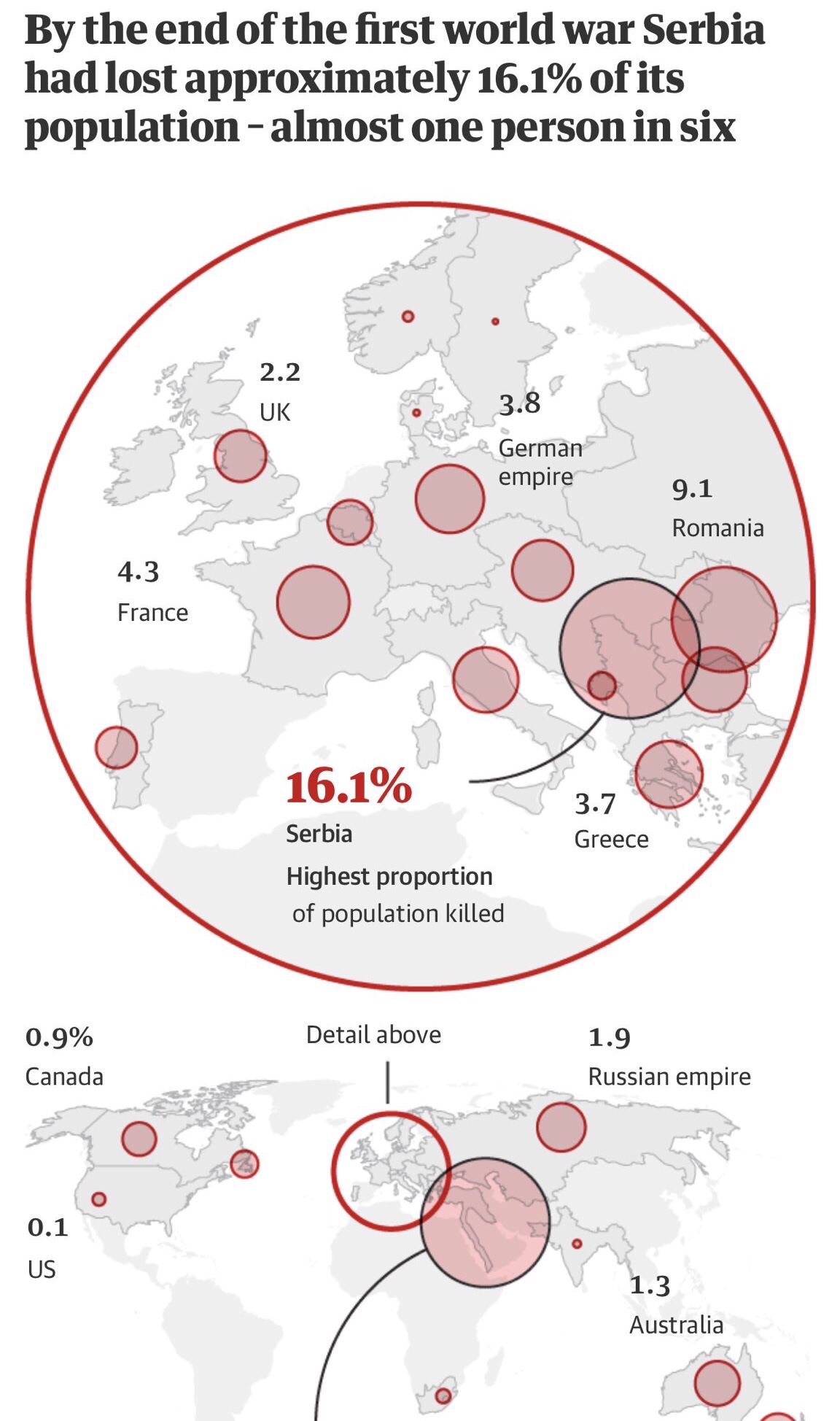
For our Serbian Comrade, Milan.

Britain of course is Ground Zero for Remembrance Day.

I find it a bit tiresome as to how both World Wars are constantly spun as being for “freedom.”

It’s a bit like how Mel Gibson retconned history in the Patriot so that a slave was fighting for the Americans as opposed to the British.

1.5mm Indians fought for the Empire in WW1 and after that war, as well as WW2, we were still subjects (slaves) of a foreign king.

It doesn’t matter that the British Empire was, by and larger, more benevolent than other Empires of its ilk but Freedom is Freedom. WW1 & WW2 weren’t fought in my name (my grandfather was a medic-doctor on the Burmese in the Second War) and while I respect the observation; I suspect it’s near hysterical commemorations.

Thankfully I can express these thoughts on BP since we have space here for privacy and nuance. However when I moonlight as a “Social Justice Ghazi” I notice the almost persistent humble brag of WASP civilisation.

History is always written by the conquerors especially English history. It’s probably a reflection of my deeply colonised mind that I can only read, write and think deeply in the English language; I’m short of any other perspective.

These thoughts sit squarely on this play I saw last night “the Djinns of Eidgah.” It’s about Kashmir and it was extraordinarily powerful. Incidentally it was written by a Bengali Hindu (Abhishek Majumdar) and the script was sterling.

I was surprised by how anti/India it was and of course as I saw the play my part-Pakistani blood, always latent always poisonous, was steaming in solidarity with my Kashmiri kin-folk.

There were some extraordinarily powerful scenes but having a blond girl play an Indian soldier and exclaim she is “Marathi” stretched incredulity. Another part was where the Arab actor (playing a Kashmiri youth) was pronouncing the lead “Bilal’s name in an Arabic rather than desi accent.

Kashmir of course is the Palestine of the Sub-continent. The Kashmiris are an arrogant, attractive and resilient people and their conflict is the zeitgeist that tends to overshadow other perhaps even equally worthy causes (Tamils, NorthEasterners, Baluch etc).

As a counter-factual if Kashmir had been joined to Pakistan (as it should have been) would there even have been a whisp out of that region today? I suspect not because the Muslims of Kashmir would have melded into Pakistan without trace or incident.

These are slightly unvarnished thoughts and I’m sympathetic that India can’t “retreat” from Kashmir without a huge loss of face. But it’s increasingly clear that Pakistan is a peripheral player in the India-Kashmir dynamics; the local Kashmiris are themselves in revolt.

The play “plays” on the tendency of the Kashmiris to refer to the Indians as “Indians.” The fact that India is seen as an entirely separate entity to Kashmir reflects that Freedom is a difficult quality to define and sometimes so is nationhood.

Racism at its best

I just heard this story.

One of Cambridge’s best colleges has a pretty good bar. The bar did a Diwali special and accordingly the Indian girls wearing saris thronged the dance floor.

At that point one of the students (Coloniser ethnicity) whispered to another “this actually looks like Pakistan.”

Brown Pundits