Neel Mukherjee for Man Booker

….Supratik attacks his mother
about food. “Don’t you agree we eat too much?”….”Everyone
eats like this.”….He attacks again: “not the servants, not the poor”……..the head servant, Madan, who is part of the
family, but remains separated from them…..”Boro-babu, the world
does not change, you destroy yourself trying to change it…Why cause
people who love you to go through such misery because of it?”…….
Communist Supratik feels “a surge of cold fury that he is being given a lesson in
political morality by the family’s cook”….

 ……………………………
We know that the Bong bhadaralok class (genteel folks) are a mighty sentimental lot. Many of them were up-rooted from erstwhile East Bengal in 1947. Then in the 1960s-1970s Bengal experienced extreme violence first from the left and then on the left (the most intriguing part of that story was left-on-left violence). Finally a bunch of super-castes migrated to the West with its attendant identity loss problems etc.

The literary output seems focused on these extreme events and that is only to be expected. However after what seems to be a million stories and plays and movies, we find the scope to be limiting (and exhausting). Is it too much to ask the writer class to pick up a wider lens?

There is a good story (we presume) to be written about the ups and downs of an unprecedented three decades of a popular vote backed communist rule which began with police torturing communists (1975-1977) and ended with communists (and police) torturing common people (2006-2011). The middle class essentially had to move out of Bengal to cities of opportunity to the north, west and south (Gurgaon, Pune, Bangalore).

How about the daring idea to divorce Kolkata (where only 20% people live) from the dialog?
You have the timeless culture of the Sunderbans, where Hindus and Muslims both pray to snake and tiger gods and where unique forms of agriculture and pisci-culture are in place and which has also experienced thunder-bolts via Force-10 cyclones? Then there is the Himalayan belt where the world-famous Darjeeling tea gardens have been devastated by mismanagement and where Hindus (Gorkhas/Nepalis, Bengalis, Tribals like Koch, Rajbonshi) are murdering other Hindus as part of a campaign for (or against) partition?
Speaking of larger than life personalities, why not put to pen the astonishing rise and fall of Huseyn Shaheed Suhrawardy? He was born in (present day) West Bengal, he was the Premier of Bengal when the massive riots happened post Direct Action Day (1946), he became the (5th) Prime Minister of (unified) Pakistan (1956), forced to resign by Iskandar Mirza (1957), exiled by Ayub Khan and finally died in exile in Beirut (1963), never to see his homeland again. From the stand-point of Bengali Hindus HSS was a veritable monster (like one Great Leader today) who was fiddling while Kolkata was burning. By the same token he was a hero second to none for Bengali Muslims. But then to his credit (and to the confusion of extremists on both sides) he proposed (along with Hindu leader Sarat Bose) an United Bengal as one nation!! After all the madness, Bengali leaders still hoped to hold hands, the idea itself is madness, or was it??

Re: HSS there is a popular anecdote which concerns Gandhi. Legend has it that the mob had managed to corner HSS in Gandhi’s presence. The mob asked Gandhi to step aside so that they can finish him off. Gandhi kept his calm and told them that they would have to kill him first. The mob went away but the grievances were building up.

Ranting aside, we wish Neel Mukherjee all the best in his quest for Booker for “The Lives of Others”. The book (in our opinion) is very different in flavor to Jhumpa Lahiri’s 2013 “The Lowland” which covers the same ground (and lost the race for Booker). Strongly recommended.
……………………..
It begins in 1966 with a profoundly shocking sequence, emblematic of
the novel’s purpose, in which a starving Bengali peasant slaughters his
wife and children before killing himself by drinking corrosive
insecticide. We are then whisked off into a seemingly unrelated double
narrative.

In one strand of this we meet three generations of the
upper-middle-class Ghosh family, who made their fortune in paper
production and are steadily losing it through the effects of Partition,
mismanagement, union trouble and domestic discord. In the other we
follow the story of one of the family’s eldest grandsons, who has
dropped out of his life of privilege to train and work as an activist
and guerilla fighter for the outlawed communist Naxalites.

The
Ghoshes are a big family. (Mukherjee provides both a family tree and a
guide to the Bengali relational terms). Though their empire spreads
across the continent, they all live in the one, old Kolkata house, the
patriarch and his wife on the top floor and the spoilt youngest’s
outcast widow and children on the gloomy bottom one.

Many (guilty)
readers, and not a few Indian novelists, would have contented
themselves with focusing on this household. It provides a tidy microcosm
of Hindu society, rigidly hierarchical, borne up by cheap labour, yet
shot through with destabilising insecurities and alliances.

As in
an equivalent dynasty imagined by Galsworthy or Mann, the company
founder supposes his commercial achievements can only be undone by his
modernising sons, while the sons despair of the father’s lack of
foresight. His wife retains a blind fondness for the family’s oldest
retainer, in effect a slave procured as a child to raise her children
and cook the delicious dishes of his impoverished background, a
situation that will bring about a tragedy of injustice and misplaced
loyalty worthy of Conrad at his darkest.

The house is riven with
conflicts born of marriage. One son has married the perfect,
peacekeeping wife, one, harbouring profound sexual shame (arising from
incestuous coprophilia, since you ask) has married a vulgarian. The
latter delights in a state of constant warfare with the family’s
unmarried daughter. This character, the most richly portrayed in
Mukherjee’s family album, rendered unmarriageable by too much education
and unfortunate looks, consoles herself with inventive spite while her
mother looks on, aware of the part she has played in creating such a
monster but powerless to intervene.

Another character who could
arguably have taken a whole novel to himself is Sona. Shy and wordless
to the point of autism, raised on scraps by his outcast mother, in the
household’s cruel scheme he is in effect an Untouchable. And yet, as the
great Ghosh boat moves inexorably towards the rocks of its social and
economic ruin, he proves to be its quietly triumphant survivor, saved by
a genius for pure mathematics.

The Ghosh household serves a
Sethian narrative feast with dishes to spare, and yet it is arguably the
novel’s much harsher second strand which matters most to Mukherjee.
Pursuing the rebel son, Supratik, on a career from 1960s Maoist idealism
through brutal murders in the jungle, to scenes of police torture that
had this reader sitting protectively on his hands, it is a graphic
reminder that the bourgeois Indian culture Western readers so readily
idealise is sustained at terrible human cost.

………

Supratik is possessed by a single-minded moral horror at the lives of
the starving and helpless. Early in the book he attacks his mother
about food. “Don’t you agree we eat too much?” She is baffled. “Everyone
eats like this.” He attacks again: not the servants. Not the poor. The
novel gives us not only Supratik’s revulsion but his mother’s sense of
what has always been as it is. His departure will cause her to break
down completely.


Maybe the most
sympathetic character is the head servant, Madan, who is part of the
family, loves and cares for them, but remains separated from them.
Towards the end of the book he has a significant conversation with
Supratik. He tells Supratik how his mother took to her bed when he left,
“shrivelling up like leather in the sun”. “Boro-babu, the world
does not change, you destroy yourself trying to change it, but it
remains as it is. The world is very big and we are very small. Why cause
people who love you to go through such misery because of it?”

Communist
Supratik feels “a surge of cold fury that he is being given a lesson in
political morality by the family’s cook” – seeing Madan from his
family’s viewpoint, “their” cook. And he lashes back at Madan, reminding
him how Madan himself begged the family to “let loose the police” on
Madan’s son, the leader of the striking workers.

…..
The novel’s second glimmer of light relates to Supratik, the
Naxalite. At the very end of the book we find out that while living in
Medinipur he had invented a means of derailing trains: this technique
has been passed on to present-day Maoists in central and eastern India
who are now using it to devastating effect. 

‘Someone
had come from Chhatitisgarh to show them the ropes, and he had
mentioned that according to local Maoist lore it was a Bengali
invention, the work of a man known as Pratik-da in the late Sixties in
some district bordering West Bengal and Bihar. Or was it West Bengal and
Orissa?’


This then is the legacy that Neel ascribes to Supratik: a method of derailing trains and killing unwary passengers: ‘his gift to his future comrades survived and for those who cared to or were old enough to remember, he lived on in his bequest.’


In other words, what Neel chooses to celebrate about Supratik’s life
is not the transmission of a spirit of resistance – something that is
more than ever necessary at a time when the environment and the poor are
being subjected to devastating violence in the name of ‘growth’ – but
rather a particular means of resisting: in this instance a technique of
mass murder. 

This is troubling, for it was precisely the means adopted
by the student-Naxals of the 1970s that doomed their movement. Violence
and bloodletting became so essential to their methods as to suggest that
the movement was not, in its essence, a social program at all but
rather a cult of ritualistic killing, like thuggee. 

This is why the
movement aroused widespread revulsion, even among those who sympathized
with its professed social aims. Its trajectory was a perfect
illustration of that deadly elision that often occurs when violence is
embraced as a means to an end: ultimately the one displaces the other
and the means becomes the end.

…..

…..

regards

Tariq Ali condemns socialism

…..A unanimous Senate vote is rare, so what explains being more loyal to
Israel…. An important factor is undoubtedly money..
…Few British citizens are aware of the role their own country played
in creating this mess…..It was not by accident, but by design that the British decided to
create a new state….. 

 ….. 
Well in all fairness, Ali Sahab condemns not so much socialism but “techno-fascist” socialists like Bernie Sanders of Vermont who are “progressive on everything except Israel.” 

It is clear that TA shares the same world-view as Imran Khan (note: TA is a devoted fan of IK), whereby the only reason that the Arab/Muslim empire of old has not recovered is due to malicious designs by a scheming West which dances to the tune of evil Zionists. Jews are so powerful that they are even able to manipulate Western elections in favor of Zionist politicans. 

Over the last few decades, Hindus and Muslims have been kicked out of their native lands in South Asia. The Muslim population has recovered in India (but is under threat), while Hindus are now extinct in Pakistan and under threat in Bangladesh. Now it is the turn of the Christians and Muslim sects in the MENA to be wiped out. Muslims are also being cleansed from Burma and are under threat in Sri Lanka. All of this is part of a grand Western-Zionist plot to destabilize Arabs/Muslims? Really???
…..
The US Senate votes unanimously to defend Israel including Senator
Bernie Sanders of Vermont. I don’t think he did it for the money. He
is a paid-up member of POEEI (‘Progressive on Everything Except
Israel’ and pronounced pooee) the liberal segment of US society, which
is not progressive on many things, including Israel.


Take, as one example, the case of  ‘Colonel’ Sanders. I thought my
late friend Alexander Cockburn was sometimes too harsh on Sanders, but I
was wrong. Sanders has been arselickin bad for a long time now as
Thomas Naylor informed us while exploding the myths surrounding the
Senator in a CounterPunch piece in September 2011:


“Although Sanders may have once been a socialist back in the 80s when
he was Mayor of Burlington, today, a socialist he is not.  Rather
he behaves more like a technofascist disguised as a liberal, who
backs all of President Obama’s nasty little wars in Afghanistan,
Iraq, Libya, Pakistan, Somalia, and Yemen..  Since he always
“supports the troops,” Sanders never opposes any defense spending
bill.  He stands behind all military contractors who bring
much-needed jobs to Vermont.

Senator Sanders rarely misses a photo opportunity with Vermont
National Guard troops when they are being deployed to Afghanistan
or Iraq.  He’s always at the Burlington International Airport when
they return.  If Sanders truly supported the Vermont troops, he
would vote to end all of the wars posthaste.”


A unanimous Senate vote is rare, so what explains being more loyal to
Israel than quite a few critical Jewish Israelis in that country
itself? An important factor is undoubtedly money. In 2006 when the London Review of Books published an article (commissioned and rejected by the Atlantic Monthly)
by Professors Walt and Mearsheimer on the Israel Lobby, there was the
usual brouhaha from the usual suspects. Not the late Tony Judt, who
publicly defended publication of the text and was himself subjected to
violent threats and hate mail by we know who.


….
The New York Review of Books, perhaps shamed by its own
gutlessness on this issue among others, commissioned a text by Michael
Massing which pointed out some mistakes in the  Mearsheimer/Walt
essay but went on to provide some interesting figures himself. His article deserves to be read on its own but the following extract helps to explain the unanimous votes for Israeli actions:


“AIPAC’s defenders like to argue that its success is explained by its
ability to exploit the organizing opportunities available in
democratic America. To some extent, this is true. AIPAC has a
formidable network of supporters throughout the US. Its 100,000
members—up 60 percent from five years ago—are guided by AIPAC’s nine
regional offices, its ten satellite offices, and its
one-hundred-person-plus Washington staff, a highly professional
group that includes lobbyists, researchers, analysts, organizers,
and publicists, backed by an enormous $47 million annual budget
.


Such an account, however, overlooks a key element in AIPAC’s
success: money. AIPAC itself is not a political action committee.
Rather, by assessing voting records and public statements, it
provides information to such committees, which donate money to
candidates; AIPAC helps them to decide who Israel’s friends are
according to AIPAC’s criteria. The Center for Responsive Politics, a
nonpartisan group that analyzes political contributions, lists a
total of thirty-six pro-Israel PACs, which together contributed
$3.14 million to candidates in the 2004 election cycle. Pro-Israel
donors give many millions more. Over the last five years, for
instance, Robert Asher, together with his various relatives (a common
device used to maximize contributions), has donated $148,000, mostly
in sums of $1,000 or $2,000 to individual candidates.

A former AIPAC staff member described for me how the system works. A
candidate will contact AIPAC and express strong sympathies with
Israel. AIPAC will point out that it doesn’t endorse candidates but
will offer to introduce him to people who do. Someone affiliated
with AIPAC will be assigned to the candidate to act as a contact
person. Checks for $500 or $1,000 from pro-Israel donors will be
bundled together and provided to the candidate with a clear
indication of the donors’ political views. (All of this is perfectly
legal.) In addition, meetings to raise funds will be organized in
various cities.

Often, the candidates are from states with
negligible Jewish populations.

One congressional staff member told me of the case of a Democratic
candidate from a mountain state who, eager to tap into pro-Israel
money, got in touch with AIPAC, which assigned him to a Manhattan
software executive eager to move up in AIPAC’s organization. The
executive held a fund-raising reception in his apartment on the
Upper West Side, and the candidate left with $15,000. In his state’s
small market for press and televised ads, that sum proved an
important factor in a race he narrowly won. The congressman thus
became one of hundreds of members who could be relied upon to vote
AIPAC’s way. (The staffer told me the name of the congressman but
asked that I withhold it in order to spare him embarrassment.)”


All this is made possible by official US policies since 1967. Were
the US ever to shift on this issue unanimous votes would become
impossible. But not even the United States has so far banned public
demonstrations opposing Israeli brutality and its consistent
deployment of state terror.


On a weekend (18-19 July 2014) where demonstrations took place in
many different parts of the world, the French government banned a
march in Paris organised by many groups including France’s
non-Zionist Jewish organisations and individuals. The ban was defied.
Several thousand people were drenched in tear gas by the hated CRS.
The French Prime Minister Manual Valls, a desperate opportunist and
neo-con, the scourge of the Roma in France, competing with Le Pen for
the right wing vote and unsurprisingly an adornment of the French
Socialist Party who models himself on a shameless war-criminal and
shyster (Tony Blair) explained the ban in terms of  ‘not encouraging
anti-semitism’, etc. 

……
The grip of the Israel Lobby in France is
complete. It dominates French culture and the media and critical
voices on Israel (Jewish and non-Jewish) are effectively banned.


The Israeli poet and critic, Yitzhak Laor (whose work depicting the
colonial brutality of Israeli soldiers has sometimes been banned in
his own country) describes the new rise of Euro-Zionism in sharp
terms. The  ‘philosemitic offensive’ is ahistorical:


It would be facile to see this memorializing culture as a belated
crisis of international conscience, or a sense of historical justice
that took time to materialize . . . The majority of United Nations
General Assembly members have emerged from a colonial past: they are
the descendants of those who suffered genocides in Africa, Asia or
Latin America. There should be no reason for the commemoration of
the genocide of the Jews to block out the memory of these millions
of Africans or Native Americans killed by the civilized Western
invaders of their continents.


Laor’s explanation is that with the old Cold War friend-enemy
dichotomy swept aside a new global enemy had to be cultivated in
Europe:


In the new moral universe of the ‘end of history’, there was one
abomination—the Jewish genocide—that all could unite to condemn;
equally important, it was now firmly in the past. Its commemoration
would serve both to sacralise the new Europe’s liberal-humanist
tolerance of ‘the other (who is like us)’ and to redefine ‘the
other (who is different from us)’ in terms of Muslim
fundamentalism. 


Laor skilfully deconstructs the Glucksmanns, Henri-Levys and
Finkelkrauts  who dominate the print media and the videosphere in
France today. Having abandoned their youthful Marxist beliefs in the
late Seventies, they made their peace with the system. The emergence
of an ultra-Zionist current in France, however, predates the ‘New
(sic) Philosophers’.  As Professor Gaby Piterburg, reviewing Laor’s
essays in the New Left Review, explained:


As in the US, the 1967 war was a turning point in French Jewish
consciousness. A young Communist, Pierre Goldman, described the ‘joyous
fury’ of a pro-Israel demonstration on the boulevard Saint-Michel,
where he encountered other comrades, ‘Marxist-Leninists and
supposed anti-Zionists, rejoicing in the warrior skills of Dayan’s
troops’. But the political reaction of the ElysĂ©e to the 1967 war
was the opposite to that of the White House.

Alarmed that Israel
was upsetting the balance of power in the Middle East, de Gaulle
condemned the aggression, describing the Jews as ‘an elite people,
sure of itself and domineering’. French Jewish organizations that
had taken a pro-Israel foreign policy for granted began to organize
on a political basis for the first time, as Pompidou and Giscard
continued de Gaulle’s arms embargo into the 70s.

In 1976 the Jewish
Action Committee (CJA) organized a ‘day for Israel’ which mobilized
100,000 people. In 1977 the formerly quietist CRIF, representative
council of some sixty Jewish bodies, produced a new charter
denouncing France’s ‘abandonment of Israel’, published by Le Monde as
a document of record.

In the 1981 presidential election the CJA
founder, Henri Hajdenberg, led a high-profile campaign for a Jewish
vote against Giscard; Mitterrand won by a margin of 3 per cent.
The boycott was lifted, and Mitterrand became the first French
president to visit Israel. Warm relations were sealed between
the CRIF and the Socialist Party elite, and a tactful veil of
silence drawn over Mitterrand’s war-time role as a Vichy official.


[A small footnote: Whenever Professor Piterburg (a former officer in
the IDF) is attacked by Zionists at public lectures for being a
‘self-hating Jew’, he responds thus: “I don’t hate myself, but I hate
you.” ]


So much for official France. The country itself is different. Opinion
polls reveal that at least 60 percent of French people are opposed to
what Israel is doing to Gaza. Are they all anti-semites?
They
couldn’t be influenced by the media, could they? Because it’s totally
pro-Israel. Could it be the case that the French population is
ignoring Hollande, Valls and the mercenary ideologues who support
them?


What about Britain? Here the  Extreme Centre that rules the country
as well as the  official ‘Opposition’ dutifully supported their
masters in Washington. The coverage of the recent events in Gaza on
state television (BBC) was so appallingly one-sided
that there were
demonstrations outside the BBC’s offices in London and Salford. My
own tiny experience with the BBC reveals the fear and timidity at
work inside. As I blogged on the London Review of Books, this is what happened:


On Wednesday 16 July I received four calls from the BBC’s Good Morning Wales.
First morning call: was I available to be interviewed about Gaza tomorrow morning? I said yes.
First afternoon call: could I tell them what I would say? I said (a)
Israel was a rogue state, pampered and cosseted by the US and its
vassals. (b) Targeting and killing Palestinian children (especially
boys) and blaming the victims was an old Israeli custom. (c) The BBC
coverage of Palestine was appalling and if they didn’t cut me off I
would explain how and why.

Second afternoon call: was I prepared to debate a pro-Israeli? I said yes.
Afternoon message left on my phone: terribly sorry. There’s been a
motorway crash in Wales, so we’ve decided to drop your item.


Few British citizens are aware of the role their own country played
in creating this mess. It was a long time ago when Britain was an
Empire and not a vassal, but the echoes of history never fade away.
It was not by accident, but by design that the British decided to
create a new state and it wasn’t Balfour alone. 

The Alternate
Information Center in Beit Sahour, a joint Palestinian-Israeli
organization promoting justice, equality and peace  for Palestinians
and Israelis recently put up a post. It was a quote  from The Bannerman Report
written in 1907 by the Prime Minister of Great Britain, Sir Henry
Campbell-Bannerman, and, as it was strategically important it was
suppressed and was never released to the public until many years
later:


“There are people (the Arabs, Editor’s Note) who control spacious
territories  teeming with manifest and hidden resources. They dominate
the intersections of  world routes. Their lands were the cradles of
human civilizations and religions.  These people have one faith, one
language, one history and the same aspirations.  No natural
barriers can isolate these people from one another 


…..if, per chance,
 this nation were to be unified into one state, it would then take
the fate of  the world into its hands and would separate Europe from
the rest of the world.  Taking these considerations seriously, a
foreign body should be planted in the heart of this nation to
prevent the convergence of its wings in such a way that  it could
exhaust its powers in never-ending wars. It could also serve as a
springboard for the West to gain its coveted objects.”


[Dan Bar-On & Sami Adwan, THE  PRIME SHARED HISTORY PROJECT, in
Educating Toward a Culture of Peace, pages  309–323, Information Age
Publishing, 2006]

…..

Link: http://www.outlookindia.com/printarticle.aspx?291478

…..

regards

“Discount Maids” on display

…”maid agencies”, display women at work….domestic workers
push each other around in wheelchairs, as though they’re taking care of the
elderly…..In another gallery, a woman cradles a baby doll and pretends to change
its diapers..
…Istiana,
an Indonesian domestic worker in
Singapore…..”Those signs that say ‘cheap price’ and ‘discount maid’. But
these are people”…. 

………………… 
It is quite a common practice in barbarian lands however you have to appreciate the grace and elan with which such activities are packaged in the free world. Complete with banners and posters..it is a worship of freedom, really. You are eligible to get a discount on human beings…because their humanity is not fully assured.

….
Also for those who would blame it on market forces gone wild, remember this. In Singapore you are not even allowed to spit on your own hands without prior govt permission (application in triplicate to the Ministry of Good Behavior). 

……………

Go to the Bukit Timah Shopping Centre, a
1970s mall in central Singapore, and you will find five levels of brightly lit
rooms and galleries called “Homekeeper” and “Budget Maid”.
Inside these rooms, dozens of women sit in a listless, artificial silence. They
nod respectfully as you enter, and some watch closely as you speak to staff.
You might take one home with you – for two years, or longer.


The women, domestic workers, come from
Indonesia, the Philippines, and Myanmar. They sit beneath garish signs and
posters, testifying to their friendliness and industriousness, or advertising
“super promo” rates and “special discounts”.


Some “maid agencies”, as they’re
known locally, display women at work. Along one aisle, domestic workers
push each other around in wheelchairs, as though they’re taking care of the
elderly. In another gallery, a woman cradles a baby doll and pretends to change
its diapers. Others stand in mock living rooms ironing the same shirt, or
making the same bed – scenes enacted elsewhere in Singapore at malls like
Katong Shopping Centre on Mountbatten Road.


Jolovan Wham, executive director of the
Humanitarian Organisation of Migration Economics (HOME), a migrant workers
advocacy group based in Singapore, said that some agencies market their
domestic workers like “commodities”. He adds that racial stereotypes
are sometimes used in transactions with patrons. “Some of the stereotypes
include Filipinos as ‘smarter’, Indonesians as ‘less bright’ and Burmese as
‘sweet-natured and compliant’.”


There have also been complaints of women
being underfed at certain employment agencies, according to
Ummai Ummairoh, president of the Indonesian Family Network
(IFN). “We always receive calls about agencies not giving enough food. In
one case, an agency was spending $20 to feed 40 people.”

Ummairoh, who also worked as a maid, added
that the shopping centres made women look like “dolls at a
supermarket”.


For Anandha Nurul, a domestic worker who
spent seven years in Singapore, her time at the shopping malls was marked by
boredom and long hours. “They did not treat me very nicely,” she
said, recalling that she was fed instant noodles for the three days she was at
her agency. “We didn’t even boil the noodles properly. We just used warm
water.”


But standards vary considerably within the
industry, and other agencies claim to afford female domestic workers more
dignified conditions. “We should be fair and treat these workers as human
beings,” said Dawn Sng of PrimeChoice Maid Agency, who claims that her agency
provides domestic workers with in-house training, free meals, and counselling.
“We should not put them into a lower category of people.”


Bukit Timah and other shopping centres like
it are the culmination of networks and organisations extending from Singapore
to various parts of Southeast Asia: from brokers who recruit women from poor
countries, to training centres that prepare women for life abroad, to
“runners” who ferry domestic workers from airports to shopping
centres, and finally to the employment agencies themselves, of which there are
hundreds in Singapore, competing in what is effectively a multimillion dollar
industry. Wham says that there are currently 215,000 domestic workers in
Singapore.

For most women, according to Wham, the
shopping centres are fleeting experiences that last no longer than a
week. Before coming to Singapore, most domestic workers have already found
their employers after a phone or webcam interview from their home countries. The
malls are essentially transition points, and the women are soon sent to their
employers after completing a “settling-in programme” and a mandatory
heath check.

..
But some maids return to the malls and can
end up staying there for as long as a month. In the language of employment
agencies, these women are “transfer maids”, and have either been
released by their original employers, or have requested to leave after
experiencing problems at work.


Shelley Thio, executive member of Transient
Workers Count Too (TWC2), attributes most problems to “working
conditions”, and cites verbal abuse, non-payment of wages, and excessive
work hours as among the most common reasons domestic workers request formal
transfers.


Thio also raised concerns over Singapore’s
“live-in” requirement, by which a full-time domestic worker is
legally obliged to live in the home of her employer.


“We
have continually advocated that the live-in requirement is unsatisfactory
because it easily leads to abuse,” Thio said, adding that some women
become vulnerable because of the removal of mobile phones, which isolates them
from friends and organisations such as HOME and TWC2.


The live-in requirement can leave women
vulnerable to sexual abuse. Earlier this year, a Cambodian domestic worker was
sexually harassed by her employer’s father, with whom she was made to share a
room. Although the woman had complained about this arrangement, both to her
employers and employment agency, nothing was done to change her situation prior
to the abuse.

….
Problems in Singapore are sometimes
compounded by unscrupulous practises and weak oversight in the female workers’
underdeveloped home countries. In Indonesian training centres, for instance,
women commonly complain that dormitories are overcrowded and that they are not
given enough food, according to Wahyu Susilo of the advocacy group Migrant
Care.


“We are always finding migrant workers
in cramped rooms and living with poor sanitary conditions. In one case we found
200 migrant workers sharing two or three toilets.”


He adds that monitoring by the Indonesian
government is generally weak, which has led to exploitative conditions at a
number of centres, including unreasonable fees and deceptive recruitment
practises.


In some cases, monitoring of training centres
in originating countries is limited due to corruption. According to the
managing director of one centre in Indonesia, who spoke to Al Jazeera on the
condition of anonymity, local police accept bribes from the training centres
they are tasked with inspecting. 


Most domestic workers who come to Singapore
have large debts in the form of placement fees paid to agencies as monthly
salary deductions.

..
Thio at TWC2 said that she has come
across instances where domestic workers end up owing $4,500 to their agencies,
adding that the average debts women accumulate are between $2,500 and $3,000.

“High placement fees are charged to the
worker because the agencies can get away with it,” according to Wham, who
said that some agencies disguise these fees as “loans”.


“The worker pays these fees because she
feels that she doesn’t have a choice. And our laws do not make it mandatory for
employers to bear the bulk of the fees.”


Some domestic maids also work in Singapore
illegally. A number of women are employed even though they are underage,
according to Thio, and some will be brought into the country under conditions
indicative of trafficking.


But at shopping centres, where clients stroll
past “Homekeeper” and “Budget Maid”, and where domestic
workers continue their unending simulation of household work, little of this is
expressed or known.

“I
watched all those things”, recounts Istiana, an Indonesian domestic worker
who has recently come to work in Singapore. “Those signs that say ‘cheap
price’ and ‘discount maid’. But these are people,” she added. 

…..

Link: http://www.aljazeera.com/indepth/features/2014/06/buy-discount-maid-at-singapore-malls-201462495012940207.html

…..

regards

Thyaga-Raja is our Raja

“Under present laws, copyright protection lasts
for a period of 60 years after the death of the artiste….there are no descendants of Thyagaraja who can
claim copyright” ….“what is happening is that music companies claiming
copyright over the compositions are foo­ling the public”….”What
they are doing is known as ‘copyfraud’”…..

………………
Most of the North-South barriers have diluted over the past six decades. Food is the first thing to have been universalized, driven by truck drivers who primarily hail from the North (dhaba culture). Side by side, here in Mumbai you have the Udupi (idli-vada breakfast) culture and the Gujarati-Rajasthani thali culture. There are now many N-S marriages in our circle and we have even Bollywood spoofs about marriages (mostly super-caste though).


The most durable division seems to us is in classical music- Carnatic vs. North Indian. There are too many super-stars and their followers who believe in rigidity and purity (nothing wrong with passion though).

It is past time to create a Classical Music Hall of Fame and for the fans on both sides of the Vindhyas to acknowledge the masters (we use Vindhya figuratively, however as Prashanth Kamath reminds us, Northern Karnataka is a hub for Hindustani music and the home of another super-man Bhimsen Joshi, thanks Prashanth). And when they do that we expect Thyaga-Raja to be the first among equals (our opinion).

….
As far as the  music companies are concerned they cant be faulted for engaging in standard corporate thuggery, after all everybody else does it. Youtube merely wants to steer clear of any legal battles. It is the society of fans (and  there are millions of them) who need to engage and tell the corporates to back-off. It will be also a good idea to petition to our pitiful politicians to stop the squabbling and start something meaningful to emphasize public ownership of works of (classical) art.
….
Early mornings in Chennai or Hyderabad, along with the azaan call and
ringing of temple bells, amidst the aroma of steaming idlis and filter
coffee, the strains of a Thyagaraja kirtanai too will waft in the air.
But who owns Thyagaraja’s music? Big music labels claim it’s theirs and
music channels on YouTube that upload videos of Carnatic music concerts
face their wrath and an unequal battle.


 ….
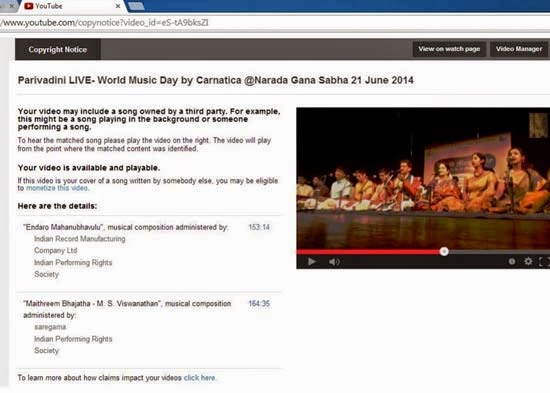
Parivadini, a music channel that uplo­ads performances of Carnatic
classical music, including renditions of compositions of the legendary
Thyagaraja (1767-1847)—composer of over 24,000 songs of which about 700
are extant—is the most recent victim. It had, after taking permission of
the organisers and per­f­ormers, uploaded live webcasts of concerts of
Carnatic music where Thya­garaja’s com­positions were being sung. 

Last
month, Parivadini got a notice of copyright infr­ingement from YouTube
for a recording it uploaded, as a music label claimed the Thyagaraja
composition (and not that particular recording—they claim, ludicrously,
ownership to the original composition itself) as their property. When
contacted, YouTube responded that when Parivadini submitted a counter
not­ification, the matter was probed and the video reinstated. 

“But it
is not just a one-off incident,” says Lalitharam Ram­achandran,
co-founder, Parivadini. “It’s a constant fight between YouTube music
channels like ours and music com­panies. And this case-to-case-based
sol­u­tion by YouTube is not a permanent one. For the channels it
becomes a nuisance.” ….

….
Adds Carnatic vocalist Sangeetha Siva­k­umar, “It
is sad that music labels make such claims. It shows their insensitivity
and lack of understanding of our art form.”


….
Musicians say the algorithm which YouTube uses to identify potential
infri­ngements needs to modified to make it sensitive to the demands and
intricacies of classical music. There should not be blanket application
of technology to all forms of music without understanding the nuances.
The continuing potency of ‘copyright claims’ vis-a-vis YouTube poses
problems, threatening the very survival of music channels. 

If they
rec­eive three copyright (CR) strikes, or three legal notices claiming
copyright vio­lations, the channel itself gets terminated. Even a single
CR strike leads to loss of access to several YouTube features. Of
course, when a channel faces a partial crackdown or a total blackout, it
is denied a fair opportunity to make money too. If copyright violation
claims go undisputed, the money goes to the labels. S.A. Karthik, a
Bangalore-based lawyer and a musician, finds it hard to believe that
anybody can claim copyright over the compositions of Thyagaraja, because
they are clearly in public domain.


Clearly, there is a need to distinguish between ground-level
copyright over com­positions and copyright over sound recordings
performed by artistes. Anybody who deals in a sound recording, the
rights to which have been acquired by a recording label, without the
latter’s permission, infringes the label’s copyright. 

But anybody who
wishes to perform the same composition as that of the recording can do
so without permission from the music label, as long as it is in public
domain. This is because there can be no copyright over such songs.
“Under present laws, copyright protection on a particular artwork lasts
for a period of 60 years after the death of the artiste. But in this
particular case, since there are no descendants of Thyagaraja who can
claim copyright, and he has been long dead, there can be absolutely no
claim of copyright on his songs,” says Shamnad Basheer, formerly with
Intellectual Pro­perty Law at the National University of Juridical
Sciences. 

“But what is happening is that music companies claiming
copyright over the compositions are foo­ling the public,” he says. What
they are doing is known as ‘copyfraud’, where they lead the public into
believing that they are the true copyright holders of var­ious artworks,
and thus extract royalty from unsuspecting small channels.


….
This is not unique to classical music. A lot of collecting societies
(those who man­age the rights to music on behalf of labels) have been
doing this—they extract money from restaurants, clubs and so on,
claiming copyright over the music being played. 

…..
Copyright lawyers say
the reason why it still continues is because big labels still haven’t
been confronted by an opponent strong enough for a bare-knuckle showdown
in court. “These are big com­panies with resources, unlike small music
channels like us, who often do not engage in fightback,” says
Lalitharam.


….
The need perhaps is for small cha­nnels to come together and fight as
a group. At stake is the survival of a relatively niche space like
Carnatic music on YouTube.

…..
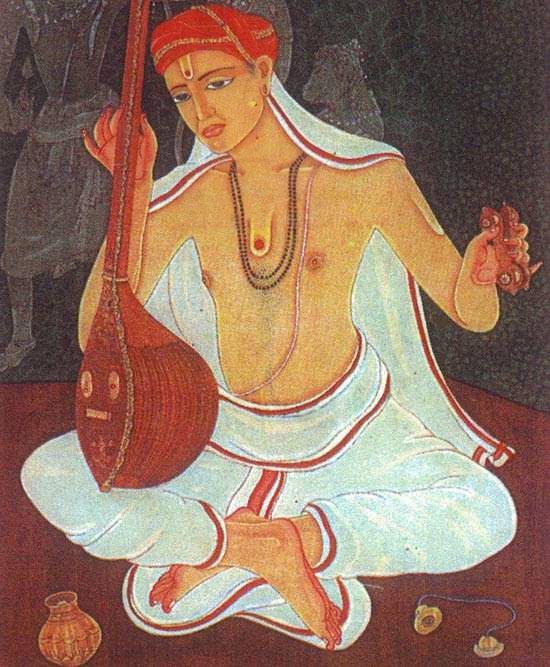
[ref. Wiki] Kakarla Tyagabrahmam (May 4, 1767 – January 6, 1847), colloquially known as Tyāgarāju or Tyāgayya in Telugu, Tyāgarājar in Tamil, was one of the greatest composers of Carnatic music or Indian classical music. 

He was a prolific composer and highly influential in the development of the classical music tradition. Tyagaraja composed thousands of devotional compositions, most in praise of Lord Rama, many of which remain popular today. Of special mention are five of his compositions called the Pancharatna Kirtis (English: “five gems”), which are often sung in programs in his honor.

Tyāgarāja began his musical training under Sonti Venkata Ramanayya,
a music scholar, at an early age. He regarded music as a way to
experience God’s love. His objective while practicing music was purely
devotional, as opposed to focusing on the technicalities of classical
music.  

….
He also showed a flair for composing music and, in his teens,
composed his first song, “Namo Namo Raghavayya”, in the Desika Todi ragam and inscribed it on the walls of the house.


After some years, Ramanayya invited Tyagaraja to perform at his house in Thanjavur. On that occasion, Tyagaraja sang Endaro Mahaanubhavulu, the fifth of the Pancharatna Kritis.
Pleased with Tyagaraja’s composition, Ramanayya informed the king of
Thanjavur of Tyagaraja’s genius. 

….
The king sent an invitation, along with
many rich gifts, inviting Tyagaraja to attend the royal court.
Tyagaraja, however, was not inclined towards a career at the court, and
rejected the invitation outright, composing another kriti, Nidhi Chala Sukhama (English: “Does wealth bring happiness?”) on this occasion.


….

Angered at Tyagaraja’s rejection of the royal offer, his brother threw the statues of Rama Tyagaraja used in his prayers into the nearby Kaveri river. Tyagaraja, unable to bear the separation with his Lord, went on pilgrimages to all the major temples in South India and composed many songs in praise of the deities of those temples.
….
It is said that a
major portion of his incomparable musical work was lost to the world
due to natural and man-made calamities. Usually Tyagaraja used to sing
his compositions sitting before deity manifestations of Lord Rama, and
his disciples noted down the details of his compositions on palm leaves.
After his death, these were in the hands of his disciples, then
families descending from the disciples. There was not a definitive
edition of Tyagaraja’s songs.


The songs he composed were widespread in their popularity. Musical experts such as Kancheepuram Nayana Pillai, Simizhi Sundaram Iyer
and Veenai Dhanammal saw the infinite possibilities for imaginative
music inherent in his compositions and they systematically notated the
songs available to them. Subsequently, indefatigable researchers like K.
V. Srinivasa Iyengar and Rangaramanuja Iyengar made an enormous effort
to contact various teachers and families who possessed the palm leaves.
K. V. Srinivasa Iyengar brought out Adi Sangita Ratnavali and Adi Tyagaraja Hridhayam (in three volumes). Rangaramanuja Iyengar published Kriti Mani Malai in two volumes.


Out of 24,000 songs said to have been composed by him, about 700 songs remain now. In addition to nearly 700 compositions (kritis), Tyagaraja composed two musical plays in Telugu, the Prahalada Bhakti Vijayam and the Nauka Charitam. Prahlada Bhakti Vijayam is in five acts with 45 kritis set in 28 ragas and 138 verses, in different metres in Telugu. Nauka Charitam is a shorter play in one act with 21 kritis set in 13 ragas
and 43 verses. The latter is the most popular of Tyagaraja’s operas,
and is a creation of the composer’s own imagination and has no basis in
the Bhagavata Purana.

Tyagaraja Aradhana, the commemorative music festival is held every year at Thiruvaiyaru
in the months of January to February in Tyagaraja’s honour. This is a
week-long festival of music where various Carnatic musicians from all
over the world converge at his resting place.
On the Pushya Bahula
Panchami
thousands of people and hundreds of Carnatic musicians sing the five
Pancharatna Kritis in unison, with the accompaniment of a large bank of
accompanists on veenas, violins, flutes, nadasvarams, mridangams and ghatams.

A crater on the planet Mercury is named Tyagaraja.

…..


Link: http://www.outlookindia.com/printarticle.aspx?291416

…..

regards

Their Bahu our Beti (we all love her)

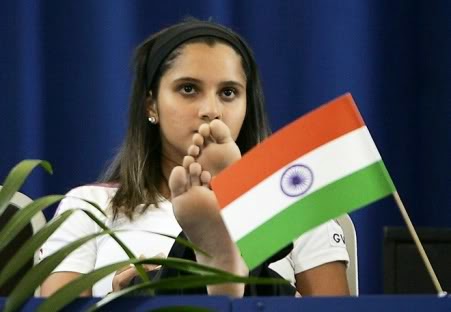
…..Sania blamed patriarchy for BJP leader’s sexist remark, saying “we live
in an extremely male chauvinist society (and) unfortunately have to deal
with this as women”…..I have an Indian
passport and am (still) playing for India”…..”I do not know
whether it happens in any other country where you have to keep proving
that you are from that country. Is it because I am married to someone
from another country? Is it because I am a woman?”….

….
There are many different layers of stupidity. You question some-one’s nationality and patriotism, a person who has made India proud on the global stage. You harm relations between neighbors, working against the goals supposedly set by your own Leader. You insult women in general by implying that a bahu (daughter-in-law) will have to change her identity upon marriage.

…….
But let us say all is fair in war (politics). You are advertising the fact that Telengana is a muslim-heavy state (historically the kingdom of Nizam) where you plan to capture votes by pitting the sons-of-soil (that magical word) against the invaders. The reason why Sania Mirza is an outsider is not because she was born in Bombay, but because her ancestors (men) came from Middle-East and Central Asia.


The effect of this (and the forcing chapati down the throat business) is that muslims will never consider voting for the BJP (reason #101). There will be no reconciliation between a party/organization that dreams of being the natural ruling party of India and the largest minority. That makes (politically) very little sense to us.

……
Now consider the fact that Sania Mirza has faced adversity off the court before as well…from muslims!!! Conservatives complained that she wears shorts (which infringes on modesty) and issued fatwas against women playing tennis (or presumably any sport). Sania of course faced down her opponents with grace and determination (just as she is doing now). BJP should be supporting Sania and (Muslim women in general) who would like to throw away the chains. These women can help provide backing for an Uniform Civil Code which is an important political plank for the BJP.

BJP rose to power on the back of Mandir politics. The slogan was “Garv se kaho hum Hindu hain” (say proudly that you are a Hindu). It is time to update the slogan as “Garv se kaho hum Bharat-vasi hain” (say with pride that we are Indians). It is the wise thing to do, it is also the right thing to do.
……………….
Indian tennis star Sania Mirza, a Muslim wed to a Pakistani
cricketer, broke down in tears Friday after being described by a Hindu
nationalist politician as “Pakistan’s daughter-in-law” and unfit to be
an Indian representative.

………..
Mirza, 27, who is married to Pakistani
cricketer Shoaib Malik, wiped away tears as she told India’s NDTV
network she was tired of continually being forced to defend her
“Indianness”.

“I am a very patriotic person that is why I am so
emotional right now,” Mirza, who wed Malik in 2010, said in the
interview aired on television.

In comments reported earlier this
week by local media, K. Laxman, a regional legislator belonging to the
national ruling Bharatiya Janata Party (BJP), questioned the credentials
of Mirza to be “brand ambassador” for the country’s newest state
Telengana in southern India.

Laxman was quoted as saying Mirza’s marriage to Malik made her a
“daughter-in-law” of Pakistan, India’s Muslim neighbor and
nuclear-armed rival with which the mainly Hindu but officially secular
country has fought three wars.

Telangana, carved this year out of
the state of Andhra Pradesh “is proud of Sania,” said in appointing her
brand ambassador for the region.

Mirza grew up in the city of Hyderabad in what is now Telangana.

“Fans
across the country don’t think her Indianness has gotten mysteriously
diluted,” because of her wedding to Malik, the Times of India said in an
opinion-page piece.

Mirza, who has played for India at all
major-level sporting events, has been defended by leaders across the
political spectrum, including BJP members who said its party member’s
comment did not reflect its official stance.

Mirza earlier this
month achieved a career-best rank of number five in the world when the
new World Tennis Association doubles chart was released.

“After
winning medals for India after I got married, (I) don’t know why I have
to keep justifying that I am Indian,” Mirza told NDTV.

The latest
incident is seen as potentially further fanning concern among Muslims
and other religious minorities over Prime Minister Narendra Modi’s Hindu
nationalist BJP government.

The controversy has erupted just days
after some MPs from the Hindu right-wing Shiv Sena tried to forcibly
feed a chapati – an Indian flatbread – to a Muslim restaurant manager
fasting for Ramadan because they were unhappy about food at a government
canteen.

The lawmakers belonging to Shiv Sena, a BJP ally, said
they had not known the canteen supervisor was Muslim and they were
complaining because the bread was so hard it “didn’t even break”.

……

Link: http://www.dawn.com/news/1121562/sania-cries-over-pakistans-daughter-in-law-taunt/

…..

regards

Irony of ironies

So it seems that Indians (or Pakistanis or Dravidians of the Indus) got to Australia before the current crop of Brit-Australians (whose descendant now go and attack Indian students for being “foreign”). Reality is so much stranger than fiction.

http://www.australiangeographic.com.au/news/2013/01/aboriginal-genes-suggest-indian-migration/

Proof (Browns are sand-niggers)

“Just as your capital is welcome here to produce good-paying
jobs in the U.S., I’d like our capital to be welcome there,” he said. “I ask
cooperation and commitment and priority from your government in so doing. Can I have that?”…..The question prompted a lengthy pause and looks of confusion
from State Department and congressional staff…….”I think your question is to the Indian government,” Biswal
said. “We certainly share your sentiment, and we certainly will advocate that
on behalf of the U.S.”………

 ……
We recommend an immediate embargo on the appointment of any new Indian-Americans as front-line officials. It is not healthy for the country’s (or a section of it) self-image as a Christian, White nation (btw did you know that Jesus was white and had blonde hair and blue eyes?).

That said, we are (easily) impressed. A Tea Party politician claiming to be a fan of Bollywood? Right now people are planning for a special lecture to be delivered to a joint session of the Congress by our Maha-Purush (Great Man). Make sure that you sign the petition, sir-ji!!!

………………
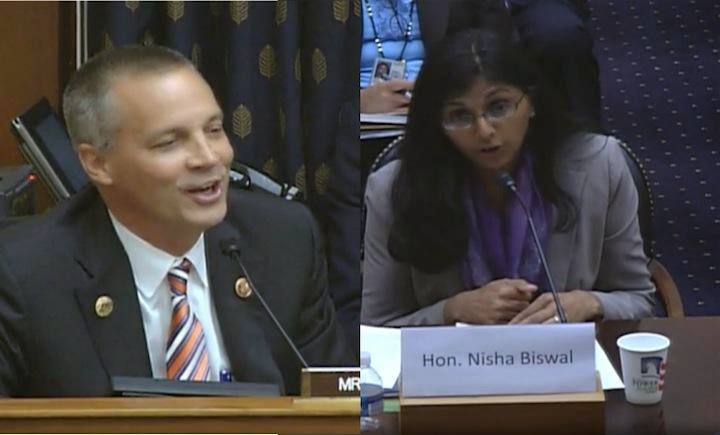
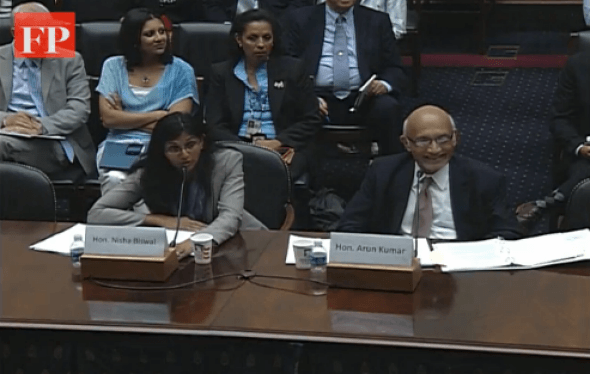
In an intensely awkward congressional hearing of the House Foreign Affairs Committee on Thursday,
freshman Rep. Curt Clawson misidentified two senior U.S. government officials as
representatives of the Indian government.


….

The two officials, Nisha Biswal and Arun Kumar, are Americans
who hold senior positions at the State Department and Commerce Department,
respectively.
Although both Biswal and Kumar were introduced as U.S. officials
by the chairman of the Asia and Pacific subcommittee, Clawson repeatedly asked
them questions about “your country” and “your government,” in reference to the
state of India.


….

“I’m familiar with your country; I love your country,” the
Florida Republican said. “Anything I can do to make the relationship with India
better, I’m willing and enthusiastic about doing so.”


….

Apparently confused by their Indian surnames and skin color,
Clawson also asked if “their” government could loosen restrictions on U.S.
capital investments in India.


“Just as your capital is welcome here to produce good-paying
jobs in the U.S., I’d like our capital to be welcome there,” he said. “I ask
cooperation and commitment and priority from your government in so doing. Can I have that?”


….

The question prompted a lengthy pause and looks of confusion
from State Department and congressional staff attending the hearing.
“I think your question is to the Indian government,” Biswal
said. “We certainly share your sentiment, and we certainly will advocate that
on behalf of the U.S.” 

………….

It’s extremely uncommon for foreign officials to testify before
Congress under oath. Even so, it’s unclear if at any point
Clawson realized his mistake, despite the existence of a witness list
distributed to the various members detailing Biswal and Kumar’s
positions. Clawson’s office did not respond to multiple requests for
comment. 


….

During the hearing, he
repeatedly touted his deep knowledge of the Indian subcontinent and his
favorite Bollywood movies. None of his fellow colleagues publicly called him
out on the oversight — perhaps going easy on him because he’s the new guy.


….

The Tea Party-backed lawmaker won a special election last month
to fill the seat of Trey Radel, who resigned after being convicted for cocaine
possession. Clawson pitched himself as an outsider with private sector experience and touted his role as chief
executive of an aluminum wheel company.


….

Thursday was Clawson’s first day sitting on the subcommittee on
Asia and the Pacific. He was named to the full committee July 9. Subcommittee
Chairman Steve Chabot (R-Ohio) promoted Clawson’s deep international business
acumen and knowledge of four languages in welcoming him. “Our newest member of
this committee, Curt Clawson … speaks four languages and all kinds of other
great stuff,” Chabot boasted.


The gaffe comes as members of Congress seek to strengthen U.S.
ties to the world’s largest democracy following the election of Indian Prime
Minister Narendra Modi this spring. Lawmakers are circulating letters to have Modi address a joint session
of Congress.


….

Following Clawson’s opening statement, Rep. Eliot Engel, the
full panel’s ranking Democrat, appeared eager to point out that Biswal and
Kumar work for the United States. “Thank you both for your service to our
country, it’s very much appreciated,” New York’s Engel said.


….
Update: While Clawson’s office did not respond to a request for comment, the congressman apologized in a statement to USA Today later
on Friday. “I made a mistake in speaking before being fully briefed and
I apologize. I’m a quick study, but in this case I shot an air ball,”
he said.

…..

Link: http://thecable.foreignpolicy.com/posts/2014/07/25/exclusive_freshman_congressman_mistakes_senior_government_officials_for_foreigners

…..

regards

Partition Tales (silent)

I checked the date….only a
few months since they had shifted from Mymensingh in Bangladesh to
Calcutta….My
grandmother was pregnant with my mother….ailing with an infected appendix….She could not make the crossover to
India — passing away in Rangpur, on the Indo-Bangladesh border when my
mother was just about 10 months old…….That was 1948…..

………………….
Who knows how many such diaries – veritable treasures all of them – may be floating around. The dead tell no tales, it is the job of the new generation to ferret out the stories behind all the (inevitable) dislocations and humanize the events beyond TNT and all the one-upmanship political crap.

The new generation is reputed to be shallow and self-centered. Not really, just the youth are puzzled by us oldie-foggies and our particular fights and resentments. They are also not too impressed by ideology and propaganda dressed up as history. They want to know the truth for themselves. Sometimes they see the truth openly laid out while the (willfully blind) oldies remain content by farting at the general direction of their (imagined) enemies.

This bangal girl sure has lots of initiative and spunk. We are thankful (and grateful), but we still hope that she goes the last mile to see the diary published. It will be a sensation for sure!!! 
……..
Recently, I went on a whirlwind trip to see my ailing parents. Once
there, I heard that my aunt, who lives alone since my uncle passed away,
is unwell too. I dropped by to see her with some sundry stuff – and
since I cannot keep my brain from working overtime – imagined myself a
grown-up Little Red Riding Hood out to do some good.


………

Anyway. Once there, we talked about old things. The new things were
more attractive though — a pair of kittens managed to make themselves
comfortable on her porch sofa — including their mother. I also
remembered to check the electrical main switch down by her staircase –
it had been sputtering during the rains, and she had had to call for
help to put it right.


Checking done, I thought of looking over the heap of old books in
there. And what should I find, but an old rusty iron suitcase that
belonged to my grandfather! I wasn’t allowed to touch it as a kid — for
they feared my mischief-making prowess. However, I knew it housed a
diary apart from numerous other papers – and the diary had priceless
details about his life — his concerns over finances, his daughters’
education, new-fangled medical theories and drugs
. I had — without
anyone’s knowledge — already read parts of the diary when in high school
— under the pretext of cleaning the mess that was her staircase.


Now, of course, my aunt readily handed the suitcase over to me. She
does not see very well, and rued that I didn’t have enough time to read
the letters aloud to her.


Nevertheless, I did open a letter and read it aloud. It was a
resignation letter. My grandfather was quitting his school in
Lalmonihaat (now in Bangladesh) owing to some personal tragedies and
other factors. He had already worked in the school for 28 years, and was
requesting for 4 months’ bonus as a full and final settlement.


I checked the date — It was dated 1948. I remembered, and my aunt
confirmed that it was the year of her mother’s death. It had been only a
few months since they had shifted from Mymensingh in Bangladesh to
Calcutta owing to communal tensions during India’s bloody partition. My
grandmother was pregnant with my mother before that, and was already
ailing with an infected appendix. She could not make the crossover to
India — passing away in Rangpur, on the Indo-Bangladesh border when my
mother was just about 10 months old. That was 1948.


What must have been my grandfather’s thoughts, with four young
children, and none to advise or confer on the next course of action? My
grandfather was the oldest amongst his siblings — and everyone looked up
to him for guidance. What would this man have endured during those
crucial months when survival was at stake?


As I thought these over, I fingered a newspaper cut-out beneath the
letter. As I opened it — I saw a map of undivided Bengal plotted and
marked according to communal lines. Areas with a majority of Hindus were
shaded black. These were the western and northern parts of Bengal.
Those with a Muslim majority were shaded grey — and a few areas were
checquered indicating a rapidly increasing Muslim population.


A strange sensation overwhelmed me as I stared at that map. I could
feel the turmoil that my grandfather had possibly felt as he had cut it
out of the newspaper after careful study. Perhaps he had thought that
someone would have the time to reflect on it in better times.


And a reflection it is — of us and the institutionalised brainwashing
that characterises our education and nationalist propaganda. I have
studied in one of the best schools and colleges in my country. My
country is India and I have never felt myself as anything beyond an
Indian. I know all that is told to us about our freedom struggle. I also
know about the blood-bath that marked the partition of India. I knew it
all from the comfortable nonchalance of a third-person perspective.
Nothing in life prepared me to face the plight that marked the life of
my grandfather — a generation that lived and breathed in an undivided
Bengal.


My grandfather was a professor of Sanskrit. He had studied at a
Sanskrit school in Mulajor on the western (now Indian) side of undivided
Bengal. From what I heard from my mother and aunts, he was highly
energetic, and pursued several interests that included reading, music,
playing at cards and cricket. He had many friends in Calcutta, and was
no doubt, a very sociable and resourceful man. He was a favourite with
his mother-in-law; the friendship lasted till the end — and the two
passed away in quick succession, within a span of a single day.


Had he lived today, my grandfather would probably not have understood
the pejorative undertones we associate with a theocratic Bangladesh. He
would have probably shaken his head at the dogma fed to our
impressionable minds about India being surrounded with enemy states.


On another note, it is possible that he would have understood every
bit of this. After all, it is but a basic tenet of statecraft to
organise and motivate a gullible public by giving them a collective
dream to nurture and protect. The flip side of this mass movement is of
course the extremism that blighted the hopes of millions as Hindu and
Muslim blood flowed on the streets of India.


What would have been the experiences of a man forced to leave the
country of his birth and seek employment in a land that suddenly
regarded him “foreign”? It would have been the early days of the slang
“Bangal” attributed to those who migrated from Bangladesh — and largely
held responsible for over-populating West Bengal and skewing
its economy. It doesn’t mean much to us today — descendants of “Bangals”
who brought about a social reformation in Bengal through their modern
outlook and work culture. Necessity forced “Bangal” women to step out of
their homes and earn a living — and I thank them for that.


Stories such as theirs have been conveniently tucked within the
cracks of history. It is not surprising, though, because  what
distinguishes the likes of my grandfather is their inability to turn
blind in the face of a collective tomfoolery. In his having to leave the
land of his birth resides the sordid story of our national leaders —
who sought to further personal ambitions by feeding off the mass
hysteria generated by India’s independence.


I’m not writing this simply to indict our leaders on an issue
analysed and talked about ad nauseam. There are enough contemporary
issues to do that. I’m writing this as part of my self-appraisal — as I
continue to live my life and evaluate the factors that shaped me. My
grandfather’s suitcase gives me that window through which I can
contextualize and understand the thoughts and motivations of scores of
people — relatives — that I hardly knew and understood less.


I cannot help wonder how life would have been had the fell swoop of
partition not puckered and tainted the seams of thought that bind me to
the past.

…..

Link: http://halfastory.wordpress.com/2011/07/09/my-grandfathers-suitcase/

…..

regards

No home but Rome

He would start off with – Bandhu! kaimun acchen? After the usual Bhalo and Ami-o Bhalo, there would be the usual bari kothaye and questions about Italy….Some would be arrogant and say their bari is Rome and dont know any other bari (bari = home)….dad would nod his head disappointingly and mutter – arrogant bastard, forgetting his roots.
……
We are especially fond of quoting Tariq Ali Sahab but this comment can come from any South Asian (non-Indian, non-Hindu) blogger.

Why they ask – when India has such a brutal record as certified by the Goddess of Aymanam (you just got to love Malayalam word-mixtures – Ay is Tamil for five, Vanam is Sanskrit for forests, Aymanam is the land of five forests- ref. Wiki) – why does India get such nothing to see here just move on press, while other countries in South Asia (mainly Pakistan) get such bad press?

We were curious about this as well. While the international press certainly played up the liberals think Modi/RSS is the devil incarnate theme, they were also (in our opinion) receptive to the Vikaas Purush (god of development) image that Modi was selling (toilets before temples etc). They liked the fact that he comes from a humble back-ground. They really really liked the fact that he is a lower caste Shudra. We may have imagined it but there was tacit appreciation of the fact that India does need a strong leader to make its way in the world….

…..That said we feel there is something more than all the above…..


That elusive factor (in our opinion) is that the West (politicians, press, public to some extent) do not simply see Hindus as a threat. They see Hindus integrating into Western society in fairly large numbers and doing well. Their interactions with India (business, sports-IPL, medical tourism) may be frustrating but manageable. They see India well integrated into the Western-Westminister model. They may even feel that India is doing a good job of keeping 1.3 bil people calm and peaceful (relatively). To the extent they think that BJP is going to keep muslims down, they may even approve of this (in small doses). Common enemies and all that.

OTOH the West is scared shit of muslims (also Chicoms). They really think that the Taliban may one fine day capture the nuclear arsenal. A muslim man is automatically considered a terrorist (unless proven innocent). You want sharia laws, you keep women in burqas, your mosques are taking over ancient pubs, you want to even islamize schools. You want to join  the jihadis in Syria, fine, just go and dont come back. BTW did you know that muslim snitches are highly valued by MI6/FBI/CIA, you can make some serious money by acting funny in the mosque? Deal??

The point is that (we imagine) the societal pressure on a South Asian immigrant from muslim background will be much more intense (as opposed to non-muslims). If asked (even by fellow browns) they may be forced to say something like Rome is our home not Rangpur. That is sad and even a bit pathetic. Or maybe it is all our imagination. Sorry to have wasted your time.
…………
Amar

I think I have been witnessing, in little visual
sightings over 4 years, the rise of the Bangladeshi community in Italy.
 

In the early years, they were selling umbrellas and knick knacks on
street corners, carrying everything they sold. Then I started seeing
them behind the counter in semi-permanent and corner shops, and in
restaurants, as waiters and chefs.

Then I saw that some of them
had their own small shops, and I even found a place with Bangladeshi
candidates for rival parties competing in local elections.

This
year, for the first time, I saw that women had followed the men, and I
saw families together – man, woman, and little children. These families
were not selling products, they were checking out things like normal
family on weekend,
and then to cap it all, I even saw overly ghettoised
Bangladeshi teens, in expensive sneakers wandering on their own.

I feel like I have seen community evolution in high speed.

Akbar

My
father just picked on any Bengali vendor whenever i was busy looking
for a street on the map – one of his ways to keep himself entertained.

He would start off with – Bandhu! kaimun acchen? After the usual Bhalo and Ami-o Bhalo, there would be the usual bari kothaye and questions about Italy and waghiara waghaira, and directions – which bus to take etc.

Some would be arrogant and say their bari is Rome and dont know any other bari (bari = home), and dad would nod his head disappointingly and mutter – arrogant bastard, forgetting his roots.

Near the colloseum, dad combined an old Pakistani film dialogue into his own – Yeh woh jaga hai jahan Rome kay zaleel kuttay kharey hokar tamasha dekhtay tey. I responded – Ab Bengali kharey hotay hain!!

We bought coconut slices and fruit salad from a Bengali vendor. In the heat the taste was heavenly.

……

Link: http://www.amar-akbar-anthony.blogspot.in/2008/10/a-on-italys-deshis.html

…..

regards

Brown Pundits