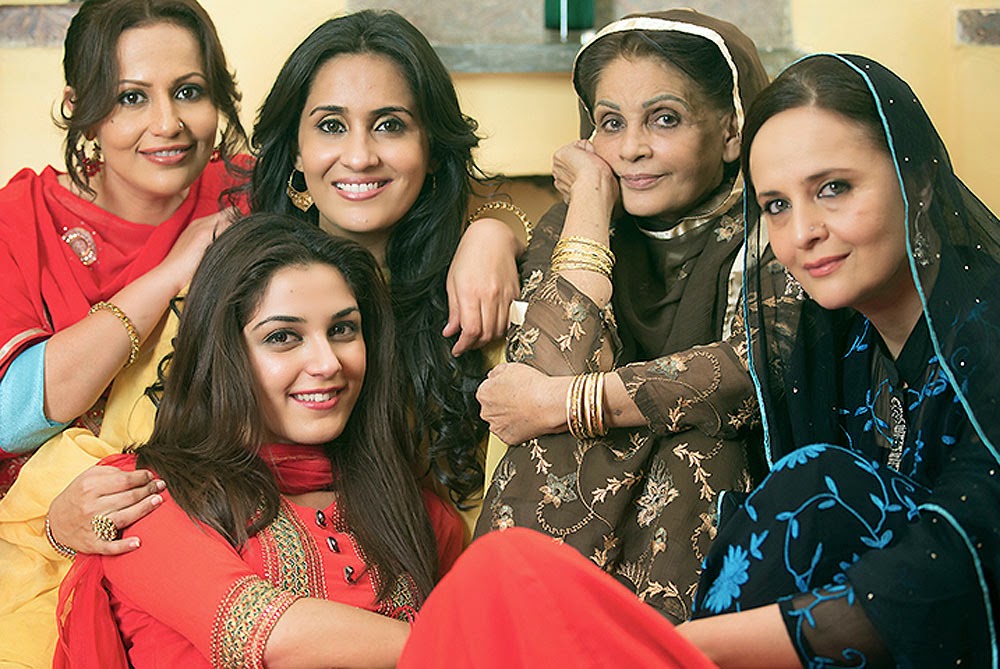
Aunn Zara (pitch-perfect Punjabi)

Zindagi Gulzar Hai….“I felt like I was caught in a
time warp”… Ritu can relate, she grew up in Delhi listening to
stories from the old Punjab narra­ted by her grandmother who had
mig­rated to India during the Partition.

The story of four great languages of South Asia (yes, all other languages are great as well).
Punjabi has faced tremendous head-winds following partition but is now enjoying a renaissance (one problem is that Punjabi Hindus prefer Hindi).
Bangla has benefited due to an independent Bangladesh which fought for the right to speak the language (Bengalis on both sides of the border are united in their love for the language).
Hindi marches on as the national language of India (and now preferred by the Prime Minister when speaking to foreign dignitaries), even though historically it had faced tremendous resistance in the South (and now only Tamil Nadu is proud to be an outlier). With BJP coming to power the Hindu-Hindi camp will be further strengthened.
Urdu has faced ups and downs, it is the national language of Pakistan, but it has been vilified as the language of Muslim invaders (85% of  India) and next as the mother tongue of Pakistani imperialists (50% of Bangladesh), and now it is also under threat from Sindhi and Pashto (and Punjabi).

All these one-time great languages (even Tamil) will ultimately lose out to English as it is the language of the elites…..even your (English) accent can identify your place/class in society. As an indicator- Hinglish is now officially permitted in Govt communications in India.

Thus it is wonderful to see people appreciating cultural treasures in their own language. From an Indian perspective, it points to a bygone era (similar to Mad Men). The generation that loves this stuff will gradually die away. In the meantime Pakistan is slowly losing out to the charms of Turkish TV. Ultimately we will all be drowned in the same-same hybrid culture with no meaningfulness. And worst of all, no appreciation of proper pronounciation!!!
…………….

  • Zindagi Gulzar Hai
    The story is about Kashaf Murtaza and her two sisters who are
    brought up by a single mother. Kashaf marries rich boy Zaroon Junaid,
    the serial traces their ups and downs.
  • Aunn Zara
    A coming-of-age story of young couple Aunn and Zara and how they
    come to terms with family, responsibility, freedom, friendship, love.
  • Kaash Main Teri Beti Na Hoti
    The tragic tale of a young girl sold off to a married man, and her travails later.
  • Kitni Girhain Aaki Hain
    A satire based on the ironies and harsh realities of a young woman’s life in Pakistan.

……….
A young woman in her 20s sits scribbling under a fluorescent lamp in a
dimly-lit room. Her thoughts are those of any girl her age—marriage, a
career and the general struggle of getting by. Zindagi Gulzar Hai,
a Pakistani serial now being aired on Zee Zindagi, started off on this
rather mundane vein but it’s struck an instant chord with viewers, at
least in north India. 

Launched this June, Zee’s new and much-hyped
channel has four Pakistani serials capturing the mood on the other side
of the border. Shailja Kejriwal, Zee’s chief creative officer, special
projects, spent nearly two years scrolling through and handpicking
content that would resonate with Indian audiences. Next on the line is
something more substantial—Pakistani films.


….
“The basic idea was to reacquaint Indian audiences with culture from
acr­oss the border. Pakistani television has bought a lot of content
from here, including daily soaps and Bollywood films. So this is a great
way for us also to connect, both at the audience level and at an
art­istic and cultural level,” says Shailja. And it seems to be working. 

Ardent TV soap add­ict Ritu was ecstatic after watching the first
episode of Zindagi Gulzar Hai. “I felt like I was caught in a
time warp,” she says. Ritu can relate, she grew up in Delhi listening to
stories from the old Punjab narra­ted by her grandmother who had
mig­rated to India during the Partition.


The initial surge in viewership is also an indication of how parched
Indian viewers are for balanced and bona fide characters. Compared to
Indian soaps, with its women always in gaudy dresses, make-up and
jewellery (even at the breakfast table!) and its over-the-top melodrama,
the imports from across the border do seem more realistic and less
shrill. Mani Sandhu, an avid viewer from Punjab, writes on Facebook: “Aunn Zara
is a fresh kind of story. My mother, who hardly watches television, is a
big fan of the serial because of the characters, the pitch-perfect
Punjabi accent, reminiscent of ’60s Punjab.” 


Now this is no new phenomenon. For decades, Indian audiences had been hooked to Pak serials like Humsafar, Dhoop Kinare and Ankahee, before the great transition took place at home with Kyonki Saas Bhi Kabhi Bahu Thi. 

“Compared to the Indian soaps, the acting is much better in Pakistani
serials. They also look more realistic and are more slow-paced than
American soaps,” says media critic Shailaja Bajpai. “In Zindagi Gulzar Hai,
the plot is clear by the second episode. It also has a youthful appeal.
The serials talk about women empowerment and problems faced by
middle-class families…which makes it all the more relatable.”


….
But not all Pakistani serials are about strong women or progressive families. Take Kitne Girhain Baaki Hai,
which deals with honour killing. The protagonist, a young girl, is
killed by her bro­ther bec­ause she marries against the family’s
wis­hes. The serial then doesn’t quite den­­ounce this ghastly act, with
none of the male characters, especially the girl’s father, repentant
about what they have done. The female characters, though educated, still
lead a retrograde life, taunted for being divorcees. They have to
remain low-key and, of course, there are the aforementioned honour
killings.


….
The top Indian soaps, in that sense, are a lot more ‘modern’. Diya Aur Baati Hum
in fact has a heroine fighting a feudal mindset to become a top cop. So
why are Indian viewers lapping up the Pakistani stuff? “Well, the
situations shown in these serials are certainly more realistic,” says
Shashi Mittal, who has scripted Diya Aur Baati Hum. “Some of
them do have outdated themes but there is still a large audience in
India which is yet to come to terms with modernisation. Our audience is
huge, it can absorb both types of content—medieval as well as modern.”


….
Navjot Gulati, who’s penned the script for Shoojit Sircar’s runningshaadi.com,
says deep down Indian society is as reg­ressive as Pakistan’s. “But I’m
glad Paki­stani serials are being shown. At least, the Indian serial
writers will be forced to write better scripts. Back in the ’90s, Indian
TV was as good as the films, but now the focus is numbers rather than
creativity. The corporate structure is flawed and most good writers are
not interested in writing for television.” 

The best script, then, would
be if a serial pops up with the realism/nuances of a Pakis­tani soap but
with a more gutsy storyline on women and the ills of society.

……..

Link: http://www.outlookindia.com/printarticle.aspx?291364

……

regards
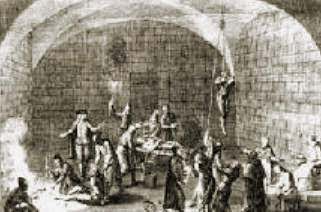
Inquisition, Reconquista and (World Cup) Football

“These children[converts]….Their hatred for idolatry is marvelous….whenever their own
parents practise it, they reproach them and come off to tell me at once….Whenever I hear of any act of idolatrous worship, I go to the place
with a large band of these children…The children run at the idols, upset them, dash them down, break them to pieces, spit on them, trample on them, kick them about, and in short heap on them every possible outrage” – Francis Xavier, inspiration behind the Goan inquisition

……..
The ‘national guide’ of the
HJS [Hindu Jagran Samity], Charudutta Pingle, was quoted saying that Goans supporting
Portugal in the ongoing World Cup would be “rubbing salt on injuries
suffered in history”

……….

As expected, people are complaining that the burden of “history” is being unfairly foisted on their shoulders.  There are a number of outstanding issues but the Goan Inquisition ranks foremost in the minds of the people whose ancestors were mercilessly persecuted for three centuries for being idolators.

History traditionally has been written by the winners and all over India the sons of Abraham are retreating in face of a relentless onslaught by the sons of Hanuman et al. The plea (from the afflicted minorities) is for an inclusive society so that all communities can co-exist and prosper in a secular republic. 

Indeed we should aim to build an India where it is possible to celebrate the victories of Pakistan (Sunnis for Saeed Ajmal) and Portugal (Catholics for Cristiano Ronaldo). The problem is that the burden of history will not go away by pretending it does not exist. Something must be done, else the poison keeps contaminating the community well.

First and foremost, the Ram Sena and others are pathetic bullies and they do a lot of harm. They are a bit like the bumbling Shia gangs of Iraq (to use an imprecise analogy). Full of reckless bravado, they create disorder and disharmony amongst the people. When the Caliphate troops show up on the scene, they disappear out of sight. They ride on a river of historical grievances but they do not seem to be able to learn from history.

This is the most important question: why the nations that were India so weak that they allowed Portugese (and others) to terrorize from Bengal to Gujarat? The answer is obviously complicated but can be reduced to one word: CASTE (based discrimination).  

Until and unless Indians realize that it was their own fault that led to a “thousand year slavery” no historical exercise will be complete.

Now to move on to the Portugese and the Catholics of Goa.

When the Portugese empire was rising it killed off (or converted) all the Moors (muslims) in the Iberian peninsula. This was as an integral part of the reconquista campaign led by Christian armies from 711AD – 1492AD (fall of Granada). Not only were the muslims (who were considered as invaders) massacred but the Jews as well.

If the thinking is that Christian Europe has shed all barbarisms of the distant past and embraced ahimsa then it is legitimate to point out that (i) Portugal was fighting colonial wars as late as the 1970s, (ii) Christians (orthodox) have been engaged in ethnic cleansing against Muslims in Bosnia as late as 1990s (a low-intensity war is still going on in Kosovo and Bosnia), and (iii) Catholics are still fighting Protestants in Northern Ireland today. Moral authority will not come so easily to the Christian Ummah, when foot-soldiers are still fighting in its name.

Right now, a “cultural reconquista” is going on in Goa. It is happening non-violently but it nevertheless oppressive. Since many Goan Catholics have Portugese citizenship (thanks to Antonio Salazar, the dictator “prime minister” of Portugal from 1932-1968), Goans have been able to emigrate to Portugal and then on to other European countries (as allowed by the European Union). One may even say that such voluntary migration is de-facto ethnic cleansing.

All this is wrong and deeply worrying, but do the Goan Catholics have any responsibility so as not to be burdened by “history”? A “Truth and Reconciliation” commission sounds like an excellent idea. Sponsorship of an all-faiths-temple in memory of the hundreds of temples that were destroyed can help close the debate on idolatry. A museum of Inquisition on the lines of the Holocaust memorial (which is strangely enough, located in the USA and not in Europe) can be set-up with some funding from the Church.

The Inquisition files were destroyed in 1812, but then people have long memories (and they will have historians on their side). The Hindu brotherhood is the winner in Goa and elsewhere in India. It is now high time to put the religious poison back in the bottle.
…….

Well
before Narendra Modi’s advent, before his acolyte Manohar Parrikar
could become chief minister in 1994, Hindu fundamentalists have viewed
Goa’s Catholics as an impediment to their larger aim of ‘Bharat’
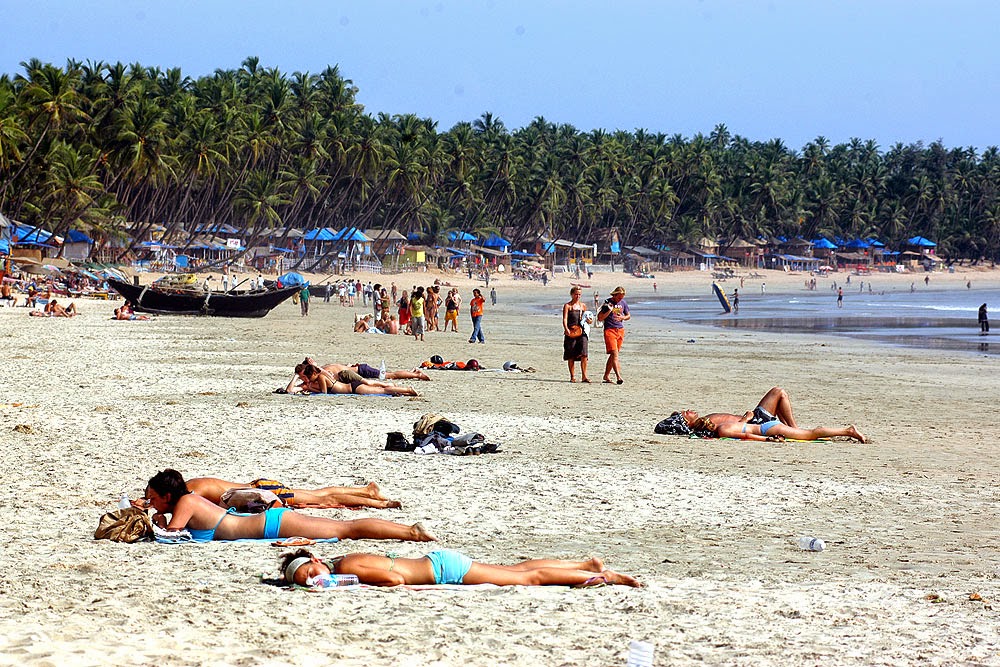
becoming a ‘Hindu nation’. Thanks to the asinine comments of Goa’s PWD
minister Sudhin Dhavalikar urging bikinis be banned and pubs closed
down, it helps to revisit extremist fears
—to see, if nothing else,
whether women visitors to the beach will choose to show him a thing or
two.

Goa’s elected representatives seem largely illiterate in at least
three languages, but hapless, overwhelmed and cornered though he may
have been on TV, Dhavalikar is anything but harmless. It is fitting that
he represents the BJP regime in Goa on behalf of the Maharashtrawadi
Gomantak Party (MGP), its loyal, right-wing ally. 

After all, in the
early ’60s, just freed of colonial rule and still a Union Territory, the
MGP’s founder and Goa’s first chief minister, Dayanand Bandodkar,  had
pushed through an opinion poll to see whether Goa should be merged with
Maharashtra.

Thankfully, he lost—perhaps the sole occasion when Goans came
together, setting aside their differences. 

But Bandodkar spr­ead seed.
For the first time, Goans in the north saw jeeploads of proto-Shiv
Sainiks, armed with tridents and orange flags, spoiling for a fight; or
knew that allegiance to the MGP was now being sought at village temples
in accompaniment to the tinkling of bells and slokas. Bandodkar kept the
MGP a truly populist party; he himself was a charismatic, benevolent,
Peron-like character who played all sides. Under his daughter Shashikala
Kakodkar, who inherited party and post, blatant nepotism entered
political life, but the MGP also changed.

Today, circle complete, it has degenerated into a private firm run by
Sudhin Dhavalikar and his cohorts who consciously cultivate a Hindu
votebank and worse, an ‘us versus them’ mentality—a phenomenon foreign
in the larger annals of Goan consciousness and identity. It may not be a
coincidence that the build-up to Narendra Modi’s ‘massive mandate’ has
blessed a fistful of Hindu extremist groupings in Goa and encouraged
them to move so far right that one more sideways step and they’d fall
off the cliff!

Regardless of their differences, Goans can teach the rest of the
country a thing or two about ‘secular’ traditions. Yet, ironically, for
four years running, they have hosted the All India Hindu Convention
organised by the Hindu Janajagr­uti Samiti (HJS). 

Noted for the specious
attempts to give Hinduism a ‘theology’—the lack of which,
paradoxically, only stre­ngthens India’s strong tradition of
syncretism—the convention is held at the Ramnath temple outside Ponda,
in close proximity to the Shantadurga and Mahalakshmi shrines. Is this
to create a Hindu Vatican, a place to issue fiats from?

The HJS shares bed with the Sanathan Sanstha (SS), to which
organisation Sudhin Dhavalikar swears fealty to, as does his brother and
both their wives. The SS were involved in the bomb blasts in Margao in
2009 and both groups have had fingers pointed at them for the
assassination of Dr Narendra Dabholkar, the much-admired rationalist,
and in the recent murder of the young Muslim software engineer.
Dhavalikar’s ideological men­tor is Pramod Muthalik, self-appointed
patriarch of the Sri Rama Sene, a group on the lunatic fringe of even
the extremists! 

It is sad that Hindu extremists persist with an
afflicted consciousness generated by their khaki-clad historians, adding
fuel to what most Goans, including Catholics, already knew—namely, that
the infamous Inquisition in Goa surpassed its Iberian counterparts in
horror and bloodthirsty zeal.


Those who trumpet this crime ignore Catholics in Goa who shamefully
accept this abhorrent part of their history, while coming to terms with
the fact that one of their ancestors may have converted under the sword.
Such attempts to find truth and accept reconciliation allow for one’s
past to be purged, and identity forged anew in present realities, made
larger and more inclusive.


Is this what really frightens the fundamentalists, what makes them
ferret out the Dark Ages from their history? The ‘national guide’ of the
HJS, Charudutta Pingle, was quoted saying that Goans supporting
Portugal in the ongoing World Cup would be “rubbing salt on injuries
suffered in history”.

It’s worth pondering. If that be the extent of their inclusiveness,
does one think they will stop at just banning bikinis and closing down
pubs?

………….

You were born in New York and went on
to study comparative religion. Why the decision to write about the
Portuguese inquisition in Goa — a whole other world?

About 15 years ago, while doing research for my first novel, The Last Kabbalist of Lisbon,
I discovered that the Portuguese exported the Inquisition to Goa in the
sixteenth century, and that many Indian Hindus were tortured and burnt
at the stake for continuing to practice their religion. 

Muslim Indians
were generally murdered right away or made to flee Goan territory.


I couldn’t use that information for my novel but decided, a few years
later, to do more research into that time of fundamentalist religious
persecution. I discovered that historians consider the Goa Inquisition
the most merciless and cruel ever developed. It was a machinery of
death.
A large number of Hindus were first converted and then persecuted
from 1560 all the way to 1812!

Over that period of 252 years, any man, woman, or child living in
Goa could be arrested and tortured for simply whispering a prayer or
keeping a small idol at home.
Many Hindus — and some former Jews, as
well — languished in special Inquisitional prisons, some for four,
five, or six years at a time.


I was horrified to learn about this, of course. And I was shocked
that my friends in Portugal knew nothing about it. The Portuguese tend
to think of Goa as the glorious capital of the spice trade, and they
believe — erroneously — that people of different ethnic backgrounds
lived there in tolerance and tranquility.
They know nothing about the
terror that the Portuguese brought to India. They know nothing of how
their fundamentalist religious leaders made so many suffer.

…………

[ref. Wiki] The first inquisitors, Aleixo Dias FalcĂŁo and Francisco Marques, established themselves in the palace once occupied by Goa’s Sultan, forcing the Portuguese viceroy to relocate to a smaller residence.


….
The inquisitor’s first act was to forbid any open practice of the Hindu faith on pain of death

Sephardic Jews living in Goa, many of whom had fled the Iberian Peninsula to escape the excesses of the Spanish Inquisition to begin with, were also persecuted.
The narrative of Da Fonseca describes the violence and brutality of the
inquisition. The records speak of the necessity for hundreds of prison
cells to accommodate the accused.


From 1560 to 1774, a total of 16,172 persons were tried and condemned or acquitted by the tribunals of the Inquisition.While it also included individuals of different nationalities, the
overwhelming majority—nearly three fourths were natives, almost equally
represented by Christians and non-Christians. Many of these were hauled
up merely for crossing the border and cultivating lands there.


Seventy-one autos de fé were recorded. In the first few years alone, over 4000 people were arrested.
In the first hundred years, the Inquisition burnt at stake 57 alive and
64 in effigy, 105 of them being men and 16 women. Others sentenced to
various punishments totalled 4,046, out of whom 3,034 were men and 1,012
were women.
According to the Chronista de Tissuary (Chronicles of Tiswadi), the last auto de fé was held in Goa on 7 February 1773.

……

Link(1):  http://www.outlookindia.com/printarticle.aspx?291360

Link(2): http://www.rediff.com/news/2005/sep/14inter1.htm

Link (3): http://krishidesh.wordpress.com/2011/08/13/goa-inquisition-bloodiest-conversions-by-christians/
……

regards

Yes, the first muslim president

The relative rank order of the religious groups on job approval has
been consistent throughout Obama’s presidency….the current rank
order, with Muslims most approving and Mormons least, exactly matches
the order seen over the more than five years in office….

Disfavored by Protestants, Catholics and Mormons, loved by Jews, atheists and followers of other religions (presumably Hindus, Jains, Sikhs,…).

But yes, loved dearly, passionately, consistently by muslims. How much of  this is backlash from the Tea Party folks claiming that Obama is a secret muslim? We have observed an automatic -bhai attached to Obama by believers (because his dad was a muslim). Folks also fondly remember the iconic Cairo speech he gave, extending a hand in friendship to all muslims. Who was at fault for the unrealized promises? Well, make a guess, go on!!!

Obama in our opinion is too smart to be much of a believer. Earlier presidents (and their wives) have made a big show of attending the church. But after his pastor was found out to be too radical, Obama has kept his religious side under wraps. His enemies would have never forgiven him anyway. And now he has a lot of friends to choose from, mostly black and brown in skin tone. Praise be to the Lord (Allah).
………..
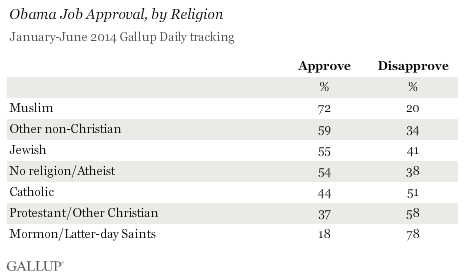
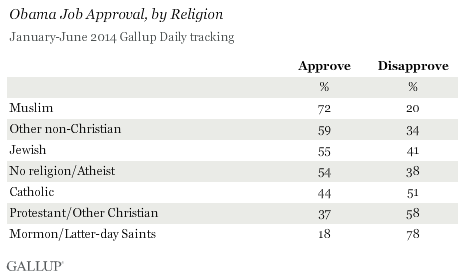
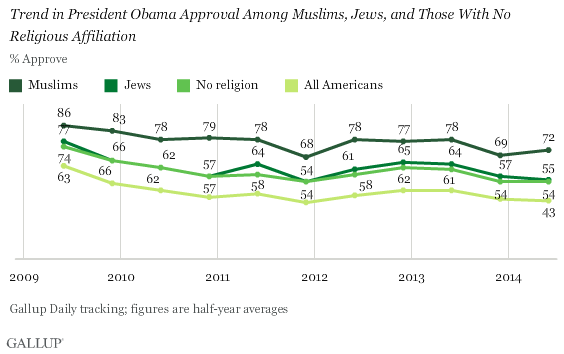
PRINCETON, NJ — Seventy-two percent of U.S.
Muslims approved of the job President Barack Obama was doing as
president during the first six months of 2014, higher than any other
U.S. religious group Gallup tracks. Mormons were least approving, at
18%.
 

In general, majorities of those in non-Christian religions —
including those who do not affiliate with any religion — approved of
Obama, while less than a majority of those in the three major Christian
religious groups did.


Obama Job Approval, by Religion, January-June 2014


The results are based on aggregated data from more than 88,000 Gallup
Daily tracking interviews conducted in the first six months of 2014 — a
time when the president averaged 43% job approval among all Americans.
Gallup interviewed 552 Muslims and at least 1,700 respondents in every
other religious group during this time.


….
The United States remains a predominantly Christian nation, with
roughly half of Americans identifying with a Protestant religion and
another quarter identifying as Catholics. Thus, the opinions of these
Christian groups are by far the most influential in determining Obama’s
overall ratings.


….
The relative rank order of the religious groups on job approval has
been consistent throughout Obama’s presidency. In fact, the current rank
order, with Muslims most approving and Mormons least, exactly matches
the order seen over the more than five years he has been in office since
January 2009.


….
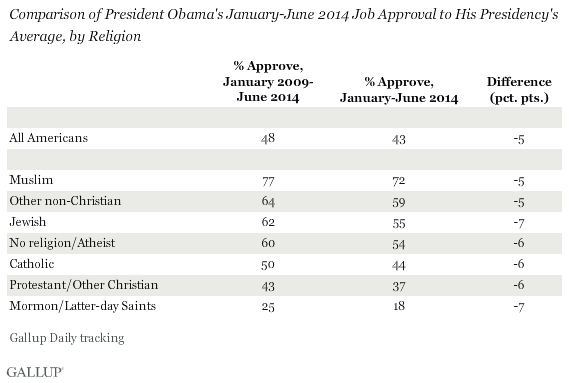
Moreover, current job approval among each religious subgroup is
between five and seven percentage points lower than the full 2009-2014
average for each. Obama’s current 43% overall job approval average is
five points lower than his 48% average so far in his presidency.


Comparison of President Obama's January-June 2014 Job Approval to His Presidency's Average, by Religion


…..
In general, when Obama’s approval rating has dropped among all
Americans, his approval rating in each religious subgroup has dropped by
a similar amount. 

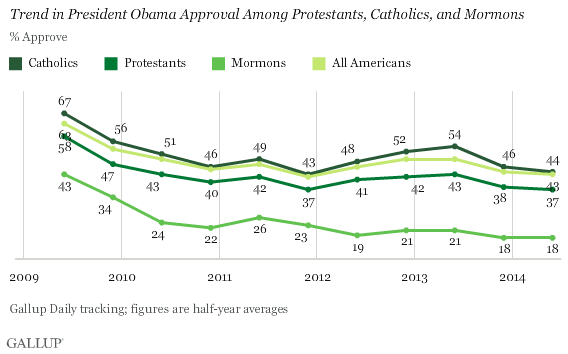
The accompanying graph shows how Obama’s average
approval rating among Protestants, Catholics, and Mormons has compared
with the average among all Americans over time. Because the movement in
each religious group has shadowed the national movement, Mormons have
been least approving of Obama in each time period. Protestants have been
consistently below the national average, and Catholics slightly above
it.


Trend in President Obama Approval Among Protestants, Catholics, and Mormons


Similarly, Muslims have been the most approving among the religious
groups in each time period. Jewish Americans and Americans with no
religious preference have also exceeded the national average job
approval in each time period, tracking each other closely.


Trend in President Obama Approval Among Muslims, Jews, and Those With No Religious Affiliation


………

Link: http://www.gallup.com/poll/172442/muslims-approving-obama-mormons-least.aspx

…….

regards

Ramayana, Mahabharata true accounts, not myths

…If Ayodhya is not the place of Ram, where did he live? Looking at the
present structures in Ayodhya, we can see people still living the way
that finds a mention in the Ramayana. Historians can only give their
opinion to enlighten people.
….

The problem with left-liberal academicians (DN Jha, Sumit Sarkar and others) is that the secular fan-base in India is microscopic and there is not much love from minority communities (who are to be sure appreciative of the majority bashing).

Conservative Muslims are least interested in the “secular” record of Akbar, they hate him for his out-reach (and the plan to kick-off a new religion). 

Conservative Sikhs are repulsed by praise for “marxist-atheist” Bhagat Singh, they believe that Sardar Singh was a faithful follower of the Panth. 

The Dalits dislike the liberals intensely since the ideologues are primarily drawn from the super-caste community- red/pink Bengal has remarkably seen only Brahmin Chief Ministers for the past two decades. Even Navayana – the pro-Dalit megaphone – is led by the non-Dalit firebrand S Anand.

There are now dark clouds on the horizon, the new govt will be sympathetic towards Hindutva scholarship and will be headed by people like Rao who are convinced that “folklore is history.” Going forward, any book considered anti-saffron will not be publishable in India. That leaves only the West and the public forums afforded by the New York Times and the Guardian (and others). That will be one crowded space already occupied by super-stars.
……………………………………………………..
The media describes him as an RSS man and the author of the
Mahabharata Project, but very little is known about the mild-mannered
historian from Telangana in academic circles. 
Yellapragada Sudershan Rao,
the new chairman of the Indian Council of Historical Research (ICHR),
describes himself as a colonial historian and argues that faith and
reason can go hand in hand in the writing of history.


………
You have lashed out against Marxist historians and their
interpretation of history. Why is the writing of history a Right vs Left
debate?


I think it is time to think about India’s history from an Indian
perspective. 

For the last 60 years, our writing and understanding of
history has been influenced by the West. Indian research has been far
too dependent on the West to write its own history. We are dependent on
their translations and interpretation. And, these are my personal views,
history writing in India is Euro-centric and imperialistic. The ICHR, I
understand, is in the process of acquiring digital records from centres
of history in the US and Europe. This will not only give us access to
our own records but will also aid us in writing history from our
perspective.


You have been appointed by the BJP government. Don’t you think institutions such as the ICHR should be free of politics? 
The MoU (memorandum of understanding) prepared by the founding fathers
of ICHR gave the powers to the government to appoint heads of social and
historical institutes. I have no qualms in admitting that these
appointments are political. 

Have previous heads of social institutes
been questioned about their appointments? Why are these questions asked
only about me? The government has been formed by a democratic process.
It has been elected by the people. To question that is to question
democracy itself. Unlike other social institutes, the ICHR attracts a
lot of attention because history is an important subject. But history
belongs to the people. We have not shown or written a comprehensive
history of India to the people of India. History is by the people, for
the people and of the people.


….
You are the author of the Mahabharata project? What is the project about?

There is a certain view that the Mahabharata or the Ramayana are
myths. I don’t see them as myths because they were written at a certain
point of time in history. They are important sources of information in
the way we write history. What we write today may become an important
source of information for the fut­ure in the future. 

When analysed, of
course, they could be declared to be true or false. History is not
static. It belongs to the people, it’s made by the people. Similarly,
the Ram­ayana is true for people…it’s in the collective memory of
generations of Indians. We can’t say the Ramayana or the Mahabharata are
myths. Myths are from a western perspective.


What does that mean?

For us, the Ramayana and the Mahabharata are true accounts of the periods in which they were written.


….
But shouldn’t the writing of history be rooted in historical evidence and research?

Western schools of thought look at material evidence of history. We
can’t produce material evidence for everything. India is a continuing
civilisation. To look for evidence would mean digging right though the
hearts of villages and displacing people. We only have to look at the
people to figure out the similarities in their lives and the depiction
in the Ramayana and the Mahabharata. 

For instance, the Ramayana mentions
that Rama had traveled to Bhad­ra­chalam (in Andhra Pradesh). A look
at the people and the fact that his having lived there for a while is in
the collective memory of the people cannot be discounted in the search
for material evidence. In continuing civilisations such as ours, the
writing of history cannot depend only on archaeological evidence. We
have to depend on folklore too.


….
Are you for correcting the writing of history?

I won’t put it that way. But real history has to come through. I am a
follower of truth. The ICHR should encourage research about India and
Greater India—from Southeast Asia all the way to Afghanistan, Iraq and
Iran. There is enough archaeological evidence to show the connect of our
civilisation there.


….
What is your view on Ayodhya?

Is it not a fact that mosques as structures came to be in India in
1000 AD? Is it not a fact that the mosque was built by a lieutenant of
Babur? A historian can only enlighten people on the facts of history.
Historians can at best say evidence of earlier remains of a Hindu
structure are there. Conflicting views are created by political leaders. 

If Ayodhya is not the place of Ram, where did he live? Looking at the
present structures in Ayodhya, we can see people still living the way
that finds a mention in the Ramayana. Historians can only give their
opinion to enlighten people.


…..
Doesn’t correcting history pose a problem? Why only cast it
in the context of two communities? How about Dalits and untouchability?


The question of untouchability is relatively recent, as recent as
3,000 years. And it has its basis in the economy. It was not based on
social status. Did we hear of untouchability before this period of 3,000
years? Let me give you an example. Sage Vishwamitra went to a Dalit hut
and asked for dog’s meat as he was hungry. The Ramayana and Mahabharata
are replete with instances of different castes, did we find a mention
of untouchability there?


…..
As a historian, are you trying to give a religious interpretation to history? 
I am a Hindu and a Brahmin. To be a Hindu isn’t a religion. In my
personal practices, I can adopt religious practices of the community to
which I belong—as a Shaivite or a Vaishnavite. But that is not what
being a Hindu is about. 

Reli­gi­ons are recent manifestations. I feel
the­re’s only Sanatana Dharma. There was no conflict between communities
or on religious lines as there was only one sanatana dharma. Now there
are several reasons for conflict to take place. 

Besides, Muslims are the
only ones who have retained their distinct culture. Can Christians or
Muslims say all religions are one? A Hindu can say that. There was no
conflict when there was sanatana dharma, Conflict or contests came about
when temples were destroyed and mosques built on the sites in medieval
times.


….
Didn’t Hindus destroy Buddhist monuments?

I agree. But Buddhism was on the wane then, in decline. But were
thousands of people killed as they were in the raids to the Somnath
temple? I won’t use the word corrections here. But the real history has
to come up.

…..

Link: http://www.outlookindia.com/printarticle.aspx?291363

……

regards

The Lion Queen

“I punched the men but they wouldn’t
apologize till the crowd forced them to”
…the woman then took off a boot,
filled it with muck and water, and emptied everything into the car

”I did this five to six times till the seat,
gearbox, steering, backseat and their phone were soaked in muck”
.

Remember it is the lioness who hunts, not the lion. She is feared universally for her strength. 

India is a jungle that desperately needs more lion queens who have the courage to throw mud on the face of drive-by cowards. Lal salaam, madam!!!
…………..
A
27-year-old woman’s online post on how she taught two men a lesson after
they “deliberately” splashed muck on her while passing by in a car, has
gone viral on social media. 
 

While most netizens have come out in her
support, some have questioned how she could “go to such limits”. The
woman is also being trolled and threatened by a few netizens.

The incident occurred around 8pm on Wednesday when the woman was walking
home after work. She had reached Shardashram Vidyamandir in Dadar
(West) when two men arrived in a car.

“As the footpath was
water-logged, I was forced to walk on the street. The stretch was dimly
lit but safe. I heard the Honda City accelerate before it splashed muck
on me. The car swerved just in time and could have hit me. I was shocked
and fuming,”.

The motorist left without offering
an apology. “I have been robbed at knife-point and even groped in the
past, but had remained quiet then. This time, I decided I wasn’t going
to be a coward. I ran after them for nearly 700 metres or so till the
car halted at a traffic signal at Kabutarkhana.  I then went and knocked
on the front door (passenger side). The motorist’s co-passenger opened
it and realized I was the same girl they had harassed. The motorist
tried to drive away, dragging me along as I had caught hold of his
friend’s shirt collar by then,” she said.

Hearing the
commotion, cops at the junction came up to check what had happened and a
crowd of bystanders gathered. “I punched the men but they wouldn’t
apologize till the crowd forced them to,” she added. Upset at what she
had to go through and the unwanted drama, the woman then took off a
boot, filled it with muck and water, and emptied everything into the
car.

“I did this five to six times till the seat, gearbox,
steering, backseat and their phone were soaked in muck. My arm is sore
from being dragged. But I hope my act prevents the men from repeating
what they did to me with any other girl,” she added.

Her online post was ‘liked’ by nearly 3,000 people and shared numerous times on Twitter and Facebook.

…….

……..

Link: http://timesofindia.indiatimes.com/city/mumbai/Mumbai-womans-post-on-harassers-goes-viral/articleshow/38222068.cms

…..

regards

“The whole world should become ahimsak”

..They demand a “hinsa,
kasaai, vyasan mukt Palitana”—sanitised of violence, butchery and vice……..Each of the 68 butchers in town has
been identified by name……
not just Muslim butchers; the
Sikligar Sikhs, who breed pigs are also under the scanner…

They are the neo-Brahmins.  Also it is the Bharatiya Jain Party (BJP).

Generally the Brahmin class has provided teachers, doctors, lawyers….people who fight with words not swords (that was reserved for Kshatriyas or Khatris). Brahmins are also not noted to be in the top economic bracket (money is in the hands of the Vaishyas or Baniyas).

Brahmins have not been either numerous or durable as rulers (there have been probably more and more long lasting Shudra rulers). Jawaharlal Nehru, who had immense contempt for religion (specifically Hinduism) nevertheless was probably the longest reigning Brahmin.

Meet Amit Shah – a Jain – the newly minted president of BJP. Jains were recently declared to be a minority by the past Congress-UPA regime (as a last-ditch vote-catching measure). Shah is expected to continue the tradition whereby India has been specially alert to the sensitivities of minorities. It is another matter that what is nectar to one community is poison to the others (see below).

As far as policies go Jains are as strict as any of the famous sons of Abraham. They also have immense wealth and they have the ear of the political establishment. Amit Shah is credited with the BJP victories in Uttar Pradesh and Bihar – critical for Mission 272 (parliamentary majority). It was Shah who memorably told the Jats of Muzaffarnagar that “this election is a fight for honor and revenge.”

In Europe there has been considerable tensions of late between the left-liberals (aligned with animal rights groups) and Jews/Muslims over kosher/halal rituals. The fight is over stunning animals before they are gored. The multi-culturalists say (with some justification) that only people who are perfect vegetarians can proclaim their moral authority on this matter, everyone else is a hypocrite and an Islamaphobe (also anti-semite).  

By this logic, Jains who introduced the concept of ahimsa to the world, have all the moral authority to over-ride objections of the filthy meat eaters….

Interestingly enough, vegetarianism is one area in which the Dharmic religions can all agree to put up an united front against the Desert religions. All our Sikh friends choose to eat vegetarian when dining out since they are actually forbidden to consume halal food.  

The only Hindus who will have serious objections to veg-only strictures are the denizens of un-India (TM)- Kerala, Bengal and Tamil Nadu. Perhaps they should be labeled apostates and barred from visiting Varanasi and Palitana.

Welcome to the land of vegetarian Iftars. Hope you enjoy the experience.
…………
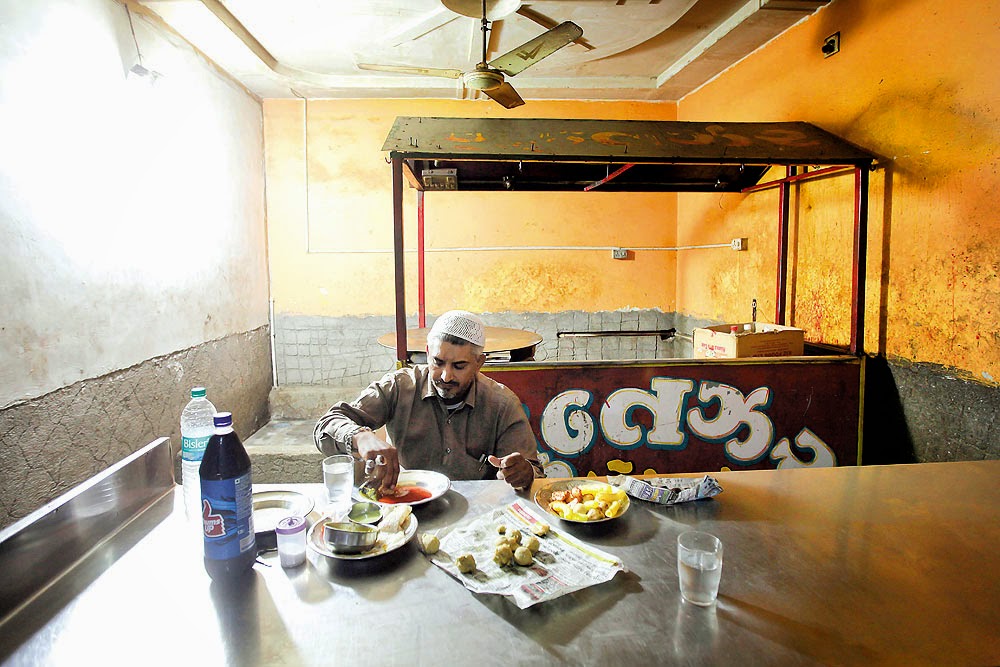
Parimal, a nondescript neighbourhood in Palitana, near Bhavnagar, in
Gujarat, is much sought after for the Jain pilgrimage town’s few
Muslim-run non-vegetarian eateries. But it’s eerily deserted on what
should have been a bustling, cheerful iftaar evening.
 

Kababs and chicken
lollipops are displayed promisingly on the menus of the stalls but the
kitchens that roll them out have been shut down since the Gujarat
government promised to look at Jain leaders’ demand that the pilgrimage
town be made a vegeta­rian-only zone. 

The stall-owners are suspicious,
reluctant to talk, and refuse to give their names. A seething resentment
fills the air. “There’s nothing for us to celebrate this Ramzan,” says
Haji Ghulam Ali, offering us goodies from the vegetarian entree to his
humble iftaar meal. He’s the only one willing to be quoted. “Our
business is hit, we’re on the verge of bankruptcy, and we can’t even eat
our regular food!”


The government notification hasn’t yet come into effect. But in
Palitana, it’s already futile—and generally has been difficult—to find
non-veg food. The carts that used to sell omelettes and boiled or
scrambled eggs around the town’s mosque and cemetery, on the outskirts,
have vanished. 

Interestingly, this region is predominantly meat-eating.
“As high as 55-60 per cent of the population are non-vegetarians—not
just Muslims, but Kolis, Sindhis and Dalits also,” says Pravin Mishra,
an Ahmedabad-based filmmaker, artist and columnist. The Jain presence is
in a few thousands, largely a floating population of pilgrims and
ascetic, peripatetic monks and nuns. In contrast, Muslims constitute 25
per cent of the resident population. It will be worst hit if
vegetarianism is enforced.

But the monks spearheading the movement say it’s not a matter of
numbers. “Palitana is like the Mecca or Kashi of Jains,” says Virag
Sagar Maharaj, a leading monk. He invokes Jain lore. Palitana has been
visited by all 24 Jain tirthankars. The Shat­runjaya hills are clustered
with 3,000 temples and 27,000 statues. There’s the symbolic ord­eal of
3,600 steps, a 3.5 km climb that takes two to three hours. 

Jains come
here to pray for moksha. 

The sentiment runs in laity too. “It’s the
centre of our faith,” says Shireesh Kotari, international president of
the Jain Social Groups Inter­national Federation. And Janki Shah, owner
of a textiles company in Ahme­d­abad, says, “It’s one of our holiest
shri­nes—our shashwata tirtha. We believe that, whatever happens,
Palitana will never vanish from the earth. It is eternal.”


They draw on the concept of ahimsa, a central tenet of Jainism: you
are not meant to hurt anything, not even a fly. “It’s not merely about
preventing people from eating non-veg food. Our movement is based on the
concept of Jeevdaya and is primarily against animal slaughter,” says
Virag Sagar Maharaj. 

Although he does not justify it, sociologist
Gaurang Jani says the demand for a no-meat zone in Palitana is linked to
the strict vegetarianism Jains practise. And Vidyut Joshi, former
vice-chancellor of Bhavnagar University, says, “I guess some ethos of
the Jain religion has to be maintained at its biggest pilgrimage
centre.”


The posters outside the ashram of Jambudweep, a subsect of the
Shwet­ambar Jains, talk of 2,000 animals butchered every day in
Palitana, 60,000 monthly and 7 lakh annually. They demand a “hinsa,
kasaai, vyasan mukt Palitana”—sanitised of violence, butchery and vice,
that is. It’s an organised effort. Each of the 68 butchers in town has
been identified by name—and the kind of animals he slaughters. 

The
Jambudweep group claims this is the first step in their rehabilitation.
It offers butchers  a compensation of Rs 9 lakh and eatery owners Rs 5
lakh. So far, 15 butchers—the campaigners have agreeme­nts on notarised
stamp papers as proof—have agreed to give up their profession.

But Muslim residents of the Parimal area say the promises aren’t being
made good.  And, compensation or not, it’s difficult to uproot oneself
from a place or give up a trade. In Gujarat, there are hardly any
non-Muslim butchers, so the demand for vegetarianism will mostly hit one
community. Mishra says it’s a case of religion being used as a
political and electoral tool. 

But it’s not just Muslim butchers; the
Sikligar Sikhs, who breed pigs and trade in them, are also under the
Jains’ scanner. Palitana looks like a starting point. Virag Sagar
Maharaj wants to take the movement forward in all of Gujarat, and later,
Maharashtra, Rajasthan, Madhya Pradesh and Uttar Pradesh. “The whole
world,” he resolutely says, “should become ahimsak.”


What is unfolding right now is clearly a clash of faiths and opposing
ways of life. “It seems all about ‘My faith is bigger than yours’,
which defies the spirit of secularism and acceptance,” says Mishra.
Ironically, the temples atop the sacred Shatrunjaya hills tell a
different story. They reflect a history of peace and togetherness, of
cultures and religions in harmony. At one of the holiest Jain sites
here, there’s the Muslim shrine to Angar Pir, at which childless couples
of every religion—including Jains—have been seeking  blessings since
time immemorial.


All is not well within the Jain sect itself. There has been dissent
amongst Jain monks too. One group accuses the other of being taken in
too easily by the promises made by the administration. Monks are even
being accused of having pocketed money meant for rehabilitating
butchers. “It’s a stunt,” says Divya Shek­har Maharaj, a monk who has
distanced himself from the movement, though he himself practises a very
rigorous form of vegetarianism. “They have promised a lot but nothing
has happened.”

 The proposal has led to sharp criticism from civil society. “Ritual
slaughter is as much an act of faith for Muslims and Hindus as animal
protection is for the Jains,” says Aakar Patel, a columnist. “To ask
another faith to change to what you think is right is an imposition and
fundamental intolerance.” 

According to education consultant Manisha
Modha Patel, no group can treat a town as its private pro­­perty. At
best, proscription of non-veg food can be applied at temple complexes.
Already, since 1999, non-veg food is not allowed within 250 metres of
Taleti, the point from which the climb up Shatru­njaya hills begins. The
road leading to the Shatrunjaya river, too, is a vegetarian zone. Now,
they want vegetarianism imposed in a 9 km radius. “Tomorrow,” says
Manisha, “they may seek a ban on onion and garlic. What if Ajmer decides
to declare itself a meat-only zone?” But Virag Sagar Maharaj counters
by drawing on the example of Haridwar and Vaishno Devi, both vegetarian
zones.


What the Palitana movement does prove is the influence of Jains in
Gujarat. They form less than one per cent of the state’s population but
dominate the economic space, and through it wield disproportionate
influence on the social, cultural and political space. Many say the
ascendancy in the ruling BJP of Amit Shah, Modi’s right-hand man, now
slotted to be party president, is adding to their clout. Shah is a Jain.


Their dominance has also been creating the misperception that
Gujaratis are vegetarian. Actually, 68 per cent of the population,
according to the last census, eats meat—this includes tribals, obcs,
Muslims, Christians, Parsis and Jews.


Meanwhile, Bhavnagar collector P.K. Solanki says that, at the moment,
the Palitana municipality is inviting objections to the proposed move
and has received 1,980 so far. Legal opinion is also being sought. The
board of the municpality is likely to decide on July 30. The decision
will be forwarded to the state government for appropriate action. Till
then, Palitana remains in suspended animation. And iftaars will remain
dhokla-khakhra affairs.

Eggless, Meatless…


  • Haridwar, Uttarakhand. No meat, no eggs, no fishing allowed in the Ganga, no alcohol.
  • Badrinath, Kedarnath, Gangotri, Yamunotri,
    Uttarakhand. All hotels, guest houses, restaurants and eateries serve
    only vegetarian fare. There are no bars.
  • Jagannath Temple, Puri, Orissa. No sale or preparation of meat, fish, poultry, eggs in all restaurants in specific areas around the temple
  • Ujjain, Madhya Pradesh. No meat, fish, eggs or liquor except in certain parts of the city.
  • Vrindavan, Uttar Pradesh. No non-vegetarian food, smoking, drinking, no leather objects in the temple vicinity.
  • Golden Temple, Amritsar. No meat in the temple complex. No smoking in the city.
  • Katra, Jammu. Only pure vegetarian food, not even onion and garlic allowed.
  • Rameshwaram, Tamil Nadu. Only vegetarian food in the town though it is a major exporter of seafood.

………

Link: http://www.outlookindia.com/printarticle.aspx?291371

……..

regards

Taliban Academy

…one of the five suicide bombing facilities….owned
and operated by the Haqqani Network in Serai Darpakhel…
…The undertaking or affidavit ‘esteshahadi’ … picture of would-be bomber, his name, his father’s name….family occupation, father’s political
affiliation….experience, if any, in militant activities.

Announcing graduate studies in “how to be a suicide bomber.” The Unique Selling Point: campus recruitment is 100%, they would like many more students!!!
…….
It was one of the many non-descript buildings around, located at the
dead-end of a small street inside Serai Darpakhel. “Go straight and
there is the door on the left”, we were told by a guard outside the
street. But even then it was hard to find the iron door, opposite
a power transformer and a heavy generator to ensure uninterrupted power
supply. 

For the unsuspecting outsiders, there was nothing
unusual about this place, except that it was known to all those who
lived nearby. It was a facility to indoctrinate and train suicide
bombers.


Step inside and there is a courtyard with big columns, mats spread out, bedrolling piled up in one corner.
Nothing unusual. Stairs lead to the upper portion painted in light cream and brown colours.

Plastered on one of the walls is a white banner inscribed with kalma and beneath it ‘the Islamic Emirate of Afghanistan’.

This
was one of the five suicide bombing facilities, locals now say, owned
and operated by the Haqqani Network in Serai Darpakhel, frequented by
would- be-bombers in their teens and twenties; Afghans and Mehsuds
mostly but boys from Mohmand and Orakzai too would turn up.


Rarely were the religious indoctrinators, mentors or those running
the centres seen outside the iron gate that shielded the dead-end house
from passersby.

No -one living in Serai Darpakhel knew who they were, except that it was a centre for suicide bombers.

Even
those brought or enrolled at the centre for ‘esteshahadi’ or martyrdom
were not allowed to step outside till the completion of his mandatory
two-month stay inside the centre.

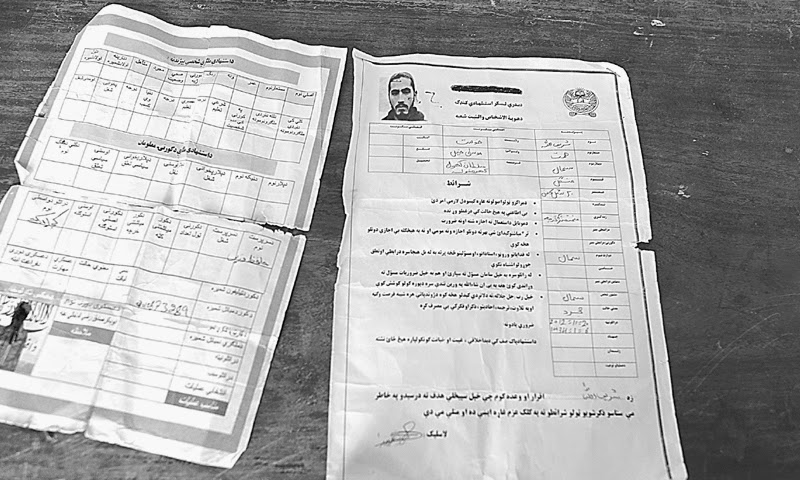
The undertaking or affidavit all ‘esteshahadi’ friends were required to sign was elaborate.

It
had a printed colour picture of the would-be bomber, his name, assumed
name, his father’s name, age, address, education, personal contact
number, family contact number, family occupation, names of
friends and acquaintances, father’s past and present political
affiliation, the number of members in the family and their monthly
income and experience, if any, in militant activities.

And the
seven rules the ‘esteshahadi friend’ were required to live by were
pretty stringent too. The use of cell phones were neither allowed nor
considered necessary, the undertaking said. For two months, neither
would the enroller be allowed to go outside nor was he allowed to go out
without permission, it read.

He was also required to make no
attempt to befriend anyone else except his other ‘fidayi brothers’
teachers and mentors. He was supposed to hand-over his personal
belongings to the centre in-charge and ask for things he might need from
him. 

Other than that, things inside the centre were kept tight with a
strict regimen of praying, spiritual and religious indoctrination and
cooking, locals say.

Even a man, who came looking for his son, was
turned away by the centre’s administrator, feigning ignorance about his
whereabouts, a local resident recalls. It was only after a lot of
contacts here and there, that the centre reluctantly let the boy go.

Not
very far from Serai Darpakhel, drive to the main Miramshah bazaar. And
there is the two-storey building of what once was the Government Girls
Higher Secondary School. When militants first moved in and started
bombing schools, this too was soon abandoned and later occupied and
converted by militants of all hue and origin into a facility for
training and distribution of dead bodies on their arrival from
battlefield or of those killed in drone strikes.

The 450 to 500
girls were later shifted to continue their studies at a degree college
inside the military cantonment in Miramshah. The militants,
surprisingly, had no objection to that.

……

Link: http://www.dawn.com/news/1118706/startling-facts-about-suicide-bombers-training-den

……

regards

The Caliphate turns radioactive (literally)

This is so much fun. Just like we have nuclear India and Pakistan ready to wipe out each other (and the world), we can look forward to a nuclear Shia-stan and Sunni-stan ready to annihilate the other. And if this was not fun inducing enough we have Gaza rockets targeting the Israeli nuclear reactor.

At this point we would just like to consult with a state-of-the-art crystal ball to know how things will be in a decade or so. The World survived the World Wars I and II, do we really have the ability to survive WWIII?
…….
Insurgents in Iraq have seized nuclear materials used for scientific
research at a university in the country’s north, Iraq told the United
Nations in a letter appealing for help to “stave off the threat of their
use by terrorists in Iraq or abroad.”

Nearly 40 kilograms (88 pounds) of uranium compounds were kept at
Mosul University, Iraq’s U.N. Ambassador Mohamed Ali Alhakim told U.N.
Secretary-General Ban Ki-moon in the July 8 letter obtained by Reuters
on Wednesday.


“Terrorist groups have seized control of nuclear material at the
sites that came out of the control of the state,” Alhakim wrote, adding
that such materials “can be used in manufacturing weapons of mass
destruction.”


“These nuclear materials, despite the limited amounts mentioned, can
enable terrorist groups, with the availability of the required
expertise, to use it separate or in combination with other materials in
its terrorist acts,” said Alhakim.


He warned that they could also be smuggled out of Iraq.


A U.S. government source familiar with the matter said the materials
were not believed to be enriched uranium and therefore would be
difficult to use to manufacture into a weapon. Another U.S. official
familiar with security matters said he was unaware of this development
raising any alarm among U.S. authorities.


…..


Link: http://www.reuters.com/assets/print?aid=USKBN0FE2KT20140709

…..

regards

Hindu Brotherhood: a seat at the high table

….Obama’s desire to strengthen economic relations…..
cooperate in enhancing energy security; deepen security cooperation,
including in maritime security, counter-terrorism and intelligence
exchange; expand consultation and coordination on Afghanistan; and, work
more broadly for security and prosperity in Asia.

What is with all the letter writing in the age of the internet?

It is a grand photo-op with a most optimistic goal: South Asia must remain part of the far-West (and not drift into a dalliance with Russia, China etc..).

It was inevitable, in the age of the trader or the Vaishya (or in the insult mode: baniya). America and India would like to do business first – ensure a bit of shared prosperity in exchange for a docile land-mass (aka security). 

We feel this is a sensible move, considering that China is scaring the shit out of everybody and the Middle East and Africa and East Europe are…scaring the shit out of everybody.

Then again it must be remembered that islanding does not work in the long term. South Asians will need to learn to live with each other, to stick their necks out of the bloody (literally) enclaves, stop the stupid bickering and get on with good governance for everyone. Only then we can have true progress.
……………..
Extending a formal invitation to Prime Minister Narendra Modi for a
visit to the US, President Barack Obama has expressed keenness to work
closely with him to make the bilateral relations a “defining
partnership” in the 21st century.


Thanking Obama for the invitation, Modi said he looks forward to a
result-oriented visit in September with “concrete outcomes” that impart
“new momentum and energy” to the strategic partnership.


Obama’s letter of invitation was handed over to Modi by Deputy Secretary of State William Burns when he called on him here.

In his letter, Obama reiterated his invitation to Modi to visit
Washington in September and to work closely with him to make India-US
relations a “defining partnership” for the 21st century, a PMO statement
said today.


While receiving the letter, Modi said he looked forward to a
“result-oriented visit with concrete outcomes that impart new momentum
and energy to India-US strategic partnership”, the statement said.


The Prime Minister was of the view that re-energising the partnership
between India and the US would send an important message to the region
and beyond.


Articulating his vision for India-US relations, Modi said that the
relationship between the world’s oldest and largest democracies should
not only be for the benefit of the two countries, but “should emerge as a
powerful force of good for peace, stability and prosperity in the
world”.


Burns conveyed Obama’s desire to strengthen economic relations,
including in next-generation technologies and manufacturing sector;
cooperate in enhancing energy security; deepen security cooperation,
including in maritime security, counter-terrorism and intelligence
exchange; expand consultation and coordination on Afghanistan; and, work
more broadly for security and prosperity in Asia.


Modi saw immense opportunities for deepening cooperation across the full
spectrum of the relationship and laid special emphasis on involving
youth in creating new avenues of promoting cooperation between the two
countries.


The Prime Minister reiterated his desire to strengthen relations with all neighbours, the statement said.


Modi recalled Obama’s telephone call soon after he became the Prime
Minister in May and expressed his appreciation for the President’s
detailed and thoughtful letter.


National Security Adviser Ajit Doval, Foreign Secretary Sujatha Singh,
US Charge d’Affaires Kathleen Stephens and Assistant Secretary of State
for South and Central Asian Affairs Nisha Biswal were also present in
the meeting.

……..


Link: http://www.outlookindia.com/news/printitem.aspx?849274

…….

regards

‘Master Licensed Locksmith Since 1968’

Young kids today have a hard time talking to a person. They
don’t look you in the eye. They are constantly on their phones, on
their iPads, on the internet…..They work at jobs they don’t really like. They
only get an identity when they buy a home they can’t afford, …..a thousand dollar suit…two hundred dollar sneakers… Can all this
shit give you an identity? 

A grand old man who is an immigrant, a family man, a liberal, a rebel who struck out on his own, one who does not want the US to be globo-cop. His advice for ambitious but challenged youngsters would be to learn something useful to do with their hands. In our opinion he represents most faithfully the American spirit and sense of purpose.
…..
I pass a tiny shop in Greenwich Village with a no-nonsense signboard
above that says ‘Greenwich Locksmiths’.
Just below this, an additional
tag-line reveals ‘Master Licensed Locksmith Since 1968’


Saeed Akhtar Mirza: Let’s start with your family. Tell me about your parents.
Philip Mortillaro: My father came as an immigrant from Italy
and my mother was from here. My father had a good job and my mother was
a seamstress. Both of them worked really hard to raise a family.


S: How did you get into the lock business?
P: I was in high school and it all started out when I was looking for
a summer job when I was 14 years old. All kids look for a summer job,
you know. Someone told me there was a hardware store and they were
looking for someone to help them move. It turned out it was not a
hardware store
 they were locksmiths. I kind of offered to help them
move, and worked there all summer long. When the summer was over, they
asked if I wanted to go back to school or work with them and learn a
life-long trade. I chose the life-long trade.


S: Why?
P: I got to like what I had learned, so I started out as an
apprentice at 14th and 2nd Avenue. By the time I was 18, I opened my
own shop, and worked there till I was 20—till 1970. Then someone
offered to buy my shop
it was an open air space that had a license for
10 years. He gave me 25,000 dollars for it. That was a lot of money…a
lot of money! So I decided to travel
I bought a car and I travelled
all over the country … to San Francisco, Seattle, Idaho, Wisconsin
… then I came back here and bought another shop
the one right here.


S: What did your father think about your move to quit school and learn a trade?
P: He didn’t like it. He expected more from me.
S: Why?
P: It’s tough convincing the mindset of the poor immigrant. He works
with his hands and he expects his children to go to college—work with
their minds. My father never once visited my shop till the day he died.

S: That’s a pity.


P: Yeah. He couldn’t believe I could be proud of my work. Liking your
work is one thing, to be proud of it is another. Let me tell you a
story. I was about 21 years old and I got this call from a Japanese
gentleman. He had a problem with a door that had come apart. Now to fix
that sounds simple but it was not. The door had the lock and hinge in
the middle—most door have it on the side. It was a complicated job
but I
fixed it. The Japanese guy was surprised and smiled. You know what he
said? He said ‘Yankee Ingenuity’. Can you believe it? ‘Yankee
Ingenuity’! I felt so proud for a job well done. And we Yankees did have
ingenuity. We could make things. Fix things. Look at us now—we can’t
do a damn thing with our hands, we’ve lost our respect for it.


S: When you say America has lost respect for people who work their hands, is there a price being paid for that?
P: Of course there is. No one wants to work hard with their hands
anymore. We’ve let the Chinese, Japanese, Koreans make things for
us—and they do a damn good job of it. There is such an emphasis on kids
getting a college education—a finance degree or study to be lawyer or a
doctor. By the time they do so, many of them are up to their necks in
debt. They become adults in trouble rather than children in trouble.
Most of them don’t get the jobs they want and end up in the mail room
or some such hell-hole.

(He took a deep breath and then continued)


P: Let me tell you another story. I know this one lady, her daughter
didn’t go to college and became a beautician because she wanted to. She
worked hard and five years ago she bought her own shop. She did what
she wanted to and now has her own shop. She’s doing great and is
earning more than most college graduates, who start out in life with a
debt on their heads.

S: Are you saying a college degree has no value?
P: No. What I’m saying is that it isn’t everything. Can every kid
with a college degree get a job that he really wants? It isn’t
possible. So many of them are miserable—jumping out of windows, getting
into drugs. They think money is the answer. If only they have more
money! For me work has to come first. Not the money. When I look at a
job I try to figure out how am I going to do it—What’s the best way?
How to get it right? Kids today think differently: they want to know
how much does it pay? They don’t ask themselves what they’d really like
to do, just how much will they earn.


S: How did all of this money mania happen?
P: Through the government and the media—they sold a dream. And
everybody got sucked in. (Shakes his head) It’s entered our blood
stream.
Young kids today have a hard time talking to a person. They
don’t look you in the eye. They are constantly on their phones, on
their iPads, on the internet. They are scared. They can’t meet people.
They don’t meet people. They work at jobs they don’t really like. They
only get an identity when they buy a home they can’t afford, when they
wear a thousand dollar suit—two hundred dollar sneakers or shoes, most
of it on credit.
That’s the dream being sold by the media. Can all this
shit give you an identity? Look at me. I have an identity in this old
tee-shirt and this old pair of jeans. Everybody in the neighborhood
knows me. They know Philip, the locksmith.


S: Is Philip, the locksmith, happy?
P: You bet I am! I earn more than a hundred thousand bucks. I have
had three wives, two mistresses, I have five children, two
grandchildren. Isn’t that a life of a happy man? I’m better-off than
most guys with degrees.

S: Do you always compare yourself with them?
P: Not really. But sometimes I do because I worry where kids are
heading today. Not just kids, adults too. I worry about what we’ve done
to ourselves. Ever seen people on the streets? When they see a work of
art or a piece of architecture that they like, they don’t soak the
experience in: they just take pictures and move on. They are in such a
terrible hurry—fucking pictures. Can you believe it?

(I smile)
S: They have no time to stand and stare.
P: Yeah. I hope they have time to see the pictures they’ve taken.
S: How long do you think that people like you, who work with their hands—how long do you think they are going to last?
P: Depends on the part of the county. In other parts of the country
it will last for a little longer, over here I don’t know. I don’t even
know if any of my kids would take over from me.


S: What kind of an America would you like to see?
 P: Let me think. There were some things in the 60s that I didn’t
like. I didn’t like the Vietnam War. I didn’t like the racism. If you
were black in this country, you were fucked. You had to face a lot of
shit. It’s much better now. But the wars are still happening—we are
into too many wars. 


S: Why?
 P: I don’t know—we are a violent country. Look at our movies,
television, video games. There’s a lot of violence out there. When we
had the draft during the Vietnam War people questioned why their kids
were being sent. We questioned the war. 


We don’t have the draft
anymore. It was scrapped. So now we have an army that can’t question
and many of our soldiers are new immigrants. So we promise them a Green
Card after their stint. We promise them some kind of college
education, so now they do four years in the army just so that when they
get out, they can get to go to college or get a Green Card. So they go
to fight, they have no choice. 

…….

Link: http://www.outlookindia.com/printarticle.aspx?291329

…..

regards

Brown Pundits