SOS!!! (send the boys in, bring our girls home)

The
Indian foreign ministry said the situation in Iraq was receiving “high
priority” but ruled out any immediate emergency evacuation of its
nationals. 

Why is that? With 18,000 Indians in Iraq and countless lives in danger, why is emergency evacuation not a consideration? Also, considering that the Kerala nurses are mostly Syrian Christians, this will attract not a molecule of mercy from the Islamists.

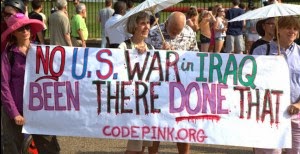
Also, Fuck Code Pink. Yes we really mean that (Omar help!!!)
India is served by one of the most powerful voluntary military forces in the world (yes we know that there are women troopers as well but probably not authorized for combat). She has the latest fighter planes, a million strong army (1.129 mil active troops, 0.96 mil reserve troops- ref. Wiki) and an aircraft carrier.

The last time the Indian Army launched a (defensive) war was 15 years ago in June-July 1999 in Kargil. A brief description follows (ref. Wiki):
…….
Once the scale of the Pakistani incursion was realised, the Indian Army quickly mobilised about 200,000 troops and Operation Vijay was launched. However, since the heights were under Pakistani control, India was in a clear strategic disadvantage. 

From their observation posts, the Pakistani forces had a clear line-of-sight to lay down indirect artillery fire on NH 1A, inflicting heavy casualties on the Indians. This was a serious problem for the Indian Army as the highway was its main logistical and supply route. 

Thus, the Indian Army’s first priority was to recapture peaks that were
in the immediate vicinity of NH1a. This resulted in Indian troops first
targeting the Tiger Hill and Tololing complex in Dras.
This was soon followed by more attacks on the Batalik-Turtok sub-sector
which provided access to Siachen Glacier. Point 4590, which had the
nearest view of the NH1a, was successfully recaptured by Indian forces
on 14 June.


Though most of the posts in the vicinity of the highway were cleared
by mid-June, some parts of the highway near Drass witnessed sporadic
shelling until the end of the war. Once NH1a area was cleared, the
Indian Army turned to driving the invading force back across the Line of
Control. The Battle of Tololing,
among other assaults, slowly tilted the combat in India’s favour.
Nevertheless, some of the posts put up a stiff resistance, including
Tiger Hill (Point 5140) that fell only later in the war. 

As the
operation was fully underway, about 250 artillery guns were brought in
to clear the infiltrators in the posts that were in the line-of-sight.
In many vital points, neither artillery nor air power could dislodge
the outposts manned by the Pakistan soldiers, who were out of visible
range. The Indian Army mounted some direct frontal ground assaults which
were slow and took a heavy toll given the steep ascent that had to be
made on peaks as high as 18,000 feet (5,500 m).
Two months into the
conflict, Indian troops had slowly retaken most of the ridges they had
lost;
according to official count, an estimated 75%–80% of the intruded area
and nearly all high ground was back under Indian control.

Following the Washington accord on 4 July, where Sharif agreed to
withdraw Pakistani troops, most of the fighting came to a gradual halt,
but some Pakistani forces remained in positions on the Indian side of
the LOC.
In addition, the United Jihad Council (an umbrella for all extremist groups) rejected Pakistan’s plan for a climb-down, instead deciding to fight on.
The Indian Army launched its final attacks in the last week of July; as
soon as the Drass subsector had been cleared of Pakistani forces, the
fighting ceased on 26 July. The day has since been marked as Kargil Vijay Diwas
(Kargil Victory Day) in India. 

By the end of the war, India had resumed
control of all territory south and east of the Line of Control, as was
established in July 1972 per the Shimla Accord. By the time all
hostilities had ended, the number of Indian soldiers killed during the
conflict stood at 527, while more than 700 regular members of the Pakistani Army were killed. The number of Islamist fighters, also known as Mujahideen, killed by Indian Armed Forces during the conflict stood at about 3,000.

……

A credible job by all means, mobilizing 20% of all your forces, and fighting up-hill at elevations of 18000 ft. against one of the most professional armies in the world.

Right now, we have 46 nurses from Kerala who are stranded in Tikrit, Iraq (40 other Indians have been reportedly kidnapped by the mad islamists). The re-imbursement from foreign shores keeps the Indian economy moving. Now is the time to show our gratitude and send in the troops and escort the terrified girls home (before they get kidnapped and sold off as slaves). A nation will be grateful (and cynically speaking, an un-Indian territory may well be converted to the Indian cause).

…….
The 46
Indian nurses in a hospital in the strife-torn Iraqi town of Tikrit
have sent an SOS to Prime Minister Narendra Modi to ensure their safe
return to India. One of the nurses told TOI over telephone that they
were living in perpetual fear as ISIS rebels have been roaming the
streets outside.

“This is a horrible,” said Jency James who
hails from Idukki district of Kerala. “We have been stuck for days
inside the hospital. The internet connection has snapped due to heavy
shelling. We don’t know when the telephone and mobile connections will
go off.” The nurses appealed to Prime Minister Narendra Modi to ensure
that they safely return home.

Diplomats, meanwhile, said the
nurses are safe, though they may be stranded. The panic stricken nurses
are reaching out to friends and families seeking help, but they cannot
be moved out of the hospital as armed militia men were occupying the
roads leading to the airport, said diplomats.  According to the embassy,
more than 18,000 Indians work in Iraq oil rigs and hospitals as doctors and nurses

Former Indian ambassador to Iraq and India’s first ambassador to ASEAN
Suresh Reddy reached the Iraqi capital of Baghdad on Wednesday to
initiate talks with the Iraqi leadership and the rebels who have held 40
Indians captive. The Indian mission is also trying to bring home more
Indians who are stranded in the strife-torn country.

Diplomatic
efforts are on also to evacuate 12 Indian workers employed by a UAE
company in Iraq. Indian ambassador to the UAE TP Seetharam told TOI over
telephone from Abu Dhabi on Wednesday that the workers were deployed in
Iraq at constructions sites. Meanwhile, the 46 Indian nurses stranded
in a Tikrit teaching hospital were safe, Indian officials said.

“We are coordinating with the ministry of external affairs in New Delhi
and our embassy in Baghdad to ensure the safety of Indians living in
Iraq. We were approached by a leading company in the UAE who are working
on some projects seeking diplomatic help to repatriate 12 Indian
workers stranded in the strife-torn area,” Seetharam said. The contact
details of the 12 stranded workers have been handed over to the Indian
embassy in Baghdad.

……

…..

Link: http://timesofindia.indiatimes.com/india/Our-lives-in-danger-Indian-nurses-in-Iraq-hospital-send-SOS-to-PM/articleshow/36762136.cms

…..

regards

“Iraq is Arabic for Vietnam”

“Lady Ace 09” from HMM-165
and piloted by Berry, took off around 05:00 – had Martin refused to
leave, the Marines had a reserve order to arrest him and carry him away
to ensure his safety. 

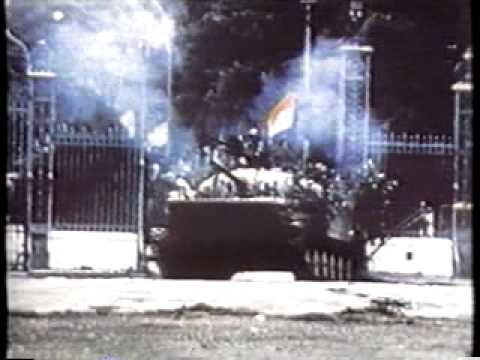
The original battle-cry of this war is not in our name crowd from 10 years ago. Ira Chernus explores the similarities between Iraq and Vietnam. Shall we see a repeat of helicopter convoys leaving the US Embassy while abandoning thousands of south viet collaborators to torture and death?

……..
At 10:48 a.m., Martin relayed to Kissinger his desire to activate “the
FREQUENT WIND” evacuation plan; Kissinger gave the order three minutes
later. The American radio station began regular play of Irving Berlin’s “White Christmas,” the signal for American personnel to move immediately to the evacuation points.


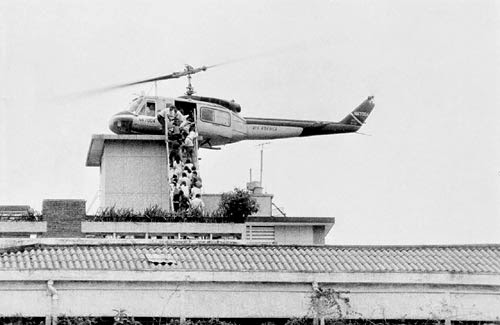
Under this plan, CH-53 and CH-46 helicopters were used to evacuate Americans and friendly Vietnamese to ships, including the Seventh Fleet, in the South China Sea. The main evacuation point was the DAO Compound
at Tan Son Nhat; buses moved through the city picking up passengers and
driving them out to the airport, with the first buses arriving at Tan
Son Nhat shortly after noon. 

The first CH-53 landed at the DAO compound
in the afternoon, and by the evening, 395 Americans and more than 4,000
Vietnamese had been evacuated. By 23:00 the U.S. Marines who were
providing security were withdrawing and arranging the demolition of the
DAO office, American equipment, files, and cash. Air America UH-1s also participated in the evacuation.


..
At 03:45 on the morning of April 30, the refugee evacuation was
halted. Ambassador Martin had been ordering that South Vietnamese be
flown out with Americans up to that point. Kissinger and Ford quickly
ordered Martin to evacuate only Americans from that point forward.


Reluctantly, Martin announced that only Americans were to be flown
out, due to worries that the North Vietnamese would soon take the city
and the Ford administration’s desire to announce the completion of the
American evacuation. Ambassador Martin was ordered by President Ford to board the evacuation helicopter.


The call sign of that helicopter was “Lady Ace 09”, and the pilot
carried direct orders from President Ford for Ambassador Martin to be on
board. The pilot, Gerry Berry, had the orders written in grease-pencil
on his kneepads. Ambassador Martin’s wife, Dorothy, had already been
evacuated by previous flights, and left behind her personal suitcase so a
South Vietnamese woman might be able to squeeze on board with her.

“Lady Ace 09” from HMM-165
and piloted by Berry, took off around 05:00 – had Martin refused to
leave, the Marines had a reserve order to arrest him and carry him away
to ensure his safety. 

Decades later, when the U.S. government reestablished diplomatic relations with Vietnam, the former embassy
was returned to the United States. The historic staircase that led to
the rooftop helicopter pad was salvaged and is on permanent display at
the Gerald R. Ford Museum in Grand Rapids, Michigan.

……
When George W. Bush and the neocons launched their war in Iraq,
critics coined the slogan, “‘Iraq’ is Arabic for ‘Vietnam.'” The point
was obvious: Another long quagmire of a war in an inhospitable foreign
land would lead once again to nothing but death, suffering, and defeat
for America.


That was back in 2003 and 2004, when the parallel was to the Vietnam war of 1965 – 1973.


Here’s what JFK told interviewers in September, 1963, about South
Vietnam under President Ngo Dinh Diem: “I don’t think … unless a
greater effort is made by the  Government to win popular support that
the war can be won out there.”


Here’s what Barack Obama told reporters
on June 13, 2014: “Iraq’s leaders have to demonstrate a willingness to
make hard decisions and compromises on behalf of the Iraqi people in
order to bring the country together. … and account for the legitimate
interests of all of Iraq’s communities, and to continue to build the
capacity of an effective security force.”


JFK: “In the final analysis it is their war. They are the ones who
have to win it or lose it. We can help them, we can give them equipment,
we can send our men out there as advisers, but they have to win it.”


Obama: “We can’t do it for them. …  The United States is not
simply going to involve itself in a military action in the absence of a
political plan by the Iraqis that gives us some assurance that they’re
prepared to work together.” 


JFK balanced his calls for Diem to reform with what sounded like a
promise that the South Vietnamese government would get U.S. aid no
matter what it did or failed to do: “I don’t agree with those who say
we should withdraw…. This is a very important struggle even though it
is far away. … We also have to participate—we may not like it—in the
defense of Asia.”


Obama sounded a similar note: “Given the nature of these terrorists,
it could pose a threat eventually to American interests as well. Iraq
needs additional support to break the momentum of extremist groups and
bolster the capabilities of Iraqi security forces. …  They will have
the support of the United States. …  We have enormous interests
there.”


Just as Kennedy publicly denied that he contemplated any significant
troop buildup, Obama insisted, “We will not be sending U.S. troops back
into combat in Iraq.” Yet JFK continued pouring “advisors” into
Vietnam throughout his presidency, just as Obama promised that there
would be “selective actions by our military …  We have redoubled our
efforts to help build more capable counter-terrorism forces so that
groups like ISIL can’t establish a safe haven. And we’ll continue that
effort. “


In his 1963 interviews JFK explained
that Vietnam itself was not the crucial issue. It was more about the
world’s perception of America’s power. Losing Vietnam would give “the
impression that the wave of the future in southeast Asia was China and
the Communists.”


Obama has not come out and said anything quite like this. Yet he must
be keenly aware that his critics at home—and even some of his usual
supporters—are urging him to make sure the world knows that the U.S.
still runs the show.


Just a week before Mosul fell to the ISIS/ISIL forces, liberal commentator Fareed Zakaria wrote that “the
world today… rests on an order built by the United States that,
since 1989, has not been challenged by any other major player.” The big
question, he said, is: “How to ensure that these conditions continue,
even as new powers—such as China—rise and old ones—such as Russia—flex
their muscles?”
Now a new power is rising in the Middle East, and the
question of preserving the world order is likely central to the
conversation in the Oval Office.


….
Indeed another usual supporter of Obama’s foreign policy, the New York Times, says that neocon Robert Kagan’s recent article “Superpowers Don’t Get to Retire”
“struck a nerve in the White House”—so much so that “the president
even invited Mr. Kagan to lunch
to compare world views.” “Events in
Iraq Open Door for Interventionist Revival,” the Times’ headline declared.  


….
So Obama is stuck in much the same dilemma that faced Kennedy:
feeling compelled, both by global geopolitical and domestic political
concerns, to bolster an ally, but knowing that all the military aid in
the world won’t help such a fatally flawed ally win the military
victory that the U.S. government wants.


….
How to resolve the dilemma? JFK insisted on keeping all his options
open. Obama said: “I have asked my national security team to prepare a
range of other options
that could help support Iraqi security forces,
and I’ll be reviewing those options in the days ahead.”


JFK sent a seemingly endless round of envoys to Vietnam to study the
situation and report back to him. Obama may well end up doing the same.


….
“We want to make sure that we have good eyes on the situation
there,” the current president said. “We want to make sure that we’ve
gathered all the intelligence that’s necessary
so that if, in fact, I
do direct and order any actions there, that they’re targeted, they’re
precise and they’re going to have an effect.” 


Have an effect? Looking back at the outcome in Vietnam, all one can say to Mr. Obama is, “Lotsa  luck, buddy.”

…..
Link: http://www.outlookindia.com/printarticle.aspx?291087
…….

regards

From Buddha’s 3 Gems to Allah’s Universal Sovereignty: South Asian Preambles

Most Countries around the world have a single consolidated written
document as their Constitution (UK, New Zealand, Israel and Canada being
notable exceptions here) and among these, a great many also have a
preamble- a brief introductory text, preceding the main body of the
written constitution. Preamble is essentially a polemic/set of guiding
principles/visionary statement on the part of Constitution makers,
before laying the foundation of a State in the main body. While it is of
little consequence in day to day workings of a State, a Preamble does
give us a fascinating insight into the ideals and cultural-historical
myths propagated by a State- the context, the bigger picture, THE
purpose behind that particular State’s existence.
 
Japan’s post-war preamble, for instance, vouches for International Peace and affirms that people of Japan shall never again be visited by horrors of war due to Government actions. French Preamble recalls Declaration of the Rights of Man and of the Citizen from 1789 and establishes France as a secular and democratic country. Likewise, North Korean Preamble promises a self-reliant socialist state that has realised the ideas and leadership of Kim Il Sung and Kim Jong Il.
And what do South Asian Preambles say? All 7 South Asian Countries
have a written constitution and all, but Maldives, have a preamble. Here’s the list :
Preamble of Afghanistan Constitution
In the name of Allah, the Most Beneficient, the Most Merciful
Praise be to Allah, the Cherisher and Sustainer of Worlds; and Praise and Peace be upon Mohammad,
His Last Messenger and his disciples and followers
We the people of Afghanistan:
• Believing firmly in Almighty God, relying on His divine will and adhering to the Holy religion of Islam;
• Realizing the previous injustices, miseries and innumerable disasters which have befallen our country;
• Appreciating the sacrifices, historical struggles, jihad and just
resistance of all the peoples of Afghanistan, admiring the supreme
position of the martyr’s of the country’s freedom;
• Comprehending that a united, indivisible Afghanistan belongs to all its tribes and peoples;
• Observing the United Nations Charter as well as the Universal Declaration of Human Rights;
And in order to:
• Strengthen national unity, safeguard independence, national sovereignty and territorial integrity of the country;
• Establish an order based on the peoples’ will and democracy;
• Form a civil society void of oppression, atrocity, discrimination as
well as violence, based on rule of law, social justice, protecting
integrity and human rights, and attaining peoples’ freedoms and
fundamental rights;
• Strengthen political, social, economic as well as defense institutions;
• Attain a prosperous life and sound living environment for all inhabitants of this land;
• And, eventually, regain Afghanistan’s appropriate place in the international family;
Have, herein, approved this constitution in accordance with the
historical, cultural and social realities as well as requirements of
time through our elected representatives in the Loya Jirga, dated
January 3, 2004, held in the city of Kabul.
Preamble of Bangladesh Constitution
We, the people of Bangladesh, having proclaimed our Independence on the
26th day of March, 1971 and through [a historic war for national
independence], established the independent, sovereign People’s Republic
of Bangladesh;
[Pledging that the high ideals of absolute trust and faith in the
Almighty Allah, nationalism, democracy and socialism meaning economic
and social justice, which inspired our heroic people to dedicate
themselves to, and our brave martyrs to sacrifice their lives in the war
for national independence, shall be fundamental principles of the
Constitution;]
Further pledging that it shall be a fundamental aim of the State to
realise through the democratic process to socialist society, free from
exploitation-a society in which the rule of law, fundamental human
rights and freedom, equality and justice, political, economic and
social, will be secured for all citizens;
Affirming that it is our sacred duty to safeguard, protect and defend
this Constitution and to maintain its supremacy as the embodiment of the
will of the people of Bangladesh so that we may prosper in freedom and
may make our full contribution towards international peace and
co-operation in keeping with the progressive aspirations of mankind;
In our Constituent Assembly, this eighteenth day of Kartick, 1379 B.S
corresponding to the fourth day of November, 1972 A.D., do hereby adopt,
enact and give to ourselves this Constitution.
Preamble of Bhutan Constitution
• We, the People of the Kingdom of Bhutan,
• Blessed by the Triple Gem, the protection of our guardian deities, the
wisdom of our leaders, the everlasting fortunes of the Pelden Drukpa
and the guidance of His Majesty the Druk Gyalpo, Jigme Khesar Namgyel
Wangchuck;
• Solemnly pledging ourselves to strengthen the sovereignty of Bhutan,
to secure the blessings of liberty, to ensure justice and tranquillity
and to enhance the unity, happiness and well being of the people for all
time;
• Do hereby ordain and adopt this Constitution for the Kingdom of Bhutan
on the Fifteenth Day of the Fifth Month of the Male Earth Rat Year
corresponding to the Eighteenth Day of July, Two Thousand and Eight.
Preamble of Indian Constitution
WE, THE PEOPLE OF INDIA,having solemnly resolved to constitute India
into a [SOVEREIGN SOCIALIST SECULAR DEMOCRATIC REPUBLIC] and to secure
to all its citizens:
JUSTICE, social, economic and political;
LIBERTY of thought, expression, belief, faith and worship;
EQUALITY of status and of opportunity;
and to promote among them all
FRATERNITY assuring the dignity of the individual and the [unity and integrity of the Nation];
IN OUR CONSTITUENT ASSEMBLY this twenty-sixth day of November, 1949, do
HEREBY ADOPT, ENACT AND GIVE TO OURSELVES THIS CONSTITUTION.
Preamble of Nepal’s Interim Constitution (2007)
WE, THE PEOPLE OF NEPAL, IN EXERCISE OF THE SOVEREIGN POWERS AND STATE AUTHORITY INHERENT IN US;
Recognizing the mandate of the Nepali people expressed, from time to
time, since before 1951 until now, through historical struggles and
people’s movements for democracy, peace and progress; Having determined
upon the progressive restructuring of the state in order to resolve the
existing problems of the country relating to class, caste, region and
gender; Expressing our full commitment to democratic norms and values
including a system of competitive multiparty democratic rule, civil
liberties, fundamental rights, human rights, adult franchise, periodic
elections, full freedom of the press, independence of the judiciary and
concepts of the rule of law; Guaranteeing the basic rights of the Nepali
people to frame a Constitution for themselves and to participate in the
free and impartial election of the Constituent Assembly in a fear-free
environment; And keeping democracy, peace, prosperity, progressive
economic-social changes and sovereignty, integrity, independence and
dignity of the country as a central concern; NOW THEREFORE, in order to
institutionalize the achievements of the revolution and movements till
this date, hereby promulgate this INTERIM CONSTITUTION OF NEPAL, 2063
(2007), prepared through a political consensus and to be in force until a
new Constitution is framed by the Constituent Assembly.
Preamble Of Pakistan Constitution
Whereas sovereignty over the entire Universe belongs to Almighty Allah
alone, and the authority to be exercised by the people of Pakistan
within the limits prescribed by Him is a sacred trust;
And whereas it is the will of the people of Pakistan to establish an order—
Wherein the State shall exercise its powers and authority through the chosen representatives of the people;
Wherein the principles of democracy, freedom, equality, tolerance and
social justice, as enunciated by Islam, shall be fully observed;
Wherein the Muslims shall be enabled to order their lives in the
individual and collective spheres in accordance with the teachings and
requirements of Islam as set out in the Holy Quran and Sunnah;
Wherein adequate provision shall be made for the minorities freely to
profess and practise their religions and develop their cultures;
Wherein the territories now included in or in accession with Pakistan
and such other territories as may hereafter be included in or accede to
Pakistan shall form a Federation wherein the units will be autonomous
with such boundaries and limitations on their powers and authority as
may be prescribed;
Wherein shall be guaranteed fundamental rights, including equality of
status, of opportunity and before law, social, economic and political
justice, and freedom of thought, expression, belief, faith, worship and
association, subject to law and public morality;
Wherein adequate provision shall be made to safeguard the legitimate interests of minorities and backward and depressed classes;
Wherein the independence of the judiciary shall be fully secured;
Wherein the integrity of the territories of the Federation, its
independence and all its rights, including its sovereign rights on land,
sea and air, shall be safeguarded;
So that the people of Pakistan may prosper and attain their rightful and
honoured place amongst the nations of the World and make their full
contribution towards international peace and progress and happiness of
humanity:
Now, therefore, we, the people of Pakistan,
Conscious of our responsibility before Almighty Allah and men;
Cognisant of the sacrifices made by the people in the cause of Pakistan;
Faithful to the declaration made by the Founder of Pakistan,
Quaid-e-Azam Mohammad Ali Jinnah, that Pakistan would be a democratic
State based on Islamic Principles of social justice;
Dedicated to the preservation of democracy achieved by the unremitting struggle of the people against oppression and tyranny;
Inspired by the resolve to protect our national and political unity and
solidarity by creating an egalitarian society through a new order;
Do hereby, through our representatives in the National Assembly, adopt, enact and give to ourselves, this Constitution.
Preamble Of Sri Lankan Constitution
The PEOPLE OF SRI LANKA having, by their Mandate freely expressed and
granted on the sixth day of the waxing moon in the month of Adhi Nikini
in the year two thousand five hundred and twenty-one of the Buddhist Era
(being Thursday the twenty-first day of the month of July in the year
one thousand nine hundred and seventy-seven), entrusted to and empowered
their Representatives elected on that day to draft, adopt and operate a
new Republican Constitution in order to achieve the goals of a
DEMOCRATIC SOCIALIST REPUBLIC, and having solemnly resolved by the grant
of such Mandate and the confidence reposed in their said
Representatives who were elected by an overwhelming majority, to
constitute SRI LANKA into a DEMOCRATIC SOCIALIST REPUBLIC whilst
ratifying the immutable republican principles of REPRESENTATIVE
DEMOCRACY, and assuring to all peoples FREEDOM, EQUALITY, JUSTICE,
FUNDAMENTAL HUMAN RIGHTS and the INDEPENDENCE OF THE JUDICIARY as the
intangible heritage that guarantees the dignity and well-being of
succeeding generations of the People of SRI LANKA and of all the people
of the World, who come to share with those generations the effort of
working for the creation and preservation of a JUST AND FREE SOCIETY:
WE, THE FREELY ELECTED REPRESENTATIVES OF THE PEOPLE OF SRI LANKA, in
pursuance of such Mandate, humbly acknowledging our obligations to our
People and gratefully remembering their heroic and unremitting struggle
to regain and preserve their rights and privileges so that the Dignity
and Freedom of the Individual may be assured, Just, Social, Economic and
Cultural Order attained, the Unity of the Country restored, and Concord
established with other Nations,do hereby adopt and enact this
CONSTITUTION as the SUPREME LAW of the DEMOCRATIC SOCIALIST REPUBLIC OF
SRI LANKA.
Maldivian Constitution does not have a Preamble.
Few (superficial?) Observations:
  1. Indian, Nepali and Sri Lankan Preambles are the only ones that do not invoke any God/deity.
  2. “Secular” is explicitly mentioned only in Indian Preamble. However Nepali
    Interim Constitution also sets up a Secular State in main body of the text.
  3. Preamble
    of  Afghanistan, Pakistan and Bhutan give
    explicit precedence to religion of majority populace. In case of Sri
    Lanka and Bangladesh- the Preamble is silent on Secularism, but the main body of the
    Constitution makes it clear that they are not Secular
    States- Islam is the state religion in Bangladesh and Buddhism given
    “foremost place” in Sri Lankan Constitution. Interesting to note that
    Secularism was one of the four
    founding principles in the original Bangladeshi constitution but was
    struck down by
    General Ziaur Rehman in 1977 and Islam made the State religion. In 2010,
    Bangladeshi SC restored Secularism as one of the founding principle but
    Islam remains the State religion, so her claim to a Secular State
    remain dubious.
  4. Pakistan & Afghanistan have the longest while Bhutan &
    India have the shortest Preambles of the 6 South Asian Countries whose
    constitution begins with a Preamble.
  5. Afghanistan’s Preamble is the only one that claims to abide by UN Charter and Universal Declaration of Human Rights.
  6. The word “Socialism/Socialist” is part of only Bangladeshi, Indian and Sri Lankan Preambles (inserted in 1970s for all three).
  7. Bhutanese Preamble is the only one that seeks guidance from a Royal
    family. Pakistani Preamble is the only other that explicitly cites an
    Individual’s name (Mr. Jinnah’s)
  8. Some other interesting titbits: naming of the
    drafting year (Male Earth Rat Year in Bhutan, Kartick in Bangladesh);
    mention of Jihad in Afghanistan; sovereignty of entire Universe (not
    just Pakistan) left with Allah alone in Pakistani Preamble; explicit mention of  independence of judiciary in Sri Lankan & Pakistani Preambles and so on, so forth.

If Amartya Sen was a Pandit, how would he vote?

“by winning 32.4 percent of the votes cast, the BJP has
effectively become the single largest political party in J&K in terms of
popular votes” 

Response: Naveen makes the excellent point that the BJP performance (and perception of performance) is exaggerated by the fact that the Valley Muslims do not vote either out of fear (of terrorists) or out of dislike (of India/Indians). At the end of the day it is the seat count (more so than the votes). The distribution is: 46 (Kashmir) and 41 (Jammu + Ladakh). BJP has announced a Mission 44 plan (with Article 370 as the winning formula). If the saffrons can capture even 40 seats it will re-create the politics of J&K

In the long run a partition (similar to Telengana/Andhra) may be the preferred path to unfreeze the frozen conflict, which may be healthy for everyone concerned.

Nilanjana Roy is mostly correct about her perceptions of our present day (Hindutva) over-lords. But then, if we discount the child-hood stories (which caused deep scars apparently) for the moment, she is also misremembering a golden age when the left was in charge of India (includes the Congress, Communists, and Left-Socialists) and the nature of freedoms enjoyed by the mango man. 

Rhetoric-wise Indira Gandhi was very much on the left (nationalization, garibi hatao etc.) but action-wise she was very much the dictator-in-chief. Not only did she ban foreign NGOs, she shut down the entire press and put the whole opposition behind bars. Her logic was that she was protecting the nation by defeating the RSS backed trouble-makers. If cartoon kids have managed to haunt Roy (her words) how come such an earth-shaking event had no impact on her? Is this because she agrees with one form of repression and not others?

The main problem with the left (as it is with the right) is that ideologues really cant respect democracy. Since the elections, leftists have gone hoarse in pointing out that BJP won 52% of the seats with 31% of the vote. The problem with this vote-share fetish is that suddenly all elections everywhere (except those in Syria, Egypt, Algeria, and North Korea) are illegitimate, because the majority did not vote for the ruling party (coalition). 

Instead of whining from the sidelines, the left should carefully (and urgently) examine the reason why BJP is suddenly the single largest vote winner in Jammu and Kashmir and may even be in a position to wield power. The left has traditionally benefited from minority polarization and mobilization. In Jammu it is now the Hindu minority community which is mobilized against the Muslim majority. Thus you have a strange situation whereby the BJP may come to power in Jammu and Kashmir by copying from the left rule-book. 

Can we please have some soul searching about what has gone wrong while the Left was in charge these many decades and how we can fix this? How did the Pandit-cleansing problem, which is basically a humanitarian one, end up as a stick on the Right with which to beat up the Left? Of the kilo-liters of ink spent on the Kashmir problem, did the New York Times spend even a few drops on the Pandit problem? If not, why not?

As the Guardian editorial points out, the British have finally left India (and presumably, the Mughals as well). The Indian people (read Hindus) are speaking in a new voice that will not defer to people who are better placed in life. The dictatorship of the left is over (even as the dictatorship of the right is rising). To win votes it will not be enough to invoke the magical Amartya Sen, one has to undertake the painful task of coalition building. How do you prevent Naveen Patnaik and Jayalalitha from joining hands with the BJP? If there is no strategy, no game-plan, then be prepared for a long night of right-wing rule.

Finally (Nilanjana) Roy makes a big point about how the wrong-headed, ancient-minded Indians (all RSS volunteers apparently) are unjustifiably suspicious about the well-intentioned West. Has she bothered speaking to (Arundhati) Roy? Even a small sampling from Roy’s pen will make people completely paranoid about the devil that is the West. Bottom-line: is the West trying to control us or not?? Speak with one voice please.
…….


Of
all the pictorial charts used in Indian schools as teaching aids, it
was the Ideal Boy that haunted my generation.
The Ideal Boy woke up and
brushed his teeth with care, saluted his parents, prayed, had his meals
on time, helped others, performed sundry duties and, more puzzling, took
“lost children to police post.”

The
Ideal Boy embodied certain Indian values, and though these seemed
innocuous enough, there was something about his smudgy features,
identifiably mainstream Hindu and North Indian, and his expression of
saintly smugness that scarred my child brain. Now that I am an adult,
and that the right-wing has come back to power in India,
I understand why I was so queasy back then. 
The feeling was a
foreboding that otherwise unobjectionable traditional Indian values —
respect for one’s family, obedience to elders, modesty for women — might
be invoked to reject or repress certain groups.
The
new Bharatiya Janata Party government seems determined to look to Asia
for political and cultural inspiration. Prime Minister Narendra Modi
projects an image of himself as an authority — even an authoritarian —
figure, in keeping with the regional ideal of a strong leader.
All the
while he has been careful to reach out to his counterparts. His first
scheduled trips abroad will be to Bhutan and then Japan: and the Chinese
foreign minister has just ended a visit to India.
His
approach isn’t just a personal predilection; it also reflects a wider
shift within India: the search, especially among right-wing politicians
and intellectuals, for a common set of Asian cultural norms that would
help them create and strengthen a new sense of Indian identity.
In
the 1990s, Lee Kuan Yew, the former prime minister of Singapore,
triggered a fierce debate by drawing a line between Western freedoms and
human rights, on the one hand, and on the other, an Asian vision of
living in harmony, which might place individual rights in abeyance for
the good of the community. In India, this “Asian values” debate found
its way into discussions on development, among other things, notably in
arguments trying to discredit environmentalists for being too heavily
influenced by the West.
The
problems with that position are the same now as they were then. As the
economist Amartya Sen put it in 1997, “What can we take to be the values
of so vast a region, with such diversity?” As a result, invoking an
Indian, or Asian, identity in such a plural country, or region, often
becomes an excuse for the majority to speak over many minorities.
And
why assume, Mr. Sen also argued, that “Western notions” were “somehow
alien to Asia”? Yet just a couple of weeks ago, a report by the Indian
government’s Intelligence Bureau on the influence of NGOs was leaked to
the media. One of its conclusions was that many local NGOs — some funded
by “donors based in the U.S., the U.K., Germany, the Netherlands and
Scandinavian countries” — had been “using people-centric issues” to
stall development projects. Another was that some of their work served
“as tools for the strategic foreign policy interests” of Western
governments.


This
stiff-collared bureaucrat-speak isn’t just a peculiarity of the
Intelligence Bureau: It reveals a suspicion of the West — and of a human
rights culture seen to have been forged in the West — that is
widespread in India, among politicians and businessmen and, indeed, many
ordinary Indians.
Every
major case of rape recently, for example, has prompted a belligerent
reaction against the victim, often couched in terms that pit India
against the West. 
On June 7, a leading ideologue of the extreme
right-wing organization Rashtriya Swayamsevak Sangh, S. Gurumurthy,
raised a minor storm of protest when he tweeted: “If Indian women
westernize rapes will rise by 50/60 times to reach the levels of West,
But there will be no media report No UN intervention.” Among his next
few tweets was this definition of Westernization: “Unbridled
individualism which destroys relations and families.”
These
days, the purportedly shady influence of the West is invoked not only
to explain why women are victims of sexual violence, but also why Indian
culture is in danger, artists should be censored or anyone who
questions the costs of development is “anti-national.” In other words,
the return of the Asian values debate in India has already become an
excuse to assault civil and political rights.
The
first time around, Mr. Sen had argued that “The so-called Asian values
that are invoked to justify authoritarianism are not especially Asian in
any significant sense.” This was a wise attempt to get beyond hopeless
dichotomies. But it appealed to rationality, and lately rationality is a
value that has seemed not Indian enough.

……

As noted by
Firstpost before, “by winning 32.4 percent of the votes cast, the BJP has
effectively become the single largest political party in J&K in terms of
popular votes, ahead of the Congress (22.9 percent), PDP (20.5 percent) and
National Conference (11.1 percent). In actual numbers, the BJP got 1.15 million
votes, the Congress 8.15 lakh votes, the PDP 7.3 lakh votes and the NC just
under four lakh votes.” 
This unexpected performance has enabled the party to up
the stakes in the assembly polls and even think of a majority on its own.
According to this Mint report, the party is planning Mission 44 – the halfway
mark in an 87-member assembly – and will plan alliances in some regions for the
same. The report even talks of the party announcing its own chief ministerial
candidate. 
The J&K assembly has 37 seats for Jammu, 46 for Kashmir Valley,
and four for Ladakh. Having won Jammu, Udhampur and Ladakh, which collectively
account for 41 assembly seats, the BJP is wondering if it can sweep the polls
in Jammu and Ladakh and come within striking distance of the halfway mark. 
The
Mint report says the party plans to use the Article 370 issue – which
politically divides the Muslim-dominated Kashmir Valley from the
Hindu-dominated Jammu region – to maximise its gains in the latter region. To
push its chances in Jammu, the home ministry is announcing a package of Rs 20
lakh for displaced Kashmiri Pandits to reclaim and rebuild their old homes in
the Valley. While their actual return may be delayed due to continuing fears
about safety and the still unsettled militant situation in the Valley, the BJP
is clearly is mission mode with the Pandits and other prospective voters.

……

Link (1): http://www.nytimes.com/2014/06/16/opinion/debate-over-asian-values-returns-to-india.html

Link (2): http://www.firstpost.com/politics/will-the-next-jk-cm-be-from-bjp-the-partys-big-plan-for-kashmir-1572573.html
……

regards

Pope applies universal salve to Middle East

Spengler writes
“Urs von Balthasar insisted that the Church must “contrast Christian universality of redemption to Jewish salvation-particularism”. For most of its long history, the Church taught that it was Israel and that Gentiles were saved by adoption into Israel; not until the 1980s did John Paul II declare that the living, breathing descendants of Abraham still were “Israel” in a theological sense. John Paul II’s declaration (restated by his successor, Benedict XVI, as well as Francis I) that the Old Covenant never was revoked was a revolution in the Church’s relationship with the Jews. Nonetheless, the new universalism


also raises the prospect a new form of anti-Judaism. It abhors the notion that God has a particular love for any section of mankind. 

Pope Francis’ impatience with Jewish particularism roils below an amicable surface. When Prime Minister Binyamin Netanyahu mentioned during his public meeting with Francis that Jesus spoke Hebrew, the pope corrected, “Aramaic!” Netanyahu patiently observed that Jesus spoke both languages. Israelis, for example the distinguished Jerusalem Post columnist Caroline Glick, read this (I believe correctly) as an effort to attenuate Jesus’ Jewish identity, that is, his association with the particularity of Israel. It is not that Francis does not want to love the Jews: he wants to love everyone in exactly the same way.”

Basically if we don’t believe that God loves the Jews above all else, we are anti-Judaism (and by extension anti-Semitic)?

Are currency movements and capital outflows the relevant lever for China problems?

I think all emerging markets are going to be hit by the tightening trend that’s especially developed in the Anglo-Saxon economies (Oz, UK & US).
After all cable at 1.70 is at multi-year highs and currency strength is going to favor GBP & USD especially as there is pressure on higher yields (and restructuring of shorter term interest rates) in US treasuries.
The asynchronous nature of the economy where the flow of capital is beginning to redirect away from emerging markets (and even Japan, the EU & Switzerland) back to the days of the infamous carry trade is invariably going to hurt growing (but inefficient) markets like India, China & Africa.
Risk-return metrics are the basis for good investment and why accept moderately higher yields at substantially higher risk levels.

– See more at: http://marginalrevolution.com/marginalrevolution/2014/06/are-currency-movements-and-capital-outflows-the-relevant-lever-for-china-problems.html#comment-158239633

Comments I’ve left around the web

I feel blogging is re-consolidating into professional writing while the social media is taking back the amateur blogger. In social media one has the benefit of vociferous and instant reactions.

So for now I’ll post my various comments that I leave on the web and linkback.

Heart for Hvovi (in 13 min 22 sec)

“As
soon as the heart was brought, the transplant began. By 10.15pm, the
heart was beating in the patient’s chest,” said Dr Suresh Rao, chief
anesthetist at Fortis Malar.

May many a million “green corridors” bloom. Best wishes (truly a second born) to Hvovi Minocherchomji (an interesting name – Naga? – if anything).

 
It is un-imaginable that people (and society in general) are silly enough to fight between themselves instead of co-operating. The silliest fights are on the basis of ideology, as if a Hindu heart beats differently from a Muslim one. If any policy question needs resolving, just apply the rule: how does it affect women (positively, adversely)? In general, the people in power need to remove bottlenecks that tend to throttle the lives of the aam aurat and lend a helping hand (and a useful heart) whenever required.

……….

Five
people with heart failure were waiting for a second shot at life and one
got lucky on Monday.
Early Monday morning changed Mumbaikar Hvovi
Minocherchomji’s life when doctors told her that she would get a new
heart.    The 21-year-old BCom student was suffering from swelling of the
heart (dilated cardiomyopathy) for four years and had decided to go to
the US for a transplant. But doctors advised her against it as the
waiting period for a heart there was two years
and she had just three
months before things might turn worse.


 Two
weeks ago Minocherchomji was admitted at Fortis Malar Hospitals in Adyar
and was enrolled in the state organ transplant registry. Good news came
at 7am. “There were five patients waiting for a heart and we chose
Hvovi as her condition was worsening by the moment. The donor’s blood
group and body weight also matched only with hers,” s
aid Dr Suresh Rao,
chief anaesthetist at Fortis Malar.


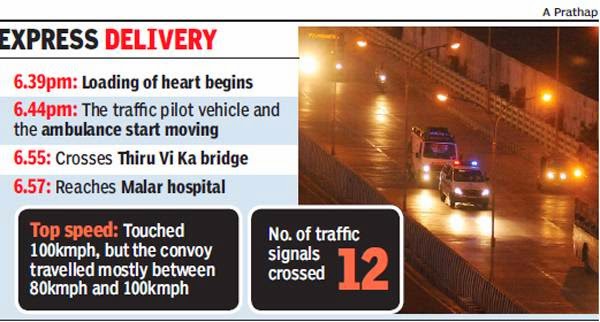
The
ambulance carrying the heart, harvested from a 27-year-old man who died
in a traffic accident and preserved in a special container at 4 degrees
Celsius,
started from Government hospital at 6.44pm and reached Fortis
Malar 13 minutes and 22 seconds later, at 6.57pm. Normally, a vehicle
takes 45 minutes to cover the stretch at peak hour.

At the
private hospital, the parents of Hvovi Minocherchomji’s, a 21-year-old
BCom student from Mumbai, received the heart – the mother in tears, the
father with a prayer on his lips.

Malar surgeons immediately got to the job of transplanting the organ on
the recipient who was kept ready. Through the day, the teams of doctors
at the two hospitals had been keeping each other informed about the
condition of the donor and the recipient. The liver and kidneys went to
other hospitals.

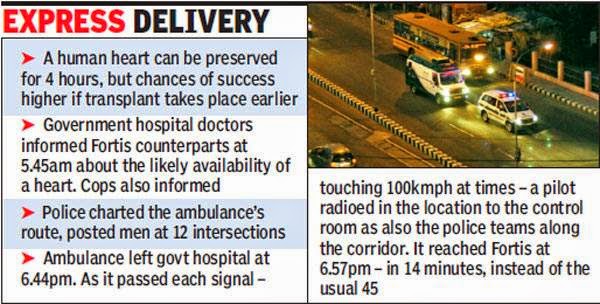
Malar got a call as early as 5.45am on Monday
that a brain-dead patient may be taken off the ventilator in a few hours
and that a heart, a liver and kidneys would be available for donation.
The Mumbai woman turned out to be luckier than five others awaiting a
heart transplant, as the donor’s blood group and body weight matched
only with hers among the other patients.

Almost simultaneously,
Karunasagar, the additional commissioner of police (traffic) was
informed about the need to transport the organ. By afternoon, the
traffic police were ready to create the green corridor, most of it along
the Beach Road and Santhome High Road, two of the busiest stretches in
the evening.

……..

Link: http://timesofindia.indiatimes.com/india/No-lal-batti-Chennai-halts-traffic-to-save-life/articleshow/36676797.cms

……

regards

Fight Taliban Arundhati Roy style

If
you look at Afghanistan, Waziristan, you know, the northeast states of
India and this whole mineral belt that goes from West Bengal through
Jharkhand through Orissa to Chhattisgarh, what’s called the Red Corridor
in India, you know, it’s interesting that the entire thing is a tribal
uprising. In Afghanistan, obviously, it’s taken the form of a radical
Islamist uprising. And here, it’s a radical left uprising. But the
attack is the same. It’s a corporate attack, you know, on these people.
The resistance has taken different forms. – See more at:
http://www.blackstarnews.com/others/extras/interview-arundhati-roy.html#sthash.x2qXMXnZ.dpuf

If
you look at Afghanistan, Waziristan, you know, the northeast states of
India and this whole mineral belt that goes from West Bengal through
Jharkhand through Orissa to Chhattisgarh, what’s called the Red Corridor
in India, you know, it’s interesting that the entire thing is a tribal
uprising. In Afghanistan, obviously, it’s taken the form of a radical
Islamist uprising. And here, it’s a radical left uprising. But the
attack is the same. It’s a corporate attack, you know, on these people.
The resistance has taken different forms. – See more at:
http://www.blackstarnews.com/others/extras/interview-arundhati-roy.html#sthash.x2qXMXnZ.dp
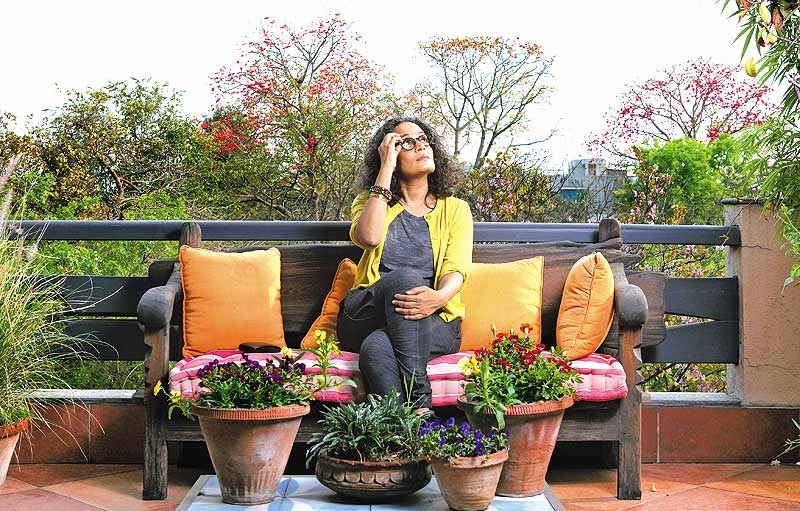
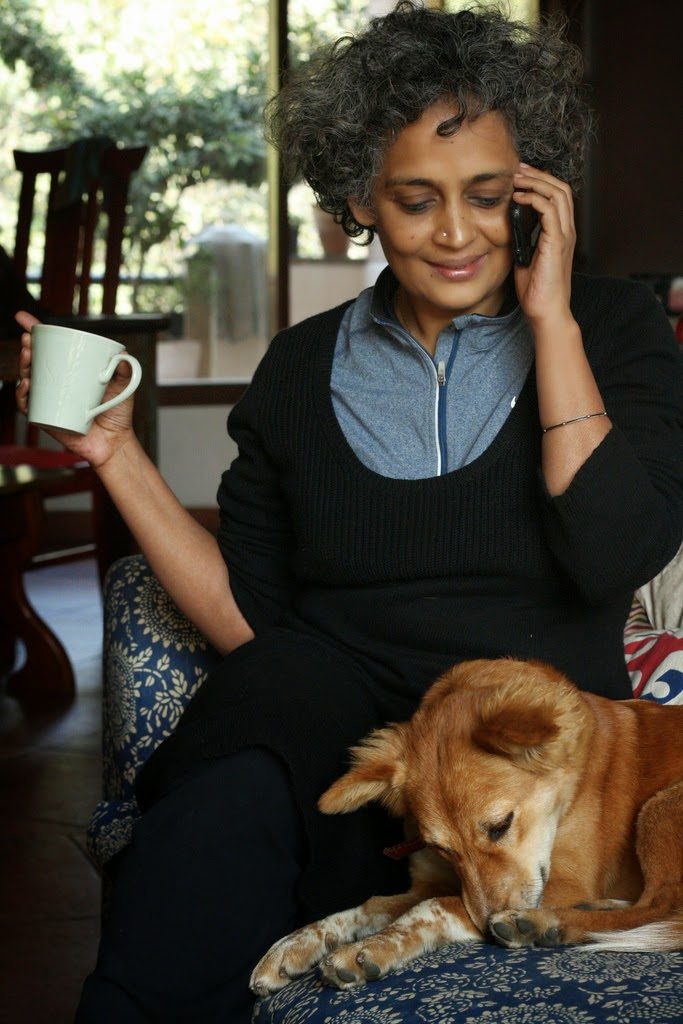
 Comrade Roy taking a break from people’s revolution, at her home in Delhi’s most posh neighborhood (High Security Diplomatic enclave in Chanakyapuri)
“When you say things like, ‘We have to wipe out the
Taliban,’ what does that mean? The Taliban is not a fixed number of people. The
Taliban is an ideology that has sprung out of a history that, you know, America
created anyway…

If you look at Afghanistan, Waziristan, you know,
the northeast states of India and this whole mineral belt that goes from West
Bengal through Jharkhand through Orissa to Chhattisgarh, what’s called the Red
Corridor in India, you know, it’s interesting that the entire thing is a tribal
uprising. In Afghanistan, obviously, it’s taken the form of a radical Islamist
uprising. And here, it’s a radical left uprising. But the attack is the same.
It’s a corporate attack, you know, on these people. The resistance has taken
different forms…
We know from the history of the war on terror that
a military strategy is only making matters worse all over the world. The war on
terror has made the world a more dangerous place. In India, they have been
fighting insurgencies military since 1947 and it has become a more dangerous
place…


In
other words, for any Taliban atrocities, pass the buck on US but
if the local State itself tries to forcibly wrest control from the crazies supposedly created by US, it will be doing a grave injustice- as then these US created crazies (somehow) convert into tribal rebels fighting against Corporate attack. In effect, whatever the course of action you pick- just make sure to blame US, Local state and Corporates for screwing up what otherwise would have been a stateless utopia. War on terror has worked nowhere, goes on Roy. To back her claim, Roy says Indian State’s fight against insurgencies has made India more dangerous (offcourse the official data that says otherwise, is State propaganda and any anectodal evidence that backs the same is no more than middle class delusion). 

PS: Having said that, I do enjoy
Ms Roy’s loquacious diatribes on India’s Hindutva crowd (though she seems OK with some of the  Sharia enthusiasts of Kashmir valley and even trieS to justify 26/11 Mumbai attack)- not as a source of serious analysis but because she tests the boundaries of
freedom of expression in India and at times, just for the heck of it (a welcome break from
right wing nutjobs of India).

Operation in North Waziristan: the end of the beginning?

1. If the aggressive PR operation launched in connection with the latest Waziristan operation is to be believed, the army has finally realized that the bad Taliban are simply intolerable and must be eliminated. They have been beheading soldiers and playing football with their heads for ages, so this realization is not exactly a stroke of genius. But as they say, better late than never.
A few hardcore skeptics continue to doubt that this operation signals any significant change in the age-old policy of playing whack-a-mole with (some) bad jihadis while keeping the good jihadi operation going, but most liberals on my time line seem to find it revolutionary. Who is right?
I am hedging my bets: I support the operation because some particularly nasty people may indeed be eliminated (or at least forced underground), but…I remain doubtful about a serious change of heart about the use of terrorists to kill Afghans or Indians. And barring such a change of heart, new layers of terrorism and violence will arise (and will have to be operated against in turn). I also dont think it will be as clean as is being shown on TV. Innocents will die and unfortunately, may die in rather large numbers.

2. There is no attempt to undermine or discredit the various Taliban front organizations and fellow travelers (JUI-S, Jamat e Islami, right wing of the PTI, etc). There is also no sign of any decisive action against the Lashkar e Jhangvi (the anti-Shia killing machine). And of course, the good Taliban and good Jihadists continue to be on our good side, planning attacks on Afghanistan and rallies in Kashmir..

3. ALL of the above will have to be tackled if Pakistan is to reverse course. That change of course therefore remains a very big IF.

4. We know from history that a small numbers of determined terrorists can maintain a terror campaign for years. So even if this operation represents a genuine change of course, it will not lead to peace in the short term. At best, it may be the “end of the beginning”.

PS: Imran Khan and the PTI have decided to support the operation. This either means its so damn serious that even IK has been scared into changing his mind…. OR that there is less here than meets the eye….Take your pick. I am an optimist, but when IK steps forward to support an operation, one must pause and at least briefly reconsider any optimism one may have felt.
On the other hand, the nephew of the chief justice (employee of a “sensitive agency”) has been kidnapped in Multan. That may indicate that the Islamists find this operation serious even if some observers do not.

Of course, there is always the “long term optimists” view: that this operation (warts and all) should be seen as yet another small step in the continuing march of Pakistan back towards the modern world. In this supposedly optimistic view, the deficiencies and doubts could all be true, but its all part of a greater process. GHQ (and PTI) may not intend to see this operation lead to future operations against good jihadists and shia-killers, but just like they (slowly) moved from garlanding Nek Mohammed to trying to kill his successors, they will also move (after many delays and unnecessary casualties) to target those who are currently their friends or are not yet a priority. .
What do you think?

Brown Pundits