Total war declared against Boko Haram

Normally we would expect the Haramis to laugh out loud in response. Here we have a fiercely ideological force which remains true to its mission as it enslaves 200+ Christian girls and demonstrates tremendous operational smarts by hoodwinking the Nigerian forces. A few more poorly equipped, low on morale forces from the neighbors should not make the tiniest difference. Plus even fewer “western observers,” NGO types in counseling positions. Finally the liberal shock troops that will always stand up in support of the forces of intolerance.

The operations are yet to start and already there are pre-emptive complaints from the liberal brigade about “Afghanistan in Nigeria.”

But on careful reading of the situation we see that the Haramis have indeed made a dreadful mistake which they will come to repent very much. 
….As the summit took place, reports emerged about the latest apparent Boko Haram attack, this one in Cameroon. Hollande said one Cameroonian soldier was killed in the Friday night
attack against Chinese nationals in northern Cameroon, which is known as
a stronghold for the Islamic extremists. Ten Chinese nationals are missing after the attack, a Chinese official said.  
  

….
The Chicoms killed upwards of 40 million of their own countrymen but they will not stand for kidnapping of 10 citizens by islamists. 

It is our considered opinion that Islamist forces will dominate the world (minus the West and East Asia) because of the sheer power of ideology and the unlimited petro-dollars at their disposal. Even parts of Europe will come under islamic domination (as it was the case a few centuries ago). But the problem with confident people is that they tend to over-reach. And China does make a nice target due to its horrible human rights record in Xinjiang.

A fight between Islamists and Chicoms will be something massive, may be something even larger than the horrors faced in World War II (and we really really hope not to see it happen and live through it). But it may be inevitable. 
………………
Nigeria
and four neighboring countries have declared a “total war” on Boko
Haram saying the dreaded Islamist militant group holding over 220
schoolgirls must be crushed as it had become a “regional al-Qaida” that
threatened all of them.


Under a “global and regional action
plan” firmed up to face the challenge posed by Boko Haram, the
governments of Nigeria, Benin, Cameroon, Niger and Chad will share
intelligence and border surveillance in the hunt for the girls still
held by the militants.

Western nations will provide technical
expertise and training to the new regional African effort against the
extreme Islamists.

“Boko Haram is no longer a local terror
group. It is clearly operating as an al-Qaida operation” in central
Africa, Nigerian President Goodluck Jonathan said while speaking at a
summit hosted by French President Hollande in Paris yesterday.

“We have shown our commitment for a regional approach. Without West
African countries coming together we will not be able to crush these
terrorists,” he said amid criticism that his government has done enough
to rescue the schoolgirls abducted last month.

Jonathan said Nigeria has deployed 20,000 troops, aircraft and intelligence sources in areas where Boko Haram is active. “The major challenge that we have faced in our search and rescue
operation so far has been the deluge of misinformation about the
whereabouts of the girls and the circumstances of their disappearance,”
the president said.

Last month, Boko Haram abducted 223
schoolgirls in northeastern Nigeria, where it is based. It released a
video earlier last week showing over 100 of the girls and offering an
exchange for prisoners.

President Jonathan has ruled out negotiations over their possible release, officials say.

Boko Haram’s guerrilla campaign has claimed 12,000 lives, with 8,000
people injured since 2009, Jonathan said at the summit which brought
together Presidents of west African countries of Benin, Cameroon, Niger
and Chad.

Hollande said the “global and regional action plan”
to face the challenge posed by Boko Haram involved “coordinating
intelligence, sharing information … border surveillance, a military
presence notably around Lake Chad and the capacity to intervene in case
of danger”.

Hollande called Boko Haram a “major threat to West
and Central Africa”, and said it had links with al-Qaida’s North-
African arm and “other terrorist organizations”.

Speaking at a press conference, Cameroon’s President Paul Biya said: “We are here to declare war on Boko Haram”. “There is determination to tackle this situation head on … to launch a
war, a total war on Boko Haram,” Chad’s President Idriss Deby said. 
Representatives from the UK, US and EU also took part in the Paris meeting.

Nigeria will coordinate patrols, pool intelligence and exchange weapons
and human trafficking information with Benin, Cameroon, Chad and Niger,
according to the agreement reached at the summit.

France, the
United States, the United Kingdom and the European Union “will
coordinate their support for this regional cooperation” through
technical expertise, training programs and support for border-area
management programmes, a summit statement said.


……
Link: http://www.reuters.com/article/2014/05/17/us-nigerian-violence-summit
…..

regards

The delusions of the king-makers

What a difference an year makes. Still Tehelka should do a re-interview of the “community leaders” – Salman Husain, Arshad Madani, Mohammed Adeeb, Zahid Ali Khan, and others – cited below to see what wonderful strategies they have cooked up to counter-act the mighty Tsu-Namo. We hope it works better than the miserable single point action plan they had devised for this election.

BTW one side-effect of a BJP sweep has been that the only most communal minded muslim parties/individuals have won as well and will be starkly prominent in the new parliament. There is the in-famous Asaduddin Owaisi of AIMIM (Hyderabad), Sirajuddin and Badruddin Ajmal of AIUDF (Barpeta and Dhubri, Axom), and E Ahamed and ET Mohammed Bashir of IUML (Malappuram and Ponnani, Kerala).

This is what full blown polarization looks like and it has not happened in one day. We will be accused of simplifying but 2014 happened because of three massively bad judgement calls made 30 years ago by the “secular” Rajiv Gandhi. 
 ……..
In 1985, prime minister Rajiv Gandhi gave in to the Muslim zealots in
the Shah Bano affair. Overruling a secular court’s decision that
repudiated wife Shah Bano was entitled to alimony from her ex-husband,
he enacted a law abolishing the alimony provision in conformity with the
Sharia. 

Only months later, Rajiv restored the balance by giving the Hindus
something as well: he ordered the locks on the Ramjanmabhoomi-Babri
Masjid in Ayodhya removed. Until then, a priest had been permitted to
perform puja once a year for the idols installed there in 1949. Now, all
Hindus were given access to what they consider the birthplace of Rama,
the prince posthumously deified as an incarnation of Vishnu.

..
Rajiv Gandhi had a huge majority and enormous good-will behind him. Yet he went ahead and appeased (conservative) muslims by denying justice to an old, infirm widow (Shah Bano). Next, he counter-appeased the (conservative) Hindus by opening the locks of Babri Masjid. Last but not the least, there was no justice to be had for the Sikhs of Trilokpuri, Delhi and elsewhere who were murdered in broad daylight.

End result: you have a Hindu-Sikh-Jain-Buddhist alliance voting for the BJP (and a fair amount of muslims as well). Congress sinks from 415 seats in 1984 to only 44 in 2014. BJP rises from 2 seats in 1984 to 286 seats in 2014 (and 340 as an alliance). Justice in its own way has been achieved, but there have been countless number of victims on the way. Will the decent, fair-minded Rahul Gandhi have the guts to face the truth and apologize to the nation for these acts of treachery? If not, bye bye for good.

……..

India’s Muslims, goes the conventional wisdom,
are a votebank. That bank is now working aggressively towards becoming the
central bank of Indian politics with a view to dominating its future political
currency. If conversations, events and initiatives of the past four weeks are
an indicator, Muslim social and political organisations as well as prominent Muslims
have evolved a one-point agenda: to deny the Bharatiya Janata Party (BJP)
strongman Narendra Modi a shot at becoming
India’s prime minister after the 16th General Election that is due in a year.
Their tactic: defeat the BJP and its potential allies in every Lok Sabha
constituency where the Muslim vote can sway the result.


“Narendra Modi is the No. 1 enemy of
India’s Muslims,” says Salman Hussain, a fiery
Islamic scholar who teaches at one of India’s most influential Islamic
seminaries, the 19th-century Darul Uloom Nadwatul, at Lucknow in Uttar Pradesh.
“If Modi becomes prime minister, more Muslims
will be massacred, more mosques demolished.”
While that may be rabble-rousing
at its worst, there is no denying that the anti-Modi sentiment among India’s
nearly 180 million Muslims has deepened since a cry went up
in the BJP last month to name Modi the party’s top prospect for the Lok Sabha
election.


“The BJP is fundamentally an anti- Muslim party and Modi proved that with
his role in the massacre of Muslims in Gujarat,”
says Arshad Madani, who leads a faction of the Jamiat Ulema-e-Hind, an
influential sociopolitical organisation of clerics.
Five months after Modi
became chief minister, more than 2,000 Muslims
died in February-March 2002 in violence by Hindu zealots of the BJP-RSS after a
train fire killed 57 Hindu passengers. “Muslims
know that if the BJP comes to power, their troubles will worsen.”


Indeed, the chant of Modi-as-PM that shot up in decibels at an all-India
meet of the BJP in New Delhi in early March set the cat among the pigeons.
Until then, the Muslim electorate across India was widely disenchanted with
Prime Minister Manmohan Singh’s United
Progressive Alliance (UPA) for unkept promises in its nine-year-rule. They were
miffed as the UPA has failed to introduce reservations for them in jobs and
educational institutions, a pre-election promise. They were also angered by the
sudden hanging in February of Afzal Guru, a Kashmiri
who had been on death row
for years after being convicted as a conspirator in the 2001 Parliament attack.


….
Muslim leaders have long slammed the Congress
for what they see as its failure to improve the Muslims’
lot after a panel led by former Delhi High Court Chief Justice Rajinder Sachar
reported in 2006 that Muslims were one of India’s most
neglected social groups in terms of education, employment, poverty and health.


But with Modi’s name to the fore, the foremost concern among Muslims
now is to stop the BJP from returning to power in New Delhi at any cost.


….
From Lucknow in the north to Hyderabad in the south and Kolkata in the east,
the dominant discourse among the Muslim community is as follows: coalition
governments that have run India unbroken since 1996 will continue as the norm.
Over the past 14 years, the BJP and the Congress
party have led two coalition governments each. Whichever of the two parties
wins more seats at the next General Election would team up with the floaters to
notch a majority and form the government.


….
Except for those political parties that are direct opponents of the Congress
in their regions and would, therefore, never join hands with it, or the
Communists who would never pair up with the Hindu sectarian BJP, all other
regional parties are capable of going either way. Hence, Muslims
should vote against the BJP, its allies and the fence-sitters who fail to
unequivocally clarify before the elections that they would have no truck with
the BJP.


“Wherever a party’s relationship with the BJP is suspect, it would lose the
Muslim vote,” says psephologist Yogendra Yadav, who has joined the recently
launched anti-corruption Aam Aadmi Party. Says Ilyas: “The Muslim is no more
attached to any one party. He now votes tactically to defeat the BJP and this
is how it will be in 2014.”


….
Muslim leaders reckon the community’s vote can make and unmake pretenders to
100-150 Lok Sabha seats.
These seats are not to be confused with those that Muslims
win. Today, there are only 30 Muslims in the Lok Sabha, just 5.5
percent of its 543 seats. As per the 2011 Census, Muslims
are nearly 15 percent of India’s 1.2 billion people.
But although Muslims
in the Lok Sabha are barely a third of their share in the population, their arc
of electoral influence is far greater. In 35 seats, they number around one in
three voters or more. In 38 other seats, Muslims
are 21-30 percent of the electorate. If the 145 seats where they are 11-20
percent are added to this, Muslim voters have the ability to influence the
outcome in a whopping 218 seats.


Ironically, until now, the Muslim vote has been most effective where it is
around 10 percent of the electorate, big enough to sway the result in a
multi-cornered contest by going all in for a single candidate, but too small to
raise alarm in the BJP or its allies to trigger attempts at a
counter-polarisation of non-Muslim votes. On the other hand, wherever their
numbers are 20 percent and above, Muslim votes have mostly been ineffective
because of a multiplicity of Muslim candidates divvying up their support, often
handing victory to the BJP on a platter.


Muslims have shortlisted Uttar Pradesh,
Bihar and West Bengal as their key battleground
states because their results would most impact who leads the next government:
the Congress or the BJP. Next in importance
for the Muslims are Andhra Pradesh, Assam,
Maharashtra and Karnataka, where the more seats in the kitty of the Congress
the less likely would be the BJP’s chances to form the government.
 

……..
Indeed, the
selection of the primary battleground states of Uttar Pradesh and Bihar is
based on their experience of coalition politics since 1998, when the BJP formed
its first stable national government heading a multi-party coalition with Atal
Bihari Vajpayee as prime minister. The key to the BJP’s victories in the 1998
and 1999 Lok Sabha elections lay in its wins in Uttar Pradesh and Bihar. These
back-to-back victories jolted the Muslims, who are around 20 percent in
these states’ overall population.


….
Chastened, the Muslims voted tactically in Uttar Pradesh
and Bihar in the 2004 Lok Sabha election, giving the BJP fewer seats and
bringing the UPA to power. Although the BJP did better in 2009 in Bihar due to
its alliance with Janata Dal (United), which virtually wiped out Lalu Prasad
Yadav’s Rashtriya Janata Dal, it still fared poorly in Uttar Pradesh, thanks to
the voting by Muslims there that gave the UPA a second
term.


Indeed, the Muslim vote has dictated the last two poll cycles in Uttar
Pradesh. In the 2007 Assembly polls, Muslims
massed behind the Bahujan Samaj Party (BSP),
giving it a clear majority, ending 15 years of unstable coalition politics. In
2012, Muslims deserted the BSP
leader, Chief Minister Mayawati, turning to the Samajwadi Party (SP) and
providing it with a majority. “Eight out of 10 Muslims
voted for the SP,” says Rajya Sabha MP Mohammad Adeeb from Uttar Pradesh, an
independent who campaigned with SP chief Mulayam Singh Yadav last
year, but now accuses him of turning his back on the Muslims.
“They won because of the Muslims.”


Muslims leaders say Uttar Pradesh Chief
Minister Akhilesh Yadav, the eldest son of Mulayam, has failed their community,
which comprises a whopping 40 million of the state’s nearly 200 million people.
Dozens of incidents of sectarian violence have caused a loss of Muslim life and
property across Uttar Pradesh. While the SP promised to free Muslim youths
arrested earlier for their alleged roles in terror plots, no such action has
yet been taken.
The state government has also stonewalled calls to disclose the
contents of an independent inquiry it commissioned into the disputed arrests of
the youths.


….
In just two weeks in March, four public meetings focusing exclusively on
the Muslims were called at Lucknow, three of
them bringing out tens of thousands of Muslims
on the streets. While one meeting, on 2 March, was directly called by Mulayam,
he also occupied centre-stage at another rally that Arshad Madani of Jamiat
Ulema- e-Hind called on 17 March.


….
On the same day, the Congress party’s Muslim face, External
Affairs Minister Salman Khurshid, who hails from Uttar Pradesh and once headed
the party’s state unit, descended on Lucknow at a town hall sort of meeting
with Muslims, exhorting them to break free
from the SP’s grip. Earlier, on 3 March, MP Adeeb led a huge rally of Muslims
jointly with the Communists to demand that Muslims
arrested in terror cases be released. “Muslims
in Uttar Pradesh have the capacity to make and unmake national governments,” he
says.
At that rally, the Muslims hooted Ashok Vajpayee, the SP
candidate from Lucknow for the 2014 polls, and refused to let him speak.


….
Of the 80 Lok Sabha constituencies in Uttar Pradesh, Muslims
number over 20 percent of the electorate in two dozen seats in west Uttar
Pradesh, including Bareilly, Badaun, Pilibhit, Rampur, Sambhal, Amroha, Meerut,
Muzaffarnagar, Saharanpur, Bijnor, Amroha and Moradabad. In east Uttar Pradesh,
Muslims
play a decisive role in at least eight seats — Azamgarh, Bahraich, Gonda,
Srawasti, Varanasi, Domariyaganj, Gonda and Balrampur.


….
In states other than Uttar Pradesh where the Muslim voters may be willing to
go against the Congress, Modi is haemorraging support
from the allies of the BJP. Bihar CM Nitish Kumar has crafted a political
miracle by fetching up Muslim votes even for the BJP because it was aligned
with him in two Assembly elections. In the 2009 Lok Sabha election, his JD(U)
won 20 of the state’s 40 seats and the BJP 12. But his aversion to Modi’s name
is now legion. Says Yogendra Yadav: “For three years, Nitish has been telling
the Muslims of his state that ‘when you vote
for me, you vote for me’.” Adds MP Adeeb: “Nitish knows that if he backs Modi,
the Muslim voters in Bihar will quickly move en masse to Lalu.”


Indeed, Yogendra Yadav believes that West Bengal CM Mamata Banerjee, too,
would need to clarify her position on the possibility of backing the BJP in
forming the next government at the Centre to her state’s 27 percent Muslim
population.
“She will have to do something before the Lok Sabha election, which
would make her position clear vis-à-vis Modi,” he says. The Muslim voters’
disenchantment with the 34-year Communist rule contributed in no small measure
to bringing Banerjee to power in the state in 2011.


For the same reason, Odisha CM Naveen Patnaik, once a BJP partner, and
former Andhra Pradesh CM Chandrababu Naidu,
who was a kingmaker in the BJP-led
coalition government of 1999 but has been in political wilderness since losing
power in the state in 2004, are keeping miles away from the BJP.


“Although the BJP has no presence in Andhra Pradesh, no party here can dare
to openly align with it now that Modi’s name has come up,” says Zahid Ali Khan
of Hyderabad, a veteran activist and editor of a leading Urdu daily newspaper,
Siyasat.


That, in effect, is true of virtually all political parties in the country
wherever the Muslim votes count. The sprawling residence of India’s prime
minister at New Delhi’s upscale 7, Race Course Road, may well turn out so near
and yet so far for Narendra Modi.

……..
Link: http://www.tehelka.com/the-modi-card-and-the-muslim-ace/
…….

regards

Tsu-Namo “massive, massive positive” for India

Well we respectfully disagree, but then this is Jim O’Neill, former head of Goldman Sachs, so what do we know? Proof (if it is ever required) that Modi’s victory is a victory for Wall Street and Dalal Street. Pankaj Mishra has got a juicy new quote (which will make his articles even more pleasurable to read). Its a win win situation!!!

…..
Modi’s Bharatiya Janata Party
and its allies won about 61 percent of seats in parliament as voters
punished the Congress party-led coalition for slowing growth, graft and
Asia’s second-fastest inflation.
 

If Modi pursues the anti-corruption
policies he’s promised, India has the potential to grow about 10 percent
annually for the next 20 years, according to Jim O’Neill, former chairman of Goldman Sachs Asset Management.


“This is the most positive development in India in 30 years,” O’Neill, who coined the acronym BRIC, referring to Brazil, India, Russia
and China, said at the SkyBridge Alternatives Conference in Las Vegas
yesterday. Modi’s victory is a “massive, massive positive” for the
nation, he said. 

….

Link: http://www.bloomberg.com/news/2014-05-16/modi-victory-spurs-optimism-india-economy-will-lead-bric-rebound.html
…..

regards

The People vs. the Coalition against Genocide

At the end it was one phone call from the leader of the free world, a liberal with impeccable qualifications, which settled the score. Indeed it can be argued that in a nightmare scenario, it is democracy which has defeated the liberals (not to forget, Modi won three elections in Gujarat as well).

The bitter truth is that there is no vote bank for liberal ideologies. The liberals know this very well. This is why many liberals are fond of Stalin and Mao, because like mushrooms they can prosper only in an un-democratic, mandarin governed, national akademy kind of environment toiling under the benevolent gaze of a dictator. Alternatively there are the pale-faced humanities departments in the West which aim to exclude people with a diversity of opinions (read conservative, religious) using the sword of tenure (which is now thankfully disappearing).

India, as a number of wise people have observed, looks right now as a mirror image of Pakistan. Well that is not quite true, the Army does not rule India (but it has a veto). About five thousand Hindus per year are reportedly leaving Pakistan for India, there is no such (not yet) migration of muslims from India to Pakistan. Also, India does not have the death penalty for blasphemy (and no votes for this), and to the extent there is an intolerant hammer, it is deployed equally in favor of conservative Muslims and Hindus (ex-communication of Salman Rushdie, Tasleema Nasreen and MF Husain, all of them muslims).

What is certainly true is that Indian muslims have (temporarily) lost their voice and the power of their vote (due to the peculiarities of the first-past-the-post system). This goes against the promise that a great man had made during Partition I, that muslims will be kings in Pakistan and king-makers in India. Again it can be argued that while this strategy has served some muslims very well, for the majority of the population of the sub-continent, dividing communities (and inciting sectarian hatred) for short-term gain has not worked out so well. There are no saints and all groups have indulged in (state-sponsored, community sponsored) genocide.  

If liberal groups such as the CAG want to gain more popular support for their get-Modi cause (and it is no doubt a very good cause), they should find a stronger voice in condemning the atrocities of Direct Action Day which illuminated the path of winning hearts and minds through polarization of people who have co-existed for centuries. 

A
single phone call that went out from the White House to Prime
Minister-designate Narendra Modi close to midnight on Friday erased
nearly a decade of stigma that Washington had heaped on the BJP leader,
ostensibly for his role in not quickly containing the communal riots in
Gujarat in 2002.


The conversation between President Obama and
“candidate” Modi, as the White House characterized him, was short and
to-the-point. After congratulating him for leading the BJP to victory in
the general election, Obama pointedly invited him to visit Washington
to advance bilateral ties between the two countries, which were too
important to be allowed to drift.

The President noted, the
White House said later in a read-out of the call, that he looks forward
to working closely with Modi to fulfill the “extraordinary promise” of
the US-India strategic partnership. Modi evidently agreed, and the
readout said “they agreed to continue expanding and deepening the
wide-ranging cooperation between our two democracies.”

There
was no mention of visas, boycotts, or a decade of Washington’s
blacklisting of Modi aggravated repeatedly by what one enraged BJP
factotum described as “dim-witted lower officials with little idea of
political and diplomatic realities.” Underpinning the phone-call was the
US desire to ‘reset’ ties with Modi, while recognizing that the
stupendous majority the Indian electorate had lavished on him trumped
any human rights campaign a small left-wing clique had mounted against
him, with the prospect of holding US-India ties hostage in its wake.

In fact, officials pointed out that President Obama went a step further
than the State Department in reaching out to Prime Minister designate
Modi, inviting him to Washington DC, when he could well have said he
looked forward to meeting him in the days to come — as they possibly
could in various multi-lateral fora over the next few months. But
clearly, the White House is ahead of the curve compared to the
bureaucracy-driven State Department when it comes to pressing the reset
button.

In fact, the State Department continued to be
“rule-bound” in its approach and language even after the White House
outreach. “The Prime Minister of India will be welcomed to the United
States. As head of government, Mr Modi would be eligible for an A-1
visa,” spokesperson Jen Psaki said in a statement that implicitly
suggested that as an individual, Modi could still be persona non-grata.

That impression was strengthened by the reaction from human rights
clique that has campaigned against Modi in the US, including a so-called
Coalition Against Genocide. “CAG has been in the forefront of
maintaining the US visa ban on Modi, and we are proud of having stood up
for truth and justice,” a CAG spokesperson said, adding that “A
possible visit to the US by Modi on a diplomatic visa, in his capacity
as the Prime Minister does not negate the earlier ban and the fact that
he is culpable for the egregious and systematic human rights abuses.”

But for now, the Indian electorate has forced Washington’s hand.
“Congrats to @narendramodi and BJP. Look forward to working
w/you/growing shared prosperity/security w/world’s largest democracy,”
tweeted secretary of State John Kerry, tagging the PM-designate even as
the scale of Modi’s victory became clear. As far as BJP and Modi
supporters are concerned, he also needed to tag his minions in the state
department.

……….

regards

A secular path to increase minority representation

A most remarkable election which has resulted in zero Muslim MPs from Uttar Pradesh and only 20 nation-wide (out of 543).

Mamata Banerjee is the super-caste leader of a party with the maximum number of muslim MPs and is now the face of secular India (not Rahul Gandhi). The sole muslim candidate of the BJP (Syed Shahnawaz Hussain, Bhagalpur) lost to a Hindu from Rashtriya Janata Dal (RJD) –  Lalu Yadav’s party that survives on a muslim-OBC vote bank!!!

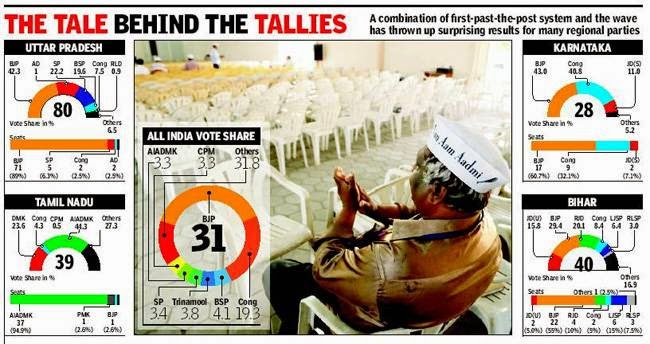
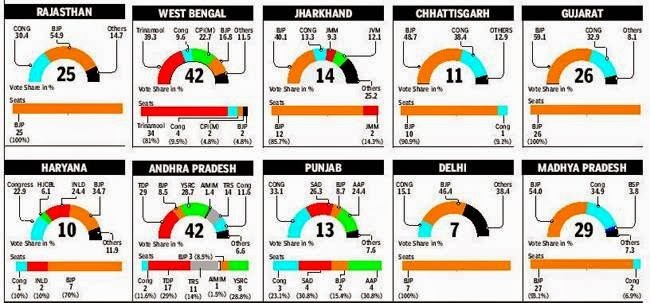
In a first-past-the-post system you normally need 35% and above to win. The BJP/NDA alliance secured 38% vote-share nation-wide and scored a massive victory. In the same way in Odisha (Biju Janata Dal), Bengal (All India Trinamul Congress) and Tamil Nadu (All India Dravida Munnetra Kazhagam) the winners swept up 40% and above votes and secured a mammoth mandate.


The losers got significant vote-share: BSP (Mayawati) got 20% in UP (zero seats), CPI(M) got 30% in Bengal (2 seats), Aam Admi Party got 33% in Delhi and 25% in Punjab (zero in Delhi but 4 in Punjab!!!), DMK got 27% in Tamil Nadu (zero). In Odisha Congress got 26% (zero) and BJP got 22% (1 seat).

The worst performance came from muslims, the largest minority in the country (20% of  the population, considering under-counting in Census and migrants from elsewhere, but multiple majority districts in Bengal, Axom, Kerala, Uttar Pradesh, Bihar, and Maharashtra).

The above shows that first-past-the-post systems are flawed and what should be in place is a sophisticated form of proportional representation which will protect the diverse nature of India (more than any number of vote-banks performing tactical voting can every hope to achieve).
………….

The 16th Lok Sabha will have one of the lowest numbers of
Muslim MPs with just about 20 of them emerging victorious in the Lok Sabha
polls which saw a saffron surge in the whole north and western parts of India.

Uttar Pradesh, which has 80 seats, has not sent any Muslim candidate in the
just concluded election.


An
analysis of the results shows that there are about 20 winners who are from the
Muslim community in the 543-member House while BJP does not have a single MP
belonging the community.

Going by estimates, there are more than 25 Muslim members in the outgoing Lower
House.

…………

Muslim MPs: West Bengal
Idris Ali, AITC, from Basirhat
Sultan Ahmad, AITC, from Uluberia
Mohammad Salim, CPI (Marxist), from Raiganj
Badrudduja Khan, CPI (Marxist), from Murshidabad
Mausam Noor, Congress, from Malda North
Abu Hashem Khan Chaudhary, Congress from Malda South
Dr Mamtaz Sanghamita, AITC, from Burdwan-Durgapur


Bihar
Tasleemuddin, RJD, from Araria
Tariq Anwar, NCP, from Katihar
Chaudhary Mahboob Ali Qaisar, LJP, from Khagaria
Mohd Asrarul Haq Qasmi, Congress, from Kishanganj


Andhra Pradesh [now Telangana] Asadudduin Owaisi, AIMIM, from Hyderabad

Assam
Sirajuddin Ajmal, AIUDF, from Barpeta
Badurddin Ajmal, AIUDF, from Dhubri


J&K
Mehbooba Mufti, PDP, from Anantnag
Muzaffar Husain Baig, PDP, from Baramulla
Tariq Hameed Karra, PDP, from Srinagar


Kerala
E Ahamed, IUML, from Malappuram
ET Mohammad Bashir, IUML, from Ponnani


Tamil Nadu Anwar Raja, AIADMK, from Ramanathapuram

Lakshadwip Mohammad Faisal PP, NCP, from Lakshadweep

……
Link: http://www.dnaindia.com/india/report-why-16th-lok-sabha-will-see-the-lowest-number-of-muslim-representation-in-india-s-democractic-history-1989170
…..
regards

“Minarets are our bayonets”

Is India also a break-out nation like Turkey? Well certainly India has a high-growth, high HDI, developed section (perhaps equal to the 77 million Turks) and then we have a one billion, desperately poor and lost-in-stone age section that has no equal anywhere. 

Is Modi like Erdogan, a man who rose from within the ranks of the religious shock-troops and took charge of a secular country, and helped liberate its Islamic soul? This brings us to mind a famous statement that the once-upon-a-time lemonade seller had made:

The SVP backs its claim by citing a famous remark by Turkish Prime
Minister Recep Tayyip Erdogan
, who once implied that the construction of
mosques and minarets is part of a strategy for the Islamization of
Europe. The pro-Islamist Erdogan said: “The minarets are our bayonets,
the domes our helmets, the mosques our barracks and the faithful our
army.”

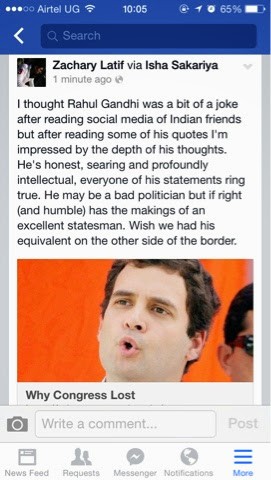
Ruchir Sharma is the Head of Emerging Markets at Morgan Stanley so he is expected to be a votary for Modi. However at the heart of the polemic below we see the same fear that secularists feel everywhere, the good old days when they could wag their fingers at the unwashed masses is over. They will now be silenced with blasphemy laws and brick-bats. The Hindu Brotherhood has arisen out of democracy but it may well lead to a soft-theocratic state where the principles of a liberal democracy (protection of minorities, tolerance of dissent) may not be respected. Just like Turkey.

Modi
is a rivetingly blunt speaker, but he is also the Indian political
master of new media technologies.
At traditional Indian political
rallies like those we witnessed in Uttar Pradesh and Bihar, half the
crowd shows up only long enough to watch the candidate’s helicopter stir
dust storms in the landing field, and those who stay (including those
paid to stay) can barely hear the crackling microphone over the din.   The
new media are much clearer. Since the election of 2009, the share of
Indians with TV has risen from 53% to 63%, the number online has risen
from 69 to 213 million, the number with smart phones from 3 to 70
million. Membership on Facebook is up from 10 to 100 million, on YouTube
from 5 to 60 million, and Modi is all over these platforms and more.

After we left Uttar Pradesh, Modi returned in the form of the life-size
hologram he has used to project himself before some 1,500 rallies and 15
million voters during the campaign.

Lord, satisfy the hope Modi has unleashed. His
political machine has been hammering home the message of how he brought
new business, new roads, new jobs and less crime to Gujarat, and now
everyone outside Gujarat seems to know all this is true. They see Modi
as an efficient strongman who will restore growth, lower the price of
onions and, as one voter put it “make the trains run on time.”

Tiwari ticks off the usual gripes against Congress, including
corruption, inflation, and crime. The folks he knows around Allahabad
are switching to Modi because “the public needs change, and Modi is
their guy.” Not far off, in the village of Saidabad, there is no
electricity at one in the afternoon when the sun is high and the
temperature hits 43 degrees Celsius, and people speak of how Modi will
turn the fans back on. Modi hardly discourages this optimism, stealing
Congress’s socialist thunder by promising every Indian a cool brick
house with a toilet.

Some of the roads along the Ganges are so
crowded or just so broken that on our road trip we often average less
than 30 kilometres an hour, but so many people living along it are now
hopeful that Modi will fill life’s potholes. In the town of Pali, Rakesh
Kumar Verma is fed up after winning two masters degrees but ending up
underemployed at the age of 42 because “the goons are in control.” Loan
officers skim 15% of a one lakh loan for themselves. The bribes required
to get even menial jobs make the jobs not worth taking.
Verma gets by
selling cheap jewellery. But Modi cleaned up corruption in Gujarat, he
can handle the goons. My colleagues start joking, every time a window
jams or a toilet won’t flush, “Modi will fix it.”

To many
voters, though, Modi is more than a repair man. He was once a tea seller
in a railway station, but now he is the self-made leader of the world’s
largest democracy, a harbinger of disruptive change.
In the district of
Bhigunia, we crawl along a pontoon bridge over the Ganges to a tiny
settlement accessible in no other way. On the far side we meet a young
Brahmin, university educated and upper caste but not working, because it
would be too embarrassing to take a job below his station in a place so
small, where his family is well known.
Under Modi though, the hope is it
will be different. Pathetic job creation under Congress will give way
to job growth. The Brahmin can go find work in a city, where he is
anonymous. Caste barriers are eroded by urbanization and
industrialization.

Traveling these bumpy roads, it becomes
clear that the Modi wave did not spread only on modern channels. One
high member of the Gandhi clan once allowed that the very poor
communicate at a level that “we”, the literate and privileged, don’t
understand. Perhaps it was this subaltern frequency that transmitted the
Modi sunbeam from the smartphone elite and the TV-watching middle class
to the rest of the 814 million.
The candidate was relentless, too,
showing up on so many stages voters wondered if there was more than one
of him, not even counting the holograms. In Bihar we hear him speak in
the town of Hajipur and he is as always spellbinding, intimate,
hilarious. He says headlines scream in Gujarat if the power goes off for
a few minutes, but celebrate in Bihar if the power goes on for a few
hours.

Modi emerges as something of an old-fashioned strongman,
delivering a multimedia message of modern development. What goes unsaid
is equally revealing. Modi and the BJP have been largely silent on
flammable foreign policy and sectarian issues, the words “Pakistan” and
“Muslims” have fallen from the party lexicon.
Asked about how Modi will
deal with Muslims, many of whom fear the BJP, the farmer Tiwari cites an
interview in which Modi dismissed such questions as “the language of
those who want to divide India.” Besides, Tiwari suggests, sectarian
strife is common in his part of the world and that in Gujarat there had
been no further violence once the scores were settled in 2002.

Modi now seems set to govern all of India, the 150 million Muslims
included and there is reason to be cautious. Though the popular vote for
the BJP is expected to come in at the highest for any single party in
three decades, it is still just around a third of the total vote. Two
thirds of India and 90% of Muslims probably did not vote for Modi or
BJP.

Modi has promised the moon. In the final weeks he
often targeted his promise that “better days are ahead” to the vast
population of Indians under the age of 28, including the roughly 100
million who were voting for the first time in this election.
The
difficulty is that to create enough jobs for all these youths, India
needs to create 10 million jobs a year for the next five years, or four
times more than it has been creating over the past five years. It will
be virtually impossible for Modi to hit the ground running on this
challenge, because his first task should be to contain India’s double
digit inflation, which means restrained government spending, high
interest rates, and job growth remaining weak until inflation is
whipped.

What then? It’s easy to imagine jobless, disappointed
youths getting angry, and the hardcore Hindu fundamentalists reviving
their old accusations that it is Muslims, with their high birth rate,
who are to blame for India’s “population bomb” and the unemployment
problem it is now creating.
In a tense environment, it’s hard to know
whether Modi would fuel the tension through innuendo, allow it to fester
by remaining silent, or defuse it by trying to quiet the mob.  On the
road the Modi wave keeps bringing to mind the tale of Turkish leader
Recep Tayyip Erdogan, another former street vendor (lemonade, not tea)
who emerged from a pious political sect (Islamic, not Hindu) to become a
self-made prime minister much to chagrin of the secular elite.
In his
early years, Erdogan shelved his social and cultural agenda to focus on
stabilizing the inflation ridden economy, and became widely popular.
After taking office with 34% vote in 2002 elections, Erdogan was
reelected with 50% in 2011. At the height of the boom, Erdogan’s name
rang throughout the land, his voice dominated all discussion echoes of
Modi in India today.  But then success went to Erdogan’s head, he
stretched two terms into three, his autocratic instincts began bubbling
to the surface as he pushed an increasingly Islamist social agenda. To
stifle the resulting protests, Erdogan rolled out riot police, blamed
foreign conspiracies, rallied his pious supporters to counter
demonstrations, and recently attempted to ban Twitter,
which his
opponents are using to organize the anti-Erdogan campaign. One wonders
if one day India’s new political messiah may also go the Erdogan way.
For now, as in Turkey during Erdogan’s early years, India is focused on
Modi’s promise that “better days are ahead.”

The writer is
head of emerging markets at Morgan Stanley Investment Management and
author of ‘Breakout Nations: In Pursuit of the Next Economic Miracles’

.
..
……
Link: http://timesofindia.indiatimes.com/home/lok-sabha-elections-2014/news/The-monophonic-voice-of-India/articleshow/35091722.cms
……

regards

Twitter for your thoughts

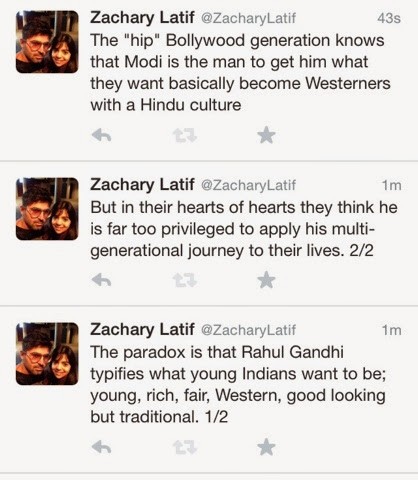
Indians have not yet reached the affluence to realise that the new elite counter culture in the West for the past 2 generations is to turn back on gross Americanisation & opt for exotic authenticity (hipster culture, Seattle-Portland-Oregon).
The rise of the far right in Indo-Israel is different to the rise of the European far-right. The Indo-Israeli far-right want to become Westerners with a thin Hindu or Hebrew overlay. The European far-rightward want to stay Westerner with a strong local colouring (even down to the provincial level; Catalonians, Basque & Scots). The local cultures (Mizrahi, Indian provincial) are fading out in this consolidation of India and Israel as far-right superpower islands in the Christian-Muslim Ocean.
It’s interesting while it’s possible to make these terms:
Hinjew
Judeo-Islamic
judeo-Christian
Indo-Christian
Indo-Muslim
Now think how odd these terms are
Christian-Islamic
Islamic-Christian
The dominant paradigms of Western Eurasian (west of Himalayas + Africa) have been the giant Christian & Islamic traditions. They are in rivalry across the space and in almost every regions. As cultural supper-powers stemming from the same Jewish-Abrahamic tradition (Islam is seen as a continuation of Christianity but in fact early Islamic history almost exclusively focuses on contact with Jewish populations, the Holy Quran is far more focused on the Old Testament than the New, though oddly Sunnism awaits the return of Christ as the Mahdi).
Christianity and Islam are the civilisational superpowers with a strong religious-ideological overlay. Different variants of Middle Eastern religion traditions (the pre-Bedouin J2 classical Middle East that migrated to Mediterranean Europe before being consumed by the 5-9th century Bedouin incursions that caught up the MENA region). It’s interesting to see how this globalised world reacts to this good cop-bad cop duo act by the Middle Eastern behemoths; perhaps a third newer Middle Eastern tradition will unite them all?

For India has now become the Muslim Pakistan

The wild jubilation that Indians (Chetan Bhagat, Vir Sanghvi, Tarek Fatah)  have been feeling at the rise of Modi reflects the final consolidation of the Hindu voting block that crosses caste & class on the national level. Pakistan has been voting centre-right governments for years now but there is no joy or jubilation when the Sharifs come to power (maybe their cardinal sin was not overseeing provincial massacres of minorities perhaps)? It is perhaps that the young Indians have now completed the transformation of India into the Hindu Pakistan, strident, aggressive & domineering. For if Modi had happened to be born Muslim what else would he have been other than a Morsi-type fanatic who had butchered minorities? Like the now desceased Ariel Sharon the rule of the modern age is that you can be as far-right as you want (esp if your ppl have a history of being oppressed like Jews & Hindus) so long as you aren’t Muslim or Christian. 

North Indians (agressive fighters) vs. South

This is that time of the year when Std X and Std XII results are declared and the parents and students alike are on a knife-edge. We lose hundreds of young souls full of promise and beauty to what can be only termed as temporary insanity. This is especially a problem in the southern states (see SNEHA interview below).
…..
Why do so many southern states have more suicides than northern states?
The second reason is cultural. If you look at the personalities, you
will see that northerners are a little more aggressive because they had
fought many wars with the Afghans, Mughals, the British, etc. while the
southerners never had to face any wars.
If you look at the expressions
also, the northerners are more expressive of their emotions than
southerners.

…..

It used to be that Kerala used to top the suicide charts but now the greatest cause of alarm is Tamil Nadu (and specifically Chennai). There are individual heroes like Lakshmi Vijayakumar and Justice Karnan who are trying to help. But much more is needed to be done, so please help out if you can.

For all the people who are on the edge (or if you are one who knows of such a person), we urge you to listen to the voice of the many failures like Justice Karnan who have now tasted success.

And yes, heartiest congratulations to Ayush. We have never before come across a person with a 99% score, and we are impressed. Keep it up.
………..
Little
did Ayush Banerjee expect that Saturday would be a red-letter day in
his life. The national Indian School Certificate Examinations (ISCE)
topper,
said he was completely surprised on hearing the news.


The Loyola School, Jamshedpur, student, who scored 99.25%, said that
though he was expecting a good result, he never expected that he would
rank first in the country. “Although I was expecting to get a good rank,
topping the country is a big surprise for me,” he said.

Son of
Pradeep Kumar Banerjee, chief researcher at Tata Steel’s R&D
department, Ayush said: “Three hours of studying everyday was sufficient
for me.”

………….
A
day after Class 12 results were announced and two ‘failed’ students
committed suicide, with eight others having reportedly attempted
suicide,
a sitting judge of the Madras high court has issued an appeal
saying he himself failed in five examinations but became a judge because
he never gave up.

Citing his own failures, not one or two
examination but in five, Justice Karnan issued a public appeal on
Saturday saying:
“My appeal to all broken hearted and ‘unsuccessful’
students of Plus Two and SSLC students this year, and for all time to
come, is not to resort to the extreme measure of taking one’s god-given
life.
Please trust me and believe that I, once a humble student and of
mediocre means, went through a difficult academic journey at a remote
village in Tamil Nadu. I failed in VI standard, VIII standard, PUC,
BSc., & BL examinations.

……..


Lakshmi Vijayakumar of the suicide prevention NGO Sneha
examines why India’s southern states register more suicides than the
northern states, in a conversation with Shobha Warrier.


The latest report of the
National Crime Records Bureau states that 135,445 people committed
suicide in the country last year. Tamil Nadu tops the list with 16,927
suicides, followed by Maharashtra (16,112), West Bengal and Andhra
Pradesh.


….
Dr Lakshmi Vijayakumar, consultant psychiatrist and
founder of Sneha, an NGO that works in suicide prevention, analyses the
situation, in a conversation with Shobha Warrier.


….
According to the NCRB report, Tamil Nadu tops the list of states that registered the maximum number of suicides…

The NCRB has been coming out with such crime reports for the last
20-30 years. For 20 years, Kerala used to be the state that registered
the maximum number of suicides followed by Karnataka, Tamil Nadu and
Andhra Pradesh. 

If you take states and Union Territories together,
Pondicherry
is the Union Territory that has the largest number of
suicides in the entire country.


The general pattern is that the southern states register more suicides than the northern states.


Is it because suicides are reported more in southern states?

Initially we also thought it was because of the better reporting
system. But recently Vikram Patel and I published a paper called Data from the Million deaths in Lancet,
which is a stratified sampling of a million homes in the country for
various causes of death and not necessarily suicide. When we analysed
the suicide part of it, we found that southern states had more suicides
than northern states.


…..
The national suicide rate is 11.2 per 100,000 but all the southern
states have more than 16.
The suicide rate in the central states is
between 10 and 15. Northern states like Uttar Pradesh, Bihar and
Rajasthan register less than five per 100,000.


This pattern has been persisting for the last 20-25 years. We know
there is an under-reporting of suicides by 25 per cent but the pattern
has been the same.


….
What could be the reason? Why do so many southern states have more suicides than northern states?

There are more suicides in southern states because of three reasons.
One, southern states are more literate than the northern states.
With
education comes higher level of expectations and that gives rise to
disappointments. In our national representative study, we tried to
analyse the data and found that education is directly proportionate to
suicide which is contrary to what we think. It may be because with
education, expectations also rise.


The second reason is cultural. If you look at the personalities, you
will see that northerners are a little more aggressive
because they had
fought many wars with the Afghans, Mughals, the British, etc. while the
southerners never had to face any wars.
If you look at the expressions
also,
the northerners are more expressive of their emotions than
southerners.


So, people of south India have a tendency to internalise their
feelings.
When there is so much of anger and frustration inside, instead
of directing it outside, you direct it inside.


These are the theoretical explanations of why suicides are high in southern states.


….
While Tamil Nadu and Kerala, the two states that are supposed
to be more advanced in all sectors, top the list, Bihar has the lowest
number of suicides.


That is the pattern we see all over. If you take the states of the
United States also, the states with higher GDP register more suicides
than the states with lower GDP. The reason is, the more you develop, the
more the expectations and more the disappointments.


In the US, the educated white male has a higher risk of committing
suicide than an unemployed black. When you blame yourself for your
failures, the suicide rates go up.


….
The NCRB report says that in Tamil Nadu the number of
suicides has gone up by six per cent last year. Kerala used to top the
list till recently. How has the number come down there and gone up in
Tamil Nadu?


Kerala used to have 28-29 suicides per 100,000 and used to top the
list, but in the last four to five years, the rate has been coming down
gradually. This is due to more awareness about taking treatment for
depression. The government also has come out with a mental health plan.
Also, rapid changes are not happening in the state these days.


….
Among the Indian cities, Chennai records the maximum number of suicides. Why is it so?

It has always been either Bengaluru or Chennai when you look at the
metros. Kolkata has the lowest with four or five in 100,000, whereas in
Chennai it is 24.9. Last year, it was almost 29. For six years,
Bengaluru had the highest number and in 2008 or 2009, Chennai became
number one. So, what we had witnessed in Bengaluru, we are now seeing in
Chennai.


Like Bengaluru, Chennai is settling down now.

In the case of suicides due to exam failures, it has come down in
Chennai compared to the rest of the state. That is because of the
intervention and awareness of schools, parents and NGOs.


….
How alarming is the situation in Tamil Nadu?

It is alarming. I would say the government should take active steps
in spreading awareness like the Kerala government did. Also, the health
sector, the social sector, and the education sector should be involved
in the plan.


I have given a policy recommendation to the Government of India and
also done a report for the World Health Organisation on public health
action to prevent suicides. We need to have an advocacy council which
will coordinate with all the sectors.


….
The report says more men commit suicide than women. Why is it so?

Not only in India but it is a global pattern. Globally we find that
more men commit suicide than women, but more women attempt suicide.


This is because men use more violent means to commit suicide. In the
western world, it is 3:1, which means for every three men, one woman
commits suicide. In India, it is 1.8:1.
More women in India try to
commit suicide because the most common method is the use of pesticides,
which is more lethal than medicines like sleeping pills.

…….
Is there any particular age at which people are more prone to suicide?

If you look at women, we see that the maximum number of suicides
happen between the ages of 15 and 29. Till 29, the number is almost the
same for both men and women. After 30, three times more men commit
suicide than women. That could be due to a lot of sociological reasons.
Till 30, Indian women are not empowered fully and children act as a huge
protective factor.


The report also says more divorced women commit suicide than married ones.

Globally, divorced and widowed women have a higher rate because of
loneliness. Chances are less for a divorced woman with a child.


….
You run Sneha to help people overcome suicidal tendencies. Has the number of calls to Sneha increased?

Yes, the number of calls has increased. We have 30-35 people calling
us everyday saying they are depressed and suicidal. People also email
and even Skype from all over the world — like from Malaysia, Saudi
Arabia, the US.


I can say we are able to help 80 to 90 per cent of the time.

…….
Link: http://www.rediff.com/news/interview/why-tamil-nadu-tops-the-country-in-suicides/20131025.htm
……

regards

Brown Pundits