
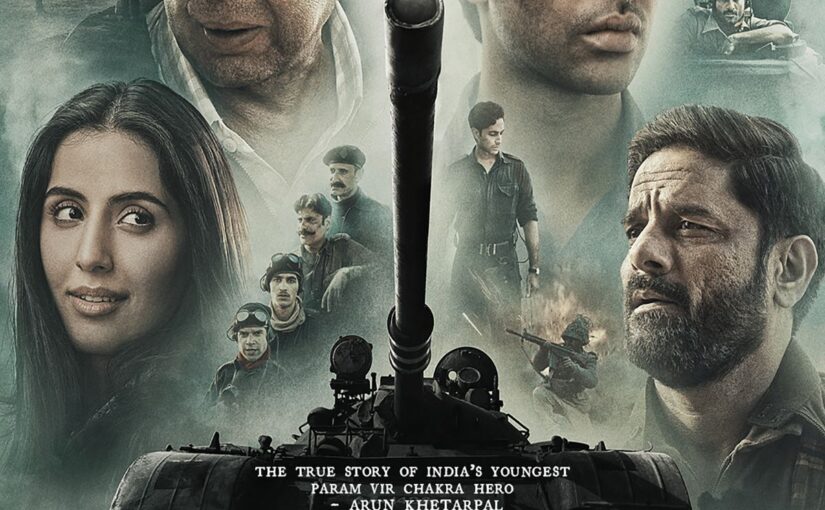
Second Lieutenant Arun Khetarpal is an Indian Army legend. A National Defense Academy (NDA) and Indian Military Academy (IMA) alum, Khetarpal was commissioned into Indian Army’s armoured regiment, Poona Horse and won India’s highest gallantry award the Paramvir Chakra, posthumously, for his heroism in the 1971 India-Pakistan war. Sriram Raghavan’s Ikkis is an autobiographical account of Arun’s life and the Battle of Basantar. A battle where Khetarpal’s Centurion tank took on the Pakistan army’s Patton tanks and fought valiantly before he succumbed to injuries on the battlefield. The movie stars Agastya Nanda, grandson of Amitabh Bachchan, as Arun Khetarpal with Dharmendra and Jaideep Ahlawat. The former plays the role of Brigadier Madan Lal Khetarpal, Arun’s father and the latter plays the role of Brigadier Nisar of the Pakistan army.
The movie recounts the visit of Brigadier Khetarpal, in 2001, to Lahore where he is hosted by Brigadier Nisar of the Pakistan Army. The senior Khetarpal is visiting Lahore for his college reunion and to visit Sargodha from where his family had to migrate in the aftermath of India’s partition in 1947. This story track runs in parallel to the story of Arun’s days at the NDA, IMA, days leading up to the battle and the battle itself. The senior Khetarpal, now in his eighties is all dewy eyed for his roots and the younger one, who has turned 21 (Ikkis is the word for the number 21 in Hindi) is eager and keen to prove his mantle on the battlefield. The retired Brigadier is serenaded by everyone, by his hosts, his former classmates and the family that now lives in his ancestral house. The young second lieutenant is learning the brutal nature of combat and the human cost of war as he rolls on towards Basantar. The dramatic arc of the movie ends with Brigadier Nisar telling the elder Khetarpal that he was the commanding officer of the Patton that shot the lieutenant’s tank and it was his assault that proved fatal.
I am a big Sriram Raghavan fan. His Johnny Gaddar makes it to every list of top 10 Hindi movies that I have ever made. Raghavan has the knack of writing stories and characters that are unconventional for commercial Hindi cinema, his plot twists don’t disappoint and nobody uses songs from Hindi movies of the 1950s, ’60s & ’70s like Raghavan. He eschews over the top dramatics and gets his actors to deliver pitch perfect performances.
Ikkis is handicapped by the fact that it is autobiographical. Raghavan has limited scope for crafting a story that surprises. This is his attempt at making a war movie and the stories of the two Khetarpals is a prop. He wants us to see that Indians and Pakistanis are the same people, there are no winners in a war, soldiers are common folk who pay with their lives for the idea of nationhood, there is common humanity that binds us all and the Pakistan army, just like the Indian army, is a professional force doing what is necessary. He uses all the tropes to make these points. Scenes of the elder Khetarpal with Brigadier Nisar’s family, his former classmates, the joyous outdoor dinner organized by the occupants of his ancestral home, the bullets ridden, lacerated bodies of soldiers and the depiction of Brigadier Nisar as an honorable gentleman who represents the best of Pakistan army. Continue reading Ikkis: Thoughts on another Propaganda Movie
Tag: Aman ki Asha
Musings on & Answers to “The Partition of Elites: India, Pakistan, and the Unfinished Trauma of 1947” (Part 3)
Continuing on, X.T.M says that “India’s post-Independence settlement created structural ambiguity” and cites four factors in particular:
- Upper-caste Hindu political dominance at the center
- Muslim demographic concentrations with limited elite integration
- A constitutional secularism that promised equality while leaving communal structures intact
- No acknowledgment that the Muslim League’s victory posed a legitimacy problem
I think his key insight is this: “The constitution guaranteed rights. It could not guarantee renewed political consent.”
The issue as I see it is that the Indian state took the most half-hearted, wishy-washy approach towards the problem of integration. It allowed Muslims to construct bastions of political power while at the same time dividing Hindus along caste and linguistic lines. It allowed criminal elements, many from a Muslim background, to dominate perhaps its most significant sector — the arts — and spread messages of the innate goodness of Indian Muslims and Pakistanis (which is only being suppressed due to both governments’ actions) and the need for peace between Hindus and Muslims, thereby constructing an illusory palace to beguile secularized urban Hindus, while behind the silver screen they fund terrorist attacks in India. The murder of Gulshan Kumar comes to mind as (seemingly) among the least of these crimes, but that he was killed outside a temple is like having salt poured into the wound and mud slung at one’s face. What to speak of 26/11 which has already been talked about, especially recently.
Again, as I mentioned previously, I don’t think the overwhelming issue is that Muslims were allowed to maintain particular political fiefdoms — it’s that Hindus were stymied from establishing systems of political power based on traditional models. When talking about ‘independence’, Moldbug (2008) in chapter 2 of An Open Letter to Open-Minded Progressives suggests that:
“One test we can apply for independence, which should be pretty conclusive, is that the structures of government in a genuinely independent country should tend to resemble the structures that existed before it was subjugated—rather than the structures of some other country on which it may happen to be, um, dependent. These structures should be especially unlikely to resemble structures in other newly independent countries, with which it presumably has nothing in common.”