
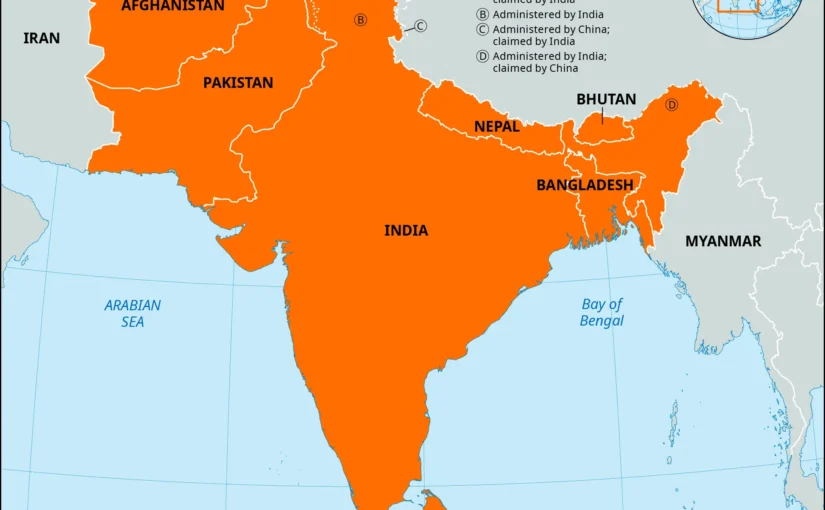
There is something faintly ridiculous about how often educated people insist on using the term South Asia as if it were a neutral, hygienic improvement on an older and supposedly “problematic” word. It is neither neutral nor an improvement. It is a bureaucratic euphemism invented to manage post-Partition discomfort, and it collapses the civilizational reality of the region rather than clarifying it.
The Indian subcontinent has had a name for millennia. It was called India because it lay beyond the Indus. Greeks used it. Persians used it. Arabs used it. Medieval Muslims, early modern Europeans, and the British all used it. The word survived because it described a geographic and civilizational unit, not because it flattered any modern state. The fact that the Republic of India later adopted the name does not retroactively invalidate its older meaning. Belgium did not abolish the word “Europe,” and Serbia’s existence does not make “European” offensive.
South Asia, by contrast, is not an ancient term misused by a nation-state. It is a late–Cold War academic construction, popularised by American area studies departments that were uncomfortable saying “India” once India no longer meant a single polity. It is a word designed to avoid an argument, not to resolve one. Like “Middle East,” it describes nothing from within the region itself. No one historically lived in “South Asia.” No one spoke “South Asian.” No one cooked “South Asian food.” Continue reading South Asia Is an Ugly Postcolonial Euphemism