Every time I used to play a strategy video game, my mind was firstly on money. Creating an income stream as well as buildings and units to magnify that income stream was the primary priority of my gameplay. Only then could I exercise my will and wrath on the codes of computer programming that were my enemies. I think recent history has shown us this is a powerful stratagem, especially on this side of the Atlantic.
‘In God we trust, all others we monitor’. Intercept Operator’s motto. National Security Agency Study, Deadly Transmissions, December 1970
Recent revelation about use of Pegasus software for surveillance of mobile phones by several governments surprised very few. It simply confirmed what most of us believe that surveillance is now part of modern life. This information is not new. In 2013, details about National Security Agency (NSA) running an electronic surveillance program on massive scale named PRISM became public. In 2012, information became public that a joint United States and Israeli cyber operation code named ‘Operation Olympic Games’ using an offensive computer virus Stuxnet damaged Iranian nuclear centrifuges at Natanz. Later, Wikileaks and revelations by Edward Snowdon about large scale surveillance all over the globe only highlighted the omnipresence of surveillance in our daily lives. United States, United Kingdom, China, Russia and Israel use extensive surveillance with state of the start equipment.
Pegasus is a commercial program sold by an Israeli company NSO. The name is derived from the first initials of company’s three founders; Niv Carmi, Shalev Hulio and Omri Lavie. It was first bought by a US based private equity firm. In 2018, when concerns emerged about the program it was sold to a London based group. Israel recognized the importance electronic and communication revolution early. The most authoritative account of Mossad was written by Gordon Thomas in 1999 titled Gideon’s Spies. Director General of Mossad Danny Yatom (1996-1998) recognized early the defensive and offensive opportunities in the brave new world of computers. He ordered research and development division to develop programs that could infiltrate computers for monitoring as well as electronic ‘microbes’ that could destroy the systems. Today, we know these ‘microbes’ as computer ‘viruses’.
Pegasus can infiltrate any mobile phone and gain access to contacts, phone calls, text messages and even take control of the microphone and camera for real time surveillance. The sales pitch for Pegasus was to fight crime and terrorism. However, there were concerns about its abuse by governments and NSO launched a public relations campaign to assure human rights groups. It sold Pegasus to governments of United Arab Emirates (UAE), Saudi Arabia, Turkey, India and Mexico. In addition to criminals and terrorists, this program was also used for surveillance of political rivals, dissidents, diplomats, journalists and human right activists and organizations. Contrary to popular belief, Pegasus is not a mass surveillance program but a targeted one.
The company is based in Israel therefore a lot of negative fallout for Israel. Government tried to distance itself from NSO, but no one believes that Israeli government would have allowed sale of such program to foreign governments without access to data. Such technology sale is strictly controlled by Israeli government based on national security concerns. It is used as a diplomatic tool to win potential allies. Prime Minister Benjamin Netanyahu used sale of such technology for improving relations with Saudi Arabia and Gulf sheikhdoms. Any Israeli government allowing sale of programs like Pegasus without having a trap door to have access to surveillance done by the clients of Pegasus will be charged with dereliction of duty. It is no surprise that countries like Russia and China develop their own programs. They may steal state of the art technology through industrial espionage but do not buy off the shelf products as it makes them vulnerable.
Public revelations of sale of surveillance technology to foreign clients by private Israeli companies is making many Israelis uncomfortable. They view such sales as damaging the Israeli brand. Israeli government has formed a high powered committee of Knesset to review the whole process of sale of surveillance technology. Now, many Israeli civil rights groups are also concerned about domestic surveillance. In Israel there are severe restrictions on surveillance of Jewish citizens of Israel but Arab citizens and Palestinians in occupied territories have no protection. Israeli society in general accepted this situation as a protective umbrella against extremist threats. Details of surveillance methods are not made public and elite Signal Intelligence (SIGINTEL) Unit 8200 is involved in this surveillance. In 2014, thirty four veterans of Unit 8200, now on reservist duty stunned Israel by writing a letter to Prime Minister refusing to serve in occupied territories. This letter highlighted the moral dilemma faced by those serving in this field.
Government decisions are guided by circumstances and there is risk of a slippery slope. There is no guarantee that government that asked for acquiescence of citizens in the name of security will not invoke an emergency to drag everybody in the net. The scare happened during the early phase of Corona pandemic. In March 2020, then Defence Minister Naftali Bennett proposed that Military Intelligence and NSO should be given the task of tracking Corona virus carriers. This meant transferring highly classified personal data of Israeli citizens collected by internal security organization Shin Bet to NSO. Knesset alarmed by this dangerous phenomenon vetoed the idea.
Surveillance and defensive and offensive cyber capabilities are part of modern national security apparatus. They are new weapons like fighter jets, tanks and missiles. Innovation is part of human story and not new, however, the revolution of modern technology is democratization of these tools. A high school dropout sitting in a dingy room with a cheap computer can bring down a hundred year old bank or turn off the electric grid of a mega city with few clicks on his keyboard. Society needs protection against these threats but also needs to put in place laws to prevent abuse by the government. Only an informed citizenry equipped with investigative tools and ever vigilance can ensure that their legitimate rights are protected at the same time when they give government the authority to use tools to protect them.
“There will come a time when it isn’t ‘They are spying on me through my phone’ anymore. Eventually, it will be ‘My phone is spying on me’. Philip K. Dick – Died 1982
In case you aren’t subscribed, Akshar interviewed an Afghan official on the latest BP podcast. Our cadence has dropped off lately, but I’m assuming we’ll speed up again at some point soon.
When the halls of power echo your voice, when titans of commerce and capital don your colors, when hallowed institutions bow to your ritual, does that make you a revolutionary? Well it does in today’s America.
It’s all a bit odd. Millions of fire-breathing activists believe they are fighting a once in a millennium battle against the forces of oppression stemming from a white supremacist state, greedy capitalist mega-corporations, and various organizations that toe the aforementioned’s line; yet all of the power centers mentioned agree with the ideology of this “resistance.” So what are they really even resisting?
History shows its style when it rhymes and repeats. The poetry of the past is a delight but can be a disaster once it reaches the present. I believe we are seeing many of those themes today. What is happening in the digital realm took place centuries ago in the physical realm. The Dark Ages beckon us in order for us to see the light of the day.
Continue reading Disinformation Feudalism
An interesting sidelight from Islamic history, by Ali MInai. Originally published on his blog “Barbarikon“, reposted here with Ali Minai’s permission.
The Caliph and the Imam
A Shocking Decision
Sometime in 816 CE – year 200 in the Hijri calendar of Islam – the seventh Abbasid Caliph al-Mamun made a very strange decision. If near-contemporary historical narratives are to be believed, he offered his throne – and thus power over lands from India to Morocco – to the leader of his fiercest opponents, the Shi’a. It was a breathtakingly audacious decision – so audacious that it failed almost immediately. The eighth infallible Imam of the Shi’a, ‘Ali bin Musa al-Rida, was not interested. Al-Mamun had to recalibrate, and he did so by nominating Ali al-Rida as his successor. The Imam demurred again, but this time the Caliph was adamant: The Imam must accept or he and his family would suffer. Imam Ali al-Rida’s family was no stranger to suffering. Almost all of his ancestors – direct descendants to the Prophet himself – had been persecuted, many martyred or imprisoned. His own father, the seventh Imam Musa al-Kadhim, had perished as a prisoner of al-Mamun’s father, the famous Harun al-Rashid of A Thousand and One Nights. Whatever the reasons, Ali al-Rida acquiesced, and on the 27th day of Ramadan in 201 AH (April 18, 817 CE), he was proclaimed “wali ‘ahd al-muslimin” – the designated successor to the 31-year old al-Mamun. Coins were soon minted asserting this new designation – the standard way of declaring authority – and the traditional black flags of the Abbasids were replaced by the green flags of the Shi’a Imams. A little more than a year later, the Imam was dead. Al-Mamun would rule for another fifteen years.
I am not an intuitive mathematician (nor an unintuitive one for that matter), but I have appreciated the importance of good guess value or nominal value developing software that uses computational geometry.
As a result, I have spent the better part of the previous 14 months wondering “why is the scientific community so slow in accepting potential aerosol dispersion of coronaviruses”. They say science progresses one funeral at a time, but since Jan 2020 we have had far too many funerals that should have sped up the progress. Ever since I read this piece – The “noble lie” on masks probably wasn’t a lie I had been spending limited time I had, browsing through old papers on the spread of respiratory illnesses to disappointing results. The wired piece helped deepen my understanding of how we may have got here. Where the 5-micron boundary for aerosols came from is an extremely fascinating story. Maybe we can expect some Netflix documentary or a long-form book on this issue in the near future.
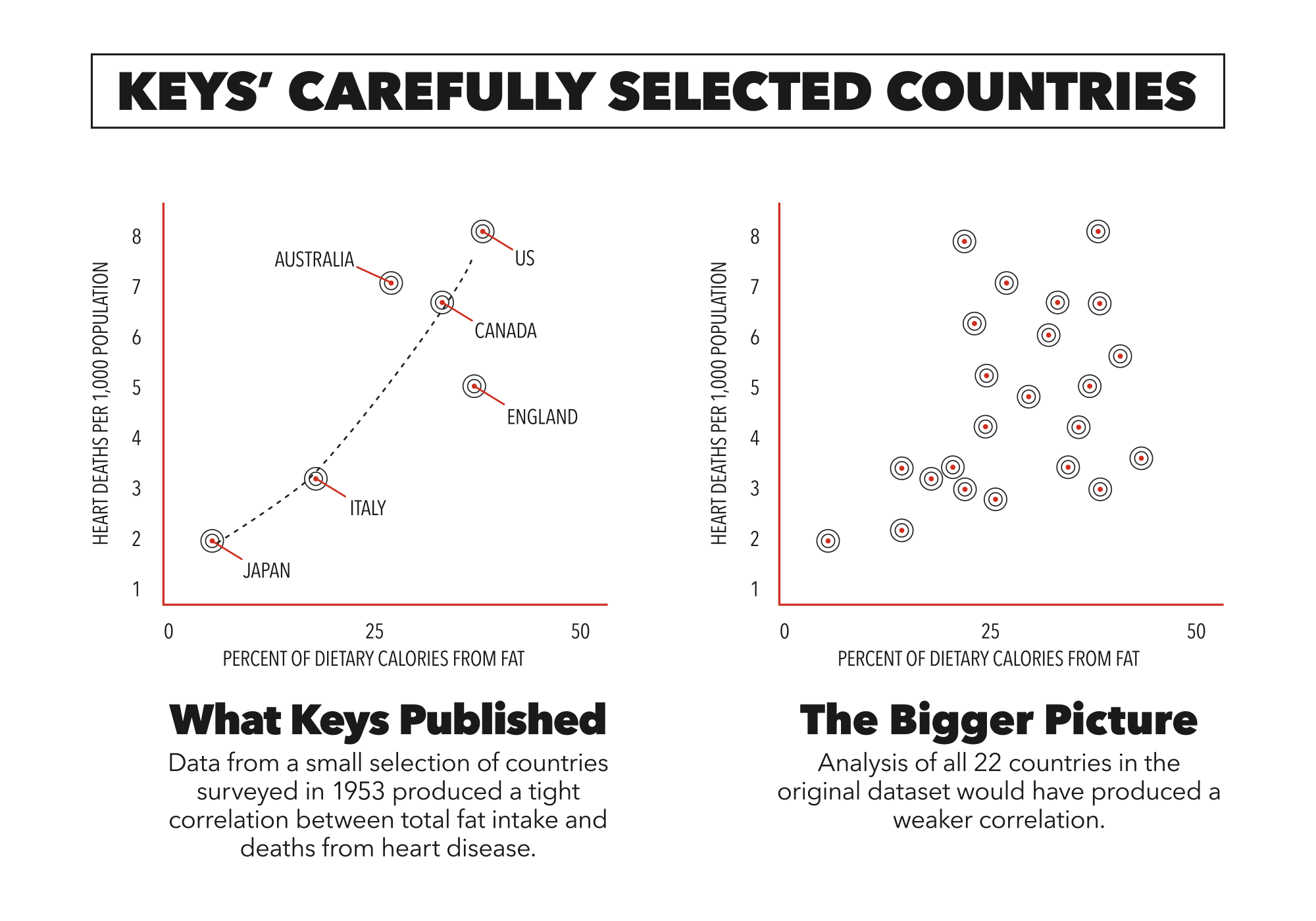
This entire episode appears exceedingly similar to the Dietary Fat is the villain dogma. Gary Taubes in his books – Good Calories, Bad calories and A Case against Sugar, has described this debate extremely well. As a video suggestion, I would recommend the youtube channel – What I have learned. In retrospect what seems appalling is how the scientific community basically accepted the faulty and weak fundamentals of the Fat theory – as initiated by Ancel Keys and propagated by hundreds after that. Ditto for the demonization of cholesterol and numerous other food items – including milk.
7 country study of Ancel Keys.
From these two examples at the very least, I would conclude the disproportionate importance of Priors and the outsized impact they have on the journey of academic and peer-reviewed science. Hopefully, the pandemic will correct some bugs in this mechanism, though this is by all accounts a slow and arduous process.
Incidentally, I was chatting with Kushal Mehra about his latest discussion with Shrikant Talageri and Kushal pointed out that he thinks the 1500 BCE dating of Rgveda is also one such Prior which has had an outsized impact on the journey of the Aryan Debate. Prima facie I found this point fair – thought I must say, the 1500BCE date has held up quite well over the centuries (especially since the recent genetic results). But has the date 1500 BCE anchored the research around it, making 1500 BCE appear the best fit for composition of Rgveda and the beginning of consolidation of the Arya into the Indian palimpsest ?
Post script:
I know this place has had a lot of AIT/OIT pieces including this one by me and lot of readers might be fed up by it (even I am to an extent). This isn’t aimed at AIT/OIT but is merely a passing reference to it.
I don’t know how Max Mueller and others came up with the date myself – but it would be an interesting story to research notwithstanding the current research. I would also highly recommend Razib’s podcast with Mallory which delves into the history of the larger indo european question.
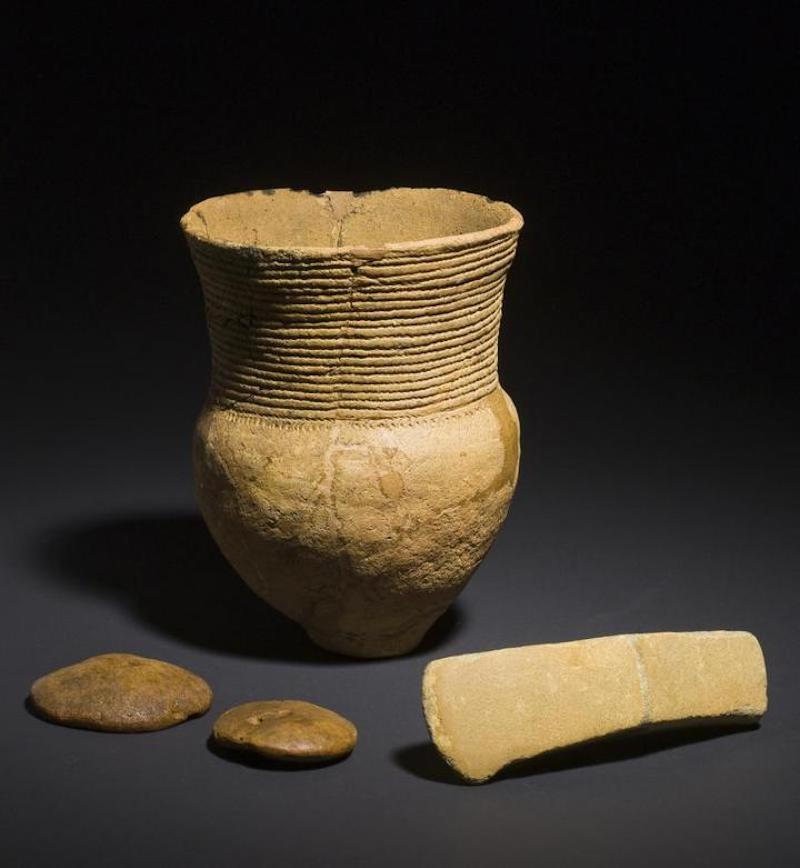
I’m spending a lot of time reading about the Corded Ware for my series on the steppe. The Corded Ware is a culture that appeared that abruptly in Northern Europe between 2900 and 2800 BC, covering a vast territory of Central and Eastern Europe in a century. The name derives from the unique marks left on their pottery.
For decades scholars have argued whether they were an indigenous development out of the farmers who occupied this region for thousands of years, or whether there was a mass migration out of the steppe. More realistically, there was a synthetic position between at some point. Perhaps the farmers were influenced by a few elite bands migrating out of the steppe?
Today due to ancient DNA we know more. The Corded Ware culture in its mature phase is about 70% Yamnaya and 30% farmer. The farmer’s ancestry almost certainly comes exclusively through women. The Y chromosomes of the farmers were G2. There is very little of that within a few generations. It is almost all R1a.
But that leaves us with the question: where did the new pots come from? The answer is straightforward: the men from the steppe took wives from the farmers. They killed their fathers and brothers and took them to their homesteads to bear them children. These women knew how to make pots because they did not come from nomadic backgrounds. They adapted their techniques to making pots that exhibited marks that made them resemble the baskets that their husbands brought in their wagons.
The miracle of the immediate emergence of a new pottery technique is due to the fact that the nomads didn’t learn to work in clay. Their wives already had the skill.
Why is this posted on this weblog? That’s a question that does have an answer…