Review: Arabs. A Three Thousand Year History of Peoples, Tribes and Empires

Mackintosh-Smith, Tim. Arabs . Yale University Press. Kindle Edition.

Tim Mackintosh Smith is one of those romantic Englishmen who used to go and settle in far off lands and “go native”. He lives in Yemen (apparently still there, even during the civil war) and has been writing about the region and the Arab people for several decades. This book is the culmination of a lifetime of study, a comprehensive history of a people and civilization to which he has become attached and about whom he knows more than most. It is well worth reading.

He begins by making it clear that this is a history of the Arabs, not a history of Islam. The first mention of the word Arab actually occurs in “in 853 BC (and) concerns the employment by the Assyrian state of a transport contractor, a certain Gindibu (‘Locust’), an Arab chieftain who owned vast herds of camels”. This is about 3000 years ago, and the coming of Islam lies about halfway through this history. While we know relatively little of the early (pre-Islamic) history of these people, Mackintosh-Smith wants us to be aware that the Arabs existed long before Islam did. Continue reading Review: Arabs. A Three Thousand Year History of Peoples, Tribes and Empires

Climate change: impact on the Hajj


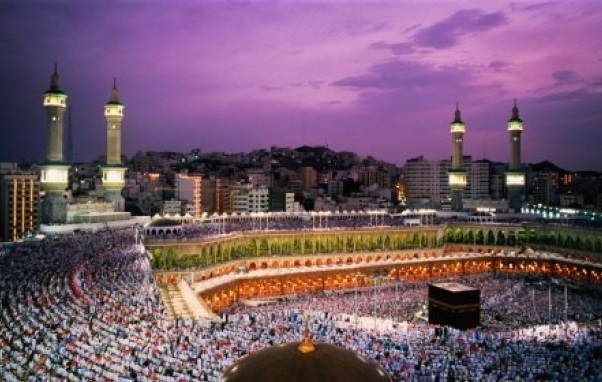
The Hajj, Mecca

**

Since I posted my poem Mourning the lost Kaaba in late November 2017 — though not, I imagine, because of my poem — a report on the likely impact of climate change on the annual Hajj pilgrimage has come out from scientists at MIT and Loyola Marymount:

Kang, Pal, & Eltahir, Future Heat Stress During Muslim Pilgrimage (Hajj) Projected to Exceed “Extreme Danger” Levels

Here’s the abstract:

The Muslim pilgrimage or Hajj, which is one of the five pillars of Muslim faith, takes place outdoors in and surrounding Mecca in the Saudi Arabian desert. The U.S. National Weather Service defines an extreme danger heat stress threshold which is approximately equivalent to a wet?bulb temperature of about 29.1 °C—a combined measure of temperature and humidity. Here, based on results of simulations using an ensemble of coupled atmosphere/ocean global climate models, we project that future climate change with and without mitigation will elevate heat stress to levels that exceed this extreme danger threshold through 2020 and during the periods of 2047 to 2052 and 2079 to 2086, with increasing frequency and intensity as the century progresses. If climate change proceeds on the current trajectory or even on a trajectory with considerable mitigation, aggressive adaptation measures will be required during years of high heat stress risk.

**

That’s the science — and while Saudi Crown Prince Mohammed bin Salman told the G20 in June that the Saudis are committed to “reducing greenhouse gas emissions and adapting to the negative effects of climate change,” beliefs concerning the Prophet’s institution of the Hajj in 632 CE following on earlier Abrahamic practice may well clash with scientific claims that the Hajj may become impossible for future devout Muslims to observe.

What happens, then, when this divine command intersects with increasing temperatures that eventually render Mecca uninhabitable? How do the climate change scientists fare when they sit across the table from the ulema, the scholar-clergy of Islam?

From a Muslim point of view, we’d better climate-correct, and do so fast:

Shahin Ashraf, We must stop climate change before it makes Hajj impossible

**

The issue I’ve raised above is tightly focused on one sanctuary, one religion, one pilgrimage. Below are some other major pilgrimage sites to consider in light of climate change:

I would be interested in the cross-disciplinary exploration of the impact of climate change as understood by the scientific consensus, global migration patterns now and as expected in the coming years, and the devotional rituals and ceremonials of the various religions involved.

Large pilgrimages and religious ceremonials

This list draws text from Wikipedia and other online information sites.

Kumbh Mela:

Allahabad, India, 120 million devotees, every 12 years. The Prayag Kumbh Mela is a mela held every 12 years at Allahabad, India. The fair involves ritual bathing at Triveni Sangam, the meeting points of three rivers: the Ganga, the Yamuna and the mythical Sarasvati. The Kumbh Mela in 2013 became the largest religious gathering in the world with almost 120 million visitors.

Arba’een:

Karbala, Iraq, 30 million pilgrims annually. The Arba’een Pilgrimage is the world’s largest annual public gathering, held every year in Karbala, Iraq at the end of the 40-day mourning period following Ashura, the religious ritual for the commemoration of martyrdom of the grandson of Prophet Mohammad and the third Shia Imam, Husayn ibn Ali’s in 680. Anticipating Arba’een, or the fortieth day of the martyrdom, the pilgrims make their journey to Karbala on foot,where Husayn and his companions were martyred and beheaded by the army of Yazid I in the Battle of Karbala. The number of participants in the annual pilgrimage reached 30 million or more by 2016.

Papal Mass

Philippines, 7 million adherents, occasional. Pope Francis’ apostolic and state visit to the Philippines garnered a record breaking crowd of 7 million people. The mass conducted by the pope was the largest gathering in papal history.

Makara Jyothi

India, 5 million pilgrims annually. This pilgrim center and temple is located amidst a dense forest in the southern region of India. It was visited by over 5 million pilgrims in 2007 for a festival known as ‘Makara Jyothi,’ occurring annually on the 14 of January. Although the Sabarimala Temple, site of the Makara Jyothi celebration) draws a crowd of 50 million visitors annually, the specific day of the miraculous celestial lighting observation gathered 5 million pilgrims in 2007.

Bishwa Ijtema:

Near Dhaka, Bangladesh, 5 million pilgrims annually. The Bishwa Ijtema, meaning Global Congregation, is an annual gathering of Muslims in Tongi, by the banks of the River Turag, in the outskirts of Dhaka, Bangladesh. It is one of the largest peaceful gatherings in the world. The Ijtema is a prayer meeting spread over three days, during which attending devotees perform daily prayers while listening to scholars reciting and explaining verses from the Quran. It culminates in the Akheri Munajat, or the Final Prayer, in which millions of devotees raise their hands in front of Allah (God) and pray for world peace.The Ijtema is non-political and therefore it draws people of all persuasion. It is attended by devotees from 150 countries. Bishwa Ijtema is now the second largest Islamic gatherings with 5 million adherents

[ this is where the Hajj, with 2.3 million pilgrims annually, fits in ]

Umrah:

Mecca, size unknown, year round. The ?Umrah is an Islamic pilgrimage to Mecca, Hijaz, Saudi Arabia, performed by Muslims that can be undertaken at any time of the year, in contrast to the ?ajj which has specific dates according to the Islamic lunar calendar. It is sometimes called the ‘minor pilgrimage’ or ‘lesser pilgrimage’, the Hajj being the ‘major’ pilgrimage which is compulsory for every Muslim who can afford it. The Umrah is not compulsory but highly recommended.

Kalachakra,:

Various locations, 500,000 participants, variously. The Kalachakra is a term used in Vajrayana Buddhism that means “wheel(s) of time”. “K?lacakra” is one of many tantric teachings and esoteric practices in Tibetan Buddhism. It is an active Vajrayana tradition, and has been offered to large public audiences. The tradition combines myth and history, whereby actual historical events become an allegory for the spiritual drama within a person, drawing symbolic or allegorical lessons for inner transformation towards realizing buddha-nature. The Dalai Lama’s 33rd Kalachakra ceremony was held in Leh, Jammu and Kashmir, India from July 3 to July 12, 2014. About 150,000 devotees and 350,000 tourists were expected to participate in the festival. The Kalachakra has also been performed, eg, by Grand Master Lu Sheng-yen of the True Buddhs School, a Chinese Vajrayana group.

**

The impacts of climate change will need to be studied as they apply not only to these sites of pilgrimage, but also to holy sites in general, notably including Jerusalem, Rome, Varanasi, and Kyoto.

Between Marx and the mullah

There is a lot of talk on this weblog about deaths in premodern conflicts. I want to clarify a few points, at least from my perspective.

Both ancient DNA and conventional history and archaeology indicate that massive population turnovers occurred in the past. If you read a book like Genghis Khan: His Conquests, His Empire, His Legacy, you note that there is plenty of record of massacres and killings in targeted fashion during the Mongol expansion. The chaos and demographic collapse induced by the Mongols have been implicated in reforestation across vast swaths of Central Eurasia (which may then have produced climate change!).

We can also look to the deep past, and the more recent past. Latin America is characterized by incredible admixture between people of disparate ancestries. This is due in large part to 1) demographic collapse on the part of native peoples 2) migration of settlers from Iberia 3) transportation of slaves from Africa.

The evidence from Europe and South Asia is also strongly suggestive of massive population replacements. Depending on your model parameters about 50-75% of the ancestors of modern Northern Europeans who were alive 5,000 years ago had descendants who were intrusive to Northern Europe. Another way to say this is that 50-75% of the ancestors of modern Danes did not live in Denmark or nearby regions 5,000 years ago. A similar number for South Asia seems to be in the 10-30% range (again, depends on your model parameters).

This elicits the question: was there genocide?

The evidence from Latin America is clear. Though there was targeted genocide on the part of the Iberian conquerors, on the whole, the deaths were mostly due to the introduction of Eurasian diseases that resulted in a cascade of consequences which resulted in famine (the Black Legend is propaganda which has influenced our modern perceptions). When a human population lives on the Malthusian margin, small perturbations can result in death due to starvation. In the case of Latin America, it is known that incapacitation of a large enough proportion of prime-age adults due to illness resulted in famine, as crops were not planted or harvested in quantities necessary to sustain villages.

In other words, population collapse was a function of reduction in labor inputs into agriculture.

And, the reality is that the Iberian conquerors, who were often younger sons of aristocratic lineages, were not inclined to engage in mass-slaughter due to the reality of their aspiration of becoming rentiers. The importation of African slaves was to a great extent a direct consequence of shortages of exploitable labor (along with the humanitarian concerns of enslaving natives). Contrast this to the situation in the Phillippines or India, where Asian peoples provided resources to support leisure-seeking European elites.

A second fact is that premodern states were not capable of the sort of coordinated genocide that has been seen in the 20th-century. They lacked the weaponry, information technology, and organizational capacity to be particularly efficient. I don’t think it’s a coincidence that the coordinated genocides against Christian groups in the Ottoman and post-Ottoman realm occurred in the modern period (Armenians and Assyrians). The older Ottoman state was neither efficient enough nor did it have the means, to engage in total exterminationism (I also believe that 19th-century European-style nationalism probably made exterminationist feelings more ‘justified’ as well).

Probably the best premodern instance of ethnic cleansing we have on record is the Spanish expulsion of the Moriscos, which occurred on the basis of presumed blood lineage, not belief (e.g., many sincere Christian Moriscos were expelled as well!). But, that effort was incomplete and patchy, effective in some areas, totally ineffective in others, and haphazard in the criteria utilized (e.g., many people with Morisco ancestry were not expelled, while families which had been sincere Christians for generations were expelled).

Which brings me back to the earlier cases. What happened in Europe and India to induce population change?

There are several things going on in my opinion. First, not all late Neolithic/early Bronze Age societies had developed an ideology of elite exploitation to the level that we’d take for granted in the modern world. By this, I mean that the leaders of these agro-pastoralist societies may not have viewed farmers of different ethnicities as potential subjects, and so wealth. In conflicts between hunter-gatherer populations often warfare results in very high mortality rates, with young children and young women of the losers assimilated into the winners. There was no ideology of group assimilation for young men into an alien population, and in societies without specialized professions and economic systems, these men might not be seen as valuable in any sense except as consumption slaves (servants for powerful people, not economic producers).

In other words, conflicts between primitive societies can be thought of as “animal conflicts,” where two groups fight over resources and don’t view the losers of the other group as resources. In contrast, societies over the past few thousand years have tended to see the defeat of the enemy as a potential for elites to accrue new subjects from which they can extract rents. This was one of the arguments made to Genghis Khan by one of his Khitai advisors as to why he should not clear the land of northern China of people so as to create pastures for horses and sheep. People were more valuable than horses and sheep. He would be richer with more people.

Of course, these are people with spears (and later swords). I don’t think that most of the demographic collapse was due to direct killing. Rather, people living on the Malthusian margin, especially the sort of late Neolithic farming that was likely marginal in Northern Europe, were likely subject to the same famine dynamics as occurred in the New World. The IVC zone in South Asia was clearly more advanced, but it too many have been relatively fragile in comparison to the agricultural regimes of later South Asian societies.

The final issue is looping back to Muslims. Did they commit genocide? Did they exterminate the local populations? Probably. But, 95-99% of the ancestry of South Asian Muslims is the same as that of South Asian Hindus of the same region. Unlike the incursion of Indo-Aryans, the arrival of Muslims, mostly Turks, Afghans, and Persians did not have a major demographic perturbation in a direct sense (indirectly, technology and organizational skills introduced by Muslim elites may have resulted in disparate demographic growth of different regions in South Asia; e.g., Eaton’s argument for the expansion into eastern Bengal).

Additionally, Islam as a dominant ideology developed during the high-tide of rent-seeking elites. Though Muhammad’s status as a merchant meant that the religion was never constitutively anti-mercantile, conquest elites invariably aimed to extract wealth out of conquered populations. Arguably, the development of Islam is a direct consequence of how lightly Christianized Arab conquest elites developing an ideology which justified their extraction of rents (“protection taxes”) from conquered populations,  as well as maintaining their separateness and distinctness.

In the Indian context, many will point out that Islamic chroniclers note the despoilation and slaughter upon the local population. I would suggest that one be cautious about the propagandistic nature of ancient conflict and war (this begins with the Battle of Kadesh). Ancient chroniclers seem to have exaggerated numbers and effectiveness routinely. At least in the early modern period, most casualties due to battlefield injuries were the consequence of infection, not immediate trauma. Similarly, I suspect that the depopulation of an invaded region was more likely a consequence of the disruption of local social fabrics more than direct killing with arrows, swords, and spears (killing people expends a lot of energy and is risky).

Because of the nature of this blog, of course, this post ends with the arrival of Muslims to India. The stupid and the disingenuous (or a mix of both) seem to fix on two extreme positions:

  1. Muslims arrived and ushered in an orgy of slaughter driven primarily by the motive of oppressing the kuffar
  2.  Turks arrived in India, and like earlier invaders aimed to extract resources and dominate the location population
These caricatures serve ideologies but don’t describe reality. Both materialist and non-materialist motives need to be considered. The chroniclers of the arrival of self-conscious Muslim military forces to South Asia clearly wished to present it as an ideological and religious act. These were ghazis, just as far to the west, the Ottomans began as ghazis. But it is also impossible not to notice the family resemblance of Muslim Turks moving into South Asia in the centuries after 1000 A.D. with the invasions and conquest of China by Turkic, Mongolic and Tungusic peoples in the centuries after 1000 A.D.

Not surprisingly, the Khitai, Jurchen, and Mongols, all made some ideological claims for their acts of aggression of conquest, often post facto and tenuously. The Khitai and Jurchen integrated themselves into the Han Chinese worldview and presented themselves more worthy stewards of the Mandate of Heaven than the Song rulers of China. The Mongols also did this, though perhaps even more foregrounded was their own peculiar ideology than their sky god had given the whole world to them to subjugate (the Mongol Yuan dynasty also gave special consideration to Tibetan Buddhism, which alienated their Han subjects).

But of course, we would notice that the major consequence of the Mongol Yuan dynasty was the transfer of resources from Han Chinese elites to arriviste Mongol elites. The overthrow of the Yuan resulted in the expulsion of the killing of many of these hated Mongol landlords. Ideological rationales were given, but the memories of Han elite dispossession were fresh.
And yet despite the fig-leaf that ideology provides, differences may result from such distinctions. The Khitai and the Mongols were more punctilious is differentiating themselves from their Han subjects than the Jurchen. They maintained their separateness due to their reduced respect and veneration of Confucian norms. And, notably, the philo-Sinic Jurchen were assimilated into the Han to a far greater extent than the Khitai and the Mongols.

Similarly, in South Asia, the ideological distinctions between the rentier class of Turks and West Asian Muslims, and native Indians was sufficient for the absorptive process to halt. Synthesis occurred. But amalgamation did not proceed to completion. In David Cannadine’s Ornamentalism the author argues that the religious difference was also the key reason that the Indian elite, Muslim, Sikh, and Hindu, did not intermarry with the British gentry.

The various arcs of history cannot be easily defined by grade-school level Marxism, or internet Hindu level psychoanalysis. In all regions that self-conscious Muslim conquest elites established themselves, their sense of distinctness, superiority, and God-given right to rule are clear. But, all these groups, whether it be the slaving regimes of Arabs in East Africa, the Ottomans in the Balkans, and yes, Muslims in South Asia, exhibited a strong orientation toward pragmatic exploitation of the riches of the regions which they conquered.

Addendum: I’m going to delete stupid comments. This means if you leave a 2,000-word comment that’s stupid, it will be for naught.

Between Tariq and Columbus

I have long followed Brian Catlos’ more academic works, so I was excited to read Kingdoms of Faith: A New History of Islamic Spain. Aside from some strange contemporary allusions, this is a good introductory book. If you are curious about more detail, the author has written good monographs.

The reason that this work is interesting is that Al-Andalus is a frontier society that’s been well studied. Liminal to both Islam and Western Latin Christendom, for various political reasons it is of particular interest in modern times.

One of the themes is Catlos’ work is though that we tend to refract the history of the Iberian peninsula between 700 and 1500 in simple stark modern dichotomous terms, the reality was that confessional identities were simply one of many loyalties. And yet if you read his work you see the meta-ethnic/civilizational identities are what determine the long-term arc of history, the hinges around which it turns.

In the initial decades after the conquest, local Christian elites and power structures remained intact, and the Arab conquest elites utilized them as administrative intermediaries. But after 800 AD a combination of local Iberian converts and Muslims from other parts of the Islamic world were numerous enough that Christian society begins to be pushed to the margins, even if numerically they remained a majority in the 800s.

Additionally, Catlos emphasizes the deep ethnic divisions between old Arab families, who monopolized religious offices 300 years after the conquest, tribes of Berber origin who occupied a position between the indigenes and the Arabs, and finally, Arabicized converts and Christians, Mozarabs. While the high culture became Arab, Latin speech persisted among the rural peasantry. Even the remnant Christian elites within Al-Andalus were literate primarily in Arabic.

One of the major insights from Kingdoms of Faith is that the conversion of Latin elites, whether Basque, Visigoth, or post-Roman, to Islam, resulted in corrosion of Christianity within Iberia. That corrosion was reversed only with political reconquest, and migration of Christian peasants from the north and the gradual conversion of Muslims in the centuries before the final expulsion of the remnant Moriscos.

Kingdoms of Faith is a useful read, not because of what it tells us about the history of Spain, but how we can compare to other regions of the world….

Review: Persian Fire

This book is basically a fun read. It covers both the Persian and the Greek side of the Greco-Persian wars quite well but I have to take away one star for Tom Holland’s (sometime mischievous or even tongue-in-cheek) propagandist style. But still, he has done his research and is fun to read, with quotes and anecdotes that enliven this history and bring it to life.
He describes the rise of the Persians and the creation of the first great world empire by Cyrus. This empire proceeded to conquer most of Asia minor (modern Turkey east of Istanbul) including multiple Greek city states (the Ionians). Holland describes the rise of the various Greek city states, with most of the attention focused on Sparta and Athens.The revolt of some of these cities against their Persian overlords and the burning of the Persian regional capital of Sardis triggered the first Persian invasion of mainland Greece, which ended with Athens historic victory at Marathon. The Persians came back with a huge army under Xerxes and as you may expect, battles like Thermopylae and Salamis get the full Tom Holland treatment; drama, suspense, objective facts and light-hearted propaganda. The book ends with the final Persian defeat and a brief survey of the (short lived) peace, prosperity and cultural efflorescence that ensued.
The book is an excellent account of the Greco-Roman wars and their background and ends on a high note. In a way, this is a bit misleading because a far greater and far more devastating war (the Peloponesian war) would break out within a few decades, so this book can be criticized for exaggerating the significance of the Persian invasion in Greek (and by extension, later Western) history. But that is a question for another day. If you have vaguely heard of Marathon, Thermopylae, the 300 Spartans, Themistocles or Salamis, but don’t really know what happened, this is the book for you. If you are ancient history nerd then you probably know all this and more, but even those who know most of the story may enjoy this effervescent and light-hearted retelling of this famous story.

Ordered to Die; A History of the Ottoman Army in WWI

Ordered to Die: A History of the Ottoman Army in the First World War (Contributions in Military Studies) Hardcover – November 30, 2000
by Edward J. Erickson  (Author)
Quick review by Major Amin
This is a very interesting, must read book.
The Ottoman Army was not logistically equipped to fight the huge battles that it was forced to fight in First World War. The main culprit was Ottoman Defence Minister Enver Pasha a man of myopic vision and petty intellect (Normal problems in Muslim world).The bottom line is that Ottoman Turkey had no reason to go to war but unnecessarily joined the war because of phenomenal stupidity of Enver Pasha.
The odds that Ottoman Army confronted were too heavy.This is the writers basic and most balanced assessment.
In Egypt the attack on Suez was a logistic miracle and Ottoman failure because of massive allied naval guns was a foregone conclusion.
In Caucasus Russian Army was vastly superior to Ottomans logistically and materially.
In Mesopotamia British numerical superiority was massive after 1916 and Ottoman failure was a foregone conclusion.
Despite all these huge odds Ottoman Army kept itself intact to finally save Turkey under Mustafa Kemal as nationalist army.
It fielded 2.8 Million troops and suffered 750,000 fatal casualties,proportionately one of the highest.
Like all third world armies it was outstanding in defense and weak in attack where greater military dynamism and superior numbers are required.

Books for 2019 on Central Asia and Islam

A comment below:

Need book recommendations. What are some great books on history of Islam and history of Persian Empire and Central Asia?

Empires of the Silk Road: A History of Central Eurasia from the Bronze Age to the Present
Lost Enlightenment: Central Asia’s Golden Age from the Arab Conquest to Tamerlane
The Silk Road: A New History
A History of Iran: Empire of the Mind
The Great Arab Conquests: How the Spread of Islam Changed the World We Live In
When Baghdad Ruled the Muslim World: The Rise and Fall of Islam’s Greatest Dynasty
In God’s Path: The Arab Conquests and the Creation of an Islamic Empire

Saudi Arabia; Kingdom at the Crossroads..

From Dr Hamid Hussain

Overview of challenges faced by Saudi Arabia and role of Crown Prince Muhammad Bin Salman (MBS). His meteoric rise from obscurity in an interesting phenomenon.

“Men in great fortunes are strangers to themselves, and while they are in the puzzle of business they have no time to tend to their health either of body or mind”.  Francis Bacon’s Of Great Place

Enjoy

Hamid


Kingdom at Crossroads

Hamid Hussain

“We always take criticism from our friends.  If we are wrong, we need to hear that we are wrong.  But if we are not wrong, we need to hear support from our friends.  What I request is that the thing you actually believe, to say it”.  Saudi Crown Prince Muhammad Bin Salman interview with The Economist, January 6, 2016

External environment of Saudi Arabia changed dramatically in the aftermath of murder of Saudi journalist Jamal Khashoggi in Saudi consulate in Turkey in October 2018.  It made international headlines and many started to ask questions about Saudi Arabia and the royal family.  This event also strained relationship of Saudi Arabia with its western allies as governments came under increasing pressure to raise this issue.

Saudi Arabia operates in a zone of opacity and not much is known about royal family dynamics and Saudi public opinion.  Crown Prince Muhammad Bin Salman (nick named MBS) moved rapidly to consolidate all power centers under his own personal command since the ascension of his father King Salman Bin Abdul Aziz to the throne in 2015.  Very little is known about how MBS consolidated his power inside the Kingdom.  He also broke with the tradition of family consensus and removed many powerful royal family members and their sympathizers from important centers of power.

MBS was first appointed Defence Minister and in this capacity, he gradually took control of all branches of the military. Defence procurement and defense construction contracts are a major source of patronage and in June 2017, MBS took control of this cash cow of patronage.  He established Saudi Arabia Military Industries (SAMI) and made it a defense subsidiary of Public Investment Fund (PIF).  PIF is country’s sovereign wealth fund under direct control of MBS. In August 2017, General Authority Military Industries (GAMI) was established and made responsible for all defense procurement.  SAMI and GAMI are controlled by an inter-ministerial committee headed by MBS.  In July 2017, commander of Royal Guard was removed, and six months later Chief of Staff of land forces and air force and air defense commanders were also removed.  Within few months of becoming heir apparent, MBS was in full control of operational and economic aspects of all defense establishments.

Parallel to these developments, interior ministry; a potential rival power center that had become a behemoth patronage center of deposed Crown Prince Muhammad Bin Nayef was gradually neutralized. In July 2017, a new ministerial level agency named Presidency of State Security (PSS) was established that reported to Crown Prince.  Counter-terrorism, internal surveillance, cyber-intelligence and national information center functions of interior ministry were transferred to PSS. MBS also took control of all economic activities as Chairman of Council of Economic and Development Affairs.  In this capacity, he cancelled and revised many previous civilian contracts most likely creating new networks of patronage loyal to him. Continue reading Saudi Arabia; Kingdom at the Crossroads..

Aasia Bibi case comes full circle (part 3)

Shahab Ahmed began the first chapter of his book ‘What is Islam?’ with these words,
” I am seeking to say the word “Islam” in a manner that expresses the historical and human phenomenon that is Islam in its plenitude and complexity of meaning. In conceptualizing Islam as a human and historical phenomenon, I am precisely not seeking to tell the reader what Islam is as a matter of Divine Command, and thus am not seeking to prescribe how Islam should be followed as the means to existential salvation. Rather, I seek to tell the reader what Islam has actually been as a matter of human fact in history, and thus am suggesting how Islam should be conceptualized as a means to a more meaningful understanding both of Islam in the human experience, and thus of the human experience at large.”

The difference between ‘literal’ Islam (something I had been taught all my life-till that point) and ‘human experience’ of Islam (as theorized by Shahab Ahmed in the lines above) became acutely aware to me in the days and months following ST’s assassination. Where did the theory end and practice start? Does believing in something and doing things contrary to those beliefs hypocrisy or just the way things work? Are the five ‘essentials’ (Tauhid, Namaz, Roza, Hajj, Zakat) of Islam necessary to be performed if you just gain brownie points with God by killing infidels/blasphemers? I was also growing up in an environment of Islamist terror. Militants who professed to be better Muslims than us mere mortals (who performed the aforementioned ‘essentials’) were killing innocent people in Lahore, in Karachi, in Swat, in KP. How does a practicing Muslim reconcile his faith with the Islam professed by the militants? How does an ordinary Pakistani Muslim view the history of Islam? (a pol sci-major friend of mine recently said something very interesting on this topic. According to him, “actual” history doesn’t really matter to people. History in the public imagination is whatever the elites/mil-establishment want it to be )

Following my basic introductions to political theory and rudimentary economics(at IPSS and beyond), I began to think about the intersection of religion and politics. I probed some fundamental concepts regarding political Islam and how accurate they were, like the concept of Muslim Ummah and the statement that ‘Islam is a complete code of life’. While I was pondering over these questions, I was still living in the same social milieu that had existed around me.

I remember debating some 9/11 ‘truthers’ among my medical school classmates. They refused to entertain the notion that it could have been an Al-Qaeda operation, done by fellow Muslims. One day, I got into an argument with a burly, 6 ft 4 in guy in m class about the ‘complete code of life’ theory. I had probably mentioned it on my Facebook wall or in some Facebook group that I didn’t believe in the veracity of this claim because it was a newer (19th/20th century) addition to Islamic teachings. That tall, muscular guy approached me in the lecture hall the next day and said that he didn’t like my comment and that he was offended by it. I tried to reason with him but he got agitated and asked me to shut it because I was questioning religion which made him angry. I switched gears and changed the topic to save my skinny ass. A few days later, I was talking to a classmate who was among the very few friends I had and she said, Please do not get killed for your ideals.

For me, the public reaction to ST’s assassination was an eye-opening experience. There was a notion of a ‘silent majority’ in Pakistan, people who didn’t like mixing religion and politics (this theory was bogus and had no basis in fact). Fasi Zaka, a very intelligent commentator and writer on Pakistani society wrote, “After Salmaan Taseer’s death, Pakistan’s ‘silent majority’ finally spoke up. They liked it.”I heard someone in the ‘liberal’ (secular liberal or group B) circle say that ST’s death closed the door on critical discussion of blasphemy laws in the near future. It was a battle that we (secular-liberals) lost. We were grossly outnumbered and there was a very remote chance that we could incrementally chip at the edifice of blasphemy laws, for example by changing/improving the law of evidence or publicizing the historical consensus among Sunni Ulema that blasphemy is not punishable by death.

Instead, we have Khadim Rizvi and Tehreek-e-Labbaik (TLP), a ragtag group that can publicly mock the most powerful people in Pakistan and get away with it. ST’s death and Qadri’s hanging opened an avenue for these peddlers of hate to come out of their cubbyholes and wreak havoc on the “silent majority”(pun intended). Mohammad Hanif wrote about the aftermath of ST’s murder for The Guardian (full piece here), an excerpt of which is relevant to what I’m saying.

“So who are these people who lionize the cold-blooded murderer? Your regular kids, really. Some Pakistani bloggers have tried to get these fan pages banned for inciting hate. But as soon as one shuts down, another five crop up. Those who have trawled the profiles of these supporters have said that they have MBA degrees, they follow Premier League football, they love the Pirates of the Caribbean films. Miley Cyrus figures on lots of these pages.”

Qadri’s name became a brand (see here and here) that became synonymous with love for the prophet and the whole blasphemy debate. One could argue that in a country that was premised on the idea of a separate homeland for a particular religion, that religion would become the yardstick by which you proved your nationalism and patriotism.  As for me, I moved out. It became apparent a few years after the ST murder that things weren’t getting any better in my homeland. I could either suck it up and keep living or leave and start afresh. It was very hard to choose one of the routes but I chose the way out.

What about the few liberal spaces left in Pakistan? They are constantly shrinking. IPSS blew out of steam (and funding), NGO-funded youth groups and ‘Countering Violent Extremism’ (CVE) forums ran out of money after the US decided to decrease its footprint in Af-Pak. I was on an exchange visit (a misnomer, really, since no one ever visited Pakistan in return) to the US in 2012 and everyone at the policy level was talking about a post-2014 withdrawal scenario. There are still some valiant people working on secular ideas in Pakistan. Social media has helped but only a little bit. It has gotten the proverbial 72 seculars in Pakistan together on Facebook but it has also fueled the rise of a neo-Islamist political class that takes part in TLP protests and roadblocks. There are also certain bubbles in which you can dare criticize the state narrative such as LitFests and English newspaper op-eds. I remember talking to a pharmacy student whom I knew from a former workplace at Lahore Literary Festival and asking him what he was doing there since most of the conversation on stage there is in English (by decree or by choice). He replied that he was there just as a spectator to see how the ‘1%’ live in Pakistan and had not understood anything that was being discussed. The most important pockets of secular space consist of indigenous movements and organizations that work with people in their own language. I worked with two such organizations that communicated with people in their languages (Punjabi, Urdu, Sindhi etc).

Social media also helped tremendously in the information warfare raged by Milestablishment, turning former Musharraf-lovers into Pakistan Tehreek-e-Insaaf (PTI) followers. There is a lot of talk about a ‘youth bulge’ in Pakistan but policymakers and commentators rarely talk about the dangers of having a majority of poorly-educated young people who are taught actively and passively that they are victims of some unknown ‘agenda’ and that if they were given the right set of circumstances, they would conquer the world. I used to teach at private medical schools in two different cities of Punjab and I saw the moral and mental confusion that young people had about their lives and their futures. Youth and Naivete go hand in hand, however constant ideological propaganda about Islam’s greatness and Pakistan’s underdog status is a terrible fertilizer for young minds.

ST was not the first victim of this madness. Sabeen Mehmood was killed in cold blood on the streets of Karachi, Raza Rumi was attacked and his driver was killed, Mashal Khan was lynched to death. Each of these individuals tried to talk about secular values in society. What would become of the society? I don’t know. I don’t make predictions. Omar Ali asked me in November 2015 (in Lahore) about my thoughts on Pakistan’s future and I told him that things were doing downhill every passing day. I standby my pessimism.


Brown Pundits