Brown Pundits – Episode 4, three Hindus talk about the Golden Age of Islam

The latest BP Podcast is up. You can listen on Libsyn, iTunes and Stitcher. Probably the easiest way to keep up the podcast since we don’t have a regular schedule is to subscribe at one of the links above.

Thanks to everyone who reviewed the podcast! Please leave more 5-star reviews. If this podcasts interests enough people I’ll be getting us on other platforms.

Note: Using the older context of Hindu.

Dynamics of the Saudi Royal Family

From Dr Hamid Hussain

This piece written in summer of 2017 is a backgrounder for Kingdom at a crossroad.  This will help in understanding the background to my upcoming piece about challenges faced by the Kingdom in the aftermath of Jamal Khashoggi murder. Stay tuned.

Hamid

Royal Rumble – Dynamics of Saudi Royal Family

Hamid Hussain

 ‘In a western democracy, you lose touch with your people, you lose elections; in a monarchy, you lose your head’.  Prince Bandar Bin Sultan, Former Saudi ambassador to Washington.


 In the last two years, Saudi Arabia has gone through many changes.  Absolute monarchies are not easy to decipher.  There are many opacities and it is very difficult for any outside observer to have a real sense of events.  Two main factors are very limited expression by Saudis in their own country and opaque decision making process in the form of decrees with flavor of palace intrigue.  A Saudi will not express his honest view in the presence of another Saudi due to fear factor.  In view of these limitations, the perspective of an outsider has severe limitations.

Current system of governance of the country is based on accession to throne of one of the sons of the founder of the country Abdul Aziz bin Abdur Rahman al-Saud (d. 1953).  He works with other family members especially senior princes, Council of Ministers (most of whom are also royal family members) and Council of Senior Clerics in running day to day affairs of the country.  There is a fair amount of competition among all these groups about various issues and King carefully balances his act to avoid open conflict.

In January 2015, Salman bin Abdul Aziz ascended to Saudi throne after the death of his brother Abdullah bin Abdul Aziz.  He came quite late into the complex inner power circle of the al Saudi royal family.  He was appointed Governor of Riyadh province in 1962; a post he held until 2011 when he was appointed Defence Minister.  For five decades, his main influence was in business and media through his sons and a half-brother (Sattam bin Abdul Aziz).  His sons controlled different business and media interests.  Abdul Aziz was Assistant & Deputy Minister of Oil and now Minister of State for Energy Affairs, Faisal owned Sharq-al-Awst newspaper and appointed Governor of Medina in 2013.  Sultan is a pilot and worked at Saudi Ministry of Information.  He now heads tourism commission with the rank of a minister.  Khalid is also a fighter pilot and in April 2017 appointed ambassador to Washington.  Turki, Saud, Rakan and Nayef are little known and involved in various business ventures.  Fahad; a business tycoon and Ahmad with media interests died in their 40s from heart disease.  Continue reading Dynamics of the Saudi Royal Family

Why Kill Jamal Khashoggi? (A personal view from Dr Hussain)

From Dr Hamid Hussain

Someone asked my two cent worth opinion on ongoing saga of Saudi journalist Jamal Khashoggi. More informed people have commented on the subject and many details are still murky. Based on my own work on the Kingdom’s power dynamics in the past, following is may take;

Thanks. With time, we change and our thoughts also evolve. This may be the case with Mr. Jamal Khashoggi and he may have been genuinely convinced that some kind of people’s participation in government is the way forward. However, we need to keep in mind the broader context as this incident is related to struggle inside the royal family. Khashoggi held some progressive views by Saudi Arabian standards related to extreme austere code of Wahabbism. However, he never questioned the legitimacy of the rule of al Saud family. He advocated increased consultation with population on important issues. He was employed by many government newspapers and any significant alternative view no matter how mild is simply a career ending move. He was not a dissident but mild critic of some policies of Prince Muhammad Bin Salman such as blockade of Qatar, Yemen war etc.

There are many Saudis in exile who are much harsher critics of royal family but why Khashoggi? More important to remember is his links with members of royal family who have been sidelined by the meteoric rise of the mercurial Prince Muhmmad Bin Salman (MBS) in 2015. Government’s view is published by a number of influential newspapers (Arab News, Sharq-ul-Awst etc) run by Saudi Research and Marketing Group. Owner of this group is Prince Turki Bin Salman. Khashoggi worked for some of these newspapers in the past. He also worked with former intelligence chief Prince Turki al Faisal and billionaire Waleed Bin Talal. He served in some advisor capacity to Turki projecting his softer image to the outside world. In 2015, Waleed opened a satellite channel Al Arab in Bahrain and in this venture partnered with Bloomberg News. Khashoggi was to be the star kid of Al Arab. This channel lasted mere eleven hours on air before it was shut down by Bahrain; a close Saudi ally and dependent on Saudi forces on its soil to protect its royal family from the restless Shia majority population.

MSB started grand purge on two fronts. One front was to sideline powerful brokers in royal family such as Crown Prince designate Prince Muhammad Bin Nayef; former interior minister, Prince Mitib Bin Abdullah; former head of Saudi National Guard (SNG). Head of SNG is a powerful position as SNG is royal family’s insurance policy against army coup. SNG recruits on tribal basis and head inserts his loyalists at various levels of positions. The second front was to weaken the financial muscle of some princes. This resulted in famous/notorious Ritz Carlton saga of billionaire princes hauled up there until they coughed up billions to get their limited freedom. Waleed was the prized prisoner of Ritz Carlton; the world’s only five star jail. Members of both groups cannot leave the country. On the other hand, other family members who have kept their heads down in the tent like Prince Turki are allowed to travel. With this in background, alleged rumor of an assassination attempt on MBS by his guards raised the fear factor by several degrees. Some reports suggest that most of his inner circle of security is now manned by foreigners.

Where Khashoggi fits into this picture? He was the window of these disgruntled royal family members to the outside world. Everybody in Washington who wanted to know what was happening in the Kingdom would knock at Khashoggi’s door. This was the main threat that MBS feared that angry royal family members may attempt to make some kind of deal with Washington to pull the royal rug from under his feet. A close study of MBS personality suggests that he acts rashly without thinking through and no one around him would even suggest an alternative thought. Hence, a very sloppy operation which is not even an intelligence operation. A rag tag team of guards, special forces people and a forensic doctor was to emulate a Mossad style overseas hit a la 2010 Dubai saga of assassination of a Palestinian operative.

Looking at the fall out of the operation, Khashoggi’s own words seem prophetic that ‘Saudi brand has been severely damaged’. What will be MBS likely response? The old Arab bedouine tradition is that when a big dust storm come down furiously (haboob), the Arab ducks down in his tent covering his head and wait until it passes away. For the next few weeks, MBS will be spending more time in his $500 million yatch parked in red sea than in his palaces. The only suggestion one can give to MBS is the words of one his own elders late King Abdullah bin Abdul Aziz; “a friend is someone who tells you the truth; not someone who believes in you’.

“Man’s history is waiting in patience for the triumph of the insulted man.” Rabindranath Tagore

Regards,
Hamid

Postscript:

Follow up intelligent questions from well informed people were inevitable thus a follow up. I wandered a little bit further as my personal quest of learning about military and conflict is to paint the horrible picture of the killing fields so that we can all avoid filling more graves.

Thanks Sir. You are correct. Trump will give him cover in view of personal/business relationship. However, there is a little bit shift in other power centers. In senate, recent vote to approve munitions to KSA was 53-47; a significant shift against KSA. If in mid-term, democrats take house of representatives, then there will be little more heat. In the long run, KSA is important and MBS cannot be pushed aside without arrangement with alternative leadership from royal family. This usually takes time. However in short term, single point agenda of getting Iran is making things complicated and they don’t want to quarantine MBS/KSA at this stage.

Anti-Iran camp of current administration coupled with almost messianic change in Bibi Netanyahu personality where he thinks his historic role is to strike nuclear assets of Iran is the possible ‘escape hatch’ for MBS. If Bibi wins in elections called early then watch for who he picks for IDF chief; who is retiring by the end of the year. In 2009-15, IDF COS, heads of all three intelligence agencies (Mossad, MI & Shin Bet) pushed Bibi back on military strike against Iran. This was complemented by Obama administration warning to Israelis that they will be alone in the mission with no military or diplomatic cover. Bibi wants a security team that will not second guess his mission. Bibi has covered a lot of ground by appointing his former national security advisor Yossi Cohen as head of Mossad, a more mellow head for Shin Bet and a new director of MI. The only chip left is COS. Two top contenders (Yair Golan & Aviv Kochavi) are their own men especially Kochavi is considered a ‘prince’; very well respected and highly professional man who cannot be bullied. Bibi may go for one of the two juniors ones for the post. If two conditions are met; first Bibi wins elections and still PM and then he picks one of the juniors as IDF COS, then I’ll put chance of Israeli strike on Iran around 50%. To hold the Arab bag, they will need MBS with General Sisi playing the second fiddle. Water is too muddy in the middle east to read tea leaves.

MBS is following the footsteps of all autocrats; thinking that they are invincible and normal rules don’t apply to them even if they see things like Saddam caught like a rat and Qaddafi dragged on the streets. This they watched with their own eyes and not something read in history books of decades or centuries old events. Power has its own logic not comprehended by commoners like us.

I can only think about words of Voltaire when I closely review personalities of three main actors on the stage for coming production; Trump, MBS & Bibi Netanyahu. “If you are desirous of obtaining a great name, of becoming the founder of a sect or establishment, be completely mad; but be sure that your madness corresponds with the turn and temper of your age. Have in your madness reason enough to guide your extravagances, and to not forget to be excessively opinionated and obstinate. It is certainly possible that you may get hanged; but if you escape hanging, you will have altars erected to you”.

As far as bankrupt leadership is concerned, Arab poet and philosopher Nizar Qabani has summed up nicely;

Every twenty years

Comes to us a gambling man

To stake our country and culture

And resources and rivers

And trees and fruits

And men and women

And the waves and the sea

At the gambling table

We die; broken, hated

Cursed like dogs

While our philosopher in his shelter cogitates destruction into victory

In the post-world war II period, in mad search for security, humanity has invented modern and more lethal killing machines to find itself less secure and living in fear. A whole new model of peaceful co-existence emerging from the wretched of the earth is needed. War mongers are busy 24/7 while those who wish peace are sleeping. They need to wake up, shake dust of their clothes and reach to the ‘other’ over the head of their leaders. The question for present generation is whether they will continue to fight the wars of their grandfathers and fathers on the altars of religion, nation etc. or choose a new path.

“Ishmael, my brother hear my plea

It was the angel who tied thee to me

Time is running out, put hatred to sleep

Shoulder to shoulder, let’s gather our sheep”

Shin Shalom, an Israeli Jewish poet

Regards,

Hamid

Iran as a modern Zoroastrian nation

After the counter-revolution the majority of Iranians have decided that they have had enough with Islam and want to return to their Zoroastrian roots. After the neo-Zoroastrians (they prefer to be called noZis) wrest back control, one of their first shock findings is that the birthplace of Zoroaster happens to be under the Naqsh-e Jahan square in Isfahan.

The noZis tear down the square and leave the rubble while they decide what to do with the site. In the interim all the medieval Muslim sites, which form the bulk of the architectural legacy of Iran, are benignly (or rather callously) neglected in favour of Persepolis (which is garishly rebuilt in what the  noZis think was Darius’s court) and other “reconstructed” Sassanian/Achamenian sites (many mosques have been discovered to have been built on top of fire temples).

Ferdowsi is the only Muslim poet truly privileged in noZi Iran but even the Shahnameh is under threat because it’s written in the “alien Arabic script” and not in the purer Pahlavi script (in fact some noZis argue that there should be a switch to the more “Aryan” Latin alphabet). At any rate the majority of Iranians are back to being officially illiterate.

Modern Persian is deemed to have far too many Arabic words and so the more rustic Dari of Yazd is chosen as a base language. Considering that this Dari was spoken by insular villagers the last millennium; it’s deemed that Avestan is the only acceptable source  language. Reality turns out to be a bit different; Old Persian in the Arabic script remains the dominant language of arts, calligraphy and culture while New Dari in Pahlavi becomes totally dependent on Anglo-French borrowings to become a complete language.

In the interim any Islamic poet, scientist or historian (even if Persian/Iranian) is sort of cast as the “other” and a scramble/obsession begins to discover ancient Persia’s scientific & aesthetic contributions. Some of Iran’s finest minds have been able to prove that ice cream in fact originated in Yazd.

Furthermore thousands and thousands of online noZis descend on the web to foam and obsess about Iran’s Muslim neighbours and to complain about Iran’s preferential treatment of her Muslim minority (they still maintain their own separate laws to the chagrin of the noZis).

They are also fuming at Eastern Iran’s still heavily Muslim region decision to secede into a new Khorasani state with Mashad & Herat as the capital. Iranian nationalists draw maps of Greater Iran that prominently figure Khorasan and constantly remind the Khorasanis that their Islamic identity is a myth and in fact they were Zoroastrians just a few generations back.

Why do nonmuslims treat muslims so badly (a)?

Two of the world’s greatest and most beloved muslim leaders and scholars discuss the holy Koran, Hadiths, Pakistan. They discuss what being a muslim means.

34 minutes in, they discuss how Imam Ali went to Usman (also written Othman or Uthman) and presented him Ali’s copy of the holy Koran, also called the book of Ali or book of Fatimah. These were Imam Ali’s and Fatimah’s notes on the Koranic versus as they were revealed. As an aside Dr. James White and Jay Smith discusses how the holy Koran was composed:

Quietly Islamic scholars discuss this frequently but are afraid to discuss this in public for fear of retaliation at the hands of Islamist extremists. Please also watch the exceptional Islamic scholars Abdullah Gondal and Abdullah Sameer discuss the formation of the holy Quran:

After discussing the holy Quran, Imam Tawidi and Tarek Fatah discuss how and why Raswa Hind was written right after the holy prophet Mohammed pbuh passed away; which called for the conquest of Arya varsha (Iran, Turan, SAARC and related civilizations in South East Asia) and Asia. Tarek Fatah’s next book–“The Hindu is Not My Enemy”–elaborates on this. Many muslims believed that Pakistan was prophesied  in the holy Koran and by Mohammed pbuh because of Raswa Hind. Pakistani psychosis is discussed.

They mention how the numbering system of the Koran comes from India and how several of the Hadiths were written by muslims long after Mohammed pbuh passed away when muslims came to India–including the Hadith on how male monkeys stoned a female monkey for engaging in physical relations without formalizing her wedding with a male monkey  (at that time monkeys only lived in greater India).

They discuss the nexus of soft Islamists and their nonmuslim collaborators that now greatly influence and control America, Europe and much of the world. They often intimidate, oppress and harm patriotic good muslims. One of the ways they do this by accusing good muslims such as Tarek, Imam Tawhidi and Maajid Nawaz of being Islamaphobes. They are banned from many networks, publications, newspapers; and are on no fly lists. But despite this attempt by nonmuslims and Islamists to stifle them; their popularity and legitimacy among muslims continues to soar.

After watching this video, please see this very interesting discussion between the wise compassionate Jaʿfari jurisprudence extraordinaire Imam Tawhidi and the great atheist Bengali Islamish scholar Mufassil Islam moderated by Lebanese Canadian heart throb Gad Saad:

Continue reading Why do nonmuslims treat muslims so badly (a)?

Book Review: Genghis Khan and the Making of the Modern World

Jack Weatherford is an anthropologist who has spent many years researching the Mongols in general and Genghis Khan in particular. The book is a very sympathetic portrayal of Genghis Khan and his descendants and their impact on world history. It is a very easy read and is an excellent summary of the rise of this amazing man and his (relatively few; a total population of less than a million) people to greatness. And there can be no doubt that Temujin is one of the most remarkable characters in world history; one of those (few) heroes about whom you can confidently say that without them, the history of his people would have been VERY different indeed. He is a one-man refutation of the idea that individuals, no matter how prominent, do not really matter and all we need to study are the aggregate/impersonal/stochastic processes that drive history. Continue reading Book Review: Genghis Khan and the Making of the Modern World

India as the hydra against Islam

In some versions of the legend of the Hydra, every time you cut off one of the heads of the monster two more grow in its place.

I have been thinking about why and how India remained predominantly non-Muslim despite most of the subcontinent being under Muslim ruling for 500 years (dating from 1250 to 1750 approximately). The contrast here would be most stark with Iran and Turan. While the zone of the Islamic Empire between Mesopotamia and the Maghreb was dominated by a Christian populace which spoke an Afro-Asiatic language, Iran and Turan retained their language and their cultural distinctiveness, as evidenced in the nationalism clear in the Shahnameh.

There was a comment on this weblog that implied India was unique because of violent resistance to Islamicization. This is patently false. To give a concrete example, the region of Tabaristan in northern Iran was dominated by warlords and dynasties which adhered to the Zoroastrian region until the 9th century, 200 years after the Arab defeat of the Sassanians. Despite the inroads of Islam in the 9th century, after more thorough integration into the Abbassid Caliphate, Tabaristan was still throwing up Zoroastrian anti-Muslim warlords into the 10th century.

But most attempts to infer the religious demographics of Iran, which are to a great extent guesswork, suggest that it was in the 10th century the region became majority Muslim. One indication of this that this is so is that this period correlates with a more muscular and resurgent Iranian high culture and reemergence of political non-Arab political power. As Zoroastrianism was no longer seen as a threat to Islam, Persian cultural identity could reassert itself without a non-Islamic connotation (there is in the 10th century a shift away from ostentatiously Arab names by Persian Muslim elites).

Basically, it seems that it took about 300 years for Iran to become majority Muslim. I’ve seen similar numbers for Egypt and the Maghreb, though in the latter region indigenous Christianity became extinct by the medieval period.

There are two related issues that I want to suggest for South Asia: scale and complexity. Though the Indian subcontinent is geographically smaller than the Arab Caliphates as their height on paper, the reality is much of the Near  East and North Africa are empty of people. Islamic rule really consisted of a string of cities and fortifications interlaced over broad swaths of the territory occupied by pastoralists, as well as a few regions of dense cultivation.

Iran, Turkey, and the Arab world consist of between 400 and 500 million people. The Indian subcontinent has 1.7 billion people. The population in the past may have been different, but I think it gives one a rough sense of the differences in magnitude over the long-term.

Second, the social complexity of South Asia is astounding. I say this as a geneticist: the differences between different castes in the same region are hard to believe. Though there is a great deal of ethno-religious diversity in the Middle East, they are not surprising. Arabs engage in a consanguinity. Ethno-religious minorities such as Copts or Assyrians have less cosmopolitan ancestry than their Muslim neighbors. This is all to be expected.

In contrast, any analysis of ethnic “Telugus” has to take into account local structure because it is so extreme. Dalits are different from middle castes are different from Brahmins. Some of this is due to genetic drift, but much of it is due to continental-scale differences in genetic admixture.

The genetic differences tell us something us deep about the nature of South Asian social relations. Defection to Islam occurred on the individual scale, but generally, quantity could only be had by mass conversions. Even when groups of people of the same community are of different religions it was probably through mass conversion of particular subsegments.

Which brings me to Bengalis. The Rise of Islam and the Bengal Frontier was written many years ago, and I read it long before I ever knew much about the genetics of South Asians. In it the author explains that the dominance of Islam on the eastern march of Bengal was due to the fact that it was a frontier society that emerged during the period of Islamic rule. Meanwhile, western Bengal was a culture which was in a stationary state.

The ability of Islam to penetrate into the Bengali-speaking peasantry was due to its fluid and unordered character. In contrast in western Bengal, a more traditional South Asiab society with well-delineated caste boundaries had already crystallized by the time of the Muslim conquest.

So here’s the thing that genetics adds: the topology of genetic variation of Bangladeshis is totally different than what you see in other South Asians. There’s very little structure. Basically aside from a few half-Brahmins and a small community of Dalits, the 1000 Genomes sample from Bangladesh shows none of the genetic variation partitioned by the community you see in most Indian samples. Or, that you see in the Indian Telugus, Gujuratis and Pakistani Punjabis (the Tamils from Sri Lanka are somewhat less structured, but still have more than the Bangladeshis).

To me, this confirms the thesis of The Rise of Islam and the Bengal Frontier. As a frontier society, eastern Bengal was mixed in a way where the structure socially and genetically that was the norm in most of South Asia by the time the Muslims arrived simply wasn’t present. Without the powerful collective substructure, Islam was able to swallow up the rural society in toto. Perhaps the best analogy might be to Indian communities in Trinidad, where caste has mostly disappeared, and Christianity has made extensive inroads.

So why didn’t India become Muslim? What is this “India” of which you speak?

Note: I moderate comments, please don’t stupid spam me.

Review: The Reconstruction of Religious Thought in Islam

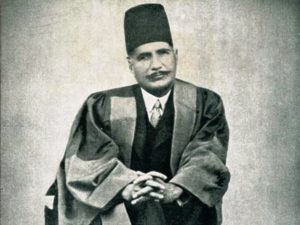
Allama Iqbal

In the late 1920s the Indian Islamist and poet Mohammed Iqbal delivered six lectures at Madras (to the Madras Muslim Association), Hyderabad and Aligarh, in which he set out his vision of the reconstruction of religious thought in Islam. Apparently Iqbal himself intended to write a second, larger book to be called “The Reconstruction of Legal Thought in Islam”, to which these lectures formed a sort of philosophical prelude.  That second book was never written, but the lectures were combined with a seventh lecture (“is religion possible”) that was delivered to the Aristotelian society in England, and published as a book “The Reconstruction of Religious Thought in Islam”.  By the time the book was published (first in Lahore in 1930, by Kapur Art Press, then with the seventh lecture included, by Oxford in 1934), Iqbal had been knighted for his services to the crown and was already a famous poet (in both Urdu and Persian) and was being honored by the Islamicate elite of India as their philosopher and thinker par excellence. Since this is the only work of philosophy that he ever composed after his PhD thesis, his status as a philosopher is heavily dependent on this slim volume.

The book is primarily targeted at contemporary Muslims, who were keenly aware of their weakness vis-a-vis Europe, as well as of their historic role as a “worthy opponent” that at some point in the past held the upper hand against Western Christian competitors. Iqbal’s primary mission here is not some open ended search for philosophical truth, it is the revival of Muslim greatness, the basic fact of which is taken for granted and is an element of faith. In his own words:

“I have tried to meet, even though partially, this urgent demand by attempting to reconstruct Muslim religious philosophy with due regard to the philosophical traditions of Islam and the more recent developments in the various domains of human knowledge.”

Like many other religiously minded thinkers of the day, he was also quite taken with modern physics and believed “the present moment is quite favorable for such an undertaking. Classical Physics has learned to criticize its own foundations. As a result of this criticism the kind of materialism, which it originally necessitated, is rapidly disappearing; and the day is not far off when Religion and Science may discover hitherto unsuspected mutual harmonies.”

In terms of his education and training, Iqbal was firmly in the Western philosophical tradition (tending mostly towards its German, orientalist, idealist and romantic currents) and like other Islamist modernizers, he took it for granted that the “Muslim world” has to come to terms with modern knowledge, but this was to be done from within the Islamic tradition and while maintaining the distinctive character of Muslim society. His grandfather may have been a Kashmiri Hindu (his son claims the conversion happened 400 years earlier) and it has been claimed that there were branches of the family that remained Hindu, but either because of this relatively recent conversion, or because of his mother’s strong Muslim faith, his commitment to Muslim separatism and supremacism was strong and unbending. He was willing to admire other traditions (including the learning of the Brahmins, about whom he has interesting things to say elsewhere) and learn from them, but they are always “other” traditions, about this there is never any doubt.

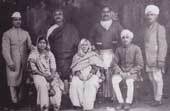
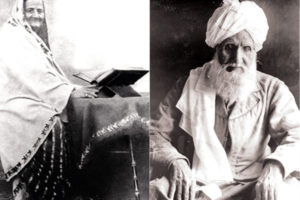
Iqbal’s (supposed) Hindu cousins
Mom and dad

The books is interesting, especially if you are philosophically inclined towards the “spiritual” and the mystical; on the other hand, if you are somewhere on the “new atheist” spectrum then the book can only be of historical interest. Even those who are willing to entertain metaphysical speculation should be aware that this is not a systematic philosophical text. All the central claims of the book are simply asserted (there is rarely any detailed argument showing why they are correct) and the historical views are very early 20th century, with the ghosts of Spengler and countless lesser writers hovering in the background. Entire cultures and historical epochs are summed up in ex-cathedra pronouncements of the sort that were popular in that age but seem to have fallen out of favor since then. For example  “the cultures of Asia, and in fact, of the whole ancient world failed because they approached reality exclusively from within and moved from within outwards. This procedure gave them theory without power, and on mere theory no durable civilization can be based”.

Always hovering in the background is his (not so original) view that history is progressive and something is gradually unfolding and developing as we move from ancient cultures (India, Greece, never China) to Islam to modern Europe. In this great drama, the “spirit of Islam” is essentially anti-classical and empiricist and it is Islam that created the foundations of modern science by introducing this attitude into humanity (“European culture, on its intellectual side, is only a further development of some of the most important phases of the culture of Islam”). This basically Hegelian view of history was all the rage in the circles that Allama Iqbal frequented (its echoes survive to this day), and if this is still your cup of tea, jump right in, Iqbal will not disappoint you. Continue reading Review: The Reconstruction of Religious Thought in Islam

Homoeroticism, Blasphemy, and Classical Muslim Society

The following stray thoughts on Islamicate homo-eroticism were penned by Irfan Muzammil on Twitter and I am posting them here for the sake of generating more discussion. My own “off the top of my head” comments are at the end in Italics.

A thread on homoeroticism, blasphemy, and classical Muslim society
By Irfan Muzammil 

In my class on Arabic literature today, we read an anecdote about one of the earliest and greatest of Arab poets, Abu Nuwas. Abu Nuwas lived during the height of Islamic civilization in the early Abbasid period, and rose to such esteem that he taught the sons of caliph Harun al-Rasheed. One of those sons al-Amin became the next caliph and Abu Nawas’ greatest patron. What’s most interesting is that his poetry is filled with eroticism of both homo and hetero kind, and with love for wine and for young boys. The anecdote we read was written by Abu Faraj, who was himself one of the descendants of Umayyad caliphs, and wrote one of the classics of Arab literature, Kitab al-Aghani (Book of Songs), a 20 volume collection of anecdotes on Arabs poets, singers, and musicians.

One of his anecdotes on Abu Nuwas, which we read in class, is about Abu Nuwas seducing a young boy but the conversation between Abu Nuwas and the boy is entirely in Quranic verses. I was frankly shocked, and told my professor that I’d be killed or jailed for even  posting this, much less writing it out in a book or teaching it in a class. But according to the professor, who is an Arab himself and an expert in Arabic and Islamic studies, this anecdote has often been quoted even in religious texts as a great example of Arab literature.  And it was only in 2001 that the Egyptian Ministry of Culture burned 6000 copies of Abu Nuwas’ books. The amount of homo-eroticism in both classical Persian and Arabic poetry is just staggering.

By the way, yesterday in my class on early Islamicate societies, we saw the naked women painted on the palaces of Umayyad caliphs. I wonder if the classical Muslim civilization was far more liberal than the modern one -unless you were a slave, or a non-elite woman, or a young boy or girl. But it does trash all those silly theories of Iqbal and Sayyid Qutb etc. about the downfall of Muslim civilization because of its moral lassitude. We were far more liberal, at least in terms of sexual mores and wine drinking, when we were at our mightiest, and our downfall began as our society became more severe and intolerant.

(I would be cautious about interpreting this in terms of liberal (then) vs intolerant (now). Times were different all round. And the elites frequently lived lives that did not concern themselves with the moral standards regarded as ideal for commoners or spouted by priests and theologians. Augustus promoted strict Roman virtue without feeling too closely bound by its strictures in his own private life. The Catholic church had a slew of libertine popes without any discernible change in the morality the church was trying to teach their followers. Every Ummayad caliph except Umar Bin Abdul Aziz was supposedly an alcoholic. As were most of the Delhi Sultans and Mughal Kings, but the religious texts in their times all had the same prohibitions they have today. And last but not the least, classical Islam developed within the womb of the Arab empire, it was not present fully formed when that empire rose to power. There is much more interesting stuff to be said about this, but perhaps another day.. meanwhile, I expect commentators will add value)

Brown Pundits